
- Release Year: 2018
- Platforms: PlayStation 4, Windows, Xbox One
- Publisher: Electronic Arts, Inc.
- Developer: EA Tiburon
- Genre: Sports
- Perspective: Diagonal-down
- Game Mode: Online PVP, Single-player
- Gameplay: Franchise mode, Longshot story mode, Real Player Motion, Ultimate Team
- Setting: American Football
- Average Score: 79/100
Description
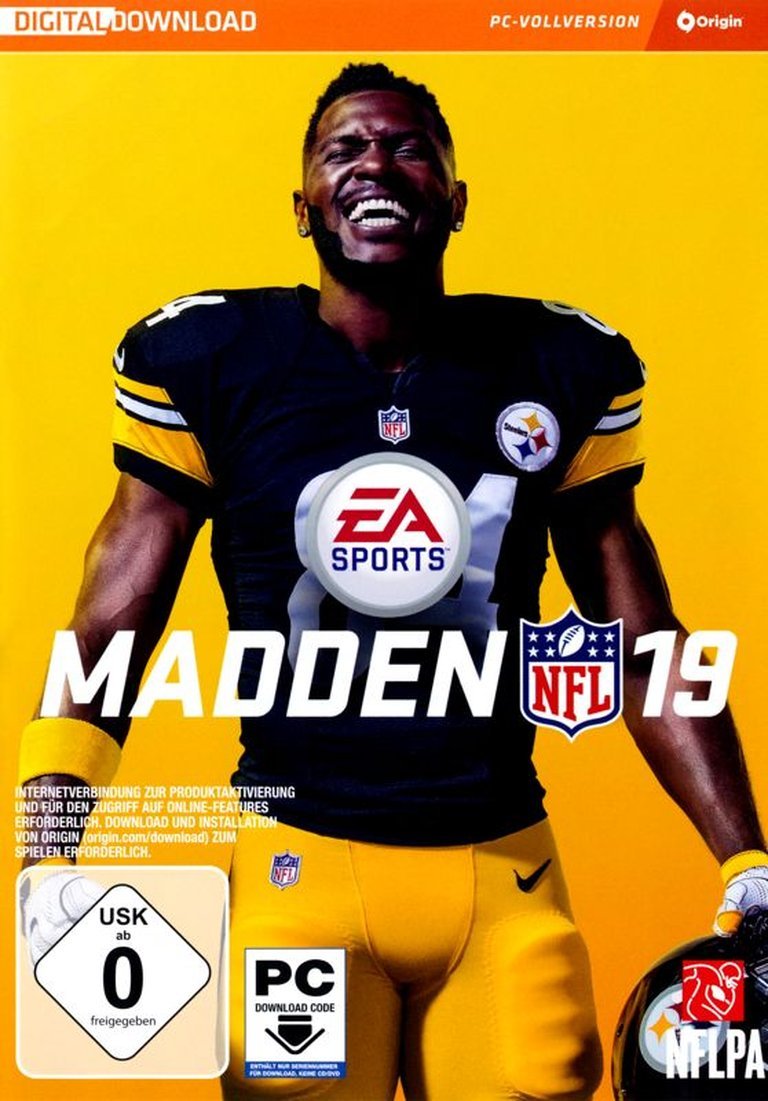
Madden NFL 19 is a sports simulation game that delivers an authentic American football experience, featuring the NFL license and realistic gameplay mechanics. Built on the Frostbite 3 engine, the game introduces ‘Real Player Motion’ technology, enhancing player movements and animations for greater realism. It includes various modes such as Franchise, Ultimate Team, and a story-driven campaign called ‘Longshot: Homecoming,’ continuing the narrative from the previous installment. With improved AI, refined controls, and updated rosters, Madden NFL 19 aims to provide both casual and hardcore fans with a deep and immersive football experience.
Gameplay Videos
Madden NFL 19 Free Download
Madden NFL 19 Cracks & Fixes
Madden NFL 19 Mods
Madden NFL 19 Guides & Walkthroughs
Madden NFL 19 Reviews & Reception
forbes.com : Madden NFL 19 is the best-looking sports video game I’ve ever played.
sbnation.com : Numerous tangible gameplay improvements solidify ‘Madden NFL 19’ as one of the best complete packages the franchise has ever offered.
ign.com : Madden NFL 19 builds a new foundation for the football franchise.
metacritic.com (80/100): An incredibly complete package and is among the best sport sims you can play currently.
opencritic.com (79/100): Madden 19 returns the primary focus where it belongs: that moment-to-moment gameplay between the end zones.
Madden NFL 19: A Return to Form or a Missed Opportunity?
Introduction: The Legacy of Madden and the Promise of Innovation
The Madden NFL series is more than just a video game—it’s a cultural institution. For over three decades, it has shaped how fans engage with football, blending simulation, strategy, and spectacle into an annual ritual. Madden NFL 19, released in August 2018, arrived at a pivotal moment. The previous year’s Madden NFL 18 had introduced the Frostbite engine, a seismic shift that promised photorealistic visuals and deeper gameplay mechanics. Yet, it also exposed the franchise’s growing pains: a struggle to balance innovation with tradition, monetization with player satisfaction, and realism with accessibility.
Madden NFL 19 sought to refine that foundation. With the tagline “Real Player Motion” (RPM) and a sequel to the surprisingly well-received Longshot story mode, EA Tiburon aimed to deliver a game that felt more dynamic, more personal, and more authentic than ever. But did it succeed? Or was it merely another incremental update in a series increasingly criticized for stagnation?
This review dissects Madden NFL 19 in exhaustive detail, examining its development, gameplay, narrative ambitions, and lasting impact on the sports gaming landscape.
Development History & Context: The Frostbite Era and the Weight of Expectations
The Studio and the Vision
EA Tiburon, the Orlando-based studio behind Madden, has been the sole developer of the series since Madden NFL 97. By 2018, the team was deep into its second year with the Frostbite engine, a tool originally designed for first-person shooters like Battlefield. The transition to Frostbite in Madden 18 was rocky—animation glitches, AI quirks, and a sense of stiffness plagued the on-field action. Madden 19 was Tiburon’s chance to prove that Frostbite could be more than just a graphical upgrade; it could revolutionize how football felt in a video game.
Director Michael Young and producer Ben Haumiller led the charge, emphasizing three pillars:
1. Real Player Motion (RPM): A new animation system that used motion-capture data from NFL players to create more fluid, context-sensitive movements.
2. Franchise Mode Revitalization: Addressing years of fan frustration with shallow management mechanics.
3. Longshot: Homecoming: Expanding the narrative experiment from Madden 18 with a deeper, more emotional story.
The game’s development coincided with a turbulent period for the NFL. The league was grappling with player protests, concussion controversies, and declining TV ratings. Madden 19 had to navigate these cultural currents carefully—something it didn’t always do successfully, as evidenced by the Colin Kaepernick censorship controversy (more on that later).
Technological Constraints and the Gaming Landscape
By 2018, the sports gaming market was dominated by EA’s monopolies (Madden, FIFA, NHL) and 2K’s NBA 2K series. The lack of competition meant Madden faced little external pressure to innovate, but internal expectations were high. Frostbite’s demands were steep:
– Animation Overhaul: RPM required thousands of new motion-capture sequences, straining development timelines.
– AI Improvements: Defensive players needed to react more intelligently to RPM’s dynamic movements.
– Physics Integration: Frostbite’s physics engine had to coexist with RPM without creating uncanny valley moments (e.g., players clipping through each other).
The result was a game that, on paper, promised a leap forward. In practice, it delivered a mix of triumphs and frustrations.
Narrative & Thematic Deep Dive: Longshot: Homecoming and the Illusion of Choice
The Story: A Tale of Two Protagonists
Longshot: Homecoming continues the story of Devin Wade (JR Lemon) and Colt Cruise (Scott Porter), first introduced in Madden 18. Where the original Longshot was a Cinderella story about an underdog quarterback, Homecoming splits its focus:
– Devin Wade: Now a backup QB for the Houston Texans, Devin struggles to earn playing time while dealing with the pressures of NFL stardom.
– Colt Cruise: After failing to make it as a receiver, Colt returns to his Texas hometown to coach his old high school team, the Mathis Bullfrogs, while grappling with family drama (including a long-lost half-sister, Loretta, voiced by Joey King).
The narrative’s strength lies in its emotional authenticity. Colt’s arc, in particular, resonates—his failure to achieve NFL glory forces him to confront his identity beyond football. The game tackles themes of legacy, redemption, and community, with Mathis High School’s financial struggles serving as a poignant backdrop.
Gameplay Integration: The Problem with Longshot
However, Homecoming suffers from a fatal flaw: it’s barely a game. The mode is 90% cinematic, 10% interactive, reducing the player’s role to:
– Scripted Drills: Completing predetermined plays with little room for creativity.
– One-Time Dialogue Choice: A single, meaningless decision near the end of the story.
– Repetitive Challenges: Some sequences force players to repeat failed objectives without explanation.
Critics like Polygon’s Owen Good noted that Homecoming “makes those tasks boring and chorelike,” stripping away the magic of the original Longshot, which at least felt like a interactive drama. The mode’s lack of branching paths or player agency makes it feel more like a visual novel with occasional football minigames than a true narrative experience.
Themes and Cultural Commentary
Madden 19 attempts to engage with real-world issues:
– Racial and Socioeconomic Struggles: Colt’s hometown, Mathis, Texas, is a working-class community fighting to keep its school open—a subtle nod to the disparities in American education.
– NFL’s Exploitation of Players: Devin’s storyline critiques the league’s treatment of young athletes, though it stops short of outright condemnation.
– Family and Fatherhood: Colt’s relationship with his estranged father (Ron Cephas Jones) adds depth, but the resolution feels rushed.
Yet, these themes are undermined by the game’s reluctance to take risks. The Kaepernick censorship—where EA initially removed his name from a soundtrack lyric before backtracking—highlighted the series’ corporate timidity. Madden exists in a strange limbo: it wants to feel real, but it’s still beholden to the NFL’s image.
Gameplay Mechanics & Systems: RPM, Franchise Mode, and the Ultimate Team Grind
Real Player Motion: A Revolution with Caveats
RPM was Madden 19’s marquee feature, and it largely delivered. The system introduced:
– Dynamic Cuts and Stumbles: Players no longer moved like robots; they leaned into tackles, recovered from stumbles, and made realistic juke moves.
– Contextual Animations: A receiver’s route would adjust based on defender positioning, creating more organic plays.
– Push/Pull Mechanics: Ball carriers could shove defenders to gain extra yards, adding a physicality missing in past entries.
The Good:
– Running Game Overhaul: For the first time in years, running felt weighty and strategic. The “hit-the-hole” and “one-cut” moves (activated via the right stick) rewarded skilled players.
– Receiver/DB Battles: Catches and interceptions became more contested, with players fighting for the ball mid-air.
– Touchdown Celebrations: Interactive, team-based celebrations (legalized by the NFL in 2017) added flair.
The Bad:
– Animation Glitches: RPM occasionally broke, leading to players teleporting, clipping, or ragdolling unnaturally.
– Learning Curve: Veterans struggled with the new running mechanics, which required precise stick inputs.
– AI Inconsistencies: Defensive backs sometimes ignored RPM logic, leading to unrealistic interceptions or missed tackles.
Verdict: RPM was a net positive, but it exposed Frostbite’s limitations. The engine wasn’t built for football, and Tiburon had to work around its quirks rather than leverage its strengths.
Franchise Mode: A Step Forward, But Not Enough
After years of neglect, Madden 19’s Franchise Mode received much-needed updates:
– Scheme Fit: Coaches now had offensive/defensive philosophies (e.g., West Coast, Spread), and players’ ratings adjusted based on scheme compatibility.
– Draft Class Sharing: Players could create and share custom draft classes, a feature that breathed life into the mode.
– Player Progression: A new X-Factor system (later expanded in Madden 20) gave stars unique abilities (e.g., Patrick Mahomes’ “Bazooka” arm).
Problems Persisted:
– Lack of Depth: Scouting, contracts, and free agency remained shallow compared to NBA 2K’s MyGM.
– AI Logic Flaws: CPU teams made illogical trades and draft picks.
– No True GM Mode: Players still couldn’t fully simulate as a general manager without playing games.
Critics’ Take:
– IGN: “Franchise mode customization offers another level of realism.”
– GamesRadar: “The best Franchise mode in years, but still behind the curve.”
– TrueAchievements: “Feels like a roster update with minor tweaks.”
Ultimate Team: The Money-Making Machine
Madden Ultimate Team (MUT) remained the game’s cash cow, and Madden 19 doubled down on monetization:
– Solo Battles: A single-player competitive mode where players faced AI-controlled teams for rewards.
– 3v3 Online: A faster, arcade-like mode that encouraged microtransactions for team upgrades.
– Training System: Replaced contracts, allowing players to permanently upgrade favorite cards—a welcome change, but still tied to grinding or paying.
The Grind:
MUT’s addictive loop (play challenges → earn coins → buy packs → repeat) was more polished than ever, but critics argued it exploited players. The mode’s pay-to-win elements were subtle but undeniable: top-tier teams required either hundreds of hours or real money.
World-Building, Art & Sound: The Illusion of Authenticity
Visuals: Frostbite’s Double-Edged Sword
Madden 19 was the best-looking entry in the series at the time:
– Player Models: Faces, uniforms, and stadiums were stunningly detailed.
– Lighting and Weather: Dynamic shadows and rain effects added atmosphere.
– Crowds and Sideline: More animated than ever, though still not as lively as real NFL broadcasts.
Issues:
– Empty Stadiums: A long-running Madden joke—no game has ever captured the energy of a real NFL crowd.
– Commentary: Brandon Gaudin and Charles Davis replaced Jim Nantz and Phil Simms, but the lines were still repetitive and glitchy.
Soundtrack: A Hip-Hop Showcase with Controversy
The game’s 30+ track soundtrack featured Migos, Post Malone, Cardi B, and Nicki Minaj, curating a modern hip-hop vibe. However, the Kaepernick censorship overshadowed it:
– EA initially removed a lyric mentioning Kaepernick from Big Sean’s “Big Bank”, citing licensing issues.
– After backlash (including from Big Sean himself), EA reversed course and patched the lyric back in.
– The incident highlighted Madden’s awkward relationship with NFL politics—it wants to be edgy but can’t risk alienating the league.
Reception & Legacy: A Critical Darling, a Fan Divider
Critical Reception: Praise with Reservations
Madden 19 earned metascores of 80-81 across platforms, with critics praising:
– RPM’s impact on gameplay (IGN: “Finally cracks that repetitive feel”).
– Franchise Mode improvements (GamesRadar: “A stunning return to form”).
– Ultimate Team’s Solo Battles (Twinfinite: “Addictive and well-executed”).
But criticisms lingered:
– Longshot’s lack of interactivity (Polygon: “A unique disaster”).
– Persistent bugs (USgamer: “Occasionally ragged”).
– Monetization concerns (Way Too Many Games: “Ultimate Team is a grind”).
Fan Reception: The Divide
Players were split:
– Hardcore fans appreciated the depth of RPM and Franchise Mode.
– Casual players found the new running mechanics frustrating.
– Story mode fans were disappointed by Longshot’s regression.
The Jacksonville Shooting: A Dark Stain
On August 26, 2018, a Madden 19 tournament at Jacksonville Landing turned tragic when a disgruntled competitor opened fire, killing two players before taking his own life. The incident cast a shadow over the game’s legacy, sparking debates about gaming culture, mental health, and esports security.
Legacy: The Last “Old-Gen” Madden?
Madden 19 was the final entry before the PS5/Xbox Series X era. It represented:
– The peak of Frostbite-era Madden before the engine’s limitations became too glaring.
– A turning point for narrative modes—Longshot’s flaws led to its discontinuation after Madden 21.
– The beginning of Ultimate Team’s dominance—future entries would prioritize MUT over Franchise.
Conclusion: A Flawed Masterpiece or a Missed Opportunity?
Madden NFL 19 is a game of contradictions:
– It innovated with RPM but stumbled with animation bugs.
– It deepened Franchise Mode but ignored long-standing issues.
– It told an emotional story but forgot to make it interactive.
Final Verdict:
✅ For hardcore football fans, Madden 19 is one of the best in the series—a game that finally made running and receiving feel alive.
❌ For casual players or story enthusiasts, it’s a frustrating step backward, marred by clunky mechanics and a half-baked narrative.
Score: 8.5/10 – A great football game that could have been legendary with more polish and courage.
Place in History:
Madden 19 sits at a crossroads—it was the last truly ambitious entry before the series fully embraced Ultimate Team’s monetization and abandoned narrative experimentation. It’s a game that dared to change, even if it didn’t always stick the landing.
For better or worse, Madden NFL 19 is the end of an era. And in many ways, the beginning of a new, more corporate one.