
- Release Year: 2017
- Platforms: Windows
- Publisher: magnussoft Deutschland GmbH
- Developer: magnussoft Deutschland GmbH
- Genre: Compilation
- Game Mode: Single-player
Description
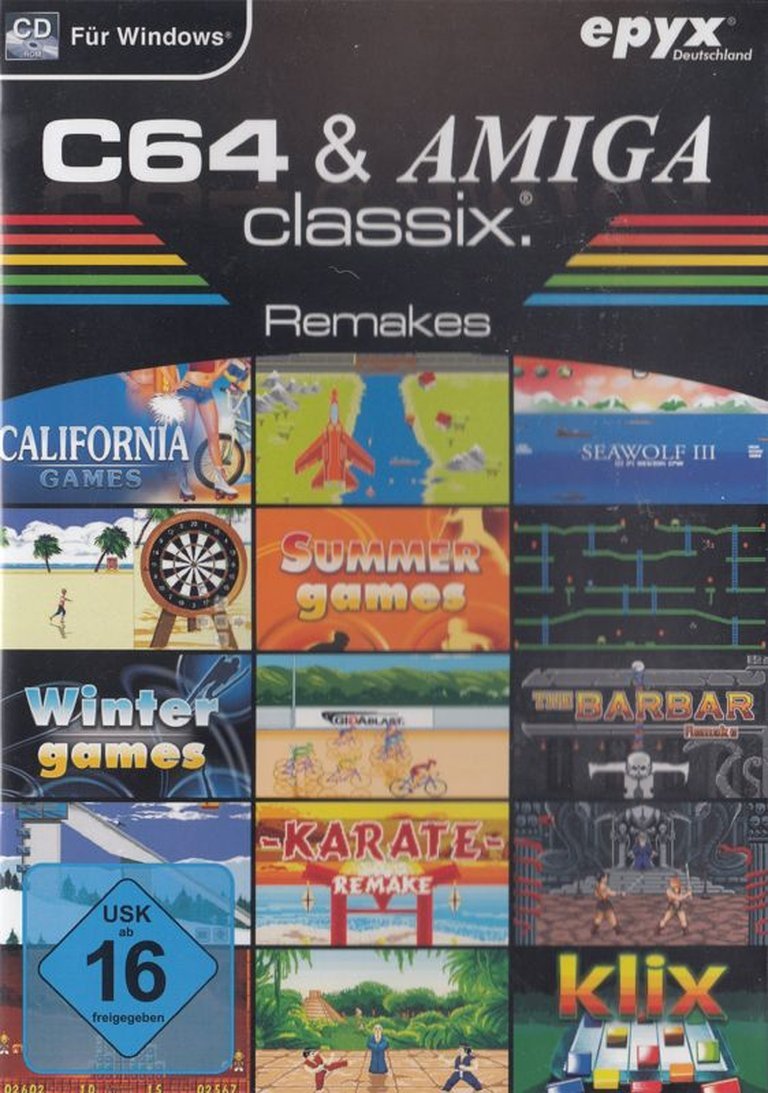
C64 & Amiga Classix Remakes is a compilation of enhanced remakes of beloved classic games originally released for the Commodore 64 and Amiga systems. The collection features a diverse lineup of titles, including action-packed adventures like The Barbar Remake and River Attack Remake, sports simulations such as California Games, Summer Games, and Winter Games, as well as puzzle and arcade-style games like KLIX and Jump Boy Remake. Developed by a team led by Maik Heinzig and published by magnussoft, this 2017 Windows release aims to modernize retro gaming experiences while preserving the nostalgic charm of the originals.
Gameplay Videos
Where to Buy C64 & Amiga Classix Remakes
PC
C64 & Amiga Classix Remakes Guides & Walkthroughs
C64 & Amiga Classix Remakes Reviews & Reception
lemon64.com : My Verdict: the C64 versions are much better than this so-called Remake.
indieretronews.com : It isn’t very often we see remakes of really old games on Steam, but it looks as if magnussoft will be providing a bunch of them that is sure to bring back those nostalgic memories.
C64 & Amiga Classix Remakes: A Nostalgic Journey Through Retro Gaming History
Introduction: The Allure of Retro Reimagined
The C64 & Amiga Classix Remakes compilation is a fascinating artifact in the annals of video game preservation—a digital time capsule that attempts to bridge the chasm between the golden age of 8-bit and 16-bit computing and the modern era of gaming. Released in 2017 by magnussoft Deutschland GmbH, this collection is not merely a re-release but a deliberate reimagining of classic titles from the Commodore 64 (C64) and Amiga platforms, two systems that defined an entire generation of gamers. The compilation’s existence raises critical questions about the nature of remakes: How does one modernize a game without stripping away its soul? Can nostalgia alone justify a purchase, or must these remakes stand on their own merit?
This review will dissect C64 & Amiga Classix Remakes in exhaustive detail, exploring its development, gameplay mechanics, artistic direction, and legacy. By the end, we will determine whether this compilation is a loving tribute to retro gaming or a missed opportunity to innovate within the constraints of its source material.
Development History & Context: A Labor of Love or a Cash Grab?
The Studio Behind the Remakes: magnussoft’s Legacy
Magnussoft, a German software publisher with a history dating back to the 1990s, has long been associated with budget-friendly compilations and retro re-releases. Their portfolio includes numerous Classix collections, from C64 Classix (2000) to Amiga ClassiX (2001), positioning them as a steward of Commodore’s legacy. However, their approach has often been met with mixed reactions. While some applaud their efforts in preserving classic titles, others critique their remakes for lacking the polish and innovation seen in more ambitious retro revivals (e.g., Street Fighter 30th Anniversary Collection or Sonic Origins).
The C64 & Amiga Classix Remakes project was spearheaded by Maik Heinzig, who served as both Project Lead and the creative force behind the compilation’s idea and concept. Heinzig’s vision was clear: to modernize these classics while retaining their retro charm. The development team, including programmers Matthias Feind and Thomas Walther, alongside artists Chie Kimoto and Jeanette Tutzschky, faced a daunting challenge: how to update games designed for 1 MHz processors and 64KB of RAM for contemporary hardware without alienating purists.
Technological Constraints & Design Philosophy
The original C64 and Amiga games were products of their time, constrained by:
– Limited processing power (C64: 1 MHz; Amiga: 7.16 MHz).
– Restricted memory (C64: 64KB RAM; Amiga: 512KB–2MB).
– Pixel art and chiptune audio as the primary mediums for visual and auditory expression.
The remakes attempt to straddle the line between faithfulness and modernization. According to the Steam description, the goal was to avoid the pitfalls of overhauling games into 3D, a mistake that plagued earlier remakes (e.g., Bubsy 3D). Instead, the team opted for enhanced 2D visuals, refined controls, and quality-of-life improvements while preserving the core gameplay loops.
The Gaming Landscape in 2017: A Retro Renaissance
The mid-2010s saw a resurgence of interest in retro gaming, fueled by:
– The success of Nintendo’s NES Classic Edition (2016).
– The rise of indie games inspired by 8-bit and 16-bit aesthetics (Shovel Knight, Stardew Valley).
– The proliferation of digital storefronts (Steam, GOG) making retro compilations accessible.
Magnussoft’s compilation arrived at a time when gamers were hungry for nostalgia, but also increasingly discerning about how that nostalgia was packaged. The question was: Would C64 & Amiga Classix Remakes capitalize on this trend, or would it be lost in a sea of superior retro collections?
Narrative & Thematic Deep Dive: Do These Games Tell Stories?
One of the most striking aspects of early C64 and Amiga games is their lack of narrative depth. Unlike modern games, which often prioritize storytelling, these classics were gameplay-first experiences, with narratives serving as little more than window dressing for the core mechanics. The remakes in this compilation are no exception.
The Games and Their (Lack of) Stories
- Jump Boy Remake – A platformer where the player navigates a character through obstacle courses. The “story” is minimal: jump, avoid hazards, reach the end.
- Karate Remake – A fighting game inspired by International Karate. The narrative is non-existent; it’s pure one-on-one combat.
- River Attack Remake – A shoot-’em-up where the player pilots a jet along a river, dodging obstacles and enemies. The premise is arcade simplicity.
- Seawolf III – A submarine combat game where the player hunts enemy vessels. The theme is Cold War-era naval warfare, but the storytelling is implicit rather than explicit.
- Drop Sector Remake – A space shooter where the player defends miners on Io (Jupiter’s moon) from alien attacks. The setting is sci-fi, but the narrative is functional.
- Pitstart Remake – A racing game with pit stops. The “story” is the race itself.
Themes: Nostalgia as the Overarching Narrative
If there’s a unifying theme across these remakes, it’s nostalgia. The games don’t attempt to weave complex narratives or character arcs. Instead, they rely on:
– Muscle memory – Players who grew up with these games will recognize the mechanics instantly.
– Visual and auditory callbacks – The remakes retain the color palettes, sound effects, and level designs of the originals.
– Simplicity – These games are easy to pick up, hard to master, a design philosophy that defined the arcade era.
The lack of narrative depth isn’t necessarily a flaw—it’s a faithful recreation of the era’s design sensibilities. However, for modern players accustomed to story-driven experiences, these remakes may feel shallow.
Gameplay Mechanics & Systems: Where the Remakes Shine (and Stumble)
The true test of any remake lies in its gameplay. Do the mechanics hold up? Are the controls responsive? Does the game feel modern enough to justify its existence, or does it merely coast on nostalgia?
Core Gameplay Loops: Arcade Perfection or Outdated Design?
Each game in the compilation adheres to a simple, repetitive loop—a hallmark of arcade design:
1. Jump Boy Remake
– Mechanics: Run, jump, avoid obstacles.
– Modernization: Smoother animations, but the physics feel floaty compared to the original.
– Verdict: A decent platformer, but lacks the tight controls of classics like Super Mario Bros.
-
Karate Remake
- Mechanics: Punch, kick, block.
- Modernization: Added combo systems, but the AI is predictable.
- Verdict: Fun for a few rounds, but lacks depth compared to Street Fighter II.
-
River Attack Remake
- Mechanics: Shoot enemies, dodge obstacles, manage fuel.
- Modernization: Widescreen support, but the hit detection feels off.
- Verdict: A faithful recreation, but the original’s tight controls are missing.
-
Seawolf III
- Mechanics: Navigate a submarine, torpedo enemies.
- Modernization: Updated graphics, but the gameplay is slow-paced.
- Verdict: Boring by modern standards—even the original was niche.
-
Drop Sector Remake
- Mechanics: Shoot aliens, protect miners.
- Modernization: New enemy patterns, but the difficulty spikes are unfair.
- Verdict: Frustrating rather than challenging.
-
Pitstart Remake
- Mechanics: Race, manage pit stops.
- Modernization: Smoother frame rates, but the physics are arcady.
- Verdict: Fun in short bursts, but lacks the depth of F-Zero.
UI & Quality-of-Life Improvements
The remakes do attempt to modernize the user interface:
– Save states (a godsend for retro gamers).
– Widescreen support (though some games still feel stretched).
– Controller support (essential for modern play).
However, the menus are clunky, and the lack of customization options (e.g., difficulty sliders, control remapping) is a missed opportunity.
Innovation vs. Faithfulness: A Delicate Balance
The biggest criticism leveled at these remakes is that they don’t innovate enough. As one Steam user put it:
“These games just somehow move slower, offer less response, and are less impressive than the old games that inspired this collection.”
The developers played it safe, opting for faithfulness over evolution. While this approach preserves the retro feel, it also means the games don’t stand out in a crowded market.
World-Building, Art & Sound: A Love Letter to the Past
Visual Design: Pixel Art vs. Modern Enhancements
The remakes retain the pixel art aesthetic of the originals but with higher resolutions and smoother animations. The results are mixed:
– Jump Boy Remake – The character sprites are crisp, but the backgrounds lack detail.
– Karate Remake – The animations are fluid, but the arenas feel empty.
– River Attack Remake – The river environments are colorful, but the enemy designs are generic.
The art direction respects the originals but doesn’t push boundaries. For comparison, games like Shovel Knight prove that retro-inspired visuals can feel both nostalgic and fresh.
Sound Design: Chiptune Nostalgia
The soundtrack is where the remakes shine brightest. The chiptune music has been remastered while retaining the iconic melodies of the originals. Games like Jump Boy and Karate feature catchy, loopable tracks that evoke the C64’s SID chip and the Amiga’s Paula sound chip.
However, the sound effects are hit-or-miss:
– River Attack’s explosions sound tinny.
– Seawolf III’s sonar pings lack depth.
Atmosphere: Does It Feel Like the ‘80s?
The compilation succeeds in recreating the feel of the era:
– The arcade-like difficulty (punishing but fair).
– The simplicity of the designs (no unnecessary fluff).
– The immediate feedback (score counters, high-score tables).
For players who grew up with these games, the atmosphere is intoxicating. For newcomers, it may feel dated.
Reception & Legacy: A Niche Product for a Niche Audience
Critical Reception: Mixed Reviews
The compilation has no professional reviews on MobyGames, and Steam user reviews are polarized:
– Positive reviews praise the nostalgia factor and faithfulness.
– Negative reviews criticize the lack of innovation, clunky controls, and outdated design.
A Lemon64 forum post sums up the consensus:
“The C64 versions are much better than this so-called Remake.”
Commercial Performance: A Budget Title
Priced at $7.99, the compilation is affordable, but its lack of marketing and niche appeal mean it hasn’t made waves in the broader gaming community.
Legacy: A Footnote in Retro Gaming History
C64 & Amiga Classix Remakes is not a landmark title. It doesn’t redefine retro remakes like Crash Bandicoot N. Sane Trilogy or Spyro Reignited Trilogy. Instead, it serves as:
– A curiosity for collectors.
– A nostalgic trip for Commodore fans.
– A cautionary tale about the limits of faithful remakes.
Conclusion: A Flawed but Fascinating Relic
Final Verdict: 6/10 – A Nostalgic Curio, Not a Must-Play
C64 & Amiga Classix Remakes is a well-intentioned but flawed compilation. It succeeds in preserving the spirit of its source material but fails to evolve in meaningful ways. For Commodore enthusiasts, it’s a worthwhile purchase—a chance to relive childhood memories with modern conveniences. For casual gamers, it’s hard to recommend over more polished retro collections.
Strengths:
✅ Faithful to the originals – Captures the look, sound, and feel of C64/Amiga classics.
✅ Affordable – Priced reasonably for a niche product.
✅ Nostalgic soundtrack – The chiptune music is a highlight.
Weaknesses:
❌ Lack of innovation – Feels like a missed opportunity to modernize.
❌ Clunky controls – Some games don’t handle as well as the originals.
❌ No narrative depth – Pure gameplay-driven experiences may not appeal to modern audiences.
Who Should Buy This?
- Retro gaming collectors who want every Commodore-related release.
- Nostalgia seekers who grew up with these games.
- History buffs interested in how remakes preserve (or fail) gaming’s past.
Who Should Skip It?
- Players expecting modernized gameplay (e.g., Crash Bandicoot remakes).
- Those unfamiliar with C64/Amiga games—the design feels dated.
- Anyone looking for deep storytelling—these are arcade experiences.
Final Thoughts: A Time Capsule, Not a Revolution
C64 & Amiga Classix Remakes is not a bad game—it’s a time capsule. It doesn’t redefine retro remakes, but it doesn’t betray its roots either. In an era where remakes are big business, this compilation is a humble, unpretentious tribute to a bygone era. For that alone, it deserves a place in gaming history—even if it’s just a small one.
Rating Breakdown:
– Gameplay: 5/10 (Faithful but flawed)
– Visuals: 6/10 (Nostalgic but unremarkable)
– Sound: 8/10 (Chiptune excellence)
– Replayability: 5/10 (Arcade-style, but lacks depth)
– Overall: 6/10 (A niche product for a niche audience)
Recommendation: Buy if you’re a Commodore fan; otherwise, proceed with caution.
End of Review
Would you like any additional sections or deeper analysis on specific games in the compilation?