
- Release Year: 2007
- Platforms: Windows
- Publisher: Micro Application, S.A.
- Genre: Compilation
- Game Mode: Single-player
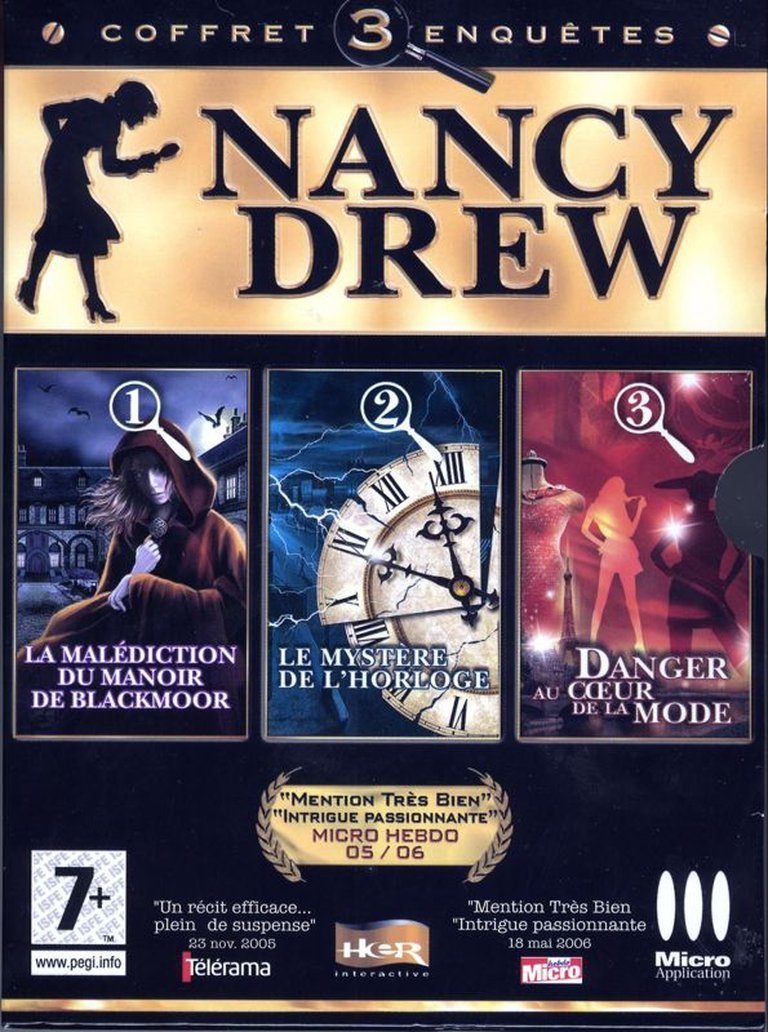
Description
Nancy Drew: Coffret 3 Enquêtes is a compilation of three mystery-adventure games featuring the iconic teenage detective Nancy Drew. The collection includes ‘Curse of Blackmoor Manor,’ where Nancy investigates a haunted English manor; ‘Secret of the Old Clock,’ a case involving a missing will and hidden family secrets; and ‘Danger by Design,’ set in the high-stakes world of Parisian fashion. Each game offers a unique setting and puzzle-driven gameplay, challenging players to solve intricate mysteries through exploration, clue-gathering, and deduction.
Nancy Drew: Coffret 3 Enquêtes: A Comprehensive Retrospective
Introduction
Few franchises in gaming history have managed to blend literature, mystery, and interactive storytelling as seamlessly as the Nancy Drew series. Nancy Drew: Coffret 3 Enquêtes, released in 2007, is a compilation that encapsulates the golden age of HeR Interactive’s beloved adventure games. This collection—featuring Curse of Blackmoor Manor (2004), Secret of the Old Clock (2005), and Danger by Design (2006)—offers a masterclass in narrative-driven gameplay, atmospheric world-building, and puzzle design. For fans of the series, this compilation is more than just a bundle; it’s a time capsule of an era when point-and-click adventures were at their peak, and Nancy Drew was the undisputed queen of digital detective work.
This review will dissect Coffret 3 Enquêtes in exhaustive detail, exploring its development history, narrative depth, gameplay mechanics, and lasting legacy. By the end, we’ll understand why this compilation remains a cornerstone of the Nancy Drew franchise and a touchstone for adventure game enthusiasts.
Development History & Context
The Studio Behind the Sleuth
HeR Interactive, founded in 1995 by Megan Gaiser, was a small but ambitious studio based in Bellevue, Washington. The company’s mission was to create engaging, educational, and empowering games for young women, a demographic often overlooked in the gaming industry at the time. The Nancy Drew series, which began in 1998 with Secrets Can Kill, was HeR Interactive’s flagship franchise. By the mid-2000s, the studio had refined its formula, blending classic mystery tropes with innovative gameplay mechanics.
The three games in Coffret 3 Enquêtes were developed during a period of significant growth for HeR Interactive. Curse of Blackmoor Manor (2004) marked the 11th installment in the series, while Danger by Design (2006) was the 14th. These games were part of what fans often refer to as the “Golden Age” of Nancy Drew games (2004–2008), characterized by richer narratives, more complex puzzles, and increasingly immersive environments.
Technological Constraints and Innovations
The early-to-mid 2000s were a transitional period for adventure games. While 3D graphics were becoming more prevalent, many studios, including HeR Interactive, still relied on 2D sprites and pre-rendered backgrounds to create their worlds. The Nancy Drew games of this era used a proprietary engine that allowed for detailed, hand-drawn environments with a first-person perspective. This approach gave the games a distinct, almost painterly aesthetic that set them apart from more polygon-heavy contemporaries.
The technical specifications for Coffret 3 Enquêtes reflect the hardware limitations of the time:
– Minimum CPU: Intel Pentium II
– OS: Windows XP
– RAM: 64 MB
– DirectX: 9.0
– Video Memory: 16 MB
– Resolution: 640×480 (fullscreen only)
These requirements were modest even for 2007, ensuring the games could run on most family PCs. However, the limitations also meant that the games relied heavily on atmosphere and storytelling rather than cutting-edge graphics.
The Gaming Landscape of 2007
By 2007, the adventure game genre was in a state of flux. The late 1990s and early 2000s had seen a decline in traditional point-and-click adventures, with many studios pivoting toward action-oriented or hybrid genres. Yet, Nancy Drew thrived by carving out a niche: it appealed to a younger, predominantly female audience that craved narrative depth and intellectual challenge over combat or twitch gameplay.
Compilations like Coffret 3 Enquêtes were a common marketing strategy at the time, allowing publishers to bundle older titles for new audiences. Micro Application, S.A., the French publisher behind this compilation, specialized in educational and family-friendly software, making Nancy Drew a natural fit for their catalog.
Narrative & Thematic Deep Dive
Curse of Blackmoor Manor (2004): Gothic Horror Meets Family Drama
Plot Summary:
Nancy Drew is invited to Blackmoor Manor in England to investigate a series of bizarre occurrences plaguing the newlywed Linda Penvellyn. The manor, steeped in centuries of eerie legends, is said to be cursed—any bride who marries into the Penvellyn family is doomed to vanish or meet a tragic fate. As Nancy explores the manor, she uncovers a web of family secrets, supernatural rumors, and psychological torment.
Themes and Analysis:
– Gothic Literature Influences: Curse of Blackmoor Manor is a love letter to Gothic fiction. The game draws heavily from classics like Jane Eyre and Rebecca, with its haunted mansion, brooding atmosphere, and themes of madness and inheritance. The Penvellyn family’s history is rife with tragedy, and the manor itself feels like a character, its oppressive presence looming over every interaction.
– Psychological Horror: Unlike earlier Nancy Drew games, which often featured more straightforward mysteries, Blackmoor Manor delves into psychological horror. The game plays with the player’s perception of reality, blurring the line between supernatural phenomena and human malice. The “Beast of Blackmoor,” a legendary creature said to stalk the manor, is a particularly effective device, keeping players on edge.
– Family and Legacy: At its core, the game is about the weight of family legacy. Linda’s struggle to escape the curse mirrors real-world anxieties about inheritance, both genetic and cultural. The game’s resolution hinges on confronting the past, making it one of the more emotionally resonant entries in the series.
Characters:
– Linda Penvellyn: The troubled bride whose sanity seems to be unraveling. Linda’s vulnerability makes her one of the most compelling characters in the series.
– Hugh Penvellyn: Linda’s husband, whose cold demeanor and obsession with family history make him a suspect.
– Jane Penvellyn: Hugh’s aunt, a former actress with a flair for the dramatic. Her knowledge of the manor’s history is crucial to unraveling the mystery.
– Diane Masque: A local historian with a personal connection to the Penvellyn family. Her role is small but pivotal.
Dialogue and Writing:
The writing in Blackmoor Manor is some of the strongest in the series. The dialogue is sharp, with each character having a distinct voice. The game’s journal entries and letters provide rich backstory, immersing the player in the manor’s dark history. The Gothic prose is occasionally over-the-top, but it suits the game’s tone perfectly.
Secret of the Old Clock (2005): A Nostalgic Trip to the 1930s
Plot Summary:
Nancy travels to 1930s Illinois to help her friend Emily Crandall, who has inherited a mysterious clock from her late father. The clock is said to hold the key to a hidden fortune, but a series of break-ins and threats suggest that someone else is after the same prize. As Nancy investigates, she uncovers a decades-old mystery involving a missing will, a disinherited heir, and a town full of secrets.
Themes and Analysis:
– Nostalgia and Historical Setting: Secret of the Old Clock is unique in the series for its 1930s setting, which allows for a delightful blend of nostalgia and mystery. The game captures the aesthetic of the era, from the Art Deco architecture to the vintage automobiles. This setting also enables the game to explore themes of class and inheritance, as the mystery revolves around a disputed will.
– The American Dream: The game’s central conflict—who rightfully inherits the fortune—touches on the American Dream and the idea of self-made success. The characters’ motivations are tied to their desires for financial security and social mobility, making the stakes feel personal.
– Time and Memory: The old clock itself is a symbol of time’s passage and the way the past lingers in the present. The game’s puzzles often involve reconstructing historical events, reinforcing the theme of memory and legacy.
Characters:
– Emily Crandall: Nancy’s friend and the heir to the Crandall fortune. Emily’s innocence and determination make her a sympathetic protagonist.
– Richard Topham: A slick, ambitious lawyer with a vested interest in the will. His charm masks a ruthless streak.
– Josiah Crowley: A reclusive inventor with a grudge against the Crandall family. His eccentricity and bitterness make him a standout character.
– Lucy Topham: Richard’s sister, whose sweet demeanor hides a sharp mind. She provides a counterpoint to her brother’s ambition.
Dialogue and Writing:
The writing in Secret of the Old Clock is lighter than in Blackmoor Manor, reflecting its more whimsical tone. The dialogue is snappy and often humorous, with Nancy’s internal monologues adding a layer of charm. The game’s historical setting allows for fun period-appropriate slang and cultural references, which enhance the immersion.
Danger by Design (2006): High Fashion and High Stakes
Plot Summary:
Nancy is hired as an intern at a prestigious Parisian fashion house, only to find herself embroiled in a mystery involving sabotage, stolen designs, and a missing heiress. The game’s glamorous setting contrasts with its darker themes, as Nancy navigates the cutthroat world of high fashion while uncovering a conspiracy that threatens the house’s future.
Themes and Analysis:
– The Fashion Industry: Danger by Design offers a behind-the-scenes look at the fashion world, complete with its glamour, pressure, and ruthlessness. The game explores themes of creativity, exploitation, and the cost of success.
– Identity and Deception: The mystery revolves around stolen identities and hidden motives. Characters are not what they seem, and Nancy must peel back layers of deception to uncover the truth.
– Art vs. Commerce: The game contrasts the artistic vision of fashion design with the commercial pressures of the industry. This tension drives much of the conflict, as characters grapple with their ideals versus their ambitions.
Characters:
– Minette: The enigmatic head designer of the fashion house. Her aloof demeanor and mysterious past make her a fascinating figure.
– Heather: A fellow intern whose friendly exterior hides a competitive streak.
– Dietrich: The fashion house’s stern business manager, whose loyalty is questionable.
– Sonny Joon: A flamboyant photographer with a knack for drama. His over-the-top personality provides comic relief.
Dialogue and Writing:
Danger by Design features some of the series’ wittiest dialogue, reflecting the game’s high-society setting. The characters’ interactions are laced with sarcasm, double entendres, and fashion-world jargon, which adds to the game’s charm. Nancy’s internal commentary is particularly sharp, offering humorous observations on the absurdities of the fashion industry.
Gameplay Mechanics & Systems
Core Gameplay Loop
The Nancy Drew games in Coffret 3 Enquêtes follow a consistent gameplay loop:
1. Exploration: Players navigate through detailed, pre-rendered environments, clicking on objects to examine them or add them to their inventory.
2. Interrogation: Conversations with suspects provide clues, red herrings, and occasional misdirection. Players must choose dialogue options carefully to extract useful information.
3. Puzzle-Solving: The games are filled with inventory-based puzzles, logic challenges, and environmental interactions. These range from simple lock-picking mini-games to complex multi-step puzzles.
4. Deduction: Players must piece together clues to identify the culprit and uncover the full story.
This loop is iterative, with players often revisiting locations and characters as new information comes to light.
Puzzle Design: Strengths and Weaknesses
The puzzles in Coffret 3 Enquêtes are a mixed bag, reflecting both the strengths and limitations of the Nancy Drew formula.
Strengths:
– Variety: The games feature a wide range of puzzle types, from cipher-solving to mechanical repairs. This variety keeps the gameplay fresh and engaging.
– Integration with Narrative: Many puzzles are tied directly to the story. For example, in Blackmoor Manor, deciphering old letters and journals is crucial to understanding the Penvellyn family’s history.
– Difficulty Curve: The puzzles generally start simple and become more complex as the game progresses, allowing players to ease into the challenge.
Weaknesses:
– Moon Logic: Some puzzles suffer from “adventure game logic,” where the solution is obscure or counterintuitive. For example, a puzzle might require combining two seemingly unrelated items in a way that isn’t telegraphed by the game.
– Pixel Hunting: The pre-rendered backgrounds, while beautiful, can make it difficult to spot interactive objects. Players often resort to systematically clicking every pixel to find hidden items.
– Repetition: Some puzzles, particularly mini-games like lock-picking, are reused across multiple games in the series, which can feel stale for veteran players.
Inventory and UI Design
The inventory system in Coffret 3 Enquêtes is functional but unremarkable. Items are stored in a grid, and players can combine them by dragging and dropping. The UI is clean and intuitive, though it lacks the polish of modern adventure games.
One notable feature is the “hint system,” which provides gradual assistance if the player is stuck. This system is more forgiving than in earlier Nancy Drew games, where players could easily paint themselves into a corner by missing a crucial clue.
Character Progression and Agency
Unlike many adventure games, Nancy Drew does not feature traditional character progression. Nancy’s abilities remain static throughout the game, and there are no RPG-like mechanics such as skill trees or experience points. Instead, progression is tied to the player’s ability to solve puzzles and advance the narrative.
This lack of mechanical progression is compensated by the games’ strong narrative agency. Players feel like they are genuinely uncovering the mystery, with each puzzle solved bringing them closer to the truth. The games also offer multiple endings based on the player’s choices, though these are often minor variations rather than branching narratives.
World-Building, Art & Sound
Setting and Atmosphere
Each game in Coffret 3 Enquêtes excels in creating a distinct sense of place:
– Blackmoor Manor: The Gothic mansion is a masterclass in atmospheric design. The game’s environments are dripping with detail, from the ornate woodwork to the eerie portraits lining the walls. The manor feels alive, with creaking floorboards, flickering lights, and distant whispers adding to the unease.
– 1930s Illinois: Secret of the Old Clock captures the charm of small-town America in the 1930s. The game’s locations, from the Crandall mansion to the local diner, are rendered with a warm, nostalgic palette.
– Parisian Fashion House: Danger by Design contrasts the glamour of high fashion with the grit of backstage drama. The game’s environments are sleek and stylish, reflecting the fashion world’s aesthetic.
Visual Direction
The Nancy Drew games of this era used pre-rendered 2D backgrounds with 3D character models. This hybrid approach allowed for highly detailed environments while keeping the technical requirements low. The art style is realistic but stylized, with a focus on mood and atmosphere over photorealism.
The character models, while somewhat stiff by modern standards, are expressive and well-animated. The games use a first-person perspective, which immerses the player in Nancy’s shoes and enhances the sense of discovery.
Sound Design and Music
Sound design plays a crucial role in the Nancy Drew games, particularly in Blackmoor Manor, where ambient noises like howling wind and distant footsteps contribute to the Gothic horror atmosphere. The games also feature voice acting, which is generally well-done, though some performances can be wooden.
The music in Coffret 3 Enquêtes is understated but effective. Blackmoor Manor features a haunting, orchestral score that complements its Gothic themes, while Danger by Design uses jazzy, upbeat tracks to reflect its fashion-world setting. The sound design and music work together to create a cohesive auditory experience that enhances the immersion.
Reception & Legacy
Critical and Commercial Reception
Nancy Drew: Coffret 3 Enquêtes was well-received by fans of the series, though it did not garner significant attention from mainstream gaming press. The compilation was praised for its value, offering three full-length adventures at a discounted price. Reviewers noted that the games were ideal for younger players and fans of mystery novels, though some criticized the puzzles for being overly obscure.
The individual games in the compilation had already established strong reputations by 2007:
– Curse of Blackmoor Manor is often cited as one of the best Nancy Drew games, thanks to its compelling narrative and atmospheric setting.
– Secret of the Old Clock was praised for its historical setting and charming characters.
– Danger by Design received mixed reviews, with some critics finding its fashion-world premise less engaging than the series’ more traditional mysteries.
Evolution of the Series
The Nancy Drew series continued to evolve after Coffret 3 Enquêtes, with later games experimenting with new settings and gameplay mechanics. However, the compilation remains a high-water mark for the franchise, representing the peak of HeR Interactive’s classic formula.
The games in Coffret 3 Enquêtes also influenced subsequent entries in the series. For example, Blackmoor Manor’s Gothic horror elements can be seen in later games like The Haunting of Castle Malloy (2008), while Danger by Design’s focus on high-stakes intrigue paved the way for titles like The Phantom of Venice (2008).
Cultural Impact and Fan Community
The Nancy Drew series has cultivated a dedicated fanbase over the years, with Coffret 3 Enquêtes holding a special place in the hearts of many players. Online communities, such as the Nancy Drew subreddit and fan forums, often cite these games as favorites, praising their narratives and puzzles.
The series’ educational value has also been noted, with teachers and parents using the games to encourage critical thinking and problem-solving skills. HeR Interactive’s commitment to creating games for young women has made Nancy Drew a cultural touchstone, inspiring a generation of female gamers.
Conclusion
Nancy Drew: Coffret 3 Enquêtes is more than just a compilation of three games—it’s a testament to the enduring appeal of narrative-driven adventure games. Each title in the collection offers a unique blend of mystery, atmosphere, and puzzle-solving, showcasing HeR Interactive at the height of its creative powers.
While the games are not without their flaws—obscure puzzles, occasional pixel-hunting, and dated graphics—they more than make up for these shortcomings with their compelling stories, memorable characters, and immersive worlds. For fans of the Nancy Drew series, Coffret 3 Enquêtes is an essential addition to any library. For newcomers, it’s a perfect introduction to one of gaming’s most beloved detective franchises.
In the pantheon of adventure games, Nancy Drew: Coffret 3 Enquêtes stands as a shining example of how to blend literature, mystery, and interactivity into a cohesive and captivating experience. It’s a reminder that sometimes, the best games are those that challenge the mind rather than the reflexes—and that a good mystery, like a fine wine, only gets better with age.
Final Verdict: 9/10 – A masterful compilation that captures the essence of the Nancy Drew series at its peak.