
- Release Year: 2004
- Platforms: Windows
- Publisher: Akella, ASCARON Entertainment GmbH, Encore, Inc., FX Interactive, S.L., MediaQuest, Take-Two Interactive Software, Inc.
- Developer: Studio II Software GmbH
- Genre: Action RPG, Hack and Slash, Role-playing (RPG)
- Perspective: Diagonal-down
- Game Mode: LAN, Online PVP, Single-player
- Gameplay: Base building, Character development – Skill distribution, Crafting, Day, Grid inventory, Horse riding, Moral choices, night cycle, Open World, Turn-based combat
- Setting: Fantasy
- Average Score: 80/100
Description
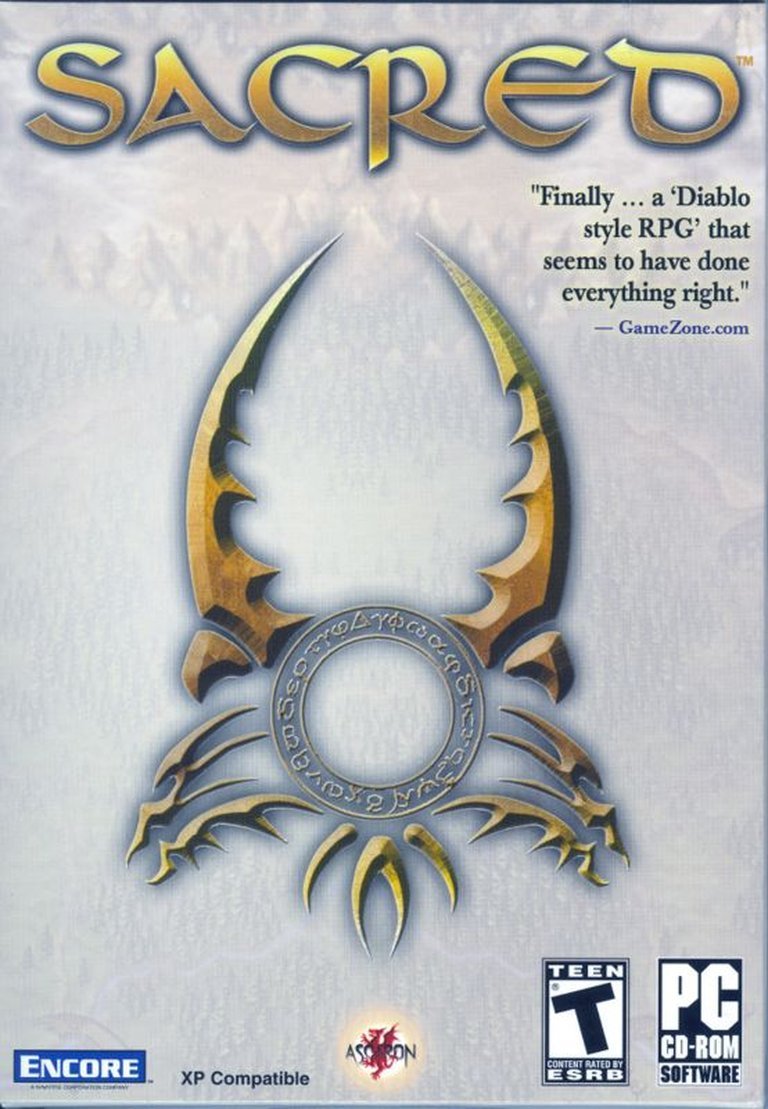
Sacred is an action role-playing game set in the fantasy world of Ancaria, where players choose from six unique character classes—such as the Dark Elf, Battle Mage, or Seraphim—to battle the necromancer Shaddar and his monstrous creations. The game features a vast open world with over 500 quests, a skill system based on collecting runes, and dynamic combat, along with multiplayer support for up to 16 players. With expansive exploration, horseback riding, and a mix of main and randomly generated side quests, Sacred offers deep character customization and a persistent world filled with towns, dungeons, and relentless enemies.
Gameplay Videos
Where to Buy Sacred
Sacred Patches & Updates
Sacred Guides & Walkthroughs
Sacred Reviews & Reception
ign.com (91/100): A massive, massive game that never gets boring and one that’s so easy to get into and so good-looking that anyone wanting good old fashioned RPG action would be stupid to even consider purchasing anything else.
metacritic.com (74/100): Sacred made me forget how disappointed I have been with many RPG’s over the last few years, was wonderful to play, and provided many hours RPG paradise.
imdb.com : The game has a kind of cozy look. And after a while you’ve probably gotten used to it. The gameplay is easy but gets harder later on. A good thing about this game is that you’ll always know what to do and the game never gets unpleasently chaotic like in most RPG’S. And that’s how this game can get pretty addictive.
gamespot.com (76/100): A great-looking, generally solid action RPG that provides a few interesting gameplay innovations.
Sacred Cheats & Codes
PC
Start the game with the /cheats=1 command line parameter. Start a single player game and press ~ during game play to display the console window. Enter sys cheats 963 to enable cheat mode. Note: Enter sys cheats on in v1.8 (Sacred Plus).
| Code | Effect |
|---|---|
| sys cheats 963 | Activate cheat mode |
| cheat lord | God mode |
| cheat sucide | Suicide |
| cheat teleport | Teleport |
| cheat tp | Teleport |
| sys cheats 369 | Disable codes |
| sys cheats off | Disable codes (v1.8) |
| cheat rare | Get rare items |
| cheat upgrade | All upgrades for the current character |
| cheat setgold # | Set gold to # |
| cheat addgold=# | Add # gold |
| cheat addexp=# | Add # EP |
| cheat setlevel=# | Set level for current character (max 255) |
| cheat setherolevel=# | Set level for current hero (max 255) |
| cheat fogofwar | No fog of war |
| cheat damage | Set health to 1 |
| cheat observer | Unknown |
| sys fps | Show Frame rate |
| cheat decap | Headless character |
PC (Sacred Gold)
Start the game with the /cheats=1 command line parameter. Start a single player game and press ~ (or the key above Tab) during a game to display the console window. Enter sys cheats 468 to enable cheat mode.
| Code | Effect |
|---|---|
| sys cheats 468 | Activate cheat mode |
| cheat lord | Invincibility |
| cheat decap | Headless character |
| cheat teleport | Teleport |
| cheat tp | Teleport |
| cheat suicide | Commit suicide |
| sys cheats 369 | Disable codes |
PC (Demo Version)
Start the game with the /cheats=1 command line parameter. Start a single player game and press ~ during game play to display the console window. Enter sys cheats=1 to enable cheat mode.
| Code | Effect |
|---|---|
| sys cheats=1 | Activate cheat mode |
| cheat god | Invincibility |
| cheat rare | Get rare items |
| cheat upgrade | All upgrades for the current character |
| cheat setgold # | Set gold to # |
| cheat addgold=# | Add # gold |
| cheat addexp=# | Add # experience points |
| cheat setlevel=# | Set level for current character (1-255) |
| cheat setherolevel=# | Set level for current hero (1-255) |
| cheat fogofwar | No fog of war |
| cheat damage | Set health to 1 |
| cheat observer | Observer mode |
| sys fps | Show Frame rate |
Sacred: A Flawed Gem in the Hack-and-Slash Crown
Introduction
In the early 2000s, the action RPG landscape was dominated by the colossal shadow of Diablo II. Amidst this backdrop, Sacred emerged in 2004 as a bold attempt to carve its own niche in the genre. Developed by Studio II Software and published by Ascaron Entertainment, Sacred promised a vast, open-ended fantasy world, a unique rune-based skill system, and a refreshing departure from the dungeon-crawling formula. Yet, despite its ambitious vision and undeniable charm, Sacred remains a game of contradictions—a title that dazzles with its creativity but stumbles under the weight of its technical shortcomings.
This review aims to dissect Sacred in its entirety, exploring its development history, narrative depth, gameplay mechanics, and lasting legacy. Through a critical lens, we will examine how Sacred sought to innovate within the action RPG genre, where it succeeded, and where it faltered. By the end, we will determine whether Sacred is a forgotten masterpiece or a cautionary tale of unfulfilled potential.
Development History & Context
The Birth of a Diablo Challenger
The origins of Sacred trace back to the late 1990s, when German developer Ikarion Software began work on Armalion, a game set in The Dark Eye (Das Schwarze Auge) universe. However, financial troubles led to Ikarion’s insolvency in 2001, and Ascaron Entertainment acquired the project, rebranding it as Sacred. This transition marked a pivotal moment in the game’s development, as Ascaron shifted the setting from The Dark Eye to an original fantasy world, Ancaria, while retaining much of the existing artwork and design.
The development team, led by Aarne Jungerberg and Michael Bhatty, sought to create a game that would stand toe-to-toe with Diablo II. Their vision was to craft a more expansive, open-world experience with a greater emphasis on exploration and player freedom. Unlike Diablo II‘s linear, act-based structure, Sacred offered a sprawling continent to explore, complete with towns, dungeons, and a vast array of side quests.
Technological Constraints and Ambitions
Sacred was developed during a transitional period in gaming technology. While 3D graphics were becoming the norm, Sacred opted for a hybrid 2D/3D approach, blending isometric 2D environments with 3D character models. This choice was partly due to the technical limitations of the time, but it also allowed for a more detailed and visually distinct world. The game’s engine, though capable of rendering large, seamless environments, struggled with performance issues, particularly in multiplayer modes.
One of the most ambitious features of Sacred was its multiplayer component. Ascaron aimed to create a robust online experience akin to Diablo II‘s Battle.net, but technical limitations and server instability plagued the launch. The game’s multiplayer was initially non-functional at release, requiring a day-one patch to enable it. Even then, the servers were woefully underprepared for the player base, leading to long wait times, crashes, and synchronization issues.
The Gaming Landscape in 2004
By 2004, the action RPG genre was in a state of flux. Diablo II had set the gold standard, but few games had successfully replicated its magic. Titles like Dungeon Siege and Divine Divinity had attempted to innovate, but none had truly dethroned Blizzard’s masterpiece. Sacred entered this competitive landscape with a unique proposition: a vast, open world, a deep character progression system, and a focus on player agency.
However, the gaming audience of 2004 was increasingly demanding. Players expected polished experiences with minimal bugs, and Sacred‘s technical issues were a significant hurdle. The game’s launch was met with a mix of enthusiasm and frustration, as players praised its ambition but criticized its execution.
Narrative & Thematic Deep Dive
The World of Ancaria
Sacred is set in the fantasy continent of Ancaria, a land teeming with diverse landscapes, from lush forests to arid deserts and frozen tundras. The world is richly detailed, with each region boasting its own unique aesthetic and lore. Unlike the confined, dungeon-heavy environments of Diablo II, Ancaria feels vast and open, inviting exploration.
The narrative revolves around the necromancer Shaddar, who accidentally summons a powerful Sakkara demon, unleashing chaos across Ancaria. The player takes on the role of one of six distinct characters, each with their own motivations and starting quests. These characters include:
- Gladiator: A brutal warrior enslaved in a colosseum.
- Seraphim: A celestial being descended from archangels.
- Vampiress: A cursed warrior seeking redemption.
- Battle Mage: A spellcaster who blends magic with melee combat.
- Wood Elf: A skilled archer and hunter.
- Dark Elf: A cunning assassin with a tragic past.
Each character’s story intertwines with the overarching plot, culminating in a final confrontation with Shaddar. The narrative is delivered through a mix of in-game dialogue, quest logs, and environmental storytelling, with a particular emphasis on humor and wit. The game’s writing is often playful, with characters like Glubba, a dim-witted ogre, providing comic relief.
Themes of Redemption and Identity
At its core, Sacred explores themes of redemption and identity. Many of the playable characters are outsiders or outcasts, struggling to find their place in a world that fears or misunderstands them. The Vampiress, for instance, is a former human warrior who was turned into a vampire and now seeks to atone for her past sins. Similarly, the Dark Elf is an assassin who falls in love with his target, leading him to question his allegiance to his people.
The game also delves into the consequences of unchecked ambition. Shaddar’s attempt to harness the power of the Sakkara demon serves as a cautionary tale about the dangers of meddling with forces beyond one’s control. This theme is reinforced by the game’s lore, which is scattered throughout Ancaria in the form of books and tombstones, many of which offer humorous or poignant insights into the world’s history.
Dialogue and Voice Acting
One of Sacred‘s standout features is its voice acting, particularly in the German version. The game boasts an impressive cast of voice actors, including Manfred Lehmann (the German voice of Bruce Willis) as the Gladiator and the voice of Dana Scully from The X-Files as the Seraphim. The dialogue is often witty and engaging, with characters delivering memorable one-liners and humorous asides.
However, the English localization suffers from some inconsistencies, with certain lines feeling stiff or out of place. Despite this, the game’s writing remains one of its strongest assets, blending humor, drama, and fantasy tropes in a way that feels fresh and engaging.
Gameplay Mechanics & Systems
Character Progression and the Rune System
Sacred introduces a unique character progression system that sets it apart from other action RPGs. Instead of traditional skill points, players must find and use runes to unlock and upgrade their abilities. Each character has a distinct set of skills, and runes for these skills can be found throughout the world or purchased from vendors.
This system adds a layer of strategy to character development, as players must decide which skills to prioritize based on the runes they acquire. However, it also introduces a potential frustration: if a player cannot find the runes they need, they may be forced to use suboptimal skills or grind for runes in specific locations.
The rune system is further complicated by the fact that higher-level skills have longer cooldowns, making them less practical in fast-paced combat. This design choice encourages players to diversify their skill sets rather than relying on a single powerful ability, but it can also lead to situations where a high-level skill is rendered useless due to its excessive cooldown.
Combat and Exploration
Combat in Sacred is fast-paced and visceral, with a strong emphasis on tactical positioning and resource management. Players must balance their use of skills, potions, and basic attacks to survive the game’s numerous encounters. The combat system is generally responsive, though some players have reported issues with hit detection and pathfinding, particularly in crowded battles.
Exploration is a key component of Sacred‘s gameplay. The world of Ancaria is vast and filled with hidden secrets, from hidden treasure chests to Easter eggs like a Pac-Man-themed dungeon and a recreation of Diablo‘s Tristram. The game’s auto-mapping feature helps players navigate the sprawling landscape, though the lack of a minimap can make orientation challenging at times.
Horses and Mounted Combat
One of Sacred‘s most innovative features is the inclusion of horses, which players can purchase and ride to traverse the world more quickly. Horses not only provide a speed boost but also offer combat bonuses, such as increased damage and defense. However, mounted combat is somewhat clunky, requiring players to dismount to attack effectively in most situations.
The horse system is a welcome addition to the genre, offering a new layer of strategy and mobility. However, the implementation is not without its flaws, as horses can be killed by enemies, leaving players stranded in dangerous areas.
Multiplayer and Technical Issues
Sacred‘s multiplayer mode was one of its most anticipated features, promising cooperative and competitive gameplay for up to 16 players. However, the multiplayer experience was marred by technical issues from the outset. The game’s servers were overwhelmed at launch, leading to long wait times, crashes, and synchronization problems.
The multiplayer mode also suffered from a lack of anti-cheat measures, allowing players to exploit the game’s client-side architecture to gain unfair advantages. These issues were eventually addressed through patches, but the damage to the game’s reputation had already been done.
World-Building, Art & Sound
Visual Design and Atmosphere
Sacred‘s visual design is a blend of 2D and 3D elements, creating a unique aesthetic that sets it apart from other action RPGs. The game’s environments are richly detailed, with lush forests, sprawling deserts, and towering mountains that evoke a sense of grandeur. The character models, while somewhat dated by modern standards, are expressive and well-animated, with each class boasting distinct visual traits.
The game’s art direction is particularly noteworthy for its use of color and lighting. The world of Ancaria is vibrant and varied, with each region boasting its own unique palette. The game’s day-night cycle adds an additional layer of immersion, with certain areas becoming more dangerous or revealing hidden secrets under the cover of darkness.
Sound Design and Music
Sacred‘s sound design is a mixed bag. The game’s ambient sounds, from the rustling of leaves to the distant howls of monsters, contribute to the immersive atmosphere. However, the combat sound effects can feel somewhat repetitive, with certain attacks lacking the impact they deserve.
The game’s soundtrack, composed by Michael Bhatty and others, is a highlight. The music is epic and atmospheric, blending orchestral arrangements with fantasy-inspired melodies. The soundtrack enhances the game’s sense of adventure, with dynamic tracks that shift to match the intensity of the action.
Reception & Legacy
Critical and Commercial Reception
Sacred received generally positive reviews upon release, with critics praising its ambitious scope, unique character progression system, and engaging combat. However, the game’s technical issues, particularly in multiplayer, were a common point of criticism. Reviewers also noted the game’s lack of polish, with some describing it as a “diamond in the rough.”
Commercially, Sacred was a success, selling over 2 million copies worldwide by 2009. The game’s popularity led to the release of two expansion packs, Sacred Plus and Sacred Underworld, as well as a compilation release, Sacred Gold. The game’s success also spawned a sequel, Sacred 2: Fallen Angel, which expanded on the original’s mechanics and introduced new features.
Influence and Legacy
Despite its flaws, Sacred has left a lasting impact on the action RPG genre. The game’s open-world design and unique character progression system have influenced subsequent titles, and its blend of humor and fantasy tropes remains a standout feature. While Sacred may not have dethroned Diablo II, it carved out its own niche, offering a fresh take on the genre that continues to resonate with players today.
Conclusion
Sacred is a game of contradictions—a title that dazzles with its creativity but stumbles under the weight of its technical shortcomings. Its ambitious vision, unique character progression system, and vast open world set it apart from other action RPGs of its time. However, its technical issues, particularly in multiplayer, and lack of polish prevent it from achieving true greatness.
Despite its flaws, Sacred remains a memorable and engaging experience, offering a fresh take on the hack-and-slash formula. Its legacy is one of innovation and ambition, and its influence can still be felt in the action RPG genre today. For players willing to overlook its technical issues, Sacred is a rewarding journey through a richly detailed fantasy world.
Final Verdict: 7.5/10 – A flawed gem that shines despite its imperfections.