
- Release Year: 2007
- Platforms: Macintosh, Windows
- Genre: Strategy, Tactics
- Game Mode: Single-player
- Gameplay: Board game, Turn-based
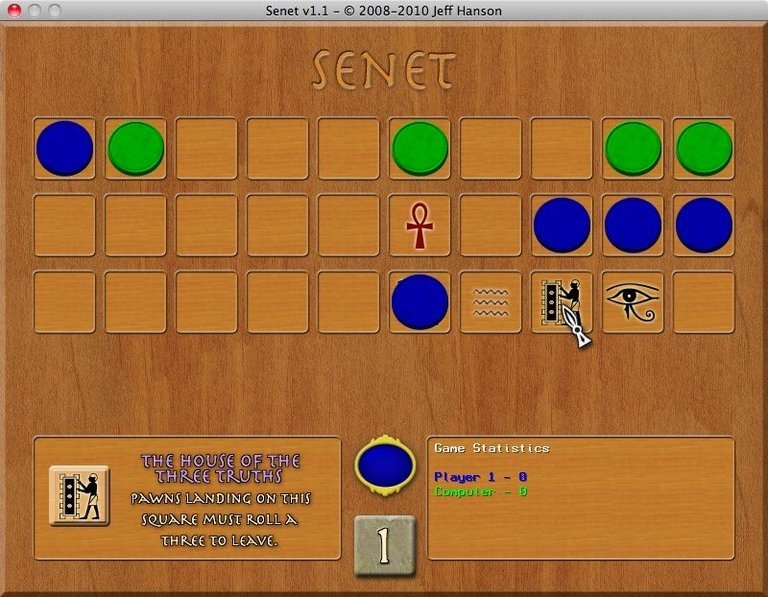
Description
Senet is an ancient Egyptian board game dating back to around 2620 BCE, making it one of the oldest known games. Played on a 30-square board, the game involves two players racing to move their pawns off the board first, using a single die to determine movement. Special squares marked with hieroglyphics add strategic depth, offering benefits like protection or penalties such as traps or setbacks. With roots in both secular entertainment and religious symbolism—even referenced in the Book of the Dead—Senet reflects Egypt’s cultural and spiritual traditions.
Where to Buy Senet
PC
Senet Free Download
PC
Senet Patches & Updates
Senet: A Journey Through Time and the Afterlife
Introduction
Few games can claim a legacy as ancient and as spiritually profound as Senet. Originating in the cradle of civilization, this board game transcended mere entertainment, evolving into a sacred ritual that mirrored the Egyptian journey through the afterlife. With roots stretching back over 5,000 years, Senet is not just a relic of the past but a cultural artifact that offers a window into the religious, social, and intellectual life of ancient Egypt. This review explores Senet in its modern digital incarnation, analyzing its historical significance, gameplay mechanics, and enduring appeal in the 21st century.
Development History & Context
The Ancient Origins of a Timeless Game
Senet (meaning “passing” in ancient Egyptian) is one of the oldest known board games, with its earliest representations dating back to c. 2620 BCE in the Mastaba of Hesy-Re. However, fragmentary boards suggest its existence as early as the First Dynasty (c. 3100 BCE). The game flourished throughout Egypt’s dynastic periods, from the Old Kingdom to the Late Period (664–332 BCE), and was even depicted in tombs of pharaohs like Tutankhamun and Queen Nefertari.
The game’s religious significance became pronounced during the New Kingdom (1550–1077 BCE), where it was associated with the Book of the Dead (Chapter 17). Here, the deceased is depicted playing Senet against an invisible opponent, symbolizing the soul’s journey through the Duat (the underworld) and its eventual rebirth.
The Modern Revival: From Archaeology to Digital
The original rules of Senet were lost to time, but the game was resurrected in the 20th century thanks to the work of Egyptologists like Gustave Jéquier, R. C. Bell, and Dr. Timothy Kendall. Their reconstructions, based on archaeological evidence and textual fragments, formed the foundation for modern interpretations.
The 2007 digital adaptation of Senet for Windows and Macintosh by an unnamed studio (as per MobyGames) sought to bring this ancient game to contemporary audiences. While the digital version lacks the grandeur of its physical predecessors—often crafted from ivory, wood, or faience—it retains the core mechanics and spiritual symbolism that defined the original.
Technological Constraints and Design Choices
The 2007 release was constrained by the technological standards of its time. The game features:
– A 2D board with 30 squares arranged in three rows of ten.
– Five decorated “houses” (squares 15, 26, 27, 28, 29, and 30) with special rules tied to Egyptian cosmology.
– Throw sticks (binary dice) replaced by a digital randomizer.
– AI opponents with basic decision-making algorithms.
The lack of 3D rendering or animated transitions reflects the era’s limitations, but the game compensates with authentic hieroglyphic symbols and a minimalist aesthetic that evokes ancient Egyptian art.
Narrative & Thematic Deep Dive
The Soul’s Journey: A Game of Life, Death, and Rebirth
Senet is more than a race game—it is a metaphor for the afterlife. The board represents the Duat, the perilous underworld through which the soul (ba) must navigate to achieve eternal life. Each square corresponds to a stage in this journey, with the decorated houses representing critical trials:
| Square | Name | Symbolism |
|---|---|---|
| 15 | House of Life (Ankh) | A safe haven, tied to the final house (27) in a cycle of renewal. |
| 26 | House of Happiness | Mandatory stopping point; represents joy before the final judgment. |
| 27 | House of Water | A trap; sends the pawn back to House 15, symbolizing the chaos of the Nile. |
| 28 | House of Three Truths | The soul is judged; only a roll of 3 allows passage to the afterlife. |
| 29 | House of Re-Atoum | The sun god’s domain; requires a roll of 2 to ascend. |
| 30 | House of Horus | The final gate; a roll of 1 or an empty first row grants rebirth. |
The Duality of Play: Secular and Sacred
Senet served two purposes:
1. Recreational Play: A pastime for all social classes, from peasants to pharaohs.
2. Religious Ritual: A means of communicating with the dead, as seen in tomb paintings where the deceased plays against an unseen opponent (often interpreted as a deity or the ka (spiritual double)).
The digital version leans into the secular aspect, stripping away the ritualistic elements in favor of accessible gameplay. However, the symbolism remains intact, making it a unique blend of historical education and strategic entertainment.
Gameplay Mechanics & Systems
Core Gameplay Loop: A Race Against the Duat
Senet is a race game akin to Backgammon or Sorry!, where players compete to move all five of their pawns off the board. The mechanics are deceptively simple but layered with strategic depth:
-
Movement: Players use four binary sticks (digitalized as a die roll) to determine movement:
- 1 white stick = move 1 space
- 2 white sticks = move 2 spaces
- …
- 4 white sticks = move 4 spaces
- All black sticks = move 5 spaces
-
Capturing: Landing on an opponent’s pawn sends it back to the start, unless the opponent has three or more pawns in a row, forming a blockade.
-
Special Squares: The decorated houses introduce risk-reward mechanics:
- House of Water (27): A trap that resets progress.
- House of Three Truths (28): A waiting zone where only a specific roll allows escape.
- House of Horus (30): The final challenge before victory.
Strategic Depth and Player Agency
While luck plays a role (due to the random stick throws), Senet rewards forward planning:
– Blockading: Placing three pawns in a row can halt an opponent’s advance.
– Sacrificial Moves: Deliberately landing on the House of Water to reset an opponent’s lead.
– Pawn Prioritization: Deciding which pawn to move based on board state and opponent threats.
UI and Accessibility
The 2007 digital adaptation features a clean, functional UI but lacks modern polish:
– Pros:
– Faithful recreation of the ancient board.
– Clear visual indicators for special squares.
– Simple controls (point-and-click).
– Cons:
– No tutorials to explain the rules or symbolism.
– Basic AI with predictable patterns.
– No multiplayer (a missed opportunity for a game rooted in social play).
World-Building, Art & Sound
Visual Design: A Minimalist Homage to Ancient Egypt
The game’s art style is understated yet evocative:
– Board Design: The 30-square grid is rendered in earthy tones, with hieroglyphic markings on the special squares.
– Pawns: Simple, geometric pieces that resemble ancient Egyptian game tokens (often shaped like hounds or cones).
– Background: A static image of an Egyptian tomb or papyrus scroll, reinforcing the historical theme.
While the graphics are not visually stunning, they serve the game’s educational purpose, immersing players in the aesthetic of ancient Egypt.
Sound Design: The Silence of the Tombs
The audio experience is minimalist:
– Ambient Sounds: Subtle echoes of wind or distant chants (likely synthesized).
– Gameplay Sounds: Soft clicks for pawn movement and dice rolls.
– Music: A looping, hypnotic melody inspired by ancient Egyptian scales.
The sound design enhances immersion but is not memorable. A more dynamic soundtrack or voiceovers explaining the lore could have elevated the experience.
Reception & Legacy
Critical and Commercial Reception
The 2007 digital adaptation of Senet received little critical attention, as evidenced by the lack of reviews on platforms like MobyGames or Metacritic. This obscurity is likely due to:
– Niche Appeal: The game caters to history enthusiasts rather than mainstream gamers.
– Limited Marketing: Released without fanfare, it failed to capture a broad audience.
– Technological Limitations: By 2007 standards, the game was graphically outdated even at launch.
However, Senet enjoys a cult following among:
– Egyptologists and historians who appreciate its educational value.
– Board game aficionados who seek ancient game experiences.
– Indie developers who draw inspiration from its mechanics and themes.
Influence on Modern Games
While Senet itself remains obscure, its legacy looms large over game design:
1. Ancient Game Revivals: Titles like The Royal Game of Ur and Mancala owe their modern popularity to Senet’s pioneering revival.
2. Narrative Board Games: Games like Gloomhaven and Pandemic Legacy incorporate progressive storytelling, a concept Senet embodied through its spiritual journey.
3. Educational Gaming: Senet is frequently used in museum exhibits and classroom settings to teach ancient Egyptian culture.
Conclusion: A Timeless Relic in the Digital Age
Final Verdict: 7.5/10 – A Flawed but Fascinating Historical Artifact
Senet (2007) is not a masterpiece of game design by modern standards. Its basic AI, lack of tutorials, and dated visuals hold it back from greatness. However, its historical significance, strategic depth, and spiritual themes make it a unique and valuable experience for those willing to engage with its ancient roots.
Who Should Play It?
- History buffs eager to interact with a 5,000-year-old game.
- Strategy gamers who enjoy abstract, luck-based competition.
- Educators looking for interactive tools to teach ancient Egyptian culture.
Who Should Avoid It?
- Casual gamers seeking fast-paced action or modern polish.
- Multiplayer enthusiasts (the lack of online play is a major drawback).
The Enduring Legacy of Senet
Senet is more than a game—it is a bridge across millennia, connecting modern players to the beliefs and pastimes of ancient Egypt. While the 2007 digital adaptation may not be the definitive version, it serves as a gateway to a richer understanding of how games can transcend entertainment to become cultural and spiritual artifacts.
In the pantheon of video game history, Senet stands as a testament to the enduring power of play—a reminder that even the simplest mechanics can carry profound meaning when rooted in humanity’s oldest stories.
Final Score Breakdown:
– Historical Authenticity: 10/10
– Gameplay Depth: 7/10
– Visual & Audio Design: 6/10
– Replayability: 6/10
– Accessibility: 5/10
– Overall: 7.5/10 – “A fascinating but flawed journey through the Duat.”