
- Release Year: 2005
- Platforms: Windows
- Publisher: Frogster Interactive Pictures AG
- Developer: Dio Games
- Genre: Strategy, Tactics
- Perspective: Top-down
- Game Mode: Hotseat, Online PVP, Single-player
- Gameplay: Automated combat, Base building, Real-time
- Setting: Futuristic, Sci-fi
- Average Score: 51/100
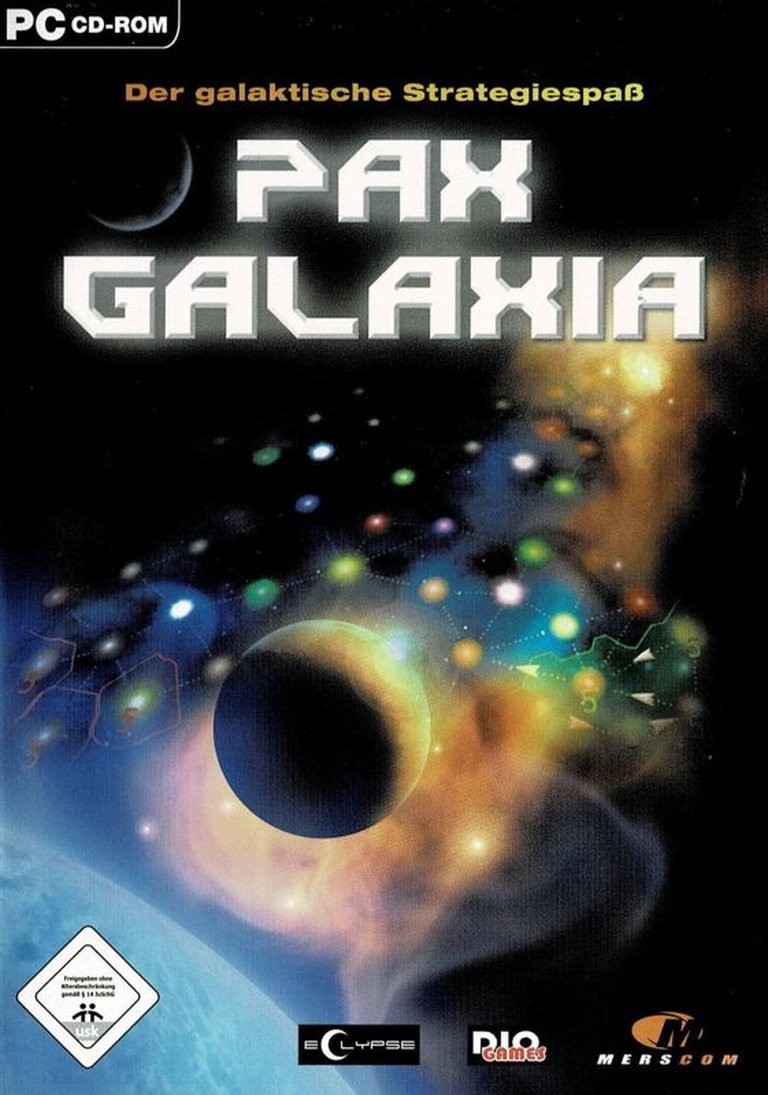
Description
Pax Solaris is a real-time strategy game set in a futuristic space environment where players aim to conquer stars on a top-down stellar map. Players issue movement and attack orders by drawing lines between connected stars, directing their fleets to expand their territory. Each star produces ships at a steady rate, and the game blends real-time gameplay with a unique hot-seat multiplayer mode that alternates turns while maintaining real-time mechanics. The focus is on tactical decision-making and resource management, with automated combat resolution and a pause feature in single-player mode.
Pax Solaris Reviews & Reception
mobygames.com (48/100): A strategy game set in space where the goal is to conquer stars with simple movement orders.
vgtimes.com (55/100): A third-person strategy game with sandbox elements, offering a mix of real-time and turn-based gameplay.
retro-replay.com : Pax Solaris delivers a deceptively simple yet deeply strategic experience with a clean, minimalist aesthetic.
gamedev.net : Very cool game, I just finished my first game, which I won. It ran just fine on my system.
Pax Solaris Cheats & Codes
PC
Type the following codes during game.
| Code | Effect |
|---|---|
| bidytj | Access Prison |
| knutw | Access Temple |
| codup | Access Rocket silo |
| benyo | Access Space lab |
PlayStation
Enter the following codes as a password.
| Code | Effect |
|---|---|
| NOHIT | Unlock Invincibility |
| HITTT | Disable Invincibility |
| BIDYE | Access Prison |
| CODUP | Access Rocket Silo |
| CODUZ | Access Rocket Silo Alternate |
| KNUTW | Access Temple |
| BENYO | Access Space Lab |
Pax Solaris: A Forgotten Gem of Cosmic Conquest
Introduction
In the vast expanse of strategy gaming, few titles have captured the essence of galactic domination as elegantly as Pax Solaris. Released in 2005 by the small Romanian studio Dio Games, this overlooked masterpiece blends real-time strategy with the simplicity of drag-and-drop mechanics, creating an experience that is both accessible and deeply strategic. Despite its modest reception at launch, Pax Solaris has cultivated a dedicated following, with fans still advocating for its revival over two decades later. This review delves into the game’s development, mechanics, and legacy, arguing that Pax Solaris is not just a relic of its time but a timeless strategy experience that deserves rediscovery.
Development History & Context
The Birth of a Vision
Pax Solaris, originally titled Pax Galaxia, was the brainchild of Diodor Bitan, a Romanian developer whose passion for strategy games led him to create a title that distilled the genre to its purest form. Developed under the banner of Dio Games, Pax Solaris emerged during a period when real-time strategy (RTS) games were dominated by titans like StarCraft and Command & Conquer. Yet, Bitan’s vision was not to compete with these giants in scale or spectacle but to carve out a niche with a game that prioritized strategic depth over graphical fidelity.
The game’s development was a labor of love, with Bitan handling programming, game design, and artwork, while Jakub Majewski contributed to level design, manual writing, and quality assurance. The team’s small size and limited resources meant that Pax Solaris had to rely on simplicity and innovation rather than cutting-edge technology. The use of libraries like SDL, SDLnet, and SDLimage underscored the game’s indie roots, allowing it to run on modest hardware while maintaining a smooth, responsive experience.
The Gaming Landscape of 2005
The mid-2000s were a transitional period for strategy games. While RTS titles like Warcraft III and Age of Empires II were still thriving, the genre was beginning to fragment into sub-genres, with games like Rome: Total War blending turn-based and real-time elements. Pax Solaris arrived at a time when players were increasingly seeking games that offered both depth and accessibility, a balance that Bitan’s creation struck with remarkable precision.
However, the game’s minimalist presentation and lack of a traditional narrative campaign put it at odds with the expectations of mainstream audiences. Critics and players alike were accustomed to games with cinematic storytelling and high-production values, making Pax Solaris an acquired taste. Its shareware business model, while innovative, also limited its reach, as players were often hesitant to invest in a game that lacked the polish of its AAA counterparts.
Narrative & Thematic Deep Dive
A Minimalist Approach to Storytelling
Pax Solaris eschews the traditional narrative structures of its contemporaries, opting instead for a minimalist approach that emphasizes emergent storytelling. There are no lengthy cutscenes, no character-driven arcs, and no scripted plotlines. Instead, the game presents players with a simple objective: conquer the galaxy. This lack of a predefined narrative allows players to craft their own stories through their strategic decisions, turning each match into a unique saga of conquest, betrayal, and survival.
The game’s setting is richly implied rather than explicitly detailed. In-game text snippets hint at ancient civilizations, merchant guilds, and a delicate balance of power on the brink of collapse. These narrative breadcrumbs encourage players to imagine the forces behind each star system they conquer, fostering a sense of immersion that transcends the game’s simple visuals. For those craving more lore, community mods and forum discussions have filled in the gaps, creating a tapestry of background contexts and alternative histories that enrich the game’s universe.
Themes of Conquest and Strategy
At its core, Pax Solaris is a meditation on the art of war. The game’s mechanics emphasize the importance of supply lines, front lines, and tactical retreats, forcing players to think like generals rather than mere tacticians. The absence of a traditional narrative allows these themes to take center stage, as players grapple with the challenges of maintaining a vast interstellar empire.
The game’s title itself, Pax Solaris, evokes themes of peace through strength, a concept that resonates throughout the gameplay. Players must balance aggression with defense, expansion with consolidation, and offense with diplomacy (in multiplayer). This delicate dance of power and restraint is what makes Pax Solaris a uniquely engaging experience, one that rewards careful planning and adaptability.
Gameplay Mechanics & Systems
The Art of Drag-and-Drop Conquest
Pax Solaris’s gameplay is deceptively simple. Players are presented with an overhead stellar map, where stars are interconnected by lines representing travel routes. The goal is to conquer all the stars by issuing movement orders to fleets. Unlike traditional RTS games, where players control individual units, Pax Solaris allows players to issue commands to entire star systems. By drawing a line between two stars, players can direct all ships passing through the origin star to move toward the destination, creating a streamlined and intuitive control scheme.
This drag-and-drop mechanic is the game’s defining feature, reducing the complexity of unit management while maintaining strategic depth. Players must carefully consider the placement of their fleets, balancing the need for expansion with the necessity of defending key chokepoints. The real-time nature of the game adds a layer of tension, as players must react quickly to shifting battle lines and unexpected enemy movements.
Production and Resource Management
Each star in Pax Solaris produces ships at a steady rate, creating a constant flow of reinforcements that players must manage effectively. The challenge lies in deciding where to allocate these resources, as every decision has ripple effects across the galaxy. Reinforcing a vulnerable front line might leave another sector exposed, while focusing on expansion could leave the player’s core systems undefended.
The game’s production system is elegantly simple, with no complex resource-gathering mechanics or tech trees. Instead, players must rely on their strategic acumen to outmaneuver their opponents, making Pax Solaris a game of pure tactics rather than logistical management.
Combat and Auto-Resolution
Combat in Pax Solaris is resolved automatically, with battles playing out based on the relative strength of the opposing fleets. This design choice keeps the focus on macro-level strategy rather than micro-level tactics, allowing players to concentrate on the broader picture of galactic conquest. While some players might miss the hands-on combat of other RTS games, the auto-resolution system ensures that Pax Solaris remains accessible and fast-paced.
Multiplayer: A Unique Hybrid Experience
One of the game’s most innovative features is its hot-seat multiplayer mode, which blends real-time and turn-based elements. Players take turns issuing commands within a set time frame, after which the AI takes over based on their last instructions. This hybrid approach creates a dynamic and unpredictable multiplayer experience, where players must adapt to the AI’s interpretations of their orders and the ever-changing battlefield.
The multiplayer mode is a testament to Bitan’s creativity, offering a fresh take on competitive strategy gaming. It encourages players to think several moves ahead, anticipating their opponents’ actions while accounting for the AI’s behavior. This layer of complexity makes Pax Solaris a uniquely engaging multiplayer experience, one that rewards both quick thinking and long-term planning.
World-Building, Art & Sound
A Minimalist Aesthetic
Pax Solaris’s visual design is a study in minimalism. The game’s stellar map is rendered in crisp, contrasting colors, with stars and travel routes standing out against the black void of space. This clean aesthetic ensures that players can easily track multiple fronts, even as the map becomes crowded with enemy fleets. While the game lacks the detailed 3D models and cinematic effects of its contemporaries, its functional design keeps the focus on strategic decision-making.
The game’s icons and animations are simple but effective, with ships moving fluidly along drawn paths and stars pulsing to indicate production rates. Battle outcomes are conveyed through brief visual cues, ensuring that players remain informed without being overwhelmed by unnecessary detail. This restrained approach to visual design is a testament to the game’s focus on gameplay over spectacle.
Sound Design: Subtle but Effective
The game’s sound design is equally understated, with ambient hums, soft chimes, and muted explosions creating a soundscape that complements the visuals without distracting from the gameplay. The audio cues serve to reinforce the feeling of orchestrating a vast interstellar empire, adding to the game’s immersive qualities. While Pax Solaris may lack the orchestral scores and voice acting of other strategy games, its subtle sound design enhances the overall experience.
Reception & Legacy
Critical Reception: A Mixed Bag
Pax Solaris received a lukewarm reception upon its release, with critics praising its innovative mechanics but criticizing its lack of polish. Game Tunnel gave the game a 70% score, commending its accessibility and strategic depth while noting that its presentation left something to be desired. German publications PC Action and GameStar were less kind, with scores of 41% and 33%, respectively, citing the game’s minimalist graphics and lack of narrative as major drawbacks.
Despite these criticisms, Pax Solaris found a niche audience that appreciated its unique blend of simplicity and depth. The game’s dedicated fanbase has kept it alive through community mods, forum discussions, and even attempts at remakes, such as Stian G. Høiland’s Pax Two project. This grassroots support is a testament to the game’s enduring appeal, proving that Pax Solaris is more than just a forgotten relic of the mid-2000s.
Influence and Legacy
While Pax Solaris may not have had a direct impact on the broader strategy genre, its influence can be seen in the numerous “Pax lookalikes” that have emerged on platforms like Steam and mobile app stores. These games often attempt to replicate Pax Solaris’s drag-and-drop mechanics and minimalist design, though few have captured the original’s depth and charm.
The game’s legacy is perhaps best exemplified by the ongoing efforts to revive it. Høiland’s Pax Two project, which aims to faithfully recreate Pax Solaris’s gameplay while modernizing its graphics and adding touchscreen support, is a testament to the game’s enduring appeal. This community-driven initiative highlights the passion that Pax Solaris continues to inspire, even two decades after its release.
Conclusion
Pax Solaris is a game that defies easy categorization. It is neither a traditional RTS nor a turn-based strategy game but a unique hybrid that blends the best elements of both genres. Its minimalist design, intuitive mechanics, and emergent storytelling make it a standout title in the strategy genre, one that rewards careful planning and adaptability.
While the game’s lack of polish and narrative depth may have limited its mainstream appeal, its dedicated fanbase and enduring legacy speak to its timeless qualities. Pax Solaris is a game that deserves to be rediscovered, a forgotten gem that offers a refreshing alternative to the bloated, spectacle-driven strategy games of today.
For those willing to look past its modest presentation, Pax Solaris offers a deeply engaging and rewarding experience, one that captures the essence of galactic conquest in a way that few games have managed to replicate. It is a testament to the power of simplicity, a reminder that great strategy games do not need to be complex to be compelling.
Final Verdict: 8/10 – A timeless strategy experience that deserves a place in the pantheon of great RTS games.