
- Release Year: 2013
- Platforms: iPad, iPhone, Windows
- Publisher: Sprakelsoft GmbH
- Developer: Sprakelsoft GmbH
- Genre: Puzzle
- Perspective: 1st-person
- Game Mode: Single-player
- Gameplay: Tile matching puzzle
- Setting: Halloween
Description
Halloween Heat 2 is an addictive Halloween-themed match-3 puzzle game developed by Sprakelsoft GmbH. Released in 2013, the game offers multiple modes including Normal, Quick, and Infinite for single-player, as well as two competitive multiplayer modes. Players match tiles to complete objectives, earn combos for higher scores, and enjoy features like HD graphics, 60 FPS performance, and custom music. With 20 objectives to complete and full Game Center support, it provides a festive and engaging puzzle experience for Halloween enthusiasts.
Halloween Heat 2: A Forgotten Gem of Mobile Puzzle Gaming
Introduction
In the vast and often overlooked landscape of mobile gaming, Halloween Heat 2 (2013) stands as a curious artifact—a seasonal puzzle game that attempted to carve out a niche in the crowded match-3 genre. Developed and published by Sprakelsoft GmbH, this title is a sequel to the original Halloween Heat (2011), a game that itself was a modest entry in the burgeoning market of holiday-themed mobile puzzlers. While Halloween Heat 2 may not have left a significant mark on the broader gaming industry, its existence offers a fascinating glimpse into the evolution of mobile puzzle games, the challenges of indie development, and the fleeting nature of seasonal digital entertainment.
This review aims to dissect Halloween Heat 2 in exhaustive detail, exploring its development context, gameplay mechanics, artistic direction, and legacy. By examining the game through multiple lenses—historical, mechanical, and cultural—we can better understand its place in the pantheon of mobile gaming and why it remains a footnote rather than a landmark.
Development History & Context
The Studio Behind the Game
Sprakelsoft GmbH, the German studio responsible for Halloween Heat 2, is a relatively obscure player in the mobile gaming industry. Founded in the early 2010s, the studio primarily focused on casual and puzzle games, with titles like Jewel Fever, Birds’n’Blocks, and Pacific Wings comprising much of its portfolio. Unlike larger studios with dedicated marketing teams and substantial budgets, Sprakelsoft operated in the indie sphere, where visibility and commercial success often hinged on word-of-mouth and App Store algorithms.
The studio’s approach to Halloween Heat 2 was typical of small-scale mobile development at the time: iterate on a proven formula, add seasonal flair, and release it in time for a holiday surge in downloads. The original Halloween Heat (2011) had laid the groundwork, offering a straightforward match-3 experience with a spooky aesthetic. Halloween Heat 2 sought to refine and expand upon that foundation, introducing new modes, improved graphics, and multiplayer functionality.
The Mobile Gaming Landscape in 2013
The year 2013 was a pivotal one for mobile gaming. The App Store, launched in 2008, had matured into a dominant force in the industry, with millions of apps vying for attention. The puzzle genre, in particular, was experiencing a golden age. Candy Crush Saga (2012) had become a cultural phenomenon, demonstrating the lucrative potential of free-to-play (F2P) models with in-app purchases (IAPs). Other match-3 games like Bejeweled and Puzzle & Dragons were also thriving, proving that the genre had mass-market appeal.
Against this backdrop, Halloween Heat 2 entered a market saturated with competitors. Its challenge was twofold: differentiate itself from the pack while capitalizing on the seasonal interest in Halloween-themed content. The game’s development was likely constrained by limited resources, both in terms of budget and manpower. This is evident in its modest feature set and the absence of a significant marketing push.
Technological Constraints
Halloween Heat 2 was designed for iOS devices, with a later port to Windows in 2015. The game’s technical specifications reflect the hardware limitations of the era. The iPhone 5, released in 2012, was the flagship device at the time, and Halloween Heat 2 was optimized for its Retina display. The game boasted “HD graphics (incl. particle-systems)” and “steady framerates with 60 FPS on most devices,” which were notable achievements for a small indie title.
However, the game’s fixed/flip-screen perspective and first-person viewpoint were somewhat anachronistic. While match-3 games like Candy Crush had embraced a more dynamic, isometric perspective, Halloween Heat 2 adhered to a simpler, grid-based approach. This design choice may have been a deliberate attempt to evoke nostalgia or to simplify development, but it also made the game feel less innovative compared to its peers.
Narrative & Thematic Deep Dive
The Absence of Story
Halloween Heat 2 is, at its core, a puzzle game, and as such, it lacks a traditional narrative. There are no characters to speak of, no dialogue, and no overarching plot. The game’s “story” is conveyed through its Halloween-themed aesthetics—spooky sound effects, eerie visuals, and a general atmosphere of playful horror. This absence of narrative is not unusual for the match-3 genre, where gameplay mechanics typically take precedence over storytelling.
However, the lack of even a minimal narrative framework is noteworthy. Many successful puzzle games of the era, such as Puzzle & Dragons or Plants vs. Zombies, incorporated light storytelling elements to give players a sense of progression and purpose. Halloween Heat 2 eschews this entirely, relying instead on its seasonal theme to provide context. This decision may have been a missed opportunity to engage players on a deeper level.
Thematic Elements: Halloween as a Hook
The game’s Halloween theme is its most defining characteristic. From the jack-o’-lanterns and ghosts that populate the game board to the haunting background music, Halloween Heat 2 leans heavily into its seasonal identity. This thematic focus is both a strength and a weakness.
On the one hand, the Halloween theme gives the game a distinct identity in a crowded market. Seasonal games often experience a surge in downloads during their respective holidays, and Halloween Heat 2 was no exception. The game’s visual and auditory design effectively captures the spirit of Halloween, making it a festive diversion for players looking for something thematically appropriate.
On the other hand, the game’s reliance on its Halloween theme limits its long-term appeal. Unlike evergreen titles like Candy Crush, which can be played year-round, Halloween Heat 2 is inherently tied to a specific time of year. This seasonal nature likely contributed to its rapid fade from relevance once the Halloween season passed.
The Psychology of Match-3 Games
While Halloween Heat 2 lacks a traditional narrative, it does engage with the psychological underpinnings of match-3 games. These games are designed to be addictive, leveraging principles of behavioral psychology to keep players engaged. The core loop of matching tiles, earning points, and progressing through levels triggers the brain’s reward system, releasing dopamine and creating a sense of accomplishment.
Halloween Heat 2 amplifies this effect with its combo system, which rewards players for chaining matches together. The game’s “Quick mode,” where players have 60 seconds to match as many items as possible, further intensifies the adrenaline rush, tapping into the player’s fight-or-flight response. These mechanics are not unique to Halloween Heat 2, but they are executed competently, making the game a satisfying, if not groundbreaking, experience.
Gameplay Mechanics & Systems
Core Gameplay Loop
At its heart, Halloween Heat 2 is a match-3 puzzle game, a genre that has remained popular for decades due to its simplicity and accessibility. The core gameplay loop involves swapping adjacent tiles to create matches of three or more identical items. When a match is made, the tiles disappear, and new tiles fall into place, potentially creating cascading matches or combos.
The game offers three single-player modes:
1. Normal Mode: Players advance to the next level by matching a required number of items, as indicated at the top of the screen.
2. Quick Mode: A timed challenge where players have 60 seconds to match as many items as possible.
3. Infinite Mode: A relaxed, untimed mode where players can enjoy the game without the pressure of a countdown.
These modes cater to different playstyles, from the goal-oriented Normal Mode to the high-pressure Quick Mode and the casual Infinite Mode. The inclusion of multiple modes adds replayability, though the core mechanics remain largely unchanged across them.
Multiplayer Modes
Halloween Heat 2 distinguishes itself with two multiplayer modes, a rarity in match-3 games at the time:
1. Multiplayer Mode 1: Both players play on their own identical game fields, competing to earn the most points in 120 seconds.
2. Multiplayer Mode 2: Both players share the same game field, again competing for the highest score in 120 seconds.
These modes are an ambitious addition, particularly for a small indie title. Multiplayer functionality in mobile games was still in its infancy in 2013, and Halloween Heat 2’s implementation was likely limited by technological constraints. The lack of online multiplayer—players would have needed to be in the same physical space to compete—further limited the appeal of these modes. Nonetheless, their inclusion demonstrates Sprakelsoft’s willingness to experiment and innovate within the constraints of the genre.
Progression and Objectives
The game features 20 objectives to complete in Normal or Quick Mode, providing a sense of progression and achievement. These objectives likely involve tasks such as reaching a certain score, completing a level within a time limit, or achieving a specific number of combos. While the exact nature of these objectives is not detailed in the available sources, their presence suggests an attempt to give players long-term goals beyond simply advancing through levels.
The game also includes full Game Center support, allowing players to track their achievements and compete on leaderboards. This integration with Apple’s social gaming platform was a smart move, as it encouraged competition and replayability.
Controls and User Interface
Halloween Heat 2 employs a simple control scheme: players can move tiles by tapping the source and then the target position or by swiping. This intuitive system is well-suited to touchscreen devices, though the lack of precision in swipe controls can occasionally lead to frustration, particularly in timed modes.
The user interface (UI) is functional but unremarkable. The game’s Halloween theme is reflected in the UI elements, with orange and black color schemes and spooky icons. However, the UI lacks the polish and sophistication of more successful match-3 games. For example, the game’s objectives and progress are displayed in a straightforward manner, without the visual flair that games like Candy Crush use to enhance player engagement.
Innovations and Flaws
Halloween Heat 2’s most notable innovation is its multiplayer modes, which were uncommon in match-3 games at the time. However, the execution of these modes was likely hampered by technological limitations, and their appeal was further diminished by the lack of online play.
The game’s greatest flaw, however, is its over-reliance on its Halloween theme. While the seasonal aesthetic is initially charming, it does little to differentiate the gameplay itself from countless other match-3 titles. The absence of unique mechanics or a compelling narrative leaves Halloween Heat 2 feeling like a generic puzzle game with a Halloween skin.
Additionally, the game’s monetization strategy appears to have been a point of contention among players. User reviews on the App Store frequently mention intrusive ads that cover the game board, particularly in the bottom row, making it difficult to play. While the game offers an in-app purchase to remove ads, the fact that this was not a default option likely frustrated many players.
World-Building, Art & Sound
Visual Design: A Spooky Aesthetic
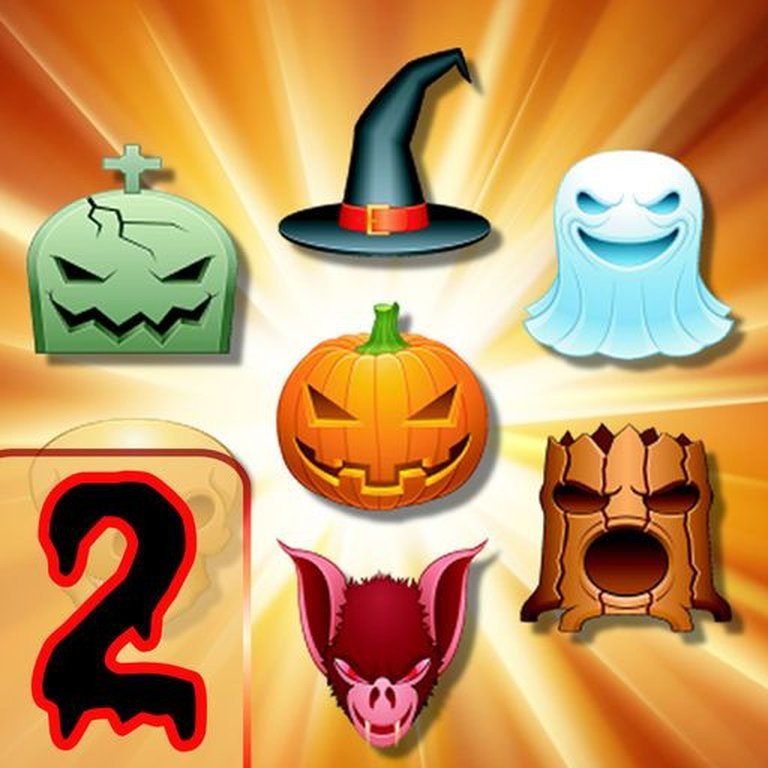
Halloween Heat 2’s visual design is its strongest suit. The game’s Halloween theme is executed with a level of detail and polish that elevates it above many of its competitors. The tiles feature iconic Halloween imagery, such as jack-o’-lanterns, ghosts, bats, and candy corn, all rendered in a vibrant, cartoonish style. The game’s particle effects, mentioned in its official description, add a layer of dynamism to the visuals, with sparkles and explosions accompanying successful matches.
The game’s Retina display support and HD graphics were notable for the time, ensuring that the visuals remained crisp and clear on high-resolution screens. The fixed/flip-screen perspective, while somewhat dated, allows for a clean and uncluttered presentation, with the game board taking center stage.
Atmosphere and Setting
The game’s atmosphere is unmistakably Halloween-themed, with a playful rather than terrifying approach to horror. The visuals are bright and colorful, eschewing the darker tones often associated with the holiday in favor of a more family-friendly aesthetic. This design choice aligns with the game’s target audience—casual players looking for a lighthearted seasonal diversion.
The setting, such as it is, is abstract. There is no overarching world or narrative context; the game exists in a void, with the Halloween theme serving as a loose framework rather than a fully realized environment. This lack of world-building is not unusual for a match-3 game, but it does limit the game’s immersive potential.
Sound Design: Enhancing the Halloween Vibe
The game’s sound design complements its visual aesthetic, with spooky sound effects and a haunting background soundtrack. The official description mentions that players can listen to their own music instead of the in-game soundtrack, a feature that suggests the developers were aware of the potential for repetitive or uninspired audio.
The sound effects—such as the “boo” of a ghost or the crunch of a matched tile—are simple but effective, reinforcing the game’s Halloween theme. The background music, while not particularly memorable, sets an appropriate mood without becoming intrusive.
Reception & Legacy
Critical and Commercial Reception
Halloween Heat 2 received little critical attention upon its release. Major gaming outlets did not review the title, and it remains absent from aggregator sites like Metacritic and OpenCritic. This lack of coverage is not surprising, given the game’s niche appeal and the crowded nature of the mobile gaming market in 2013.
User reception, as evidenced by App Store reviews, was mixed. The game holds a modest 1.4 out of 5 rating based on five reviews, with many players expressing frustration over intrusive ads. One reviewer, “500Pix,” lamented the non-removable ads in the new version, stating, “I remove Halloween Heat 2 that same day. Very disappointed at the non-remove able, and annoying ads!” Another reviewer, “Handbag Junkie,” echoed this sentiment, noting that ads frequently covered the bottom row of the game board, making it unplayable.
Despite these complaints, some players enjoyed the game’s core mechanics. The lack of widespread criticism or praise suggests that Halloween Heat 2 was largely overlooked, neither a critical darling nor a commercial flop.
Evolution of the Game’s Reputation
In the years since its release, Halloween Heat 2 has faded into obscurity. It is not discussed in gaming forums, nor has it developed a cult following. Its legacy, such as it is, lies in its status as a minor entry in the match-3 genre, a footnote in the history of mobile puzzle games.
The game’s failure to make a lasting impact can be attributed to several factors:
1. Lack of Innovation: While Halloween Heat 2 introduced multiplayer modes, these were not enough to differentiate it from the myriad other match-3 games on the market.
2. Seasonal Limitations: The game’s Halloween theme, while initially appealing, limited its long-term relevance.
3. Monetization Issues: The intrusive ads and lack of a clear path to remove them frustrated players, leading to negative reviews and reduced retention.
4. Limited Marketing: As an indie title, Halloween Heat 2 lacked the marketing budget and visibility of larger competitors like Candy Crush.
Influence on Subsequent Games
Halloween Heat 2’s influence on subsequent games is negligible. The match-3 genre has continued to evolve, with titles like Candy Crush Saga, Puzzle & Dragons, and Homescapes dominating the market. These games have introduced innovative mechanics, such as level-based progression, narrative elements, and social features, that Halloween Heat 2 lacked.
The game’s multiplayer modes, while ambitious, did not set a trend. Match-3 games have largely remained single-player experiences, with multiplayer functionality limited to leaderboards and asynchronous competition. Halloween Heat 2’s attempt to introduce real-time multiplayer was ahead of its time but ultimately unsuccessful.
Conclusion: A Forgotten but Fascinating Artifact
Halloween Heat 2 is not a great game, nor is it a particularly bad one. It is, instead, a fascinating artifact of a specific moment in mobile gaming history—a time when indie developers were experimenting with seasonal themes, multiplayer mechanics, and free-to-play models. The game’s strengths—its charming Halloween aesthetic, competent match-3 mechanics, and ambitious multiplayer modes—are outweighed by its flaws, including intrusive ads, a lack of innovation, and limited long-term appeal.
In the grand tapestry of video game history, Halloween Heat 2 is a minor thread, easily overlooked amid the larger, more vibrant patterns. Yet, its existence is a testament to the creativity and ambition of indie developers working within the constraints of a rapidly evolving industry. For those willing to look past its shortcomings, Halloween Heat 2 offers a glimpse into the challenges and opportunities of mobile gaming in the early 2010s.
Final Verdict: Halloween Heat 2 is a forgettable but inoffensive puzzle game that serves as a time capsule of early mobile gaming. Its Halloween theme and multiplayer modes are its most notable features, but they are not enough to elevate it above the countless other match-3 games vying for attention. For fans of seasonal puzzlers, it may offer a brief diversion, but it is unlikely to leave a lasting impression.
Score: 5/10 – A competent but unremarkable entry in the match-3 genre, held back by its lack of innovation and intrusive monetization.