
- Release Year: 1998
- Platforms: Windows
- Publisher: Midas Interactive Entertainment Ltd., Prism Leisure Corporation Plc
- Developer: BWM Software GmbH
- Genre: Action
- Perspective: Side view
- Game Mode: Single-player
- Gameplay: Arcade, Paddle, Pong
- Setting: Futuristic, Sci-fi
- Average Score: 58/100
Description
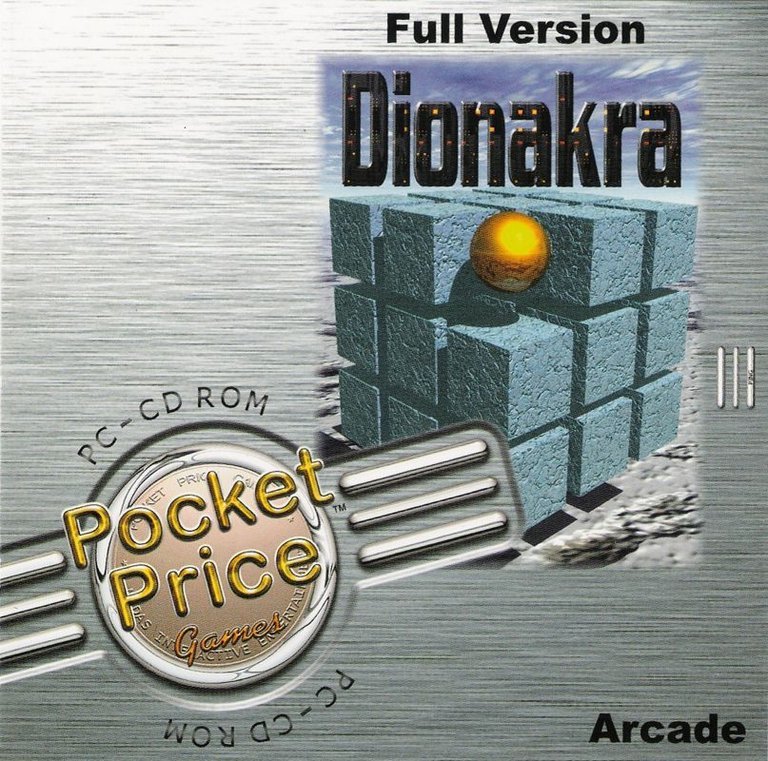
Dionakra is a sci-fi-themed Breakout clone where players control a paddle to bounce a ball and destroy space crystals in 50 levels. As Tony, the galactic dustbin man, you must clear each stage while collecting power-ups that alter paddle size, ball speed, or add weapons like lasers. The game features unique level backgrounds, animated effects, and a password system to unlock later stages, blending classic arcade action with futuristic visuals.
Gameplay Videos
Dionakra Free Download
Dionakra Guides & Walkthroughs
Dionakra Reviews & Reception
mobygames.com (58/100): Very neatly made!
retro-replay.com : Dionakra builds upon the classic Breakout formula with tight, responsive controls that make guiding Tony’s pad feel precise and intuitive.
Dionakra Cheats & Codes
PC
Enter level passwords at the main menu.
| Code | Effect |
|---|---|
| FIRST | Unlocks Level 1 |
| PADDLE | Unlocks Level 2 |
| CAVERN | Unlocks Level 3 |
| ASTEROID | Unlocks Level 4 |
| TEMPLE | Unlocks Level 5 |
| METEOR | Unlocks Level 6 |
| GLACIER | Unlocks Level 7 |
| PEAK | Unlocks Level 8 |
| VALLEY | Unlocks Level 9 |
| FANTASY | Unlocks Level 10 |
| TREASURE | Unlocks Level 11 |
| ISLAND | Unlocks Level 12 |
| TWISTER | Unlocks Level 13 |
| BUTTERFLY | Unlocks Level 14 |
| CANNON | Unlocks Level 15 |
| THUNDER | Unlocks Level 16 |
| LIGHTNING | Unlocks Level 17 |
| OCEAN | Unlocks Level 18 |
| TERRAIN | Unlocks Level 19 |
| OAK | Unlocks Level 20 |
| FORGE | Unlocks Level 21 |
| CASTLE | Unlocks Level 22 |
| TOMB | Unlocks Level 23 |
| WATERFALL | Unlocks Level 24 |
| POTION | Unlocks Level 25 |
| MAGIC | Unlocks Level 26 |
| STABLE | Unlocks Level 27 |
| HEAVEN | Unlocks Level 28 |
| FORCE | Unlocks Level 29 |
| ARMORY | Unlocks Level 30 |
| CLIFF | Unlocks Level 31 |
| TIDE | Unlocks Level 32 |
| SNOWCAP | Unlocks Level 33 |
| JUNGLE | Unlocks Level 34 |
| SERPENT | Unlocks Level 35 |
| AIRCRAFT | Unlocks Level 36 |
| POWDER | Unlocks Level 37 |
| COMPASS | Unlocks Level 38 |
| ARROW | Unlocks Level 39 |
| CORE | Unlocks Level 40 |
| REACTOR | Unlocks Level 41 |
| GRAVEYARD | Unlocks Level 42 |
| WATERHOLE | Unlocks Level 43 |
| SPEEDBOAT | Unlocks Level 44 |
| BEACH | Unlocks Level 45 |
| SILVER | Unlocks Level 46 |
| AMNESIA | Unlocks Level 47 |
| METAPHOR | Unlocks Level 48 |
| CHAMBER | Unlocks Level 49 |
| JUDGEMENT | Unlocks Level 50 |
Dionakra: A Cosmic Cleanup of Classic Breakout
Introduction
In the vast cosmos of arcade gaming, few titles manage to carve out a niche as distinctly as Dionakra. Released in 1998 by BWM Software GmbH and published by Prism Leisure Corporation Plc and Midas Interactive Entertainment Ltd., Dionakra is an enhanced clone of the classic Breakout formula, infused with a whimsical sci-fi twist. This game invites players to step into the boots of Tony, the galactic dustbin man, tasked with cleaning up scattered space crystals left behind by interstellar mining operations. While it may not have achieved the commercial success of its contemporaries, Dionakra stands as a testament to the enduring appeal of simple yet addictive gameplay mechanics, wrapped in a charming narrative and polished presentation.
Development History & Context
Dionakra emerged during a period when the gaming landscape was rapidly evolving. The late 1990s saw the rise of 3D graphics and complex narratives, yet there remained a steadfast appreciation for the simplicity and immediacy of arcade-style games. BWM Software GmbH, a relatively small studio, recognized this niche and sought to create a game that honored the legacy of Breakout and Arkanoid while introducing modern enhancements.
The development team, led by Klaus Hartmann, Ralf Schneider, Roland M., and Michael Rasche, aimed to create a game that was accessible yet engaging. The technological constraints of the era meant that the game had to be optimized for lower-end hardware, ensuring a steady frame rate and responsive controls. The result was a game that ran smoothly on Windows 95 and later systems, with minimal system requirements that made it accessible to a broad audience.
Dionakra was part of a series that included Rapanui (1998) and Crystal Hammer (2000), all of which were variations on the Breakout theme. This series was part of the broader “Pocket Price Games” releases, which aimed to provide affordable, high-quality gaming experiences.
Narrative & Thematic Deep Dive
At its core, Dionakra is a game about cleaning up space debris, a premise that is both humorous and oddly compelling. Players assume the role of Tony, the galactic dustbin man, who must clear 50 levels of space crystals. The narrative is lighthearted, with brief interludes between levels presented as pixelated comic-book panels. These vignettes offer humorous commentary from Tony as he navigates space debris, encounters cosmic hazards, and marvels at bizarre alien artifacts.
The story doesn’t strive for deep character development but provides just enough flavor to differentiate Dionakra from pure clones. Tony’s offbeat quips and the escalating “hazard reports” read like log entries from a space sanitation fleet, reinforcing the notion that cleaning up the cosmos can be both perilous and oddly gratifying. This playful narrative backdrop adds charm without bogging down the action, striking the right balance between function and fun.
Gameplay Mechanics & Systems
Dionakra builds upon the classic Breakout formula with tight, responsive controls that make guiding Tony’s pad feel precise and intuitive. The core gameplay loop involves using a paddle at the bottom of the screen to ricochet a bouncing ball into bricks (space crystals) at the top of the playfield. Once all the bricks are destroyed, the player advances to the next level.
The game introduces a variety of power-ups and penalties that keep the gameplay loop fresh throughout all 50 levels. These include:
- Paddle and Ball Size Changes: Power-ups can enlarge or shrink the paddle and ball, affecting the player’s ability to control the ball.
- Multi-Ball Mayhem: Increases the number of balls in play, testing the player’s multitasking skills.
- Ball Speed Adjustments: Power-ups can slow down or speed up the ball, adding an element of risk and strategy.
- Laser Gun: Allows the player to mow down rows of crystals.
- Explosive Rounds: Makes the ball explosive, causing chain reactions on impact.
Negative items, such as shrinking pads or accelerated balls, add an element of risk, turning even early-stage levels into tense, nail-biting affairs if the player isn’t paying attention.
The level design in Dionakra excels at gradually ramping up difficulty without feeling unfair. Early stages introduce basic block layouts and simple power-ups, while later levels challenge players with intricate patterns, indestructible barriers, and rapid-fire sequences that demand split-second reflexes. The inclusion of a password system to resume play is a welcome nod to retro gaming, letting players tackle tougher stages at their own pace.
With an initial stock of lives that feels generous but not endless, Dionakra encourages skill improvement rather than brute-forcing through levels. Losing a life after a misstep stings, but the game’s reward curve—new power-ups, eye-catching level themes, and incremental challenges—keeps players motivated to dive back in and clear every last crystal.
World-Building, Art & Sound
Dionakra’s visual style pays homage to the neon-lit arcades of the ’80s while injecting a modern sheen. Each brick type—ranging from fragile shards to mighty crystalline columns—is rendered with crisp textures and subtle animations that highlight hits, cracks, and explosions. The dynamic lighting effects, especially during power-up activation, add a burst of color that keeps the screen lively even during marathon sessions.
The backgrounds shift across themed zones—floating asteroid fields, crystalline nebulae, and derelict space stations—providing a sense of progression and variety. While the action remains focused on the pad and ball at the bottom of the screen, these scenic backdrops offer visual relief and help distinguish one set of ten levels from the next. Parallax scrolling layers impart depth, making the playfield feel more than just a static grid.
Particle effects from exploding blocks, laser beams cutting through the void, and the multi-ball trails are handled cleanly, without obscuring the critical action. Even on lower-end hardware, Dionakra maintains a steady frame rate, ensuring no dropped frames interfere with split-second paddle movements. The UI is minimalist yet informative, displaying scores, remaining lives, and active power-up icons without cluttering the main viewport.
Sound design complements the graphics with retro-inspired chiptune melodies and satisfying impact noises. Each brick collision emits a distinct tone, giving auditory feedback that helps players track multiple balls during hectic moments. The combination of visuals and audio crafts an immersive package that harkens back to arcade glory days while feeling polished enough for modern players.
Reception & Legacy
Upon its release, Dionakra received mixed reviews from critics. Gameguru Mania gave it a score of 60%, praising its similarities to Arkanoid but noting its lack of innovation. Bravo Screenfun also scored it 60%, describing it as a classic Breakout variant with nice extras but uninspiring graphics. PC Player (Germany) gave it a 55%, acknowledging its addictive nature but criticizing its short playtime.
Despite these mixed reviews, Dionakra has garnered a dedicated fan base over the years. Its unique blend of storytelling, art, and challenging gameplay has carved a lasting legacy within the gaming sphere. Players who venture into the world of Dionakra often emerge with a sense of nostalgia, recalling the ingenious puzzles and delightful surprises that awaited them on their journey.
Conclusion
Dionakra delivers a compelling Arkanoid-style package that blends classic Breakout mechanics with modern enhancements. Its 50 levels of escalating challenge, diverse power-ups, and thoughtful level design ensure that the core gameplay loop remains eternally engaging. Whether replaying earlier stages to master tricky patterns or forging ahead to uncover new crystal formations, the sense of accomplishment is consistently satisfying.
The audiovisual presentation elevates the experience without overshadowing the fundamentals. Clean graphics, vibrant particle effects, and a driving chiptune soundtrack create an atmosphere that’s both nostalgic and refreshingly polished. Even as the difficulty curve ramps up, the responsive controls and clear visual cues keep frustration at bay, allowing players to focus on honing their reflexes.
Dionakra’s playful story adds just enough narrative spice to give context to the crystal-smashing missions. Tony’s galactic tidying adventures may not redefine video game storytelling, but they inject warmth and humor into an intensely kinetic gameplay loop. The password system and checkpoint structure respect the player’s time, making it easy to pick up and play whenever the mood strikes.
All in all, Dionakra stands out among Breakout clones by delivering a finely tuned blend of mechanics, aesthetics, and personality. It’s a must-have for fans of classic arcade action and a delightful discovery for newcomers eager for fast-paced, brick-blasting thrills. Strap in, grab the pad, and prepare for a cosmic cleaning spree unlike any other.