
- Release Year: 2002
- Platforms: Windows
- Publisher: Infogrames do Brasil Ltda., Infogrames Europe SA, Infogrames, Inc., Sold Out Sales & Marketing Ltd.
- Developer: Kamehan Studios
- Genre: Action, Tactical shooter
- Perspective: 1st-person
- Game Mode: LAN, Online PVP, Single-player
- Gameplay: Objective-based, Shooter, Team-based
- Setting: Anti-terrorism, Military, Modern
- Average Score: 65/100
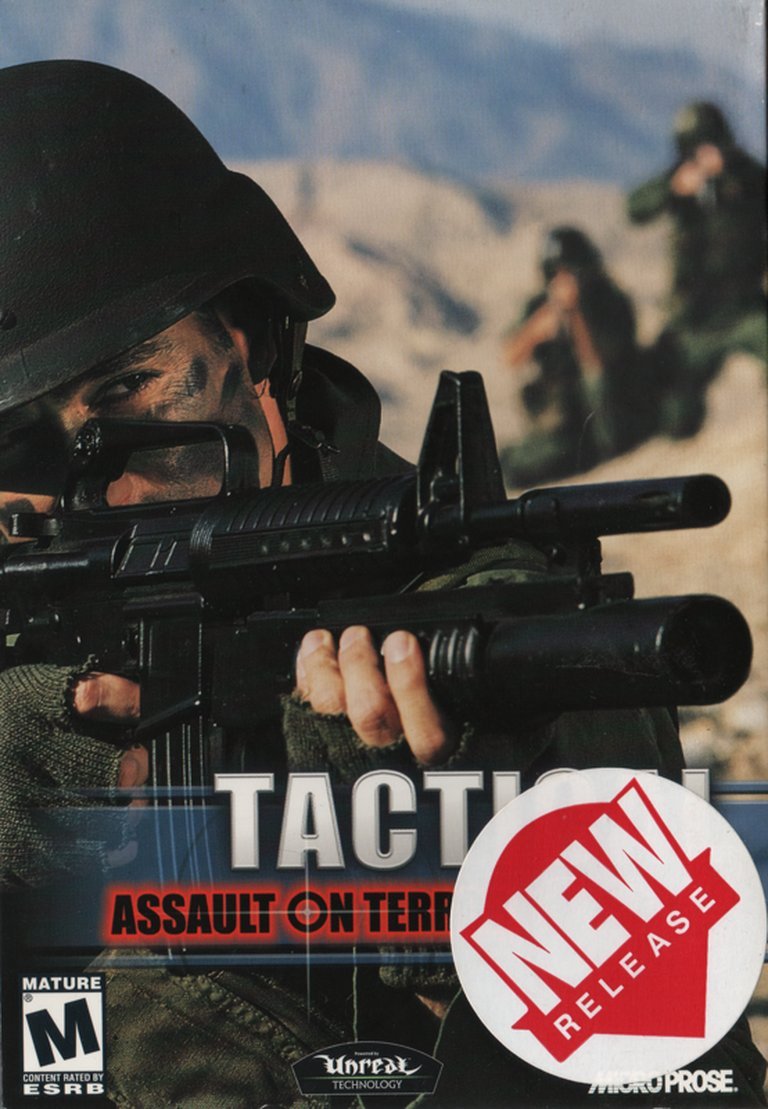
Description
Tactical Ops: Assault on Terror is a team-based tactical shooter where players assume the roles of terrorists or anti-terrorist forces, engaging in objective-driven missions such as hostage rescues and hideout captures. Originally a mod for Unreal Tournament, the standalone game features over 30 maps, 20 real-world weapons, and detailed character models, offering both single-player and multiplayer modes with support for up to 32 players online.
Gameplay Videos
Tactical Ops: Assault on Terror Free Download
Tactical Ops: Assault on Terror Cracks & Fixes
Tactical Ops: Assault on Terror Patches & Updates
Tactical Ops: Assault on Terror Mods
Tactical Ops: Assault on Terror Guides & Walkthroughs
Tactical Ops: Assault on Terror Reviews & Reception
metacritic.com (84/100): Ultra-Violent shooter with lots of memories.
en.wikipedia.org (57/100): Tactical Ops received mixed to average reviews, with critics faulting the game’s similarities to the non-commercial version and lack of defining features compared to other multiplayer first-person shooters.
ign.com (56/100): TACTICAL OPS: ASSAULT ON TERROR is a semi-realistic game in which you can choose to play as a member of Special Forces or as a Terrorist.
oldpcgaming.net : Tactical Ops is the most unsubtle rip-off of Counter-Strike, with the obvious difference that it’s powered by the Unreal Engine instead of the Half-Life engine.
Tactical Ops: Assault on Terror Cheats & Codes
PC
Press the tilde key [~] to bring up the console and enter the following codes:
| Code | Effect |
|---|---|
| iamtheone | Enable cheats |
| god | God mode |
| fly | Flight mode |
| ghost | Ghost mode |
| walk | Disable fly mode |
| suicide | Suicide |
| invisible 1 | Invisibility |
| invisible 0 | Disable Invisibility |
| behindview 0 | 1st person view |
| behindview 1 | 3rd person view |
| slomo | Slow motion |
| slomo 1 | Disable slow motion |
| playersonly | Disable AI |
Tactical Ops: Assault on Terror: A Retrospective Analysis of a Forgotten Tactical Shooter
Introduction: The Rise and Fall of a Counter-Strike Challenger
In the early 2000s, the tactical first-person shooter genre was dominated by Counter-Strike, a mod-turned-standalone phenomenon that redefined competitive multiplayer gaming. Amid this landscape, Tactical Ops: Assault on Terror (2002) emerged as a bold contender, seeking to carve its niche by leveraging the Unreal Engine’s prowess and offering a distinct flavor of team-based combat. Developed by Kamehan Studios and published by Infogrames under the MicroProse banner, Tactical Ops was a commercial adaptation of a popular Unreal Tournament mod, a transition that would ultimately define both its strengths and its shortcomings.
This review delves deep into Tactical Ops: Assault on Terror, examining its development history, gameplay mechanics, narrative context, and lasting legacy. Through a critical lens, we explore why this game, despite its ambitions, remains a footnote in gaming history—a cautionary tale of timing, market saturation, and the challenges of monetizing mod culture.
Development History & Context: From Mod to Market
The Modding Origins
Tactical Ops began its life in 1999 as SWAT, a fan-made modification for Unreal Tournament (1999). Developed by Paris-based Kamehan Studios, led by programmer Laurent Delayen, the mod aimed to replicate the tactical, objective-driven gameplay of Counter-Strike within Epic Games’ Unreal Engine. By 2000, the mod had evolved into Tactical Ops, gaining a dedicated following for its realistic weapon handling, diverse maps, and team-based mechanics.
The mod’s success caught the attention of Infogrames, which saw an opportunity to capitalize on the burgeoning tactical shooter market. In 2002, Infogrames secured a publishing deal to release Tactical Ops as a standalone retail title, commissioning Kamehan Studios to expand the mod with a single-player campaign and additional content. This transition from free mod to commercial product was fraught with challenges, as the development team—comprising over 50 designers, programmers, and testers—rushed to meet Infogrames’ deadlines.
Technological Constraints and Market Saturation
The early 2000s were a pivotal era for first-person shooters. Counter-Strike had already cemented its dominance, while Global Operations (2002) and America’s Army (2002) were vying for attention. Tactical Ops entered this crowded arena with the Unreal Engine 1, a powerful but aging framework by 2002 standards. While the engine allowed for vibrant visuals and fluid gameplay, it also imposed limitations on the game’s physics and AI, particularly in the single-player mode.
Delayen later admitted that the rushed development cycle prevented the team from implementing “deep and complex” scenarios, forcing them to rely on bot-driven simulations of the multiplayer experience. This compromise would become one of the game’s most criticized aspects.
Narrative & Thematic Deep Dive: A Thin Veneer of Realism
Plot and Setting
Tactical Ops eschews a traditional campaign narrative in favor of a series of disconnected, objective-based missions. Players assume the role of either Special Forces operatives or terrorists, engaging in asymmetrical warfare across 30+ maps. The game’s scenarios—hostage rescues, bomb defusals, and VIP extractions—are lifted directly from the Counter-Strike playbook, with little innovation in mission design.
Thematically, Tactical Ops leans heavily into the post-9/11 zeitgeist, framing its conflict as a battle between lawful authority and anarchic terrorism. However, the game’s lack of narrative depth or character development renders its themes superficial. Unlike Counter-Strike, which at least attempted to ground its factions in recognizable archetypes (e.g., SAS vs. terrorists), Tactical Ops offers no backstory for its combatants, reducing them to faceless avatars in a digital warzone.
Dialogue and Atmosphere
The game’s dialogue is minimal, limited to radio chatter and bot commands. The voice acting, while serviceable, lacks the polish of contemporaries like Rainbow Six: Rogue Spear (1999). The ambient sound design, however, is a standout feature. Gunfire echoes realistically, and the screams of wounded hostages add a visceral layer to the gameplay. The soundtrack, composed of tense, synth-driven tracks, reinforces the game’s high-stakes atmosphere, though it occasionally veers into generic action-movie territory.
Gameplay Mechanics & Systems: A Mixed Bag of Innovation and Repetition
Core Gameplay Loop
Tactical Ops adheres closely to the Counter-Strike formula: players earn in-game currency by completing objectives or eliminating enemies, which they then use to purchase weapons and equipment between rounds. The game’s economy system is one of its few innovations. Unlike Counter-Strike, where cash is awarded instantly upon killing an enemy, Tactical Ops requires players to physically loot corpses to collect money. This mechanic discourages camping and encourages aggressive play, as players must risk exposure to retrieve funds.
The game’s weapon arsenal is another highlight. With over 20 real-world firearms—including an M16 with an underslung grenade launcher and a Russian automatic shotgun—the loadout options feel more varied than Counter-Strike’s. Each weapon has distinct handling characteristics, and the game’s damage model emphasizes realism, with headshots and armor penetration playing critical roles in firefights.
Multiplayer: The Heart of the Experience
Tactical Ops shines in its multiplayer mode, supporting up to 32 players across LAN and internet connections. The maps, ranging from claustrophobic urban environments to sprawling military bases, are well-designed, with multiple paths to objectives and strategic choke points. The game’s netcode is stable, and the community-driven modding scene added longevity with custom maps and game modes.
However, the multiplayer experience is marred by the same issues that plagued early online shooters: toxic behavior, team-killing, and unbalanced matches. The lack of a robust matchmaking system means that players often encountered mismatched skill levels, leading to frustration.
Single-Player: A Missed Opportunity
The single-player campaign is Tactical Ops’ most glaring weakness. The AI bots, while functional, exhibit predictable behavior, often charging blindly into gunfire or failing to react to threats. Their pathfinding is rudimentary, with bots frequently getting stuck on geometry or ignoring tactical advantages. The missions themselves are repetitive, with little variation in objectives or enemy placement.
The game’s attempt to simulate a multiplayer experience with bots falls flat, as the AI lacks the adaptability and cunning of human opponents. This flaw underscores the game’s identity crisis: it was designed as a multiplayer experience but forced to include a single-player mode to justify its retail price.
UI and Progression
The user interface is a direct carryover from Unreal Tournament, featuring a Windows-like menu system that, while functional, feels dated by 2002 standards. The HUD is clean but unremarkable, with health, ammo, and objective markers displayed in a straightforward manner. The game’s progression system is tied to its economic model, with no persistent unlocks or character customization—a missed opportunity to differentiate itself from Counter-Strike.
World-Building, Art & Sound: A Study in Contrasts
Visual Design
Tactical Ops benefits from the Unreal Engine’s advanced lighting and texturing capabilities. The maps are detailed, with convincing environmental storytelling—rusted metal, shattered glass, and blood splatters add immersion. Character models, however, are less impressive. The player skins are detailed but lack animation fluidity, with stiff movements and limited facial expressions.
The game’s art direction leans into a gritty, realistic aesthetic, though it occasionally strays into the uncanny valley. The lack of dynamic lighting or advanced shaders (features that would later define Unreal Tournament 2003) makes the visuals feel static compared to contemporaries like Far Cry (2004).
Sound Design
The sound design is one of Tactical Ops’ strongest elements. Weapon sounds are punchy and distinct, with each firearm having a unique audio profile. The ambient noise—distant gunfire, hostage whimpers, and environmental echoes—creates a tense atmosphere. The voice acting, while limited, is clear and functional, though the bots’ repetitive callouts grow tiresome over time.
The soundtrack, composed of synth-heavy tracks, complements the game’s high-stakes action but lacks memorability. Unlike Counter-Strike’s minimalist approach, Tactical Ops attempts to heighten tension with music, though the result is often more distracting than immersive.
Reception & Legacy: A Game Caught in the Shadows
Critical Reception
Tactical Ops received mixed reviews upon release, with critics praising its multiplayer depth but lambasting its single-player shortcomings. Aggregated scores placed it firmly in the “average” range, with Metacritic assigning a 57/100 based on 12 critic reviews. German publications like GameStar (87%) and PC Games (82%) lauded its visuals and weapon variety, while Western outlets like IGN (56%) and Computer Gaming World (50%) dismissed it as a Counter-Strike clone.
The most common criticisms included:
– Lack of Innovation: Critics argued that Tactical Ops offered little beyond its inspiration, with GameSpy noting that it “doesn’t capture the feeling of teamwork and excitement” that Counter-Strike delivered.
– Poor AI: The single-player bots were universally panned for their predictable behavior and lack of tactical awareness.
– Questionable Monetization: Many reviewers questioned the wisdom of charging for a mod, with PC Zone stating, “To pay for what is essentially a free mod seems like madness.”
Commercial Performance and Community
Despite its lukewarm reception, Tactical Ops found a niche audience, particularly in Europe, where it briefly entered the top 10 sales charts in Germany. The game’s modding community kept it alive post-launch, with custom maps and game modes extending its lifespan. However, it never achieved the cultural ubiquity of Counter-Strike, and its player base dwindled as newer shooters like Call of Duty (2003) and Battlefield 1942 (2002) took center stage.
Influence and Legacy
Tactical Ops’ legacy is one of missed potential. It demonstrated that the Unreal Engine could support a tactical shooter, paving the way for later titles like America’s Army and SWAT 4 (2005). However, its failure to innovate beyond Counter-Strike’s formula relegated it to obscurity.
The game’s development history also serves as a case study in the challenges of commercializing mod culture. While Counter-Strike succeeded as a standalone product due to its unique identity and Valve’s support, Tactical Ops struggled to justify its existence beyond its mod roots. This lesson would later inform the industry’s approach to mod monetization, with titles like Day of Defeat (2003) and Team Fortress 2 (2007) offering more substantial single-player experiences.
Conclusion: A Flawed but Fascinating Footnote
Tactical Ops: Assault on Terror is a game of contradictions. It boasts a robust multiplayer experience and a diverse arsenal but is hamstrung by its rushed development and lack of innovation. Its visuals and sound design are impressive for their time, yet its AI and single-player content feel half-baked. In the shadow of Counter-Strike, Tactical Ops struggled to find its voice, ultimately fading into obscurity.
Yet, for those who experienced it, Tactical Ops holds a nostalgic charm. Its fast-paced gameplay, varied maps, and community-driven modding scene offered a unique flavor of tactical combat. While it may not have changed the genre, it remains a fascinating artifact of early 2000s FPS design—a reminder of the risks and rewards of turning mod passion into commercial ambition.
Final Verdict: 6.5/10 – A competent but forgettable entry in the tactical shooter genre, best remembered as a Counter-Strike also-ran.
For modern players, Tactical Ops is a curiosity worth exploring for its historical significance, but its flaws are too glaring to recommend it over its contemporaries. If you’re a fan of retro shooters or modding culture, it’s a worthy time capsule. For everyone else, it’s a cautionary tale of what happens when ambition outpaces execution.