
- Release Year: 1998
- Platforms: DOS, Windows
- Publisher: Digital Integration Ltd.
- Developer: Digital Integration Ltd.
- Genre: Compilation
- Perspective: First-person
- Game Mode: Single-player
- Gameplay: Flight Simulation
- Setting: Modern military
- Average Score: 65/100
Description
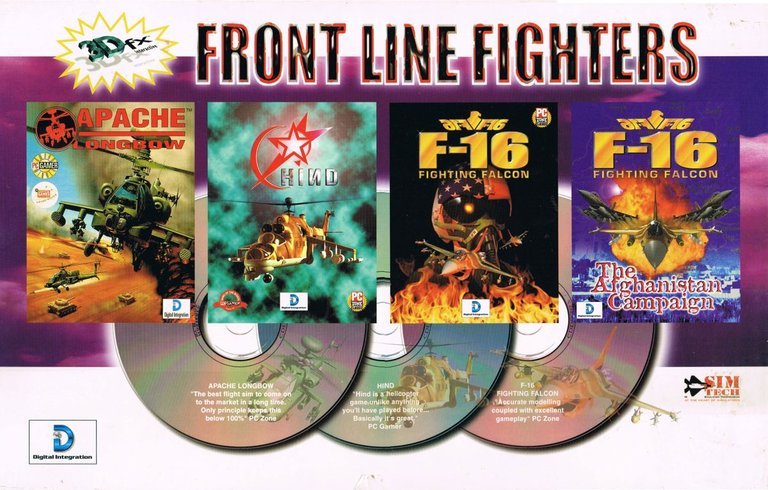
Front Line Fighters is a compilation of three updated flight simulations from Digital Integration, including Apache, Hind: The Russian Combat Helicopter Simulation, and F-16 Fighting Falcon, along with its Afghanistan Campaign add-on. Released in 1998 for Windows and DOS, the bundle features enhanced terrain, textured maps, and support for 3Dfx accelerator cards, with improved visual effects like clouds and fog in the helicopter simulations. This collection offers a comprehensive experience for combat flight enthusiasts, combining realistic gameplay with upgraded graphics for an immersive military aviation experience.
Where to Buy Front Line Fighters
PC
Front Line Fighters Patches & Updates
Front Line Fighters Reviews & Reception
mobygames.com (79/100): A compilation of three flight simulations with improved terrain and textured maps.
videogamegeek.com (62.5/100): The rather large Front Line Fighters box contains 3 simulators, each of which can be customized from very realistic to practically arcade mode.
vgtimes.com (55/100): A first-person simulator with a mixture of action, flight simulator and helicopter simulator.
Front Line Fighters Cheats & Codes
Nintendo (NES)
| Code | Effect |
|---|---|
| OUPIPE | Invincibility |
| 0025:01 | Invincible |
| 002F:0B+0030:E3+003B:17+003C:E3 | Start As Tank |
| LEVKGGPZ | Infinite Lives |
Front Line Fighters: A Comprehensive Retrospective on a Classic Flight Sim Compilation
Introduction: The Golden Age of Flight Simulations
In the late 1990s, the flight simulation genre was at a crossroads. The rise of 3D acceleration cards like the 3Dfx Voodoo series was revolutionizing visual fidelity, while developers struggled to balance realism with accessibility. Amid this evolution, Front Line Fighters (1998) emerged as a bold statement—a compilation that bundled three of Digital Integration’s most celebrated military flight simulators into a single, updated package. More than just a re-release, it was a testament to the studio’s commitment to refining its craft, offering players a chance to experience Apache, HIND: The Russian Combat Helicopter Simulation, and F-16 Fighting Falcon (complete with its Afghanistan Campaign expansion) with enhanced graphics, improved terrain, and new atmospheric effects.
For flight sim enthusiasts, Front Line Fighters was a dream come true: a curated collection of some of the most respected combat flight titles of the era, all optimized for the cutting-edge hardware of the time. But beyond its technical merits, the compilation also served as a snapshot of the genre’s evolution, capturing the tension between arcade-style action and hardcore simulation. This review will dissect Front Line Fighters in exhaustive detail, exploring its development, gameplay, narrative context, and lasting legacy.
Development History & Context: Digital Integration’s Flight Sim Legacy
The Studio Behind the Sims
Digital Integration Ltd., a British developer founded in the early 1990s, carved a niche for itself in the flight simulation market with a focus on military aircraft. Unlike competitors such as Jane’s Combat Simulations or MicroProse, Digital Integration prioritized a balance between accessibility and depth, making their titles appealing to both casual players and hardcore sim fans. Their earlier works, including Tornado: Operation Desert Storm (1993) and F-16 Fighting Falcon (1995), were praised for their robust flight models and mission variety, though they often lagged behind in graphical polish.
By the mid-1990s, the flight sim landscape was dominated by two trends:
1. The Rise of 3D Acceleration: Games like Flight Unlimited (1995) and EF2000 (1997) showcased the potential of hardware-accelerated graphics, setting new standards for visual realism.
2. The Shift Toward Dynamic Campaigns: Titles such as Jane’s Longbow 2 (1997) introduced dynamic mission structures, where player actions influenced the broader conflict.
Digital Integration, however, remained committed to a more structured, mission-based approach. Their games were known for:
– Detailed Flight Models: Accurate physics that rewarded mastery of each aircraft’s unique handling.
– Mission Editors: Tools that allowed players to craft custom scenarios, extending replayability.
– Multiplayer Support: Networked dogfights and cooperative missions, a rarity in the genre at the time.
The Birth of Front Line Fighters
Front Line Fighters was conceived as both a celebration of Digital Integration’s back catalog and a response to the growing demand for updated visuals. The compilation included:
– Apache (1995) – A simulation of the AH-64 Apache attack helicopter.
– HIND: The Russian Combat Helicopter Simulation (1996) – Focused on the Mil Mi-24 Hind, a heavily armored Soviet gunship.
– F-16 Fighting Falcon (1997) – A jet fighter sim with a strong emphasis on air-to-air combat.
– F-16 Fighting Falcon: The Afghanistan Campaign (1997) – An expansion adding new missions and terrain.
The key selling point was the 3Dfx acceleration support, which brought:
– Textured Terrain: Replacing the flat, monochrome landscapes of the original releases with detailed, varied environments.
– Volumetric Clouds and Fog: Dynamic weather effects that not only enhanced immersion but also added tactical depth (e.g., using fog for cover).
– Improved Draw Distances: Allowing players to spot enemies and landmarks from greater distances.
The compilation was also a strategic move. By bundling three full games and an expansion, Digital Integration offered exceptional value—something increasingly rare in an era where publishers were shifting toward standalone, premium-priced titles.
Technological Constraints and Innovations
The late 1990s were a time of rapid hardware evolution. Front Line Fighters was designed to run on systems with:
– Minimum Requirements: A Pentium processor, 16MB of RAM, and DOS 5.0 or Windows 95.
– Recommended Setup: A 3Dfx Voodoo card (or equivalent) for optimal performance.
While these specs seem quaint by modern standards, they were cutting-edge at the time. The inclusion of Glide API support (3Dfx’s proprietary graphics library) ensured that players with Voodoo cards could experience smooth frame rates and enhanced visuals. However, the game’s reliance on 3Dfx also meant that those without compatible hardware would miss out on its most significant improvements—a limitation that would later be criticized.
Narrative & Thematic Deep Dive: War Without Words
Flight simulators, by their nature, are not story-driven experiences. Unlike RPGs or adventure games, they rarely feature cinematic cutscenes, voice acting, or branching narratives. Instead, Front Line Fighters tells its stories through:
– Mission Briefings: Text-based summaries that set the stage for each sortie.
– Geopolitical Context: The scenarios are grounded in real-world conflicts (e.g., the Afghanistan Campaign’s counterterrorism missions).
– Atmospheric Immersion: The tension of flying through a fog-shrouded valley, the adrenaline of a dogfight, or the satisfaction of a precision strike.
Apache: The Lone Gunship
Apache casts the player as a pilot in a fictional border conflict, where insurgent forces threaten civilian populations. The missions are structured around:
– Reconnaissance: Scouting enemy positions while avoiding detection.
– Escort Duties: Protecting friendly convoys from ambushes.
– Precision Strikes: Targeting SAM sites and armored columns with Hellfire missiles.
The narrative is minimal but effective. The briefings, accompanied by grayscale photographs, evoke the tension of asymmetrical warfare. There’s no overarching plot, but the progression from low-risk patrols to high-stakes assaults creates a natural sense of escalation.
HIND: The Soviet Behemoth
HIND places the player in the role of a Soviet pilot during a civil war, with objectives ranging from:
– Insertion/Extraction: Transporting troops under fire.
– Close Air Support (CAS): Providing cover for ground forces.
– Deep Penetration Raids: Destroying enemy strongholds behind front lines.
The Hind’s rugged design (it’s often called a “flying tank”) is reflected in the mission structure. Unlike the Apache, which relies on stealth and precision, the Hind thrives in direct engagements, using its heavy armor and firepower to overwhelm opponents. The narrative here is more about brute force than finesse, reinforcing the helicopter’s reputation as a relentless war machine.
F-16 Fighting Falcon: From Dogfights to Counterterrorism
The F-16 titles offer a stark contrast to the helicopter sims. The base game focuses on:
– Air Superiority: Engaging in dogfights against MiGs and Sukhois.
– Gunnery Drills: Practicing weapon systems in controlled environments.
The Afghanistan Campaign expansion, however, shifts the focus to:
– Asymmetrical Warfare: Striking Taliban strongholds, escorting convoys, and conducting SEAD (Suppression of Enemy Air Defenses) missions.
– Tactical Complexity: The Afghanistan terrain, with its narrow canyons and rugged mountains, forces players to adapt their strategies.
The briefings in the Afghanistan Campaign are particularly noteworthy for their attempt to ground the missions in real-world military operations. While the storytelling is still minimal, the scenarios feel more “authentic” than the generic conflicts of earlier flight sims.
Themes: The Reality of Combat
Front Line Fighters doesn’t delve into the moral complexities of war, but it does convey the isolation and tension of aerial combat. The lack of voice acting or cinematic sequences means that the player’s experience is defined by:
– The Sound of War: The roar of engines, the crackle of radio chatter, the explosion of ordnance.
– The Weight of Responsibility: Knowing that a missed shot or poor maneuver could mean failure (or worse, in multiplayer, the loss of a teammate).
– The Thrill of Mastery: The satisfaction of executing a perfect nap-of-the-earth flight in an Apache or outmaneuvering an enemy fighter in an F-16.
In this sense, Front Line Fighters is less about telling a story and more about creating an experience—one that immerses the player in the high-stakes world of military aviation.
Gameplay Mechanics & Systems: A Masterclass in Flight Simulation
Core Gameplay Loops
Each title in Front Line Fighters follows a similar structure:
1. Mission Selection: Choose from pre-designed sorties or create custom missions using the built-in editor.
2. Briefing: Review objectives, loadouts, and rules of engagement.
3. Flight: Execute the mission, balancing speed, altitude, and weapon management.
4. Debriefing: Analyze performance, with feedback on accuracy, damage taken, and mission success.
The compilation’s strength lies in its variety:
– Helicopter Sims (Apache and HIND): Emphasize low-altitude flight, hover control, and precision targeting.
– Jet Sim (F-16): Focus on high-speed dogfights, afterburner management, and beyond-visual-range (BVR) combat.
Flight Models: Realism vs. Accessibility
Digital Integration’s flight models were praised for their balance between realism and playability:
– Apache: The helicopter’s weight and rotor physics are convincingly modeled, requiring careful collective and throttle adjustments. Nap-of-the-earth (NOE) flying—skimming just above terrain to avoid radar—is both challenging and rewarding.
– HIND: The Mi-24’s bulk is reflected in its slower, more deliberate handling. It’s less agile than the Apache but far more durable, encouraging a “tank-like” playstyle.
– F-16: The jet’s aerodynamics are faithfully recreated, with realistic stall behavior, G-force effects, and afterburner mechanics. Dogfights demand precise energy management (e.g., trading speed for altitude).
The games offer adjustable difficulty settings, allowing players to toggle features like:
– Autopilot Assistance: Helps maintain altitude and heading.
– Weapon Steering: Simplifies missile targeting.
– Damage Modeling: From “arcade” (invincibility) to “realistic” (one hit can be fatal).
This flexibility made Front Line Fighters accessible to newcomers while still appealing to hardcore sim fans.
Combat Systems: Weapons and Tactics
Each aircraft has a distinct arsenal:
– Apache:
– Hellfire Missiles: Laser-guided, ideal for precision strikes.
– Hydra Rockets: Unguided, effective against soft targets.
– 30mm Chain Gun: Devastating at close range but requires careful aiming.
– HIND:
– AT-6 Spiral Missiles: Wire-guided anti-tank weapons.
– S-5 Rockets: High-explosive, area-effect munitions.
– GSh-23L Cannon: A rapid-fire autocannon for strafing runs.
– F-16:
– AIM-9 Sidewinder: Heat-seeking missiles for dogfights.
– AIM-120 AMRAAM: Radar-guided, long-range engagement.
– M61 Vulcan: A 20mm rotary cannon for close-quarters combat.
The weapon systems are deeply integrated into the gameplay:
– Lock-On Mechanics: Requires maintaining a steady aim for missile guidance.
– Countermeasures: Flares and chaff to evade enemy missiles.
– Loadout Customization: Players can tailor their aircraft’s weapons to the mission (e.g., more missiles for air-to-air, more rockets for ground attacks).
Multiplayer: The Ultimate Test
Front Line Fighters supported networked multiplayer, a feature that was still relatively rare in flight sims at the time. Players could engage in:
– Dogfights: One-on-one or team-based air combat.
– Cooperative Missions: Coordinated strikes against AI-controlled enemies.
– Helicopter vs. Jet Battles: A unique dynamic, as the slower but more maneuverable choppers faced off against faster, more fragile jets.
The multiplayer mode was a standout feature, offering a level of replayability that single-player missions couldn’t match. However, it was hampered by the technological limitations of the era—lag and connection issues were common, and the lack of dedicated servers meant that matches were often hosted peer-to-peer.
Mission Editors: A Sandbox for Creativity
One of Digital Integration’s hallmarks was its robust mission editors, and Front Line Fighters was no exception. Players could:
– Design Custom Maps: Place waypoints, enemy units, and objectives.
– Adjust Weather and Time of Day: Fog, rain, and night missions added complexity.
– Script Events: Trigger reinforcements, ambushes, or dynamic objectives.
This feature extended the game’s lifespan significantly, allowing the community to create and share their own scenarios.
UI and Controls: A Mixed Bag
The user interface in Front Line Fighters was functional but dated:
– Cockpit Layouts: Detailed but cluttered, with small text that could be hard to read at lower resolutions.
– Menu Navigation: Intuitive but lacking the polish of later sims (e.g., Falcon 4.0).
– Control Schemes: Fully customizable, supporting joysticks, throttles, and rudder pedals.
The lack of voice acting in briefings and radio chatter was a notable omission, especially compared to contemporaries like Jane’s Longbow 2, which featured full voiceovers.
World-Building, Art & Sound: Crafting the Illusion of War
Visual Design: From Flat to Textured
The most significant upgrade in Front Line Fighters was its visual overhaul:
– Terrain: The original games featured flat, low-detail landscapes. The compilation introduced textured maps, with varied environments (deserts, forests, urban areas) that felt more alive.
– 3Dfx Support: Players with Voodoo cards enjoyed smoother frame rates, longer draw distances, and improved lighting.
– Weather Effects: Volumetric clouds and dynamic fog were added to Apache and HIND, creating a more immersive atmosphere. Flying through a fog bank at low altitude in the Hind, only to emerge into a hail of enemy fire, was a visceral experience.
However, the visuals were still held back by the era’s limitations:
– Low-Resolution Textures: Even with 3Dfx, textures appeared blurry by modern standards.
– Limited Polygon Counts: Aircraft and terrain models lacked the detail of later sims.
– Pop-In: Objects would sometimes appear suddenly as the player approached, breaking immersion.
Sound Design: The Symphony of War
The audio in Front Line Fighters was understated but effective:
– Engine Sounds: The roar of the Apache’s turbines, the whine of the F-16’s afterburner, and the thud of the Hind’s rotors were all faithfully recreated.
– Weapon Effects: Missiles whooshed, cannons rattled, and explosions boomed with satisfying weight.
– Radio Chatter: While not voice-acted, the text-based communications added to the realism.
The lack of a dynamic soundtrack was a missed opportunity. Unlike games like Ace Combat, which featured orchestral scores, Front Line Fighters relied entirely on ambient and mechanical sounds. This made the experience feel more “authentic” but less cinematic.
Atmosphere: The Tension of the Skies
The true strength of Front Line Fighters lay in its atmospheric immersion:
– The Isolation of Flight: The vast, open skies could feel lonely, especially in single-player missions.
– The Thrill of the Hunt: Spotting an enemy through the fog, locking onto a target, and firing a missile created moments of intense focus.
– The Fear of Failure: Running low on fuel, taking damage, or being outnumbered added a layer of tension that kept players on edge.
The Afghanistan Campaign stood out for its clausrophobic canyons and rugged terrain, which forced players to fly carefully or risk crashing into a mountainside. The dynamic weather effects (e.g., sandstorms reducing visibility) further heightened the realism.
Reception & Legacy: A Compilation Ahead of Its Time
Critical Reception: Praise with Reservations
Front Line Fighters received generally positive reviews, with critics praising its value and updated visuals but noting its limitations.
Positive Aspects:
– GameBlitz (85%): Called it “a necessary addition to the library of any combat simulation freak,” highlighting the improved graphics and mission variety.
– GameStar (Germany, 82%): Praised the helicopter sims (Apache and HIND) as “still first-class” even in the era of Longbow 2, though it criticized the lack of additional effects.
– PC Action (Germany, 80%): Recommended it as a “price-friendly collection of serious flight simulations.”
Criticisms:
– The Adrenaline Vault (70%): While acknowledging the value, it noted that the games were “hardly original” and that the updates were incremental rather than revolutionary.
– Lack of Dynamic Campaigns: Unlike Jane’s Longbow 2, which featured a dynamic mission structure, Front Line Fighters relied on scripted scenarios.
– 3Dfx Dependency: Players without a Voodoo card missed out on the most significant improvements.
Commercial Performance and Community Impact
Front Line Fighters was not a blockbuster, but it found a dedicated audience among flight sim enthusiasts. Its budget-friendly price (around $60 at launch) made it an attractive option for players looking to expand their libraries without breaking the bank.
The multiplayer community was particularly active, with players organizing dogfight tournaments and cooperative missions. However, the lack of official server support meant that the scene was fragmented, relying on third-party tools like Kali or direct IP connections.
Legacy: A Bridge Between Eras
Front Line Fighters occupies a unique place in flight sim history:
– A Transition Point: It represented the shift from 2D sprites to 3D-accelerated graphics, setting the stage for later titles like Falcon 4.0 and Lock On: Modern Air Combat.
– A Testament to Compilations: In an era where publishers were moving toward standalone releases, Front Line Fighters proved that well-curated bundles could still resonate with players.
– Influence on Later Sims: The mission editors and multiplayer modes in Front Line Fighters foreshadowed features that would become standard in later flight sims.
However, its lack of a dynamic campaign system and reliance on scripted missions meant that it was eventually overshadowed by more ambitious titles. By the early 2000s, games like Jane’s F/A-18 and IL-2 Sturmovik had raised the bar for realism and immersion, leaving Front Line Fighters as a respected but somewhat dated relic.
Conclusion: A Flawed but Essential Classic
Front Line Fighters is a time capsule of late-1990s flight simulation—a compilation that captured the best of Digital Integration’s work while pushing the boundaries of what was possible with the hardware of the era. Its strengths lie in:
– Exceptional Value: Four full games (three sims + one expansion) for the price of one.
– Updated Visuals: The 3Dfx support and textured terrain were significant upgrades over the original releases.
– Varied Gameplay: From the methodical helicopter combat of Apache and HIND to the high-speed dogfights of F-16, the compilation offered something for every type of flight sim fan.
However, it was not without its flaws:
– Dated UI and Lack of Voice Acting: The presentation felt sparse compared to contemporaries.
– No Dynamic Campaigns: The scripted missions, while well-designed, lacked the replayability of later sims.
– Hardware Limitations: The reliance on 3Dfx meant that not all players could experience the game at its best.
Final Verdict: 8/10 – A Must-Have for Flight Sim Enthusiasts
Front Line Fighters is not the most advanced or polished flight sim of its era, but it remains one of the most generous and well-crafted compilations ever released. For players who experienced it in 1998, it was a chance to relive classic titles with a fresh coat of paint. For modern audiences, it’s a fascinating glimpse into the evolution of the genre—a bridge between the pixelated sims of the early 1990s and the hyper-realistic experiences of the 2000s.
If you’re a fan of military flight simulations, Front Line Fighters is well worth revisiting. It may not have the dynamic campaigns or voice-acting polish of later titles, but its core gameplay, mission variety, and multiplayer modes still hold up today. In the pantheon of flight sims, it stands as a testament to the creativity and ambition of Digital Integration, a studio that understood the thrill of aerial combat better than most.
Final Thought:
Front Line Fighters is more than just a compilation—it’s a love letter to the golden age of flight simulations, a time when developers were still figuring out how to balance realism with fun, and when the sky was the limit for what a PC could achieve. For that alone, it deserves its place in gaming history.