
- Release Year: 2002
- Platforms: PlayStation 2, PlayStation, Windows
- Publisher: The 3DO Company, Ubi Soft Entertainment Software
- Developer: Anco Software Ltd.
- Genre: Sports
- Perspective: Diagonal-down
- Game Mode: Hotseat, Single-player
- Gameplay: Isometric, Non-sticky ball physics, Three-button controls
- Setting: Football (European), Soccer
- Average Score: 35/100
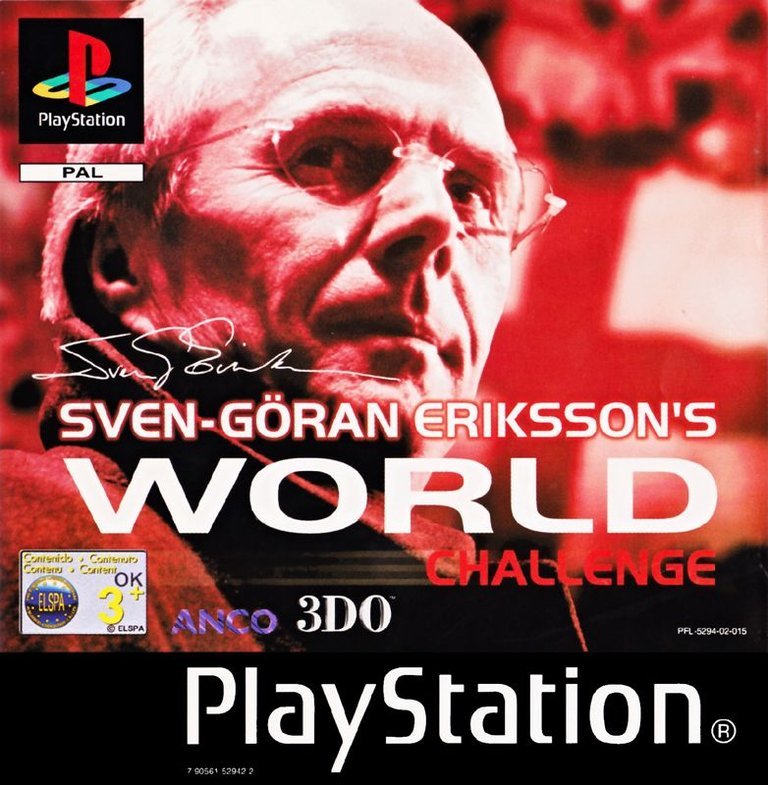
Description
Sven-Göran Eriksson’s World Challenge is a soccer game released in 2002, featuring 204 national teams and multiple gameplay modes, including Exhibition matches, League, Play-offs, World Cup qualification, and the World Cup championship. The game employs a control scheme reminiscent of the Kick Off series, with a focus on simple mechanics—using just three buttons for shooting, passing, and tackling—while avoiding the ‘ball-sticking’ to players’ feet common in other soccer games. It offers an isometric perspective and supports both single-player and two-player offline modes, catering to fans of fast-paced, uncluttered soccer action.
Gameplay Videos
Sven-Göran Eriksson’s World Challenge Cracks & Fixes
Sven-Göran Eriksson’s World Challenge Patches & Updates
Sven-Göran Eriksson’s World Challenge Mods
Sven-Göran Eriksson’s World Challenge Reviews & Reception
mobygames.com (35/100): Average score: 35%
mobygames.com (35/100): Average score: 35%
Sven-Göran Eriksson’s World Challenge Cheats & Codes
PlayStation 2 (PAL) – Xploder v1+ Codes
Enter codes using Xploder v1+ device.
| Code | Effect |
|---|---|
| sel+L2 | Away team score 0 |
| sel+R2 | Away team score 99 |
| sel+up | Home team score 0 |
| sel+down | Home team score 99 |
| L1+R1+R2+L2 | Go to half time |
| 2015F90C 03E00008 2015F910 00000000 20160228 03E00008 2016022C 00000000 |
Dumb AI |
| 1027CCFE 00004180 | Zoom in |
| 1027CCFE 00003F80 | Zoom out |
| 20281204 3F822F1B | Speedy ball |
| 20281204 3F420000 | Max terrain friction |
| 20281208 3FE00000 | Bouncing ball |
| 20281208 30000000 | No rebound |
PlayStation 2 (PAL-Unk) – Action Replay v1 / GameShark v1
Enter codes using Action Replay v1 or GameShark v1 device.
| Code | Effect |
|---|---|
| 0E3C7DF2 1853E59E EE8EFDFA BCA99C80 |
Master Code |
| 0E92CBFE BCA99981 FE96EE88 BCA99B83 |
Away Team Score 0: Press Select+L2 |
| 0E92CBFE BCA99881 FE96EE88 BCA99BE6 |
Away Team Score 99: Press Select+R2 |
| DE96EC86 FB899B83 | Bouncing Ball |
| DE890582 BF899B8B DE89058E BCA99B83 DE88FCA6 BF899B8B DE88FCA2 BCA99B83 |
Dumb A.I |
| 0E92CBFE BCA98B82 CE96ED26 BCA9D583 |
Go To Half Time: Press L1+R1+R2+L2 |
| 0E92CBFE BCA99A71 FE96EE8E BCA99B83 |
Home Team Score 0: Press Select+Up |
| 0E92CBFE BCA99A41 FE96EE8E BCA99BE6 |
Home Team Score 99: Press Select+Down |
| DE96ECFA FBEB9B83 | Max Terrain Friction |
| DE96EC86 ECA99B83 | No Rebound |
| DE96ECFA FB2BCA9E | Speedy Ball |
| CE972AFC BCA9DC03 | Zoom In |
| CE972AFC BCA9DA03 | Zoom Out |
PlayStation 2 (PAL-Unk) – ARMax
Enter codes using ARMax device.
| Code | Effect |
|---|---|
| Z431-3G31-FT61B 13PE-D0JJ-7DE49 KCQ2-PJAW-4XV7C VFE7-FK9B-M32EA KQEK-5ZFB-F8UP9 |
Master Code |
| MJ61-7CER-T60TE EJ4Y-W2RE-YYK8E TYW8-ZG6C-EBE17 |
Away Team Scores 0 (Press Select+L2 To Activate) |
| VNQD-MZ39-M6KVR 9RB0-EGUB-GC2WH ZAHQ-N5M4-F78XK |
Away Team Scores 99 (Press Select+R2 To Activate) |
| 9WY7-JYHV-T0PPT 3KF8-MX8R-CRX1Q H2U8-48D7-YMPW8 EM8F-91E2-57B8A W66W-5NXU-JP43R |
Dumb A.I |
| R476-UXN8-BVKZY GPPU-J160-Q72KF GF4Y-XBZA-8MMPX |
Go To Half Time (Press L1+L2+R1+R2 To Activate) |
| WA4K-MAP5-WMMKJ 8BFX-9F6Z-XR9YD YT9P-FXRT-P4YDA |
Home Team Scores 0 (Press Select+Up To Activate) |
| C3GX-GYK7-VRHMM DT4U-6ZG6-MMUDM FECU-RY7P-CAXAA |
Home Team Scores 99 (Press Select+Down To Activate) |
PC – Trainer
Use the trainer during gameplay.
| Code | Effect |
|---|---|
| 1 | Time reset to zero |
| 2 | Force to time up/injury time |
| 3 | Get 10 goals for topper team |
| 4 | Get no goals for topper team |
| 5 | Get 10 points for lower team |
| 6 | Get no points for lower team |
Sven-Göran Eriksson’s World Challenge: A Forgotten Relic of Early 2000s Football Gaming
Introduction: The Ghost of Football Games Past
In the annals of football video game history, Sven-Göran Eriksson’s World Challenge (2002) stands as a curious artifact—a game that arrived at the tail end of an era, clinging to the mechanics of the past while the industry surged forward. Developed by Anco Software Ltd. and published by Ubi Soft and The 3DO Company, this title attempted to capitalize on the hype surrounding the 2002 World Cup and the star power of its namesake, the then-England manager Sven-Göran Eriksson. Yet, despite its ambitious scope—featuring 204 national teams and a variety of game modes—it was met with near-universal disdain from critics and players alike.
This review seeks to dissect World Challenge in its entirety: its development context, its mechanical and aesthetic choices, its reception, and its legacy. Was it a misguided homage to the Kick Off series, or a cynical cash grab riding the coattails of a footballing icon? And why, in an era dominated by FIFA and Pro Evolution Soccer, did this game fail so spectacularly?
Development History & Context: The Last Gasp of Anco Software
The Studio Behind the Game: Anco’s Legacy and Decline
Anco Software Ltd., founded by Anil Gupta, was once a titan of football gaming. In the late 1980s and early 1990s, the studio was synonymous with Kick Off (1989) and Player Manager (1990), games that revolutionized the genre with their fast-paced, skill-based gameplay. Kick Off, in particular, was a cultural phenomenon, selling over a million copies and earning critical acclaim for its intuitive controls and realistic ball physics.
However, by the early 2000s, Anco was a shadow of its former self. The studio had struggled to adapt to the 3D revolution, and its later titles—such as Kick Off 2002—were seen as relics of a bygone era. Sven-Göran Eriksson’s World Challenge was developed in this twilight period, using the same engine and mechanics as Kick Off 2002. The game was essentially a reskin, repurposed to capitalize on the 2002 World Cup and the popularity of Eriksson, who was then at the height of his fame as England’s manager.
Technological Constraints and Market Pressures
The early 2000s were a pivotal time for sports games. FIFA 2002 and Pro Evolution Soccer 2 had set new standards for realism, graphics, and gameplay depth. Anco, however, was working with outdated technology. World Challenge used an isometric, diagonal-down perspective—a holdover from the Kick Off series—that felt archaic compared to the 3D, camera-angled approaches of its competitors.
The game’s development was also rushed to coincide with the World Cup, limiting the time available for polish or innovation. The result was a product that felt unfinished, with clunky controls, rudimentary AI, and a lack of the depth that modern football games demanded.
The Eriksson Factor: A Marketing Gimmick
The inclusion of Sven-Göran Eriksson’s name and likeness was a clear attempt to leverage his popularity. At the time, Eriksson was a household name in England, having led the national team to a strong showing in the 2002 World Cup. The game’s marketing promised “detailed player models” and “intuitive ball control,” but in reality, it delivered little more than a Kick Off clone with a fresh coat of paint.
Narrative & Thematic Deep Dive: The Illusion of Depth
Plot and Structure: A Hollow World Cup Fantasy
Sven-Göran Eriksson’s World Challenge lacks any meaningful narrative or thematic depth. The game is a straightforward football simulator, offering six modes: Exhibition, Training, League, Play-offs, World Cup Qualification, and World Cup Championship. There is no story, no character development, and no attempt to immerse the player in the world of international football beyond the most superficial level.
The game’s only nod to realism is its inclusion of 204 national teams, but even this is undermined by the fact that the teams are composed of “fantasy players” rather than real-world stars. This decision was likely due to licensing constraints, but it robs the game of the authenticity that players craved.
Dialogue and Presentation: A Silent Spectacle
The game features no commentary, no in-game dialogue, and no meaningful interaction beyond the basic menus. The absence of these elements—standard in contemporary football games—makes World Challenge feel sterile and disconnected. The only “voice” in the game is the occasional text-based update, which does little to enhance the experience.
Themes: Nostalgia vs. Innovation
At its core, World Challenge is a game torn between nostalgia and the demands of a rapidly evolving market. It clings to the Kick Off formula, which emphasized fast-paced, arcade-style gameplay over simulation realism. While this approach had its charms in the 1990s, by 2002 it felt outdated. The game’s refusal to evolve left it stranded in the past, unable to compete with the more sophisticated offerings of FIFA and PES.
Gameplay Mechanics & Systems: The Flaws of a Bygone Era
Core Gameplay Loop: Simplicity to a Fault
Sven-Göran Eriksson’s World Challenge boasts a simplistic control scheme, with just three buttons: shoot, pass, and tackle. This minimalist approach harkens back to the Kick Off series, where the ball did not “stick” to the players’ feet, requiring precise timing and skill. However, in World Challenge, this mechanic feels clunky and unresponsive.
The ball physics are erratic, with passes and shots often behaving unpredictably. The AI is equally problematic, with players frequently making illogical decisions, such as running into their own teammates or failing to react to obvious scoring opportunities. The result is a game that feels more like a chaotic pinball machine than a football simulation.
Game Modes: Quantity Over Quality
The game offers six modes, but none are particularly well-executed:
– Exhibition Match: A basic one-off game with no frills.
– Training: A rudimentary practice mode that does little to prepare players for the game’s quirks.
– League/Play-offs: Generic tournament structures with no unique features.
– World Cup Qualification/Championship: The game’s main selling point, but marred by poor AI and repetitive gameplay.
The lack of a career mode or any form of progression system further limits the game’s replayability. Players are left with little incentive to return after completing a tournament.
UI and Accessibility: A Cluttered Mess
The user interface is a particular weak point. Menus are poorly organized, with critical options hidden behind unintuitive right-click menus. The game’s lack of a tutorial or in-depth instructions leaves players to fend for themselves, exacerbating the frustration caused by the erratic controls.
World-Building, Art & Sound: A Visual and Auditory Letdown
Visual Design: Stuck in the Past
The game’s isometric, diagonal-down perspective was a staple of the Kick Off series, but by 2002, it felt outdated. The player models are blocky and lack detail, with animations that are stiff and unrealistic. The stadiums are similarly barebones, with little to no crowd detail or atmosphere.
The game’s attempt at “motion capture” is laughable, with player movements that are more reminiscent of marionettes than professional footballers. The lack of facial details or expressive animations further detracts from the immersion.
Sound Design: A Silent Stadium
The audio experience is equally underwhelming. There is no commentary, and the crowd noise is a monotonous, looping track that does little to create a sense of atmosphere. The sound effects—such as the thud of the ball or the referee’s whistle—are basic and uninspired.
Atmosphere: A Ghost Town
The combination of poor visuals and sound design results in a game that feels devoid of life. There is no sense of excitement or tension, even in high-stakes matches. The stadiums are empty shells, and the players move like automatons. It’s a far cry from the vibrant, dynamic environments of FIFA or PES.
Reception & Legacy: A Critical and Commercial Failure
Critical Reception: A Universal Panning
Sven-Göran Eriksson’s World Challenge was met with near-universal disdain from critics. German publications were particularly harsh:
– Gameswelt (63%): Praised the game’s uncomplicated controls and quick action but criticized its outdated graphics and gameplay flaws.
– PC Action (29%): Dismissed it as a “malade” (sick) Kick Off 2002 clone, with graphics and gameplay that were “as bad as Alexander Zickler’s calf muscle.”
– GameStar (26%): Mocked the AI, which was “dumber than the Saudi Arabian national team,” and the “detail-poor 3D graphics.”
– Gamesmania.de (23%): Derided the game as a “small-sided tournament for the E-youth of Süder-Barup,” far removed from real football.
The game’s MobyGames score of 4.6 (out of 5) from players and a 35% average from critics speaks volumes about its reception.
Commercial Performance: A Forgotten Footnote
The game’s commercial performance is difficult to gauge, but it’s safe to assume it was overshadowed by FIFA 2002 and Pro Evolution Soccer 2. Its lack of licensing, poor reviews, and outdated mechanics made it a hard sell in a crowded market.
Legacy: The End of an Era
Sven-Göran Eriksson’s World Challenge marked the end of Anco Software’s relevance in the football gaming space. The studio closed its doors in 2003, following the death of its founder, Anil Gupta. The Kick Off series, once a pioneer, faded into obscurity, remembered only by nostalgic fans of 1990s gaming.
The game’s legacy is one of failure—a cautionary tale about the dangers of resting on past laurels. It serves as a reminder that even the most beloved franchises must evolve or risk being left behind.
Conclusion: A Relic Best Left in the Past
Sven-Göran Eriksson’s World Challenge is a game that exists in the shadow of its predecessors and the giants of its era. It is a relic of a time when football games were simpler, but also a testament to the dangers of stagnation. Its clunky controls, outdated visuals, and lack of depth make it a difficult game to recommend, even to the most die-hard fans of the Kick Off series.
In the grand tapestry of football gaming history, World Challenge is a footnote—a forgotten experiment that failed to capture the magic of its inspiration. It is a game that, much like the career of its namesake, started with promise but ultimately fell short of expectations.
Final Verdict: 2/10 – A Museum Piece, Not a Masterpiece
For those curious about the evolution of football games, Sven-Göran Eriksson’s World Challenge is a fascinating case study in what happens when a studio fails to adapt. But as a playable experience, it is best left in the past, where it belongs.