
- Release Year: 1999
- Platforms: Linux, Macintosh, PlayStation, Windows Apps, Windows
- Publisher: Acer TWP Corp, Eidos Interactive Limited, Sold Out Sales & Marketing Ltd., Underdone Gaming, Warzone 2100 Project
- Developer: Pumpkin Studios
- Genre: Strategy, Tactics
- Perspective: Diagonal-down
- Game Mode: LAN, Online PVP, Single-player
- Gameplay: Base building, Real-time strategy (RTS), Research, Resource gathering, Unit Design
- Setting: Futuristic, Post-apocalyptic, Sci-fi
- Average Score: 87/100
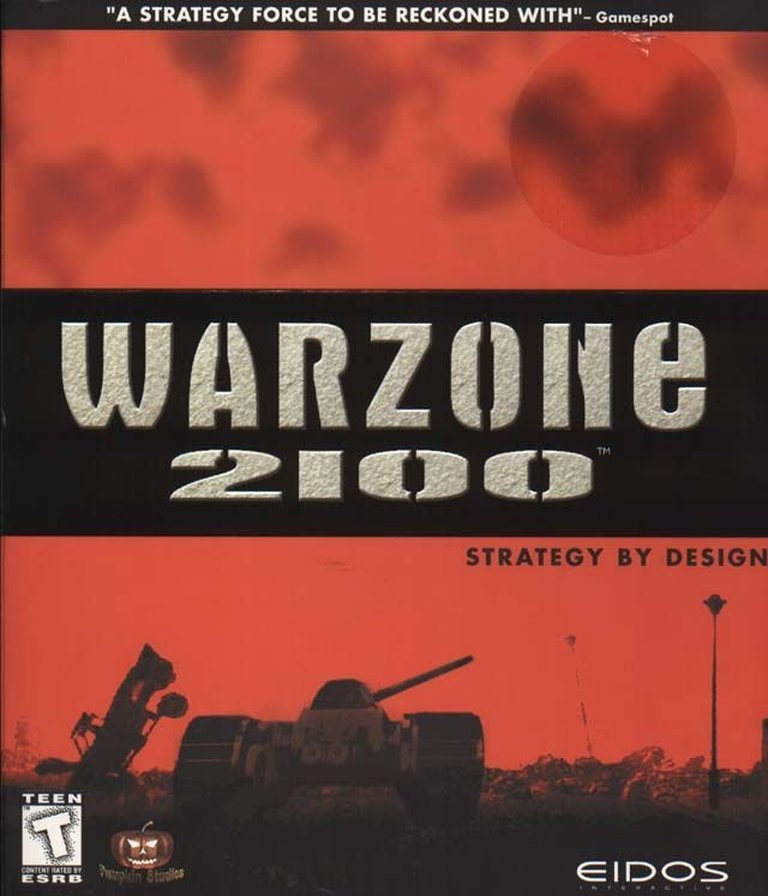
Description
Warzone 2100 is a post-apocalyptic real-time strategy game set in a world devastated by a catastrophic nuclear war triggered by a computer malfunction. Players command one of the surviving factions, scavenging technological artifacts from enemies to research and build customizable units, including tanks, hovercraft, VTOLs, and cyborgs. With a fully 3D battlefield, rotatable camera, and deep strategic gameplay, the game emphasizes tactical prowess over brute force, as players often face technologically superior foes. The story unfolds as players uncover the truth behind the nuclear apocalypse while battling rival factions in a fight for dominance.
Gameplay Videos
Where to Buy Warzone 2100
PC
Warzone 2100 Free Download
Warzone 2100 Cracks & Fixes
Warzone 2100 Mods
Warzone 2100 Guides & Walkthroughs
Warzone 2100 Reviews & Reception
metacritic.com (84/100): This game is a PC Legend, its a 3D ‘legos with guns’ real time strategy game that was way ahead of its time.
imdb.com (90/100): Definite winner! Everyone who enjoys strategies, whether real time or turn based, should play this game…
Warzone 2100 Cheats & Codes
PC
Press ‘t’, enter the code and hit return.
| Code | Effect |
|---|---|
| time toggle | starts, stops timer |
| get off my land | kills all enemy units on map |
| show me the power | 1000 extra power |
| whale fin | strange number of power |
| hallo mein schatz | next level |
| work harder | completes all research |
| double up | harder units |
| kill selected | kills the selected units |
| john kettley | toggle weather rain,snow,clear |
| biffer baker | almost invulnerable |
| sparkle green | stronger units |
| timedemo | shows frame rate and gfx engine data |
| easy | sets easy difficulty level |
| normal | sets normal difficulty level |
| hard | sets hard difficulty level |
| version | tells you when the game code was compiled |
| carol vorderman | displays a programmer message |
| mouseflip | inverts the mouse vertical rotation direction |
| shakey | toggle screen shake when units die |
| how fast | display game speed |
| demo mode | unknown |
| let me win | causes you to win the current mission (campaign mode only) |
| more power | adds an additional 1000 power |
| superpower | maximum power |
| give all | allows you to build & research everything |
| research all | gives you everything researched |
| reload me | immediately reloads currently selected unit/structure |
| deity | lets you see everything on the map (equivalent of having Uplink Center) |
| build info | tells you the date when the game was built |
| count me | prints the number of objects in the game |
| demo | starts demo mode |
| droidinfo | shows unit info & stats |
| no faults | audio clip – ‘There are no faults in the renderer at the moment’ |
| sensors | shows sensor ranges when sensors are selected |
| showorders | shows current order & action for selected droid |
| clone wars | creates multiple copies of selected unit(s) |
Warzone 2100: A Post-Apocalyptic Masterpiece of Strategy and Innovation
Introduction
In the annals of real-time strategy (RTS) gaming, few titles have left as indelible a mark as Warzone 2100. Released in 1999 by Pumpkin Studios and published by Eidos Interactive, this game emerged during a golden age of RTS titles, yet it distinguished itself through a combination of groundbreaking features, a compelling post-apocalyptic narrative, and a unique approach to unit customization and tactical depth. Warzone 2100 is not merely a relic of its time; it is a living testament to the power of community-driven development, having evolved from a commercial product into one of the most enduring open-source games in history. This review will delve into the game’s development history, narrative depth, gameplay mechanics, artistic and auditory design, critical reception, and its lasting legacy in the gaming world.
Development History & Context
The Birth of a Vision
Warzone 2100 was conceived during a period when the RTS genre was dominated by titans like Command & Conquer and StarCraft. Pumpkin Studios, a relatively small developer, sought to carve out a niche by integrating innovative mechanics into a familiar framework. The game’s development was spearheaded by a team of 64 individuals, including notable figures such as Jim Bambra (Director of Projects), Nick Cook (Director of Development), and Alex McLean (Head of Software Engineering). The studio’s ambition was to create a fully 3D RTS that would leverage the emerging capabilities of contemporary hardware, particularly the iViS 3D graphics engine developed by Sam Kerbeck of Eidos Interactive.
Technological Constraints and Innovations
The late 1990s presented significant technological challenges. Hardware acceleration was still in its infancy, and developers had to balance graphical fidelity with performance. Warzone 2100 addressed these constraints by employing a grid-based 3D world where vehicles could navigate realistic terrain, complete with elevation changes that affected line-of-sight and projectile trajectories. The game’s camera system was another standout feature, offering players the ability to rotate, zoom, and pan freely—a rarity in RTS games of the era, which often relied on fixed isometric perspectives.
The Gaming Landscape of 1999
The year 1999 was a pivotal one for the RTS genre. StarCraft: Brood War had cemented its status as a competitive esports title, while Age of Empires II was captivating history buffs and strategy enthusiasts alike. Amidst this competitive landscape, Warzone 2100 sought to differentiate itself through its post-apocalyptic setting, modular unit design, and a campaign structure that emphasized persistence and progression. The game’s release on both Windows and PlayStation further broadened its appeal, though the console version faced criticism for its control scheme, which struggled to adapt the complexity of PC RTS mechanics to a controller.
Narrative & Thematic Deep Dive
A World in Ruins
Warzone 2100 is set in a bleak, post-nuclear future where humanity has been reduced to scattered factions vying for survival. The game’s backstory revolves around a catastrophic malfunction of the NASDA (North American Strategic Defense Agency) satellite system, which inadvertently triggers a global nuclear holocaust. The player assumes the role of a commander within “The Project,” a faction dedicated to rebuilding civilization by reclaiming lost technology and fending off hostile groups.
The Campaign Structure
The campaign is divided into three distinct segments, each corresponding to a different team (Alpha, Beta, and Gamma) operating in various regions of the United States. The narrative unfolds through a series of missions that are interconnected, with the player’s base and units persisting across multiple scenarios. This persistence creates a sense of continuity and investment, as players grow attached to their veteran units and strategic strongholds.
Themes of Survival and Technological Reclamation
At its core, Warzone 2100 explores themes of survival, resilience, and the ethical dilemmas of technological advancement. The player’s primary objective is to recover “artifacts”—remnants of pre-war technology—that can be reverse-engineered to unlock new weapons, vehicles, and defenses. This mechanic underscores the game’s central premise: that humanity’s salvation lies in its ability to reclaim and repurpose the tools of its own destruction.
The Antagonists: Nexus and the Factions
The game’s primary antagonist is Nexus, a sentient computer virus that has infiltrated and corrupted the NASDA system. Nexus manipulates other factions, such as the New Paradigm and the Collective, to further its own agenda of global domination. The revelation that Nexus is orchestrating the conflict adds a layer of intrigue and moral complexity to the narrative, as players must confront the consequences of unchecked technological hubris.
Gameplay Mechanics & Systems
Unit Customization and Modular Design
One of Warzone 2100‘s most innovative features is its modular unit design system. Players can customize their vehicles by selecting from a variety of chassis, propulsion systems, and weaponry. This system allows for an astonishing degree of strategic flexibility, as players can tailor their forces to counter specific threats or exploit enemy weaknesses. For example, a lightweight chassis with wheels and a machine gun might be ideal for scouting and hit-and-run tactics, while a heavily armored tracked vehicle equipped with a howitzer could serve as a frontline assault unit.
Resource Management and Base Building
Unlike many RTS games that rely on multiple resource types, Warzone 2100 simplifies resource management by focusing solely on power generation. Oil derricks, which are scattered across the map, provide a steady stream of power that can be used to construct buildings, research new technologies, and produce units. This streamlined approach reduces micromanagement and allows players to focus on tactical decision-making.
The Role of Artillery and Sensors
Artillery plays a pivotal role in Warzone 2100, with players encouraged to employ indirect fire to soften enemy defenses before committing to a direct assault. The game’s sensor mechanics further enhance this strategic depth, as players can deploy counter-battery sensors to detect and target enemy artillery positions. This emphasis on reconnaissance and coordinated strikes adds a layer of realism and tactical nuance that sets Warzone 2100 apart from its peers.
Experience and Veterancy
Units in Warzone 2100 gain experience through combat, which improves their accuracy, damage output, and durability. This system incentivizes players to preserve their veteran units, as they become increasingly valuable over time. The ability to “recycle” experience from destroyed units to newly constructed ones further reinforces the importance of strategic resource allocation and unit preservation.
Mission Design and Time Limits
The campaign missions in Warzone 2100 are notable for their variety and challenge. Many missions are timed, which adds a sense of urgency and forces players to balance aggression with caution. The inclusion of “Away” missions, where players must deploy a limited force to a remote location, introduces additional strategic considerations, as players must carefully select their units and manage their resources in unfamiliar terrain.
World-Building, Art & Sound
Visual Design and Atmosphere
Warzone 2100‘s visual design is a testament to the creative constraints of its era. The game’s 3D environments, while not as detailed as modern titles, are functional and immersive, with terrain that dynamically affects gameplay. The color-coded factions—such as the Project’s green, the New Paradigm’s yellow, and Nexus’s ominous black—help players quickly identify friend from foe, even in the heat of battle. The game’s post-apocalyptic aesthetic is further enhanced by its depiction of ruined cities, scorched landscapes, and makeshift fortifications, all of which contribute to a palpable sense of desolation and struggle.
Sound Design and Music
The game’s sound design is equally effective, with weapon effects that convey a satisfying sense of impact and destruction. The ambient soundtrack, composed by Martin Severn, complements the game’s somber tone, with haunting melodies that underscore the gravity of the player’s mission. While the voice acting is minimal, the occasional radio transmissions and mission briefings add depth to the narrative and reinforce the game’s immersive atmosphere.
Reception & Legacy
Critical Reception
Upon its release, Warzone 2100 received generally positive reviews from critics. Publications such as Science Fiction Weekly and GameGenie praised the game for its innovative mechanics, engaging campaign, and impressive 3D graphics. The PlayStation version, while lauded for bringing a complex RTS experience to consoles, was criticized for its cumbersome controls. Overall, the game’s MobyScore of 7.7 and critic average of 79% reflect its status as a well-regarded, if not groundbreaking, entry in the genre.
Commercial Performance and Abandonware Status
Despite its critical acclaim, Warzone 2100 did not achieve significant commercial success. The game’s niche appeal and the competitive landscape of the late 1990s RTS market likely contributed to its modest sales. However, the game’s legacy was far from over. In 2004, Eidos Interactive released the game’s source code under the GNU General Public License, transforming Warzone 2100 into an open-source project. This decision breathed new life into the game, as a dedicated community of developers and modders began to enhance and expand upon the original vision.
The Warzone 2100 Project
The open-source release of Warzone 2100 marked the beginning of a remarkable renaissance. The Warzone 2100 Project, a community-driven initiative, has since released numerous updates that have improved the game’s graphics, stability, and compatibility with modern operating systems. The project’s transparency and collaborative ethos have fostered a vibrant modding community, with players creating custom maps, campaigns, and total conversions that continue to expand the game’s replayability.
Influence on the Genre
Warzone 2100‘s influence on the RTS genre is evident in its emphasis on unit customization, persistent campaign progression, and tactical depth. Games such as Earth 2150 and Total Annihilation share similarities with Warzone 2100, particularly in their focus on modular unit design and large-scale battles. The game’s open-source legacy has also inspired other abandonware projects, demonstrating the potential for community-driven development to preserve and enhance classic titles.
Conclusion
Warzone 2100 is a game that defies easy categorization. It is at once a product of its time—a late-1990s RTS with all the hallmarks of the genre—and a pioneering title that introduced mechanics and features that would influence subsequent games. Its post-apocalyptic narrative, modular unit design, and emphasis on artillery and sensors set it apart from its contemporaries, while its transition to open-source status has ensured its longevity and continued relevance.
The game’s journey from commercial release to community-driven project is a testament to the power of collaborative development and the enduring appeal of well-crafted strategy games. Warzone 2100 may not have achieved the commercial success of titles like StarCraft or Command & Conquer, but its legacy as an innovative and influential RTS is secure. For fans of the genre, Warzone 2100 remains a hidden gem—a game that rewards strategic thinking, creativity, and perseverance, and one that continues to evolve thanks to the dedication of its community.
In the pantheon of RTS classics, Warzone 2100 occupies a unique and deservedly revered position. It is a game that challenges players to think critically, adapt dynamically, and embrace the complexities of post-apocalyptic warfare. For those willing to delve into its depths, Warzone 2100 offers an experience that is as rewarding as it is unforgettable.