
- Release Year: 1998
- Platforms: Windows
- Publisher: Cyberium Multi Media B.V., Reflexive Entertainment Inc.
- Developer: Reflexive Entertainment Inc.
- Genre: Action
- Perspective: Top-down
- Game Mode: Single-player
- Gameplay: Arcade, Shooter
- Setting: Futuristic, Sci-fi
- Average Score: 71/100
Description
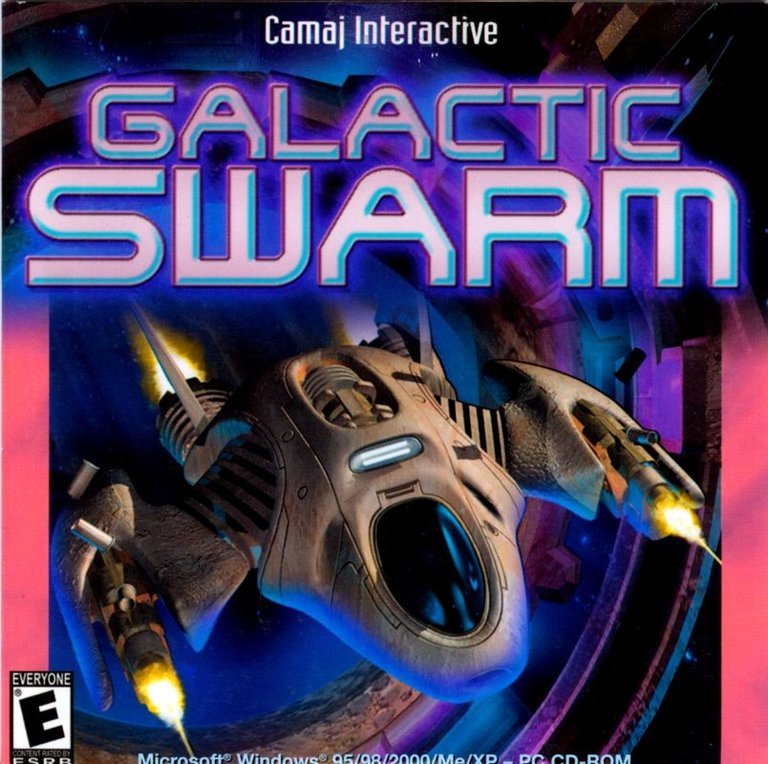
Swarm is a fast-paced, top-down arcade shooter set in a sci-fi universe, where players pilot the agile T-77 spacecraft to destroy space debris and hostile creatures while mining the valuable EZT material. The game features 100 levels, four difficulty settings, and a narrative driven by Saul, the protagonist, who provides context for each mission. Players can upgrade their twin cannons and collect various weapons, including explosives, to enhance their combat and mining capabilities. With its addictive gameplay, vibrant graphics, and engaging sound design, Swarm offers a classic yet thrilling experience reminiscent of Asteroids but with added depth and storytelling.
Gameplay Videos
Where to Buy Swarm
Swarm Free Download
PC
Swarm Guides & Walkthroughs
Swarm Reviews & Reception
en.wikipedia.org : The game received mixed reviews. Next Generation said, “For gamers after some good old-fashioned, arcade-style action, Swarm delivers. Just don’t go in expecting bleeding-edge graphics or an enthralling story because they’re nowhere to be found here.”
mobygames.com (71/100): Swarm follows in the Asteroids tradition where the player must pilot a lone ship and destroy a bunch of derelict space debris as well as hostile space-faring creatures while collecting items.
squakenet.com : For lovers of twitch shooters and arcade classics comes this neat and enjoyable take on the timeless Asteroids formula.
Swarm Cheats & Codes
PC
Enter one of the following codes during game play
| Code | Effect |
|---|---|
| debug all weapons | All weapons |
| debug full shields | Full shields |
| debug mace | Mace |
| debug dum | Very fast game play |
| debug fps | View frame rate |
Swarm: A Retrospective on Reflexive Entertainment’s Arcade Gem
Introduction
In the late 1990s, the video game landscape was dominated by the rise of 3D graphics and complex narratives. Amidst this evolution, Swarm (1998) emerged as a refreshing throwback to the arcade classics of yesteryear, blending the simplicity of Asteroids with modern sensibilities. Developed by Reflexive Entertainment, Swarm is a top-down shooter that captures the essence of arcade gameplay while introducing subtle innovations. This review delves into the game’s development, narrative, gameplay mechanics, and its lasting impact on the genre.
Development History & Context
Reflexive Entertainment, founded in 1997, was a fledgling studio when Swarm was released in March 1998. The game was developed by a small team of six individuals, including Lars Brubaker and James C. Smith, who would later become key figures in the studio’s growth. The studio’s vision was to create accessible, arcade-style games that could be enjoyed by casual and hardcore gamers alike.
Technologically, Swarm utilized pre-rendered 3D graphics, a technique that allowed for detailed visuals without the computational demands of real-time 3D rendering. This approach was common in the late 1990s, as developers sought to balance visual fidelity with performance on the hardware of the era. The game was released for Windows, leveraging the growing popularity of PC gaming as a platform for arcade-style experiences.
The gaming landscape in 1998 was marked by the transition from 2D to 3D graphics, with titles like Half-Life and StarCraft pushing the boundaries of what was possible. Swarm, however, embraced its retro roots, offering a nostalgic yet polished experience that stood out amidst the sea of complex, narrative-driven games.
Narrative & Thematic Deep Dive
Swarm is set in the Praulac Nebula, a region of space inhabited by the Clagnor, an insectoid alien race. The game’s plot revolves around Raul Mastesson, a prison convict offered a chance at redemption by fighting the Clagnor for a year. If he survives, his name will be cleared, though he is tempted by the offer of “twice the pay” for another year of service. This premise sets the stage for a high-stakes, action-packed adventure.
The narrative is delivered through the voice of Saul, a mission director who narrates the opening of each level. Saul’s commentary provides context for the player’s actions, explaining how Raul got into his current situation and what he must do to survive. While the story is minimal, it adds a layer of depth to the gameplay, making the player’s actions feel purposeful rather than purely mechanical.
Thematically, Swarm explores themes of redemption and survival. Raul’s journey from convict to hero is a classic underdog story, resonating with players who enjoy narratives of personal growth and overcoming adversity. The game’s sci-fi setting also allows for exploration of themes like alien encounters and interstellar conflict, though these are largely backdrop to the core gameplay.
Gameplay Mechanics & Systems
At its core, Swarm is a top-down shooter that follows the Asteroids tradition. The player controls the T-77, an agile and speedy assault craft armed with twin cannons. The gameplay revolves around destroying space debris and hostile alien creatures while collecting EZT nodules, a fictional mineral that serves as the game’s primary objective.
The game features three types of levels:
1. “Get all the EZT” levels: The player must collect all EZT nodules in the level while fending off Clagnor enemies and avoiding obstacles like asteroids and space junk.
2. “Kill them all” levels: These levels, which appear every 10 levels or so, task the player with destroying all Clagnor drones in the area. There are no EZT nodules in these levels.
3. Bonus levels: Appearing every 5 or 10 levels, these levels contain no enemies or EZT nodules. Instead, the player can freely explore and collect weapons, ammunition, and shield bonuses for a limited time.
The game’s wrap-around space areas create a dynamic and challenging environment, as enemies and obstacles can appear from any direction. The player’s ship is subject to inertia-based physics, adding a layer of strategy to the gameplay. Upgrades, such as enhanced cannons and explosive devices, can be collected throughout the levels, allowing the player to customize their approach to combat.
Swarm offers four difficulty settings and 100 playable levels, providing a substantial amount of content for players to explore. The game’s simplicity and accessibility make it easy to pick up and play, while the variety of levels and upgrades ensure that the experience remains engaging over time.
World-Building, Art & Sound
The game’s setting in the Praulac Nebula is brought to life through its pre-rendered 3D graphics. The visuals are simple yet effective, with detailed ship designs and vibrant alien landscapes. The top-down perspective allows for a clear view of the action, while the wrap-around space areas create a sense of immersion and depth.
The sound design in Swarm is equally impressive, with a mix of ambient space noises and dynamic combat sounds. The game’s music, composed by Chad Max, complements the action, providing a tense and engaging backdrop to the gameplay. The voice acting, particularly the narration by Saul, adds a layer of personality to the game, making the player’s journey feel more personal and engaging.
Reception & Legacy
Swarm received mixed reviews upon its release, with critics praising its addictive gameplay and accessible design while noting its lack of innovation. The game’s average critic score of 71% reflects this sentiment, with reviews highlighting its strengths as a fast-paced, arcade-style shooter.
Next Generation magazine summed up the game’s appeal, stating, “For gamers after some good old-fashioned, arcade-style action, Swarm delivers. Just don’t go in expecting bleeding-edge graphics or an enthralling story because they’re nowhere to be found here.” This sentiment was echoed by other critics, who appreciated the game’s simplicity and accessibility.
Despite its mixed reception, Swarm has endured as a cult classic, beloved by fans of arcade-style shooters. The game’s legacy is evident in its influence on subsequent titles, such as Escape Velocity and Starscape, which also embraced the top-down shooter genre. In 2008, Reflexive released Swarm Gold, an updated version of the game that improved upon the original’s mechanics and visuals.
Conclusion
Swarm is a testament to the enduring appeal of arcade-style shooters. While it may not have pushed the boundaries of the genre, it delivered a polished and engaging experience that resonated with players. Its blend of simple mechanics, accessible design, and engaging gameplay makes it a standout title in the late 1990s gaming landscape.
In the annals of video game history, Swarm occupies a unique place as a bridge between the arcade classics of the past and the modern shooters of the future. Its legacy is one of accessibility and fun, a reminder that sometimes, the simplest games can be the most enjoyable. For fans of arcade-style shooters, Swarm remains a must-play title, a gem that continues to shine brightly in the vast expanse of gaming history.