
- Release Year: 2012
- Platforms: Windows
- Publisher: magnussoft Deutschland GmbH
- Genre: Compilation
- Game Mode: Single-player
- Gameplay: Hidden object
- Average Score: 80/100
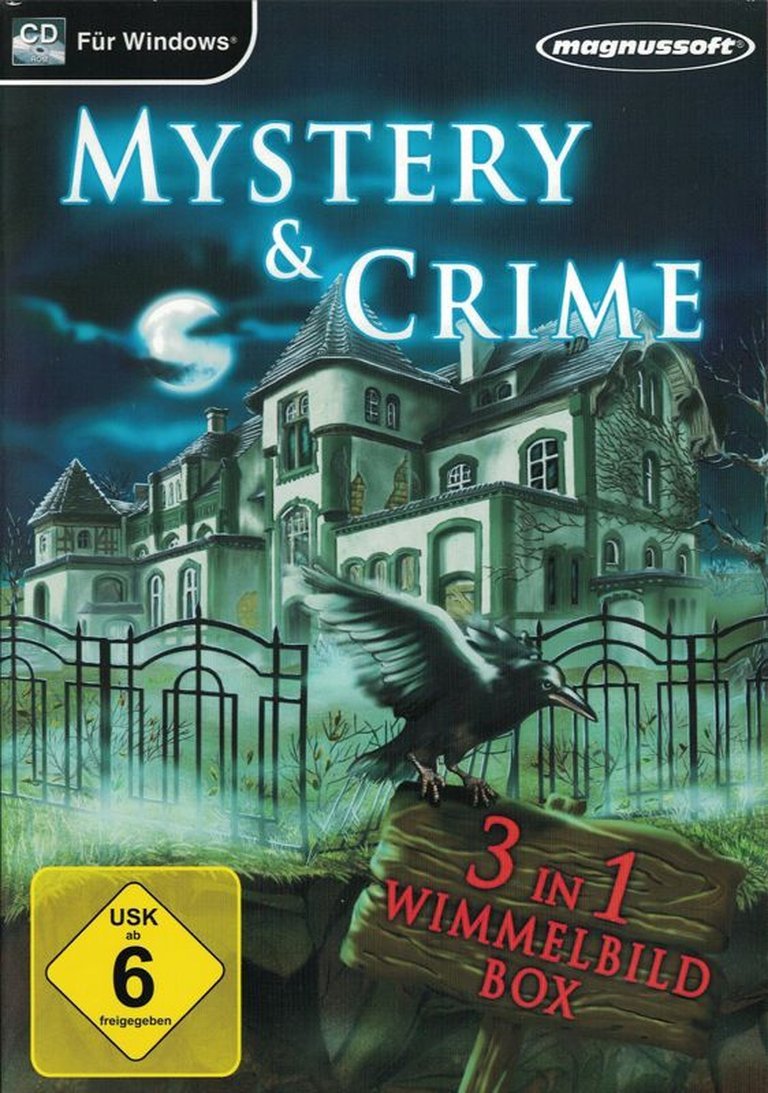
Description
Mystery & Crime: 3 in 1 Wimmelbild Box is a 2012 Windows compilation featuring three distinct hidden object adventure games—Der Landsitz von le Cros, Spuk im Wirtshaus, and Milinda Wind—each offering unique mysteries and immersive settings. Published by magnussoft Deutschland GmbH, this collection caters to puzzle enthusiasts with varied themes, from eerie estates to haunted inns, delivering hours of engaging gameplay.
Mystery & Crime: 3 in 1 Wimmelbild Box Reviews & Reception
gamearchives.net (80/100): Enjoyably tough and esoteric, if a little uneven.
Mystery & Crime: 3 in 1 Wimmelbild Box: A Hidden Gem in the Hidden Object Genre
Introduction
In the vast and often overlooked landscape of casual gaming, compilations like Mystery & Crime: 3 in 1 Wimmelbild Box serve as time capsules—a curated selection of experiences distilled into a single package. Released in 2012 for Windows by magnussoft Deutschland GmbH, this anthology bundles three distinct hidden-object adventure games: Der Landsitz von le Cros, Spuk im Wirtshaus, and Milinda Wind. Far from a mere assemblage of games, this compilation embodies the German tradition of Wimmelbild—literally “teeming picture”—where meticulous detail and immersive storytelling converge. This review dissects its historical context, narrative depth, mechanical nuances, and enduring legacy, arguing that Mystery & Crime: 3 in 1 Wimmelbild Box is a microcosm of the hidden-object genre’s evolution, balancing accessibility with ambitious world-building and thematic complexity.
Development History & Context
Mystery & Crime: 3 in 1 Wimmelbild Box emerged during a pivotal moment for casual gaming. The early 2010s saw a surge in demand for accessible, narrative-driven experiences amid the rise of battle royales and AAA epics. Magnussoft Deutschland GmbH, a German developer with a history of producing Wimmelbild collections, leveraged this trend by compiling three previously standalone titles into a cohesive anthology. The choice to release on DVD-ROM—a relic in an era of digital storefronts—signals a deliberate targeting of older, less tech-savvy players or those nostalgic for physical media.
The three included games represent different subgenres of the hidden-object style:
– Der Landsitz von le Cros: A supernatural thriller rooted in classic ghost stories.
– Spuk im Wirtshaus: A psychological horror exploring trauma and dreams.
– Milinda Wind: An adventure blending mystery and historical fiction.
Technologically constrained by the genre’s reliance on pre-rendered 2D scenes and static puzzles, the developers compensated through rich environmental storytelling. The 2012 release date places it alongside titles like The Walking Dead (2012) and Journey (2012), underscoring a parallel universe where narrative depth could thrive without cutting-edge graphics. The compilation’s lack of a specific rating further highlights its intent to appeal to an adult audience, eschewing juvenile tropes for mature themes.
Narrative & Thematic Deep Dive
Each game in the anthology weaves intricate narratives, leveraging the hidden-object format as a narrative device rather than a mere mechanic.
Der Landsitz von le Cros
The player, initially a skeptic of the supernatural, arrives on a cursed island teeming with phantoms and grotesque entities. The narrative pivots on a ghost’s desperate plea for help, forcing the protagonist to confront their disbelief. The theme of belief vs. reality permeates every scene, with hidden objects symbolizing fragments of the island’s tragic past. Unlike many horror games, this title avoids jump scares in favor of psychological unease, using the Wimmelbild aesthetic to create a “living” diorama where every clickable item tells a story—e.g., a child’s toy near a crumbling crypt hints at a lost family.
Spuk im Wirtshaus
Two years after awakening from a coma, Laura remains tormented by the Sandman’s vengeance. Tim’s attempt to distract her with a ski trip backfires, plunging her into a surreal nightmare realm. This entry excels in blending psychological horror with dream logic: hidden objects manifest as manifestations of guilt (e.g., a shattered hourglass symbolizing time wasted in recovery). The dialogue, sparse yet poignant, explores trauma’s lingering effects, while the ski resort setting contrasts sharply with the claustrophobic dreamscapes, highlighting Laura’s internal conflict between escapism and confrontation.
Milinda Wind
This game is a love letter to literary adventure. Players assist young Minha in rescuing her father from wrongful execution in 19th-century Brazil. The narrative emphasizes perseverance and justice, with puzzles tied to the novel’s themes—e.g., navigating a river requires assembling parts of Verne’s iconic floating raft, La Jangada. Hidden objects here are not just tools but cultural artifacts: maps, compasses, and indigenous symbols immerse players in Verne’s world, turning scavenging into an act of historical preservation.
Collectively, these narratives demonstrate the genre’s range: from supernatural dread to psychological complexity and historical reverence. The anthology’s strength lies in its thematic diversity, proving hidden-object games can tackle adult themes with nuance.
Gameplay Mechanics & Systems
Mystery & Crime: 3 in 1 Wimmelbild Box adheres to core hidden-object mechanics but introduces subtle refinements.
Core Mechanics
- Hidden-Object Scenes: Players locate items from lists within cluttered, detailed scenes. Difficulty scales via timed modes or optional hints.
- Mini-Games: Each game integrates puzzles—jigsaw fragments, pattern-matching, or logic challenges—that break up the scavenging. For instance, Milinda Wind features raft-building puzzles requiring spatial reasoning.
- Inventory Management: Items found in one scene often unlock new areas or trigger narrative events, creating a satisfying feedback loop.
Innovations and Flaws
- Dynamic Environments: Spuk im Wirtshaus alters hidden-object lists mid-scene based on player choices, adding replayability.
- Static Interactivity: Despite lush art, interactions feel limited. Clicking rarely yields surprises, reducing immersion.
- Pacing Issues: Der Landsitz von le Cros repeats scene structures, while Milinda Wind’s reliance on literary references may alienate unfamiliar players.
The UI is utilitarian but functional, with a clean inventory bar and accessible hint system. However, the lack of voice acting or dynamic sound effects highlights the genre’s budget constraints, relying instead on atmospheric music and visual storytelling.
World-Building, Art & Sound
The anthology thrives in its visual and atmospheric design.
Art Direction
- Der Landsitz von le Cros: Gothic art with muted palettes (grays, deep blues) evokes decay and mystery. Textures—peeling paint, fog—enhance tactile realism.
- Spuk im Wirtshaus: Contrasts the vibrant ski resort with distorted dreamscapes, using color shifts (e.g., sickly greens) to denote psychological instability.
- Milinda Wind: Painted, watercolor-style backdrops evoke 19th-century illustrations, blending authenticity with artistic license.
Sound Design
Ambient soundscapes are pivotal: creaking floors in Der Landsitz von le Cros, whispers in Spuk im Wirtshaus, and river currents in Milinda Wind. While voice acting is absent, subtle audio cues (e.g., a chime when an item is found) provide tactile feedback. The minimalist score—predominantly piano or strings—elevates tension without overwhelming, proving that less can be more in audio design.
World-Building
Each game constructs microcosms: the forsaken island’s tragic history, Laura’s fractured psyche, and Verne’s Amazonian river. Details like handwritten notes in Der Landsitz von le Cros or indigenous artifacts in Milinda Wind deepen immersion, encouraging players to “read” the environment as text.
Reception & Legacy
Mystery & Crime: 3 in 1 Wimmelbild Box arrived with minimal fanfare, reflecting the niche status of hidden-object compilations. MobyGames lists no critical reviews, and Amazon.de shows no customer feedback—a testament to its audience’s quiet dedication. Commercially, it occupies a middle ground: affordable but not a blockbuster.
Its legacy, however, is more nuanced. As part of magnussoft Deutschland GmbH’s Wimmelbild Box series (e.g., Box 3 and 5 released in 2020–2021), it cemented the anthology model for casual games. It also influenced indie developers like Deadly Premonition (2010), which similarly blends hidden-object mechanics with narrative depth. While ignored by mainstream outlets, it thrives in hidden-object communities, celebrated for its thematic maturity and handcrafted artistry.
Conclusion
Mystery & Crime: 3 in 1 Wimmelbild Box is an unassuming masterpiece—an anthology where three distinct worlds converge to showcase the hidden-object genre’s untapped potential. Its narratives, steeped in supernatural dread, psychological complexity, and historical reverence, prove that storytelling need not scale with budgets. While its gameplay adheres to genre conventions, its art and sound design elevate it above mere “casual” fare.
In a gaming landscape dominated by spectacle, Mystery & Crime: 3 in 1 Wimmelbild Box is a quiet triumph—a reminder that the most immersive experiences often hide in plain sight. For players seeking substance over style, or narrative over spectacle, this compilation is not just a game but a time capsule—a testament to the enduring power of stories told through cluttered rooms and whispered secrets.
Final Verdict: An essential, if niche, entry in gaming history—a love letter to the art of Wimmelbild and the unspoken narratives that dwell within.