
- Release Year: 1999
- Platforms: Windows
- Publisher: Empire Interactive Europe Ltd., KaosKontrol, Inc.
- Developer: KaosKontrol, Inc.
- Genre: Action
- Perspective: 3rd-person
- Game Mode: Single-player
- Gameplay: Platform
- Average Score: 78/100
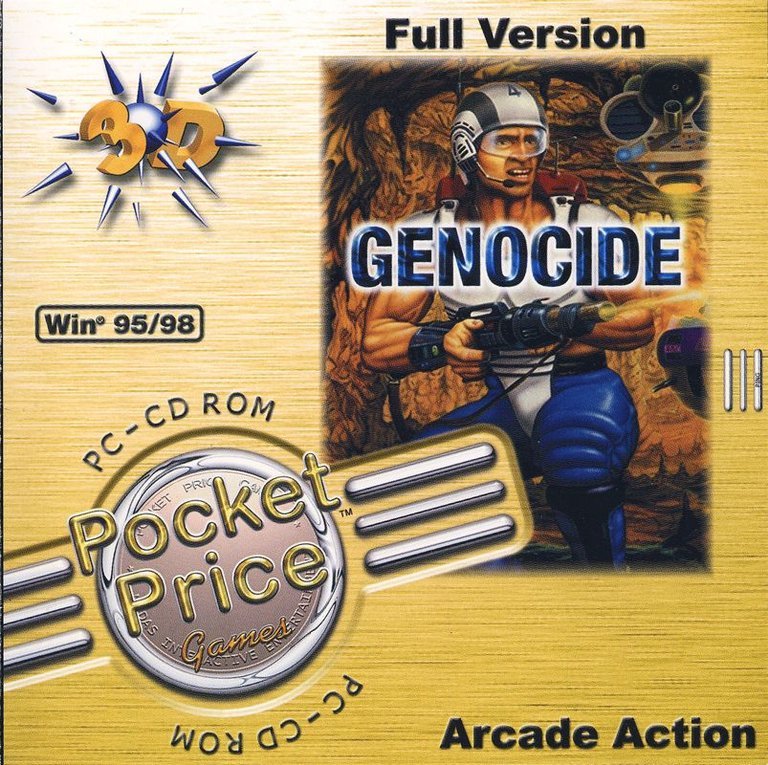
Description
Genocide: Remixed Version is an enhanced re-release of the 1998 action game Genocide, featuring upgraded graphics, additional content, and a built-in level editor. Players navigate a side-scrolling, third-person perspective using keyboard controls for movement and mouse for aiming, with customizable settings including gore toggles, difficulty levels, and an in-game console for cheats and adjustments. The game offers a mix of fast-paced platforming and combat, with options to fine-tune gameplay elements like frame rate and soundtrack.
Gameplay Videos
Genocide: Remixed Version Free Download
Genocide: Remixed Version Guides & Walkthroughs
Genocide: Remixed Version Reviews & Reception
mobygames.com (80/100): A triumphant return to form for the series.
myabandonware.com (100/100): Memories memories..
vgtimes.com (55/100): A third-person action game with platforming elements.
Genocide: Remixed Version Cheats & Codes
PC
Press [TAB] to bring down console, then type:
| Code | Effect |
|---|---|
| god | God Mode |
| framesync | Toggle frame sync |
| fps | Show Framerate |
| give [item] | Gives [Item] – See List Below |
| quit | Exit game |
| rocketl | Gives rocketl |
| minigun | Gives minigun |
| nailgun | Gives nailgun |
| pulserifle | Gives pulserifle |
| health | Gives health |
| armor | Gives armor |
| ammo1 | Gives ammo1 |
| ammo2 | Gives ammo2 |
| ammo3 | Gives ammo3 |
Genocide: Remixed Version – A Forgotten Gem of Late ’90s Action
Introduction: The Legacy of a Cult Classic
Genocide: Remixed Version (1999) is a game that exists in the shadowy liminal space between obscurity and cult adoration. A re-release of the 1998 original Genocide, this “remixed” iteration arrived at a time when the gaming landscape was rapidly evolving—just as 3D accelerators were becoming standard, and the first-person shooter was cementing its dominance. Yet, Genocide: Remixed Version clung to a side-scrolling, mouse-aimed, destructible-environment formula that felt both anachronistic and refreshingly bold. Built on the engine of Abuse (1996), a game developed by Crack dot Com, Genocide inherited a unique control scheme: keyboard movement paired with mouse-aimed shooting—a hybrid that predated modern twin-stick shooters and foreshadowed the precision of later titles like Broforce and Risk of Rain.
This review seeks to excavate Genocide: Remixed Version from the dustbin of late ’90s shareware obscurity and examine it not just as a product of its time, but as a fascinating artifact of experimental design, technical constraint, and the fleeting nature of gaming trends. While it may lack the polish or narrative depth of its contemporaries, Genocide: Remixed Version stands as a testament to the creativity of small studios like KaosKontrol, Inc., and the enduring appeal of raw, unfiltered action.
Development History & Context: The Birth of a Hybrid
The Studio and the Engine
KaosKontrol, Inc., the developer behind Genocide: Remixed Version, was a small, relatively unknown studio operating in the late 1990s. Little is documented about the team’s background, but their work on Genocide reveals a deep understanding of the Abuse engine—a tool originally designed for a game that blended platforming, shooting, and environmental destruction. Abuse itself was a critical darling upon release, praised for its innovative controls and dark, comic-book-inspired aesthetic. By licensing and modifying this engine, KaosKontrol positioned Genocide as a spiritual successor, albeit with a grittier, more violent tone.
The decision to use the Abuse engine was both pragmatic and ambitious. On one hand, it allowed a small team to leverage existing technology, reducing development time and cost. On the other, it enabled Genocide to inherit Abuse’s defining feature: fully destructible environments. Walls, floors, and ceilings could be blasted apart, creating dynamic pathways and tactical opportunities. This was a rarity in 1998–1999, when most side-scrollers still adhered to rigid, pre-defined level geometry.
The Gaming Landscape of 1999
The late 1990s were a period of seismic shift in PC gaming. Half-Life (1998) had redefined the first-person shooter with its immersive storytelling and physics. Unreal (1998) and Quake II (1997) pushed graphical fidelity to new heights. Meanwhile, real-time strategy games like StarCraft (1998) and Age of Empires II (1999) dominated multiplayer scenes. In this environment, a 2D side-scrolling action game—even one with destructible environments—was an oddity.
Yet, Genocide: Remixed Version wasn’t entirely alone. Games like Shadow Warrior (1997) and Blood (1997) proved that there was still an audience for over-the-top, gore-heavy action. The rise of budget CD-ROM compilations (such as the 10 Action Packed PC Games series that later included Genocide) also ensured that smaller, niche titles could find an audience. KaosKontrol’s game was marketed as part of this ecosystem, often bundled with other action titles in budget packs—a strategy that ensured its survival, if not its fame.
Technological Constraints and Innovations
Genocide: Remixed Version was constrained by the hardware of its era. The original 1998 release ran at lower resolutions and with simpler textures, but the “Remixed” version introduced True Color textures and support for resolutions up to 640×480—a modest but notable upgrade. The game also included an in-game level editor, a feature that hinted at KaosKontrol’s ambition to foster a modding community, though one that never fully materialized.
However, the remixed version also removed several features from the original, including:
– The “Airducts” level, a fan-favorite stage.
– Dynamic lighting, which had added atmospheric depth to the original.
– Multiplayer support, a surprising omission given the rise of LAN gaming.
These changes suggest that the “Remixed” moniker was somewhat misleading. While the game received graphical enhancements and additional content, it also lost elements that had defined the original. This tension between addition and subtraction would come to define Genocide: Remixed Version’s legacy.
Narrative & Thematic Deep Dive: A Thin Veneer of Sci-Fi Brutality
Plot Overview: Escape from Thras 5
Genocide: Remixed Version casts players as Shad, a biodroid and former marine captain wrongfully imprisoned on Thras 5, a brutal prison colony on a metalyte-mining planet in the 23rd century. The game’s opening cinematic (extended in the Remixed version) establishes a dystopian sci-fi setting where an evil corporation, The Regime, rules with an iron fist. Shad’s mission is simple: escape. No grand narrative twists, no moral dilemmas—just survival.
The story is delivered through minimalist cutscenes and environmental storytelling. The prison’s industrial corridors, flickering lights, and grotesque mutant guards paint a picture of a world where humanity has been reduced to a commodity. The game’s title, Genocide, is not just a provocative label but a thematic statement: this is a world where mass extermination is business as usual.
Themes: Oppression, Survival, and Institutional Violence
Despite its thin narrative, Genocide: Remixed Version engages with several dark themes:
1. Institutional Brutality: The prison colony of Thras 5 is a microcosm of systemic oppression. Guards are not just enemies but symbols of a larger, faceless regime. The game’s environments—crammed with cages, torture devices, and industrial machinery—reinforce the idea of dehumanization.
2. Survival Against Odds: Shad is a lone figure against an army. The game’s difficulty (even on “Easy”) emphasizes the futility of resistance in a rigged system. Yet, the destructible environments offer a glimmer of agency: if the world is oppressive, at least you can blow it apart.
3. Corporate Dystopia: The Regime is never fully explained, but its presence looms large. The game’s sci-fi trappings—biodroids, metalyte mining, high-tech weaponry—suggest a future where corporations have replaced governments, and human life is expendable.
Characters and Dialogue: Minimalism as a Strength
Shad is a silent protagonist, a cipher for the player’s aggression. The game’s few NPCs—prisoners, scientists, and mutant abominations—are similarly underdeveloped, existing primarily as targets or obstacles. Dialogue is sparse, often limited to grunts, screams, and the occasional taunt from enemies.
This minimalism is not necessarily a flaw. Genocide: Remixed Version is not a story-driven experience; it is a power fantasy wrapped in dystopian imagery. The lack of exposition forces players to focus on the gameplay, which is where the game truly shines.
Gameplay Mechanics & Systems: Destruction as a Core Loop
Core Gameplay: A Marriage of Platforming and Shooting
Genocide: Remixed Version is, at its heart, a run-and-gun platformer with a twist: mouse-aimed shooting. This control scheme, inherited from Abuse, was revolutionary in 1996 and remained unique in 1999. Players use the keyboard to move and jump while the mouse controls aiming and shooting. This hybrid system allows for precise, 360-degree aiming—a rarity in side-scrollers of the era.
The game’s levels are designed around this mechanic. Enemies often attack from multiple elevations, requiring players to aim upward or downward while navigating platforms. The destructible environments add another layer of strategy: blowing holes in walls can create shortcuts, reveal hidden items, or even trap enemies.
Combat and Weaponry: Tools of Destruction
Shad’s arsenal is modest but effective:
– Pulse Rifle: The default weapon, reliable but weak.
– Shotgun: High damage at close range, ideal for crowded corridors.
– Rocket Launcher: Devastating against groups and bosses, but limited ammo.
– Flamethrower: Useful against swarms of weaker enemies.
– Betty (Attack Drone): A floating companion that fires independently, providing cover fire.
Each weapon has a distinct feel, and ammo management is crucial. The game’s difficulty spikes when players run out of rockets or shotgun shells, forcing them to rely on the weaker pulse rifle.
Character Progression: A Missed Opportunity
One of Genocide: Remixed Version’s biggest weaknesses is its lack of meaningful progression. Unlike modern roguelites or Metroidvanias, Shad does not gain permanent upgrades. Health, weapons, and ammo reset at the start of each level, and armor is time-limited. This design choice reinforces the game’s brutal difficulty but also makes progression feel repetitive and punishing.
The level editor, included in the Remixed version, was likely intended to extend the game’s lifespan. However, without a robust modding community, this feature remained underutilized.
UI and Console: A Glimpse of Modernity
The game’s in-game console is a fascinating anachronism. Players can:
– Adjust the frame rate.
– Change difficulty settings on the fly.
– Enable god mode or infinite ammo.
– Play specific CD tracks as background music.
This level of customization was rare in 1999, especially in a budget action game. It suggests that KaosKontrol was experimenting with player agency in ways that would later become standard in PC gaming.
World-Building, Art & Sound: A Gritty, Industrial Nightmare
Setting and Atmosphere
Genocide: Remixed Version takes place entirely within the Thras 5 prison complex, a sprawling, industrial hellscape. The game’s levels include:
– Prison Blocks: Claustrophobic corridors lined with cells.
– Industrial Zones: Factories, smelters, and conveyor belts.
– Laboratories: Where The Regime conducts grotesque experiments.
– Waste Disposal: Toxic pits and incinerators.
The environments are dark, metallic, and oppressive, reinforced by the game’s limited color palette (even in the “True Color” Remixed version). The art style is functional rather than artistic, prioritizing readability over aesthetic flair.
Visual Design: A Product of Its Engine
The Abuse engine’s limitations are evident in Genocide’s visuals. Characters and enemies are pixelated sprites, and animations are stiff. The Remixed version’s higher-resolution textures do little to mask the game’s low-poly origins. Yet, there is a charm in its rawness—a reminder of an era when games were judged more on gameplay than graphical fidelity.
Sound Design: The Silence of the Oppressed
The game’s audio is minimalist but effective:
– Gunfire is punchy and satisfying.
– Explosions have weight, reinforcing the destructible environments.
– Ambient sounds—dripping water, humming machinery, distant screams—enhance the prison’s oppressive atmosphere.
The music, however, is forgettable. The Remixed version includes an in-game music track selector, but the compositions are generic industrial/techno loops that do little to elevate the experience.
Reception & Legacy: The Forgotten Child of a Forgotten Era
Critical and Commercial Reception
Genocide: Remixed Version received little critical attention upon release. It was not reviewed by major gaming publications, and its MobyGames score remains “n/a” due to a lack of recorded reviews. The game’s player score (4.0/5 based on a single rating) suggests a small but dedicated fanbase.
Commercially, Genocide found its audience through budget compilations, such as:
– 10 Action Packed PC Games: All Action (2007)
– 10 PC Games Mega Pack Vol. 1 (2008)
– Ultimate Gamer Multidisc (2007)
These bundles ensured that the game remained available long after its initial release, though it never achieved mainstream success.
Influence and Legacy
Genocide: Remixed Version’s influence is subtle but detectable in later games:
– Destructible Environments: Titles like Worms and Broforce would later refine the concept, but Genocide was an early adopter.
– Mouse-Aimed Side-Scrolling: The control scheme paved the way for games like Risk of Rain and Enter the Gungeon, which blend precision shooting with platforming.
– Brutal Difficulty: The game’s punishing design foreshadowed the rise of “masocore” platformers like Super Meat Boy and Celeste.
Yet, Genocide remains largely forgotten, overshadowed by more polished or innovative titles of its era. Its legacy is one of what could have been—a game with bold ideas but limited execution.
Conclusion: A Flawed but Fascinating Relic
Genocide: Remixed Version is not a great game by modern standards. Its clunky controls, repetitive level design, and lack of progression make it a tough sell for contemporary audiences. Yet, it is a fascinating artifact—a snapshot of a moment when developers were experimenting with hybrid genres, destructible environments, and player agency.
Its greatest strength is its unapologetic brutality. Genocide does not pretend to be anything other than what it is: a violent, challenging, and occasionally frustrating action game. It is a product of its time, warts and all.
Final Verdict: 6.5/10 – A Cult Classic for the Patient and the Nostalgic
For historians and retro enthusiasts, Genocide: Remixed Version is worth experiencing as a curiosity. For modern players, it serves as a reminder of how far action games have come—and how some ideas, no matter how bold, can fade into obscurity.
Yet, in the annals of gaming history, Genocide deserves a footnote. It is a testament to the creativity of small studios, the importance of experimental design, and the enduring appeal of blowing stuff up with a mouse and keyboard.
And sometimes, that’s enough.