
- Release Year: 2015
- Platforms: Arcade, Linux, Macintosh, Windows
- Publisher: Death by Audio Arcade
- Developer: Caroline Partamian, Courtney Gray, Jane Friedhoff, Jenny Jiao Hsia, Lauren Stern, Mark Kleeb, Scully
- Genre: Action
- Perspective: Side view
- Game Mode: Single-player
- Gameplay: Beat ’em up, brawler
Description
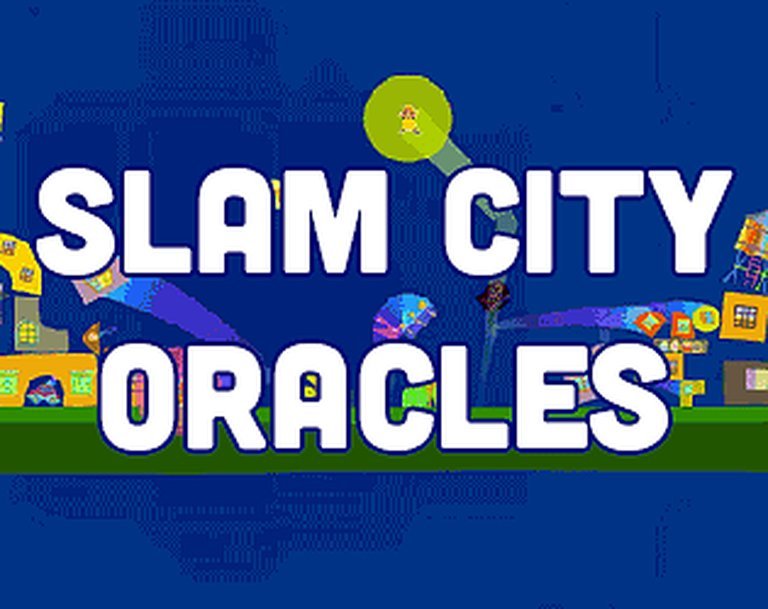
Slam City Oracles is a chaotic, riot grrrl-inspired physics-based brawler where two players team up as rebellious teen girls to smash, break, and wreak havoc on their surroundings within a two-minute time limit. Designed by Jane Friedhoff with vibrant art by Jenny Jiao Hsia and a punk-rock soundtrack by Scully, the game blends frantic, disorienting gameplay with a sense of gleeful destruction, offering a unique mix of cooperative mayhem and vertigo-inducing fun.
Slam City Oracles Reviews & Reception
latimes.com : A game that turns to punk rock’s riot grrl movement of the 1990s for inspiration, offering a bright and cuddly experience without losing its edge.
arcadecommons.org : A rambunctious, riot grrrl, Katamari-meets-Grand Theft Auto physics game, in which you and a friend slam onto the world around you to cause as much chaos as possible in two minutes.
autostraddle.com : A smash-em-up game where you rocket two badass beings into the ground, buildings, clouds and whatever the fuck else they can hit — and you do it all to a riot grrrl soundtrack.
jfriedhoff.itch.io : A rambunctious, riot grrrl, Katamari-meets-Grand Theft Auto physics game, in which you and a friend slam onto the world around you to cause as much chaos as possible in two minutes.
Slam City Oracles Cheats & Codes
PC
Type the code when Fingers passes the ball to you.
| Code | Effect |
|---|---|
| FFLLY | The next breakaway will result in a Super Slam. |
Slam City Oracles: A Riot Grrrl Manifesto in Game Form
Introduction: The Game That Dares You to Take Up Space
In the vast, often homogenous landscape of video games, Slam City Oracles (2015) stands as a defiant, neon-bright middle finger to the status quo. Developed by Jane Friedhoff and illustrated by Jenny Jiao Hsia, this two-minute burst of anarchic joy is more than just a game—it’s a political statement, a therapeutic outlet, and a love letter to women in gaming. At its core, Slam City Oracles is a cooperative, physics-based “slam-em-up” where two players control teenage girls as they bounce, crash, and smash their way through a whimsical, construction-paper world. But beneath its adorable exterior lies a radical reimagining of what games can—and should—be.
This review will dissect Slam City Oracles from every angle: its development as a reaction to the gaming industry’s toxic culture, its riot grrrl-inspired mechanics, its subversive themes of female empowerment, and its lasting impact as a cult classic. By the end, it will be clear why this game is not just a footnote in indie history, but a necessary disruption.
Development History & Context: A Game Born from Frustration and Defiance
The Creators and Their Vision
Slam City Oracles was designed and programmed by Jane Friedhoff, a queer game developer and researcher whose work often explores the intersection of play, identity, and social justice. The art was crafted by Jenny Jiao Hsia, whose bright, playful aesthetic gives the game its distinctive, almost tactile visual style. The soundtrack, a punk-infused riot of energy, was composed by Scully, a Brooklyn-based, women-fronted rock band.
Friedhoff’s inspiration for Slam City Oracles was deeply personal. In interviews, she has spoken about feeling isolated and marginalized in the gaming industry, particularly during the height of Gamergate in 2014. The game became an escape—a way to channel her frustration into something joyful and empowering. As she told The Mary Sue, “SCO became a bit of an escape from that. Those feelings definitely influenced the creation of a game where the women are invincible, where the women take up space and shake up the world.”
The No Quarter Exhibition and Arcade Innovation
Slam City Oracles was commissioned for New York University’s 2014 No Quarter exhibition, an annual showcase for experimental games. The arcade version, built by Friedhoff and Mark Kleeb, was notable for its vertical screen layout, a rarity in arcade cabinets. The cabinet itself was designed to be tall and imposing, with large, LED-lit “smash” buttons that emphasized the game’s physical, tactile nature.
The game’s development was also influenced by French sociologist Roger Caillois’ concept of ilinx—the idea of play as a form of disorientation and vertigo. Friedhoff wanted players to feel the same giddy, uncontrollable rush as riding a merry-go-round too fast. This philosophy is baked into the game’s mechanics, where movement is deliberately clumsy and unpredictable.
The Gaming Landscape in 2015: A Backdrop of Darkness
When Slam City Oracles released in September 2015, the gaming industry was dominated by gritty, hyper-masculine power fantasies. Franchises like Call of Duty, Halo, and Metal Gear Solid ruled the market, while indie darlings like Undertale and Her Story offered narrative depth but rarely the same kind of unapologetic, chaotic fun.
Friedhoff saw Slam City Oracles as a rebellion against this trend. As she told the Los Angeles Times, “At least in games, it’s so much more acceptable to be gray and serious and dark, so I really feel like it’s rebellious to be happy and exuberant and cheerful.” The game’s riot grrrl ethos—loud, messy, and unapologetic—was a direct response to an industry that often punished women for taking up space.
Narrative & Thematic Deep Dive: Smashing the Patriarchy, One Building at a Time
The Plot (Or Lack Thereof)
Slam City Oracles is not a game with a traditional narrative. There are no cutscenes, no dialogue, and no explicit goals beyond causing as much chaos as possible in two minutes. The “story” is told through its mechanics and aesthetics: two teenage girls, rendered in Hsia’s bold, cartoonish style, bounce through a world made of clouds, buildings, and giant slices of pizza, leaving destruction in their wake.
Yet, the lack of a conventional plot is precisely what makes the game so thematically rich. The absence of narrative allows the mechanics themselves to carry the message.
Themes: Female Empowerment, Cooperation, and Subverting Expectations
1. Taking Up Space
The most overt theme in Slam City Oracles is the idea of women unapologetically occupying space. The characters are stocky, clumsy, and powerful—a deliberate contrast to the thin, sexualized female bodies that dominate gaming. As Friedhoff explained, “If you’re big or clumsy, or not super graceful, that’s OK. That’s going to get you points in this game.”
This theme is reinforced by the game’s scoring system, which rewards players for knocking over as many objects as possible. The more you destroy, the higher your score—a direct inversion of the societal expectation that women should be quiet, small, and unobtrusive.
2. Cooperation Over Competition
Unlike most multiplayer games, Slam City Oracles is exclusively cooperative. There is no versus mode, no way to “win” against your partner. Instead, the game encourages synchronized slamming, where players work together to create domino effects of destruction.
Friedhoff’s decision to avoid competition was both practical and ideological. As she noted, “In a game that’s about creating a domino effect of things toppling each other over, it’s really hard to decide who triggered what!” But more importantly, she wanted to foster collaboration and camaraderie, values often sidelined in gaming culture.
3. The Riot Grrrl Ethos
The game’s connection to riot grrrl—the 1990s feminist punk movement—is more than just aesthetic. Riot grrrl was about DIY culture, female solidarity, and rejecting societal norms, all of which are embodied in Slam City Oracles.
- DIY Aesthetic: The game’s construction-paper visuals and handcrafted feel evoke the zines and mixtapes of riot grrrl.
- Female Solidarity: The game’s two-player cooperative design mirrors the movement’s emphasis on women supporting women.
- Rejecting Norms: The game’s lack of traditional “skill” requirements (no combos, no precision platforming) makes it accessible to amateurs and non-gamers, aligning with riot grrrl’s “it’s OK to be an amateur” philosophy.
4. Catharsis and Play as Resistance
Perhaps the most powerful aspect of Slam City Oracles is its therapeutic potential. The game is short, intense, and physically engaging, making it a perfect outlet for frustration. As A.E. Osworth wrote in Autostraddle, “When you want to smash all the patriarchy and feel thwarted, play this game. You will feel better when your two minutes are up.”
This idea of play as resistance is central to Friedhoff’s design philosophy. By creating a game where destruction is joyful and consequence-free, she offers players a safe space to be loud, messy, and powerful—qualities often suppressed in women.
Gameplay Mechanics & Systems: The Art of Controlled Chaos
Core Gameplay Loop: Slam, Bounce, Repeat
At its heart, Slam City Oracles is a physics-based sandbox where players control one of two characters (distinguished by their hair color) and slam into objects to knock them over. The controls are simple:
- Left/Right Arrow Keys: Move.
- Down Arrow Key: Slam (the primary action).
- Up Arrow Key: Does nothing (a deliberate design choice to avoid overcomplicating the controls).
The slam mechanic is where the game’s genius lies. Pressing down sends your character rocketing downward, creating a shockwave that topples nearby objects. The force of the slam depends on how long you hold the button, allowing for strategic timing (e.g., waiting for your partner to slam first to create a chain reaction).
Physics and Movement: The Ilinx Effect
The game’s physics are deliberately unpredictable. Characters bounce erratically, often flying into the air or ricocheting off walls in ways that feel out of control. This is Friedhoff’s implementation of Caillois’ ilinx—the disorienting, vertigo-inducing aspect of play.
- Uncontrollable Movement: Players often lose control mid-air, leading to panicked, hilarious moments as they try to regain their footing.
- Chain Reactions: The game’s domino-effect physics mean that one well-timed slam can topple an entire city block, rewarding coordination and experimentation.
Scoring and Achievements: Rewarding Chaos
The game’s scoring system is tied to how much destruction you cause. Points are awarded for:
- Knocking over objects (buildings, clouds, pizza slices).
- Creating chain reactions (bonus points for domino effects).
- Synchronized slams (bonus points for slamming at the same time as your partner).
There are also 50 achievements to unlock, adding replayability to an otherwise short experience. These achievements encourage creative play, such as:
– “High Five All the Pizzas”: Slam into a certain number of pizza slices.
– “Cloud Nine”: Knock over a chain of clouds.
– “BFFs Forever”: Complete a level with both players slamming in perfect sync.
UI and Accessibility: Minimalism at Its Best
The game’s UI is stripped down to the essentials:
– A timer (two minutes per round).
– A score counter.
– A minimap (showing the positions of both players).
This minimalism ensures that nothing distracts from the pure, unadulterated joy of slamming. The game is also highly accessible:
– Simple controls (only three buttons).
– No precision required (unlike platformers or fighting games).
– Short play sessions (perfect for quick, cathartic bursts).
Innovations and Flaws
Innovations:
- Cooperative-Only Multiplayer: A rare design choice that prioritizes collaboration over competition.
- Physics as Narrative: The game’s mechanics themselves tell a story—one of chaos, empowerment, and female solidarity.
- Therapeutic Gameplay: The short, intense, consequence-free destruction makes it a unique stress-relief tool.
Flaws:
- Limited Single-Player Mode: The game is designed for two players, and while it’s possible to play solo (controlling both characters), it’s less satisfying.
- Short Length: At two minutes per round, the game is over almost as soon as it begins. While this aligns with its arcade roots, some players may find it too brief.
- Lack of Progression: There’s no unlockable content beyond achievements, which may limit long-term engagement.
World-Building, Art & Sound: A Construction-Paper Revolution
The Setting: A World Made for Smashing
Slam City Oracles takes place in a whimsical, toy-like world that feels like it was glued together from construction paper. The environment is filled with:
- Buildings: Blocky, colorful structures that topple like dominoes.
- Clouds: Fluffy, bouncy platforms that drift lazily until slammed.
- Giant Pizza Slices: Because why not?
- Miscellaneous Objects: Trees, lampposts, and other slam-able debris.
The world is deliberately fragile, designed to crumble under the players’ weight. This destructible environment reinforces the game’s themes of chaos and empowerment—the world is yours to break.
Art Style: Jenny Jiao Hsia’s Playful Rebellion
Jenny Jiao Hsia’s art is the soul of Slam City Oracles. Her bold, cartoonish, and slightly messy aesthetic perfectly captures the game’s riot grrrl spirit.
- Character Design: The two protagonists are stocky, expressive, and full of personality. Their oversized heads and tiny bodies give them a childlike, mischievous vibe.
- Color Palette: The game is drowned in bright, saturated colors—pinks, blues, yellows—that reject the grim, desaturated tones of most modern games.
- Handcrafted Feel: The art has a tactile, almost tangible quality, as if it were drawn with markers and glue sticks.
Hsia’s work is a visual manifesto—a rejection of the hyper-realistic, male-gazey art that dominates gaming. Instead, it embraces imperfection, playfulness, and femininity.
Sound Design: Scully’s Punk Anthem
The soundtrack, composed by Brooklyn-based band Scully, is a frenetic, upbeat riot of punk energy. The music is fast, loud, and unapologetic, perfectly matching the game’s chaotic gameplay.
- Short, Intense Tracks: Each round lasts the length of one song, making the music an integral part of the experience.
- Lyrics and Themes: While the songs don’t have explicit lyrics in-game, Scully’s riot grrrl-inspired sound reinforces the game’s feminist themes.
- Sound Effects: The crash of buildings, the thud of slams, and the giggles of the characters add to the playful, destructive atmosphere.
Atmosphere: A Celebration of Chaos
The combination of art, sound, and mechanics creates an atmosphere of pure, joyful anarchy. The game feels like:
– A punk concert (loud, rebellious, energetic).
– A playground (silly, unstructured, free).
– A therapy session (cathartic, empowering, liberating).
It’s a world where destruction is not violent, but playful—where smashing things doesn’t hurt anyone, but feels incredible.
Reception & Legacy: From Cult Classic to Feminist Icon
Critical Reception: A Game That Divided and United
Slam City Oracles was not a commercial blockbuster, but it resonated deeply with the audiences it was made for.
Positive Reception:
- Kotaku: Evan Narcisse called it “a game about two girls gleefully breaking the world,” comparing it favorably to Katamari Damacy.
- The Mary Sue: Kaira Zenine Villanueva praised its empowering mechanics, calling it “a love letter to other women in games.”
- Autostraddle: A.E. Osworth dubbed it “Super Smash Sisters,” highlighting its female-centric design.
- Kill Screen: Jess Joho noted that “SCO’s sense of play and impact feels like exactly what the teen girl experience in games needed.”
Mixed/Critical Reception:
- Some players found the game too short or too simple, lacking the depth of more traditional brawlers.
- The lack of single-player focus was a turn-off for those without a local co-op partner.
- The arcade-only origins meant it flew under the radar for many gamers.
Commercial Performance: A Niche Success
The game was released as a pay-what-you-want title on itch.io, making it accessible to a wide audience. While it didn’t sell millions, it found a dedicated fanbase in:
– Indie game circles.
– Feminist and queer gaming communities.
– Arcade enthusiasts (the physical cabinet remains a beloved curiosity).
Legacy: A Blueprint for Feminist Game Design
Slam City Oracles may not have changed the industry overnight, but its influence is profound and enduring.
1. Inspiring a New Wave of Feminist Games
The game’s unapologetic feminism paved the way for other woman-centric, cooperative experiences, such as:
– Lovers in a Dangerous Spacetime (2015).
– Celeste (2018) (which also explores themes of mental health and self-acceptance).
– A Short Hike (2019) (a wholesome, low-stakes exploration game).
2. Proving That Games Can Be Political Without Being Preachy
Slam City Oracles doesn’t lecture—it embodies its politics through mechanics and design. This approach has influenced modern indie developers to weave themes into gameplay rather than relying on heavy-handed storytelling.
3. The Rise of “Cozy Chaos” Games
The game’s short, intense, consequence-free destruction has inspired a subgenre of “cozy chaos” games, where play is about joyful mess-making rather than competition. Examples include:
– Untitled Goose Game (2019).
– Teardown (2020).
– Pode (2018).
4. A Symbol of Resistance in Gaming Culture
In an industry still grappling with toxicity and exclusion, Slam City Oracles remains a symbol of defiance. It’s frequently cited in discussions about:
– Female representation in games.
– The importance of cooperative play.
– Games as therapeutic tools.
Conclusion: Why Slam City Oracles Matters More Than Ever
Slam City Oracles is not a perfect game. It’s short, repetitive, and niche. But perfection was never the point.
What makes Slam City Oracles essential is its uncompromising vision. It’s a game that dares to be loud in a world that tells women to be quiet. It celebrates clumsiness in an industry obsessed with precision. It replaces competition with cooperation in a culture that thrives on rivalry.
In 2025, as the gaming industry continues to grapple with issues of representation, toxicity, and accessibility, Slam City Oracles feels more relevant than ever. It’s a reminder that games don’t have to be dark, serious, or hyper-competitive to be meaningful. They can be silly, messy, and full of heart.
Final Verdict: A Masterpiece of Feminist Game Design
Rating: 9/10 – A Cult Classic That Deserves a Wider Audience
Slam City Oracles is not for everyone. If you’re looking for deep mechanics, long play sessions, or competitive multiplayer, you’ll be disappointed. But if you’re looking for a game that feels like a hug from your best friend while you both smash the patriarchy, this is essential playing.
Play it with someone you love. Play it when you’re angry. Play it when you need to remember that taking up space is not just allowed—it’s necessary.
And above all, keep slamming.