
- Release Year: 2005
- Platforms: Windows
- Publisher: Idigicon Limited
- Developer: Idigicon Limited
- Genre: Number puzzle, Puzzle, Sudoku, Word
- Perspective: Top-down
- Game Mode: Single-player
- Gameplay: Customizable difficulty, Customizable size, High-score list, Hint system, Print puzzles, Tileset editing, Undo ability
- Average Score: 52/100
Description
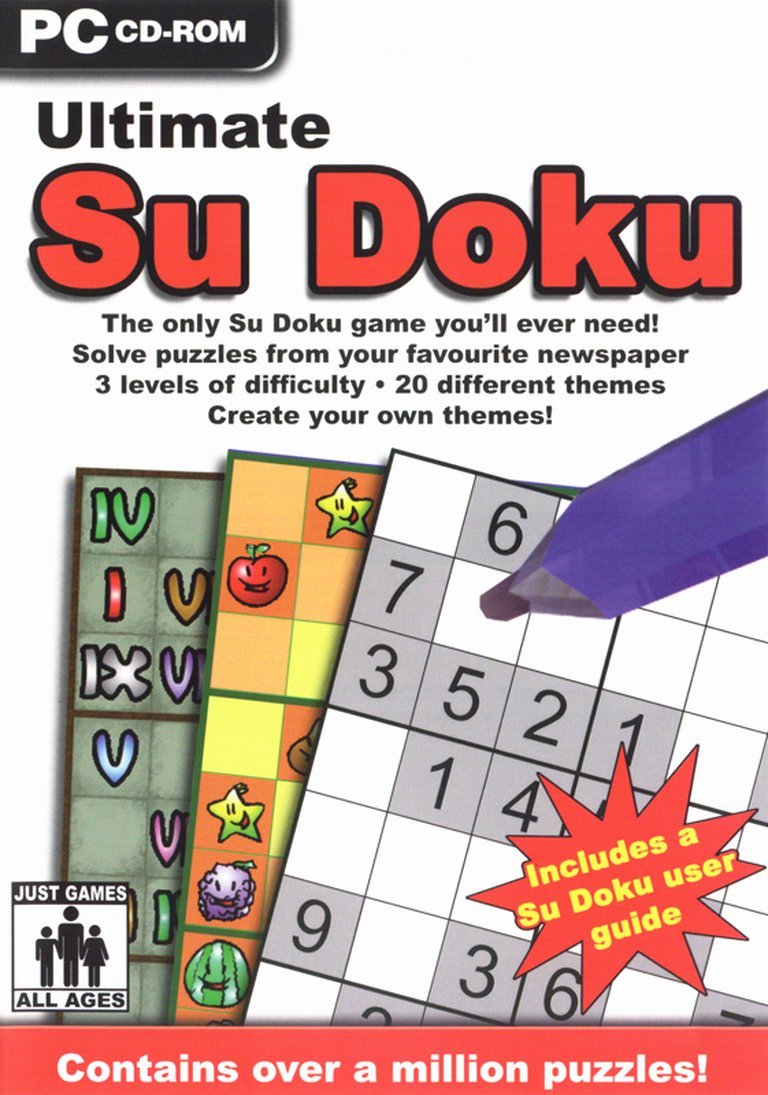
Ultimate Su Doku is a highly customizable Sudoku game released in 2005 for Windows. Players can adjust difficulty levels, grid sizes (from 4×4 to 9×9), and choose from 20 tilesets, with the option to create or edit their own using an integrated image editor. The game features standard controls (left-click to place numbers, right-click to pencil in guesses), a high-score list, undo functionality, hints, and a toolkit for printing puzzles. It offers a blend of accessibility and depth for both casual and dedicated Sudoku enthusiasts.
Ultimate Su Doku Reviews & Reception
pocketgamer.com (50/100): An accurate recreation of the sudoku experience on mobile phone, but the lack of features makes for an ultimately disappointing affair.
vgtimes.com (55/100): A top-down strategy game with puzzle elements from the masters at Idigicon Limited.
Ultimate Su Doku Cheats & Codes
NDS (USA)
Input these codes using a Codebreaker device or emulator (e.g., Desmume).
| Code | Effect |
|---|---|
| 0000A233 59555345 01E315C1 427313FD |
Enable Code (Must Be On) |
| C9EFB4E8 08289537 | Low Time |
Ultimate Su Doku: A Deep Dive into the Quintessential Digital Sudoku Experience
Introduction: The Puzzle That Conquered the World
In the mid-2000s, the world was gripped by a phenomenon that transcended borders, languages, and cultures: Sudoku. Amidst this global craze, Ultimate Su Doku (2005) emerged as a definitive digital adaptation of the beloved number puzzle, developed and published by the UK-based studio Idigicon Limited. While Sudoku’s origins trace back to 18th-century Swiss mathematician Leonhard Euler and its modern form to 1979’s Number Place by Howard Garns, Ultimate Su Doku represented a pivotal moment in the puzzle’s digital evolution. This review explores how the game captured the essence of Sudoku while innovating in accessibility, customization, and player engagement, cementing its place as a cornerstone of early 2000s casual gaming.
Development History & Context: Riding the Sudoku Wave
The Studio Behind the Game
Idigicon Limited, a relatively obscure UK developer, seized the opportunity presented by Sudoku’s explosive popularity in 2005. The studio’s modest team—credited with just four individuals (Rich Hanson, Ric Lumb, Steve Smith, and Bo Haglund, who provided the Sudoku engine DLL)—crafted a game that was both a product of its time and a testament to the power of simplicity in design. The game’s development coincided with Sudoku’s transition from niche puzzle to mainstream obsession, fueled by its adoption in newspapers like The Times and USA Today, as well as its digital proliferation.
Technological Constraints and Design Philosophy
Released exclusively for Windows via CD-ROM, Ultimate Su Doku was constrained by the hardware limitations of the mid-2000s. Yet, these constraints bred creativity. The game’s top-down perspective and mouse-driven interface (left-click to place numbers, right-click to pencil in guesses) were intuitive, leveraging the familiarity of point-and-click mechanics. The inclusion of a Sudoku engine DLL by Bo Haglund underscored the game’s technical foundation, ensuring robust puzzle generation and validation.
The Gaming Landscape of 2005
The mid-2000s were a golden age for casual and puzzle games, with titles like Bejeweled (2001) and Peggle (2007) dominating the space. Ultimate Su Doku entered this landscape as part of a broader Sudoku gaming boom, competing with titles like Sudoku Master (2005) and Big Su Doku (2007). Its differentiation lay in its customization options, which appealed to both novices and veterans of the puzzle genre.
Narrative & Thematic Deep Dive: The Story of a Number
The Absence of Narrative
Unlike traditional video games, Ultimate Su Doku eschews narrative entirely. There are no characters, no plot, and no dialogue—just the pure, unadulterated challenge of the puzzle itself. This minimalism is its strength. The game’s “story” is the player’s journey from confusion to mastery, from frustration to euphoria upon solving a particularly vexing grid. The thematic underpinning is one of logic, patience, and perseverance, universal themes that resonate across cultures.
The Cultural Phenomenon of Sudoku
The game’s thematic depth is rooted in Sudoku’s cultural significance. As detailed in sources like Sudoku Dragon and Kokolikoko, Sudoku’s evolution from Euler’s Latin Squares to Garns’ Number Place and finally to its Japanese refinement reflects a global collaboration of mathematical and recreational thought. Ultimate Su Doku taps into this legacy, offering players a direct connection to a puzzle that has captivated minds for centuries.
Gameplay Mechanics & Systems: The Art of the Puzzle
Core Gameplay Loop
At its heart, Ultimate Su Doku is a digital translation of the classic Sudoku rules:
– Fill a 9×9 grid with numbers 1–9.
– No repetition in rows, columns, or 3×3 subgrids.
– Use logic to deduce the correct placement of numbers.
The game’s brilliance lies in its execution of these simple rules. The left-click/right-click mechanics for placing numbers and penciling in guesses are intuitive, while the undo function and hint system provide a safety net for players. The high-score list for fastest solvers adds a competitive edge, though it’s secondary to the personal satisfaction of solving a puzzle.
Customization and Accessibility
Ultimate Su Doku’s standout feature is its customization:
– Difficulty Levels: Three tiers (Easy, Medium, Hard) cater to players of all skill levels.
– Grid Sizes: Options range from 4×4 (for beginners) to the standard 9×9, with intermediate sizes like 6×6.
– Tilesets: Twenty included tilesets, with an integrated image editor for creating custom visual themes. This feature was revolutionary for its time, allowing players to personalize their experience.
The game also includes a toolkit for printing puzzles, a nod to Sudoku’s newspaper roots and a practical feature for players who wanted to solve on the go.
Innovative Systems
While Ultimate Su Doku doesn’t reinvent the wheel, it refines the Sudoku experience in several ways:
– Pencil Marks: The ability to jot down potential numbers in a cell is a staple of Sudoku, and the game’s implementation is seamless.
– Hint System: A lifeline for stuck players, though its use is optional, preserving the integrity of the puzzle.
– Error Highlighting: Visual feedback for incorrect placements helps players learn from mistakes without outright solving the puzzle for them.
Flaws and Limitations
The game is not without its shortcomings:
– Lack of Advanced Features: Unlike later Sudoku games, Ultimate Su Doku lacks time trials, multiplayer modes, or dynamic difficulty adjustment.
– Repetitive Gameplay: For players seeking variety, the absence of alternative puzzle types (e.g., Killer Sudoku, Jigsaw Sudoku) may feel limiting.
– No Save Function: Puzzles must be completed in one sitting, a notable omission given the game’s 2005 release.
World-Building, Art & Sound: Minimalism as a Virtue
Visual Design
Ultimate Su Doku’s art direction is functional rather than flashy. The top-down perspective and grid-based layout are clean and uncluttered, ensuring that the focus remains on the puzzle. The inclusion of twenty tilesets—ranging from classic black-and-white to more elaborate themes—allows players to tailor the visual experience to their preferences. The integrated image editor is a standout feature, empowering players to create their own aesthetic, a rarity in puzzle games of the era.
Sound and Music
The game’s audio design is minimalist, with no soundtrack or sound effects to speak of. This absence is intentional, as Sudoku is a game of concentration, and extraneous noise would detract from the experience. The silence is, in itself, a design choice that enhances immersion.
Atmosphere and Setting
There is no “world” in Ultimate Su Doku beyond the grid itself. The game’s setting is the player’s mind, and its atmosphere is one of quiet focus. The lack of distractions—no animations, no cutscenes, no unnecessary flourishes—creates a meditative space where the player and the puzzle exist in harmony.
Reception & Legacy: A Quiet Triumph
Critical and Commercial Reception
Ultimate Su Doku flew under the radar of major gaming publications, with no critic reviews archived on platforms like Metacritic or MobyGames. However, its inclusion in Mega Sudoku Plus (2005) and its presence on abandonware sites like My Abandonware and Retrolorean suggest a cult following. Player reviews, while scarce, praise its customization options and faithful adaptation of Sudoku mechanics.
Influence on the Genre
While Ultimate Su Doku did not revolutionize the Sudoku genre, it contributed to the normalization of digital Sudoku games. Its customization features, particularly the tileset editor, influenced later titles like Ultimate Sudoku (2005) by puzzle.tv, which expanded on the concept with additional grid sizes and multiplayer support. The game’s legacy is one of quiet innovation, proving that even the simplest puzzles could benefit from thoughtful digital design.
The Sudoku Boom and Beyond
The mid-2000s Sudoku craze was a fleeting but impactful moment in gaming history. Ultimate Su Doku rode this wave, offering a polished, customizable experience that stood out in a crowded market. While it may not be remembered as a landmark title, it played a role in shaping the digital puzzle landscape, paving the way for more ambitious Sudoku games and puzzle hybrids.
Conclusion: The Ultimate Digital Sudoku Experience?
Ultimate Su Doku is a paradox: a game with no story, no characters, and no flashy graphics, yet it is deeply engaging. Its strength lies in its purity—it is Sudoku, distilled to its essence and enhanced by thoughtful digital design. The customization options, intuitive controls, and lack of distractions make it a standout title in the genre, even if it lacks the bells and whistles of later entries.
Final Verdict: 8/10 – A Masterclass in Puzzle Design
Ultimate Su Doku is not a game for those seeking narrative depth or action-packed gameplay. It is, however, a masterclass in how to adapt a classic puzzle for the digital age. Its customization features, accessibility, and faithful adherence to Sudoku’s core mechanics make it a must-play for puzzle enthusiasts. While it may not have left a lasting mark on gaming history, it remains a shining example of how simplicity and elegance can create a timeless experience.
For fans of Sudoku, Ultimate Su Doku is more than just a game—it’s a celebration of logic, patience, and the joy of solving. And in a world increasingly dominated by complex, story-driven experiences, its minimalism is a breath of fresh air.