
- Release Year: 1996
- Platforms: Macintosh, Pippin, Windows 16-bit, Windows
- Publisher: Bandai Digital Entertainment Corp., Hasbro Interactive, Inc.
- Developer: Duck Soup Productions Inc., Turning Point Software
- Genre: Adventure, Educational
- Perspective: 3rd-person
- Game Mode: Single-player
- Gameplay: Disguise customization, Inventory management, Mini-games, Point-and-click, Puzzle elements
- Setting: Country Fair, Veggie Valley
- Average Score: 72/100
Description
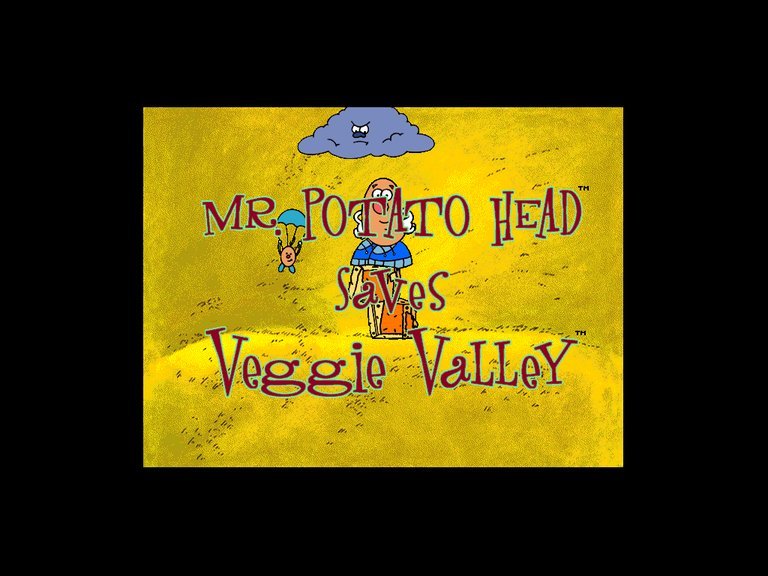
Mr. Potato Head Saves Veggie Valley is a charming educational adventure game designed for preschoolers, where players join Mr. Potato Head and his daughter, Sweet Potato, on a quest to save their drought-stricken valley and its threatened Country Fair. The game features point-and-click gameplay, simple puzzles centered around item collection and usage, and a disguise editor that lets players customize the characters’ appearances. With fully-voiced interactions, mini-games like a counting-themed pinball and a fishing match game, and two difficulty levels, it blends lighthearted fun with early learning concepts.
Gameplay Videos
Mr. Potato Head Saves Veggie Valley Guides & Walkthroughs
Mr. Potato Head Saves Veggie Valley Reviews & Reception
myabandonware.com (85/100): This is a really great game for the younger ones.
mobygames.com (60/100): A short educational adventure game with point-and-click controls.
Mr. Potato Head Saves Veggie Valley: A Nostalgic Journey Through a Forgotten Edutainment Classic
Introduction: The Humble Spud’s Digital Adventure
In the mid-1990s, as the CD-ROM revolution transformed personal computers into multimedia powerhouses, a peculiar hero emerged from the world of children’s toys to save a drought-stricken valley. Mr. Potato Head Saves Veggie Valley (1995) stands as a fascinating artifact of the edutainment boom—a time when toy manufacturers and software developers collaborated to create interactive experiences that were equal parts education and entertainment. This point-and-click adventure, developed by Duck Soup Productions and Turning Point Software under the Hasbro Interactive banner, may not have reshaped the gaming landscape, but it occupies a unique niche in the history of children’s software.
At its core, the game is a charming, if simplistic, quest where the iconic plastic tuber and his daughter, Sweet Potato, must restore rainfall to their parched homeland. Yet beneath its whimsical surface lies a carefully constructed educational tool designed to teach problem-solving, basic arithmetic, and creative expression to preschoolers. This review will dissect the game’s development, narrative structure, gameplay mechanics, and cultural impact, arguing that while Mr. Potato Head Saves Veggie Valley may not be a masterpiece, it represents an important evolutionary step in the fusion of licensed properties and interactive learning.
Development History & Context: The Birth of an Edutainment Experiment
The Studio and the Vision
Duck Soup Productions and Turning Point Software, the studios behind Mr. Potato Head Saves Veggie Valley, were part of a wave of developers specializing in children’s software during the mid-1990s. Hasbro Interactive, the publishing arm of the toy giant, sought to leverage its vast catalog of intellectual properties to create digital experiences that would extend the play value of its physical toys. The choice of Mr. Potato Head—a character with a rich history dating back to 1952—as the protagonist was strategic. The toy’s modular, customizable nature made it an ideal candidate for an interactive adventure where players could manipulate the character’s appearance.
The game’s development coincided with the rise of CD-ROM-based edutainment titles like JumpStart and Reader Rabbit. Unlike those series, however, Mr. Potato Head Saves Veggie Valley was not part of an ongoing franchise. It was a standalone experiment, blending the familiarity of a beloved toy with the novelty of digital storytelling. The creative team, led by writers Laurie Bauman Arnold and Annie Fox, aimed to craft a narrative that was accessible to preschoolers while incorporating educational elements that aligned with early childhood development goals.
Technological Constraints and Platform Diversity
Released in November 1995, the game initially launched on PC CD-ROM before expanding to Macintosh and the ill-fated Apple Pippin in 1996. The Pippin version, published by Bandai Digital Entertainment, was particularly notable as it was one of the few titles available for the short-lived console. The game’s technical requirements were modest, reflecting the hardware limitations of the era. It ran on Windows 3.1 and Windows 95, as well as Classic Mac OS, ensuring broad accessibility for families with home computers.
The development team faced the challenge of creating a visually engaging experience within the constraints of early CD-ROM technology. The game’s art style was deliberately bright and cartoonish, with large, easily clickable objects to accommodate the motor skills of young players. Voice acting, a relatively new feature in children’s games at the time, was fully implemented, with Marcus Lewis voicing Mr. Potato Head and Isabel Estrada as Sweet Potato. This attention to audio detail was part of a broader industry trend toward making educational software more immersive.
The Gaming Landscape of 1995
The mid-1990s were a golden age for edutainment software. Companies like Broderbund, The Learning Company, and Humongous Entertainment dominated the market with titles that combined learning objectives with engaging gameplay. Mr. Potato Head Saves Veggie Valley entered this competitive space as a licensed property, competing with original IPs like Freddi Fish and Putt-Putt.
What set it apart was its reliance on a pre-existing, widely recognized character. Hasbro’s strategy was to create a digital extension of the physical toy, allowing children to interact with Mr. Potato Head in a new way. The game’s release also coincided with the growing popularity of multimedia PCs in households, making it a timely product for tech-savvy parents looking to supplement their children’s learning with interactive software.
Narrative & Thematic Deep Dive: A Simple Story with Educational Depth
Plot Overview: A Quest for Rain
The game’s narrative is straightforward but effective for its target audience. Veggie Valley, the idyllic home of Mr. Potato Head and his family, is suffering from a severe drought. The local rain cloud, which should be watering the crops, has instead drifted over the nearby Country Fair. Determined to save their home, Mr. Potato Head and Sweet Potato embark on a journey to the fair, where they must complete a series of tasks to earn the use of an airplane. Their ultimate goal is to lasso the cloud and bring it back to Veggie Valley.
The story unfolds across several key locations:
1. Mr. Potato Head’s House: The game begins here, with the family discussing the drought and deciding on a plan.
2. The Journey to the Fair: The duo travels through the valley, encountering various characters and obstacles.
3. The Country Fair: The bulk of the gameplay takes place here, where players complete mini-games and puzzles to progress.
4. The Airplane Ride: After completing the tasks, the potatoes use the plane to capture the cloud.
5. The Return to Veggie Valley: The residents stack themselves to reach the cloud, and Sweet Potato’s silly costume finally coaxes it into raining.
Character Analysis: The Potato Family and Beyond
-
Mr. Potato Head: The protagonist is portrayed as a capable but somewhat bumbling father figure. His role is primarily to guide the player through the game’s challenges, offering encouragement and occasional hints. His voice acting, provided by Marcus Lewis, gives him a warm, avuncular tone that resonates with young players.
-
Sweet Potato: As the daughter, Sweet Potato is more adventurous and curious. She often takes the lead in solving puzzles, reinforcing the game’s educational themes. Isabel Estrada’s voice work captures the enthusiasm of a child, making her relatable to the target audience.
-
Mrs. Potato Head: Though she appears briefly at the beginning, her presence reinforces the family dynamic. Rinda Ray’s voice acting adds a nurturing tone to the household.
-
Supporting Characters: The fair is populated by a variety of anthropomorphic vegetables, each with distinct personalities. These characters serve as quest-givers and sources of information, often providing hints or items necessary for progression.
Themes: Problem-Solving, Teamwork, and Creativity
The game’s themes are carefully tailored to its preschool audience:
– Problem-Solving: The core gameplay loop revolves around gathering items and using them to overcome obstacles. This teaches children basic logic and cause-and-effect relationships.
– Teamwork: Mr. Potato Head and Sweet Potato work together, modeling cooperative behavior. The game subtly reinforces the idea that collaboration is key to success.
– Creativity: The disguise editor, a standout feature, allows players to customize the characters’ appearances. This not only adds a layer of fun but also encourages creative expression.
– Persistence: The game’s puzzles are designed to be challenging but not frustrating, teaching children the value of perseverance.
Dialogue and Voice Acting: A Fully Voiced Experience
One of the game’s strengths is its fully voiced dialogue. In an era when many children’s games relied on text or minimal audio, Mr. Potato Head Saves Veggie Valley stood out for its commitment to immersion. The voice acting is cheerful and engaging, with each character having a distinct vocal personality. This attention to audio detail helped make the game more accessible to pre-readers, ensuring that even the youngest players could follow the story.
Gameplay Mechanics & Systems: Point-and-Click Adventure for Preschoolers
Core Gameplay Loop: Exploration and Puzzle-Solving
The game is a classic point-and-click adventure, simplified for a young audience. Players control Mr. Potato Head and Sweet Potato as they explore Veggie Valley and the Country Fair. The core mechanics include:
– Inventory Management: Items collected are stored in Sweet Potato’s backpack. Players must use these items in the correct locations to progress.
– Puzzle-Solving: The puzzles are designed to be intuitive, often involving basic logic (e.g., finding a key to unlock a door or using a tool to fix something).
– Character Interaction: Clicking on characters triggers dialogue, which often provides hints or advances the plot.
Disguise Editor: A Standout Feature
One of the game’s most innovative elements is the disguise editor. Players can customize Mr. Potato Head and Sweet Potato by swapping out facial features, accessories, and clothing. This feature serves multiple purposes:
– Gameplay Utility: Certain puzzles require specific disguises to proceed. For example, dressing as a clown might be necessary to gain access to a particular area.
– Creative Play: The editor allows for open-ended experimentation, encouraging children to express their creativity.
– Educational Value: The act of mixing and matching features reinforces concepts like patterns and categorization.
Mini-Games: Educational Diversions
The Country Fair includes three mini-games, each designed to teach a specific skill:
1. Funny Photo Booth: Essentially a second disguise editor, this mini-game lets players create silly faces and take virtual photos.
2. Counting Pinball: A pinball game that teaches basic counting. Players must hit numbered bumpers in sequence to score points.
3. Match & Catch Fishing: A memory game where players match pairs of fish. This reinforces pattern recognition and memory skills.
These mini-games are accessible from the main menu, allowing players to engage with them independently of the main story. They also feature two difficulty levels, making the game adaptable to different skill levels.
User Interface and Accessibility
The UI is designed with young children in mind:
– Large, Colorful Icons: Buttons and interactive elements are oversized and brightly colored, making them easy to identify.
– Simple Controls: The game is entirely mouse-driven, with no complex key combinations required.
– Visual and Audio Feedback: Actions are accompanied by animations and sound effects, providing immediate feedback to the player.
Difficulty and Progression
The game’s difficulty is carefully balanced for its target audience. Puzzles are straightforward, and the game provides ample hints through dialogue and environmental clues. The two difficulty settings adjust the complexity of the mini-games, ensuring that both younger and slightly older children can enjoy the experience.
World-Building, Art & Sound: Crafting a Whimsical Veggie Universe
Setting and Atmosphere: A Colorful, Inviting World
Veggie Valley is a vibrant, cartoonish world filled with anthropomorphic vegetables and playful architecture. The art style is deliberately simple, with bold colors and exaggerated features that appeal to young children. The Country Fair, in particular, is a highlight, featuring a variety of attractions like a Ferris wheel, a pinball machine, and a fishing game.
The game’s atmosphere is cheerful and lighthearted, with a focus on positivity and cooperation. Even the drought, which serves as the central conflict, is presented in a way that is serious but not frightening. The overall tone is one of optimism, reinforcing the idea that problems can be solved through teamwork and creativity.
Visual Design: A Feast for Young Eyes
The visual design of Mr. Potato Head Saves Veggie Valley is a product of its time, reflecting the aesthetic sensibilities of mid-1990s children’s software. Key elements include:
– Character Design: The potatoes and other vegetables are rendered in a cartoonish style, with large eyes and expressive faces. This makes them instantly recognizable and relatable to young players.
– Environmental Detail: While the backgrounds are not overly complex, they are filled with interactive elements. Clicking on objects often triggers animations or sound effects, rewarding exploration.
– Consistency: The art style is consistent throughout the game, creating a cohesive visual experience. This is particularly important for young children, who benefit from familiarity and predictability.
Sound Design and Music: Enhancing the Experience
The game’s sound design is another area where it excels. The voice acting, as previously mentioned, is a standout feature, but the background music and sound effects also contribute to the immersive experience:
– Music: The soundtrack is upbeat and cheerful, with simple, repetitive melodies that are easy for children to remember. The music changes subtly depending on the location, helping to reinforce the game’s sense of place.
– Sound Effects: Every action, from clicking on an object to solving a puzzle, is accompanied by a sound effect. This provides immediate feedback and makes the game more engaging.
– Ambient Noise: The Country Fair, in particular, is filled with ambient sounds like laughter, carnival music, and the clinking of games. This helps to create a lively, dynamic atmosphere.
Reception & Legacy: A Forgotten Gem of the Edutainment Era
Critical and Commercial Reception
Mr. Potato Head Saves Veggie Valley received a mixed but generally positive reception upon release. All Game Guide, the only major critic to review the game, awarded it a 60%, praising its educational value and entertainment factor but noting its simplicity. Player reviews on MobyGames average 3.8 out of 5, with many nostalgic comments from adults who played it as children.
Commercially, the game was not a blockbuster, but it found a niche audience among parents looking for educational software. Its inclusion in the Mac Kids Pack in 2000 helped extend its lifespan, introducing it to a new generation of players.
Evolution of Reputation
Over the years, Mr. Potato Head Saves Veggie Valley has faded from the public consciousness, overshadowed by more popular edutainment franchises like JumpStart and Reader Rabbit. However, it retains a cult following among those who played it in their youth. Online forums and abandonware sites are filled with fond memories of the game, with many users expressing nostalgia for its simple charm.
Influence on Subsequent Games
While Mr. Potato Head Saves Veggie Valley did not spawn a direct sequel, it contributed to the broader trend of licensed edutainment software. Hasbro Interactive continued to produce similar titles, such as Mr. Potato Head: Activity Pack (1997) and Mr. & Mrs. Potato Head Go on Vacation (2001). These games followed a similar formula, blending adventure gameplay with educational content.
The game’s influence can also be seen in modern educational apps, which often incorporate customization features and mini-games to teach basic skills. The disguise editor, in particular, foreshadowed the character customization options that are now standard in many children’s games.
Conclusion: A Small but Significant Step in Edutainment History
Mr. Potato Head Saves Veggie Valley is not a revolutionary game, nor is it likely to be remembered as a classic. However, it occupies an important place in the history of edutainment software. As one of the first licensed properties to successfully transition from physical toy to interactive adventure, it demonstrated the potential of digital play to extend the life of beloved characters.
The game’s strengths—its accessible gameplay, educational value, and charming presentation—make it a noteworthy example of how children’s software can be both fun and instructive. While it may not have the depth or complexity of modern games, its simplicity is part of its appeal. For the preschoolers of the mid-1990s, Mr. Potato Head Saves Veggie Valley was a gateway to the world of interactive storytelling, and for that, it deserves to be remembered.
Final Verdict: A charming, if modest, edutainment title that successfully blends learning and play. While it may not be a must-play for modern audiences, it remains a fascinating artifact of the CD-ROM era and a testament to the enduring appeal of Mr. Potato Head. 7/10 for its historical significance and educational value.