
- Release Year: 2009
- Platforms: Windows
- Publisher: Mastertronic Games Ltd.
- Genre: Compilation
- Game Mode: Single-player
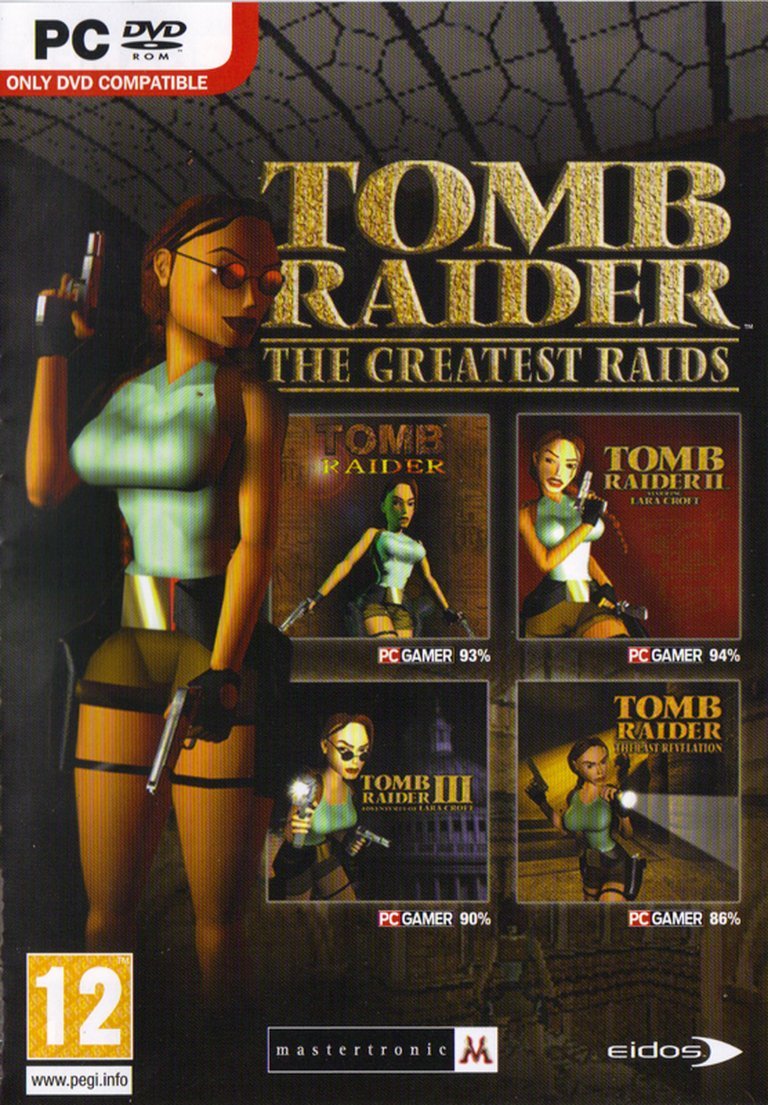
Description
Tomb Raider: The Greatest Raids is a compilation of the first four classic Tomb Raider games, originally released between 1996 and 1999. The collection includes Tomb Raider, Tomb Raider II, Tomb Raider III: Adventures of Lara Croft, and Tomb Raider: The Last Revelation, offering players the chance to experience Lara Croft’s iconic adventures across ancient tombs, perilous ruins, and exotic locations. These games are celebrated for their groundbreaking gameplay, exploration mechanics, and the introduction of Lara Croft as a pioneering female protagonist in gaming.
Tomb Raider: The Greatest Raids Free Download
Tomb Raider: The Greatest Raids Reviews & Reception
reddit.com : Underworld is my least favorite game in the series. I played it on PC and it was really buggy and the camera was going crazy while platforming.
gaminggorilla.com : Tomb Raider: Underworld, was very well-received by fans and critics.
gamesradar.com : One of the best-looking games on Xbox 360, Underworld represents the pinnacle of second-phase Lara.
Tomb Raider: The Greatest Raids Cheats & Codes
PlayStation (PSX) – NTSC
Enter codes at the inventory screen.
| Code | Effect |
|---|---|
| L2, R2, L1, Circle, Triangle, L1, R2, L2 | Skip to the next level |
| L1, Triangle, R2, L2(2), R2, Circle, L1 | All weapons and ammunition reload |
PlayStation (PSX) – PAL
Enter codes at the inventory screen.
| Code | Effect |
|---|---|
| L2, R2, Triangle, L1(2), Circle, R2, L2 | Skip to the next level |
| L1, Triangle, L2, R2(2), L2, Circle, L1 | All weapons and ammunition reload |
Tomb Raider Remastered (Tomb Raider 1)
Perform the following actions in-game.
| Code | Effect |
|---|---|
| Step forward, Step backwards, Turn around 3 times counter-clockwise, Jump forward | Skip to the next level |
| Step forward, Step backwards, Turn around 3 times counter-clockwise, Jump backwards | Unlock all guns with max ammo |
Tomb Raider Remastered (Tomb Raider 2)
Perform the following actions in-game.
| Code | Effect |
|---|---|
| Equip flare, Step forward, Step backwards, Turn around 3 times counter-clockwise, Jump forward | Skip to the next level |
| Equip flare, Step forward, Step backwards, Turn around 3 times counter-clockwise, Jump backwards | Unlock all guns with max ammo, max health packs, and max flares |
| Step forward, Step backwards, Turn around 3 times counter-clockwise, Jump backwards | Exploding Lara |
Tomb Raider Remastered (Tomb Raider 3)
Perform the following actions in-game.
| Code | Effect |
|---|---|
| Draw pistols, Step backwards, Step forwards, Crouch, Stand up, Turn around 3 times, Jump forward | Skip to the next level |
| Draw pistols, Step backwards, Step forwards, Crouch, Stand up, Turn around 3 times, Jump backwards | Unlock all guns with max ammo and max med kits |
| Draw any one-handed or dual-wielded weapon other than the pistols, Step backwards, Step forwards, Crouch, Stand up, Turn around 3 times, Jump either forwards or backwards | Exploding Lara |
PC Edition – v1.2 Revised
Face north and enter the inventory screen, then highlight the specified item and hold the corresponding keys.
| Code | Effect |
|---|---|
| L + I + F + T | Skip to the next level |
| C + T + R + L | Unlock all weapons |
| A + L + T + G + R | Unlock all items |
| F + I + R + E | God Mode |
PC Edition – v1.2 Supplemental
Perform the following actions in the inventory screen.
| Code | Effect |
|---|---|
| Press the LOOK button (0) and quickly press the 9 button at the top of your keyboard | Unlimited Large Medi Packs |
Tomb Raider: The Last Revelation (PlayStation)
Face north and hover over the specified item in the inventory screen, then press the corresponding buttons.
| Code | Effect |
|---|---|
| L1, L2, R1, R2 | Skip the Level |
| L1, L2, R1, R2, Up | All Weapons, Infinite Ammo, First Aid Kits, and Flares |
| L1, L2, R1, R2, Down | All Items |
Tomb Raider: Chronicles (PlayStation)
Hover over the specified item in the inventory screen, then press the corresponding buttons.
| Code | Effect |
|---|---|
| L1, Up, Cross/X | Skip the Level |
| L1, L2, R1, R2, Up | All Weapons, Infinite Ammo, First Aid Kits, and Flares |
| L1, L2, R1, R2, Down | All Items |
Tomb Raider: The Angel of Darkness (PlayStation)
Pause the game and hold the specified buttons, then return to gameplay and press the corresponding buttons.
| Code | Effect |
|---|---|
| Crouch, Look Around, Down, Action (pause screen), then Action, Up, Walk, Action, Right, Down (in-game) | Level Select |
| Drag, Look Around, Left, Action (pause screen), then Walk, Walk, Walk (in-game) | All Weapons and Medkits |
Tomb Raider Remastered (Maximum Health Cheat)
Press the following sequence of buttons on your controller.
| Code | Effect |
|---|---|
| PlayStation: R2, R2, L2, R2, L2, L2, L2, L2, L2, L2, R2, L2, L2, L2, R2, L2, L2, L2, L2, L2 | Maximum Health |
| Xbox: RT, RT, LT, RT, LT, LT, LT, LT, LT, LT, RT, LT, LT, LT, RT, LT, LT, LT, LT, LT | Maximum Health |
| Nintendo Switch: ZR, ZR, ZL, ZR, ZL, ZL, ZL, ZL, ZL, ZL, ZR, ZL, ZL, ZL, ZR, ZL, ZL, ZL, ZL, Z | Maximum Health |
Tomb Raider Remastered (Racetrack Key)
Press the following sequence of buttons on your controller.
| Code | Effect |
|---|---|
| R, L, L, L, R, L, L, L, L, L, L, R, L, L | Racetrack Key (in Lara’s home) |
PlayStation (PSX) – Default Controls
Enter codes at the inventory screen.
| Code | Effect |
|---|---|
| L1, Triangle, R2, L2, L2, R2, Circle, L1 | All Weapons |
| L2, R2, L1, Circle, Triangle, L1, R2, L2 | Level Skip |
PlayStation (PSX) – Control Method 2
Enter codes at the inventory screen.
| Code | Effect |
|---|---|
| Triangle, Circle, R2, L2, L2, R2, L1, Triangle | All Weapons |
| L2, R2, Triangle, L1, Circle, Triangle, R2, L2 | Level Skip |
PlayStation (PSX) – Control Method 3
Enter codes at the inventory screen.
| Code | Effect |
|---|---|
| Triangle, R1, R2, L2, L2, R2, L1, Triangle | All Weapons |
| L2, R2, Triangle, L1, R1, Triangle, R2, L2 | Level Skip |
PlayStation (PSX) – GameShark Codes
Enter the following GameShark codes.
| Code | Effect |
|---|---|
| 80089100 000A | Turbo Mode |
| 8008872C 0008 | All Items |
| 8008872C 0005 | All Guns |
| 8001FF24 3400, 8001FF26 3400 | Can walk in lava |
| 8017673E 0000, 8018130E 0000, 801947B2 0000, 801765E6 0000, 80188312 0000, 8018EB42 0000, 8019D332 0000, 801AB7AE 0000, 801A028A 0000, 80181E76 0000, 8018952E 0000, 8018EFE6 0000, 8019ED86 0000, 8019C392 0000, 801A2FD6 0000 | Color Modifier of Lara’s Skin & Clothes |
| 80176752 0000, 80181322 0000, 801947C6 0000, 801765FA 0000, 80188326 0000, 8018EB56 0000, 8019D346 0000, 801AB7C2 0000, 801A029E 0000 | Direction Lara Faces Modifier |
Tomb Raider: The Greatest Raids – A Definitive Retrospective
Introduction: The Legacy of a Legend
Few franchises in gaming history have left as indelible a mark as Tomb Raider. Since its debut in 1996, the series has redefined action-adventure gameplay, introduced one of gaming’s most iconic heroines, and evolved through multiple eras of technological and narrative innovation. Tomb Raider: The Greatest Raids, a 2009 compilation of the first four core games, serves as both a celebration of Lara Croft’s early adventures and a testament to the enduring appeal of the franchise. This retrospective will dissect the compilation’s historical significance, gameplay mechanics, narrative depth, and cultural impact, offering a comprehensive analysis of why these games remain essential to understanding the evolution of interactive entertainment.
Development History & Context: The Birth of an Icon
The Core Design Era (1996–2003)
The Tomb Raider series was born in the mid-1990s at Core Design, a British studio under Eidos Interactive. The original game, released in 1996, was a technical marvel, pushing the boundaries of 3D graphics and environmental storytelling. Inspired by Prince of Persia and Indiana Jones, the team sought to create a cinematic, puzzle-driven adventure. The protagonist, Lara Croft, was initially conceived as a male character but was reimagined as a female to avoid comparisons to Indiana Jones. Her design—athlete, intelligent, and fiercely independent—challenged the male-dominated gaming landscape of the era.
The success of Tomb Raider (1996) was meteoric, selling over 7 million copies and reversing Eidos’ financial struggles. This led to an aggressive annual release schedule, with sequels arriving in rapid succession:
– Tomb Raider II (1997) expanded the scope with larger environments and a more ambitious narrative.
– Tomb Raider III (1998) introduced branching pathways and multiple artifacts to collect.
– Tomb Raider: The Last Revelation (1999) refined the formula with improved AI and a darker, more cinematic story.
However, the pressure of annual releases took its toll. Tomb Raider: The Angel of Darkness (2003), developed for the PlayStation 2, was plagued by development issues, including engine limitations and rushed production. Its poor reception marked the end of Core Design’s tenure with the franchise.
The Compilation’s Role
Tomb Raider: The Greatest Raids (2009) arrived at a pivotal moment. Published by Mastertronic Games Ltd., the compilation was designed to reintroduce the classic games to a new generation of players. It included:
1. Tomb Raider (1996)
2. Tomb Raider II (1997)
3. Tomb Raider III: Adventures of Lara Croft (1998)
4. Tomb Raider: The Last Revelation (1999)
The compilation was released on Windows via DVD-ROM, offering a convenient way to experience the foundational entries in the series. While it lacked modern enhancements, it preserved the original gameplay and aesthetics, serving as a historical artifact for fans and scholars alike.
Narrative & Thematic Deep Dive: The Evolution of Lara Croft
Plot Overview
The four games in The Greatest Raids form a cohesive narrative arc, chronicling Lara Croft’s transformation from a seasoned adventurer to a global icon. Each game explores distinct themes while maintaining a consistent focus on archaeological discovery, ancient mysteries, and supernatural threats.
-
Tomb Raider (1996)
- Plot: Lara is hired by Jacqueline Natla to retrieve the Scion of Atlantis, a powerful artifact. As she uncovers the Scion’s pieces in Peru, Greece, and Egypt, she discovers Natla’s true intentions: to resurrect the lost civilization of Atlantis and rule the world.
- Themes: Betrayal, the dangers of unchecked ambition, and the ethical implications of archaeological exploitation.
-
Tomb Raider II (1997)
- Plot: Lara searches for the Dagger of Xian, a relic that grants its wielder the power of a dragon. Her quest pits her against Marco Bartoli, a mafia leader with his own designs on the dagger.
- Themes: The corrupting influence of power, the clash between ancient mysticism and modern crime.
-
Tomb Raider III: Adventures of Lara Croft (1998)
- Plot: Lara is tasked with recovering four meteorite artifacts scattered across the globe. The artifacts hold immense power, and their misuse could trigger catastrophic mutations.
- Themes: Environmentalism, the consequences of tampering with natural forces, and the hubris of scientific experimentation.
-
Tomb Raider: The Last Revelation (1999)
- Plot: Lara accidentally unleashes Set, the Egyptian god of chaos, while exploring his tomb. With the help of Semerkhet, she must re-imprison Set before he engulfs the world in darkness.
- Themes: Mythology vs. reality, the cyclical nature of history, and the personal cost of heroism.
Character Development
Lara Croft’s characterization evolves subtly across the four games:
– Early Games (1996–1998): Lara is portrayed as a confident, almost invincible adventurer, with little emotional depth. Her motivations are driven by curiosity and the thrill of discovery.
– The Last Revelation (1999): The game introduces Werner Von Croy, Lara’s former mentor, adding a layer of personal conflict. The ending, where Lara is trapped in a collapsing pyramid, hints at vulnerability, foreshadowing later narrative developments.
Dialogue and Writing
The dialogue in the early Tomb Raider games is minimal, relying on environmental storytelling and atmospheric cues to convey narrative. Cutscenes are sparse but effective, using full-motion video (FMV) to advance the plot. While the writing is functional rather than profound, it establishes the series’ pulp adventure tone, blending Indiana Jones-style escapism with gothic horror elements.
Gameplay Mechanics & Systems: The Foundation of a Genre
Core Gameplay Loop
The Tomb Raider series is built on a triad of exploration, puzzle-solving, and combat, a formula that has influenced countless action-adventure games. The Greatest Raids showcases the evolution of these mechanics across the first four entries.
-
Exploration and Platforming
- Movement: Lara’s tank controls (where pressing up moves her forward relative to her orientation) were revolutionary at the time but feel clunky by modern standards. Players must master precise jumps, shimmying along ledges, and mid-air grabs to navigate the treacherous environments.
- Level Design: The games feature non-linear, interconnected levels inspired by real-world archaeological sites. For example, Tomb Raider’s St. Francis’ Folly and Tomb of Tihocan are labyrinthine, requiring players to backtrack and revisit areas with new tools.
-
Puzzle-Solving
- Environmental Puzzles: Players must manipulate levers, switches, and movable blocks to progress. The puzzles are logic-based, often requiring spatial awareness and trial-and-error.
- Inventory System: Lara carries a limited set of tools, such as grappling hooks, flares, and keys, which are used to solve puzzles and unlock new areas.
-
Combat and Enemies
- Weapons: Lara’s dual pistols are her signature weapon, but she also wields shotguns, Uzis, and grenade launchers. Combat is lock-on based, with enemies ranging from wild animals (bears, wolves) to supernatural foes (mummies, mutants).
- Enemy AI: Early games feature predictable enemy patterns, but The Last Revelation introduces more aggressive, dynamic behaviors, such as enemies flanking the player.
Innovations and Flaws
-
Innovations:
- 3D Environmental Interaction: The ability to climb, swim, and crawl in a fully 3D space was groundbreaking.
- Save System: The use of save crystals (later replaced by manual saves) allowed players to manage progress strategically.
- Atmospheric Sound Design: The ambient audio cues (e.g., distant howls, echoing footsteps) enhanced immersion.
-
Flaws:
- Camera Issues: The fixed camera angles often obscure critical platforming sections, leading to frustration.
- Control Scheme: The tank controls and lack of analog movement make precise navigation difficult.
- Repetitive Combat: Enemy encounters can feel tedious, with little variation in tactics.
World-Building, Art & Sound: Crafting an Iconic Aesthetic
Visual Design
The Tomb Raider series is renowned for its atmospheric, detailed environments, which blend real-world architecture with fantastical elements.
-
Architectural Influences:
- Tomb Raider (1996): Peruvian ruins, Greek monasteries, Egyptian pyramids.
- Tomb Raider II (1997): The Great Wall of China, Venetian canals, Tibetan monasteries.
- Tomb Raider III (1998): Indian temples, Nevada deserts, Antarctic research bases.
- The Last Revelation (1999): Egyptian tombs, Cairo streets, Angkor Wat.
-
Lighting and Textures: The games use pre-rendered backgrounds and dynamic lighting to create a sense of depth. The Last Revelation introduces real-time lighting effects, enhancing the eerie atmosphere of its Egyptian settings.
Sound Design and Music
The audio design of Tomb Raider is a masterclass in immersion and tension.
- Ambient Sounds: The echoing drips of water, distant growls, and creaking mechanisms heighten the sense of isolation and danger.
- Voice Acting: Lara’s early voice actors (Shelley Blond, Judith Gibbins, Jonell Elliott) delivered stoic, no-nonsense performances, reinforcing her cool, collected persona.
- Music: Composer Nathan McCree crafted the iconic Tomb Raider theme, a haunting melody that blends orchestral grandeur with electronic undertones. Later games, such as The Last Revelation, incorporated ethnic instruments to reflect their settings.
Reception & Legacy: A Cultural Phenomenon
Critical and Commercial Reception
The Tomb Raider series was a critical and commercial juggernaut, with the first four games selling a combined 27 million copies by 2003.
- Tomb Raider (1996): 91% (PS1) on Metacritic, praised for its innovative gameplay and immersive worlds.
- Tomb Raider II (1997): 89% (PS1), lauded for its expanded scope and refined mechanics.
- Tomb Raider III (1998): 85% (PS1), criticized for its increased difficulty and repetitive puzzles.
- The Last Revelation (1999): 82% (PS1), praised for its narrative depth and improved AI, but marred by technical issues.
The Greatest Raids compilation received limited critical attention, but Retro Gamer awarded it 80%, noting:
“It’s easy to laugh at Lara’s pointy boobs now, but there’s no denying that the first three Tomb Raider games remain excellent gaming experiences. Yes, they look a little rough around the edges now, but the gameplay and sense of exploring huge locations is still perfectly handled.”
Cultural Impact
Lara Croft transcended gaming to become a global icon:
– Sex Symbol and Feminist Figure: Lara’s hyper-sexualized design sparked debates about female representation in gaming. While some criticized her as a male fantasy, others saw her as a symbol of female empowerment.
– Merchandising and Media: Lara appeared on magazine covers, in commercials, and even in a U2 concert. The 2001 and 2003 films starring Angelina Jolie further cemented her mainstream appeal.
– Industry Influence: Tomb Raider pioneered 3D platforming and cinematic storytelling, influencing games like Uncharted, Prince of Persia: The Sands of Time, and Assassin’s Creed.
Evolution of the Franchise
The Tomb Raider series has undergone three major reinventions:
1. Core Design Era (1996–2003): Focused on puzzle-solving and exploration.
2. Crystal Dynamics Era (2006–2018): Introduced modernized controls, narrative depth, and character development (Legend, Anniversary, Underworld).
3. Reboot Era (2013–Present): Emphasized survival mechanics and emotional storytelling (Tomb Raider 2013, Rise of the Tomb Raider, Shadow of the Tomb Raider).
Conclusion: The Enduring Appeal of Tomb Raider: The Greatest Raids
Tomb Raider: The Greatest Raids is more than a mere compilation; it is a time capsule of gaming history, preserving the foundational experiences that defined a genre. While the games show their age in controls and graphics, their level design, atmospheric storytelling, and pioneering gameplay remain influential.
Final Verdict
- Gameplay: 8/10 – Clunky controls and dated mechanics are offset by brilliant level design and satisfying exploration.
- Narrative: 7/10 – Simple but effective storytelling, with The Last Revelation offering the most depth.
- Visuals & Sound: 7/10 – Atmospheric and immersive, though technically limited by 1990s hardware.
- Legacy: 10/10 – A cornerstone of action-adventure gaming, with Lara Croft as one of the most iconic characters in media history.
Overall Score: 8.5/10 – A Must-Play for Fans of Gaming History
The Greatest Raids is essential for retro gamers, historians, and anyone interested in the evolution of interactive storytelling. While modern remasters (Tomb Raider I–III Remastered) offer polished alternatives, the original games retain a raw, unfiltered charm that captures the magic of their era. As Lara Croft continues to evolve, this compilation stands as a testament to her enduring legacy—a legacy built on courage, curiosity, and the thrill of the raid.