
- Release Year: 1980
- Platforms: Intellivision, Windows, Xbox 360
- Publisher: Mattel Electronics, Microsoft Corporation, Sears, Roebuck and Co.
- Developer: APh Technological Consulting
- Genre: Gambling, Sports
- Perspective: Side view
- Game Mode: Hotseat, Single-player
- Gameplay: Betting, Racing
- Setting: Horse racing
- Average Score: 94/100
Description
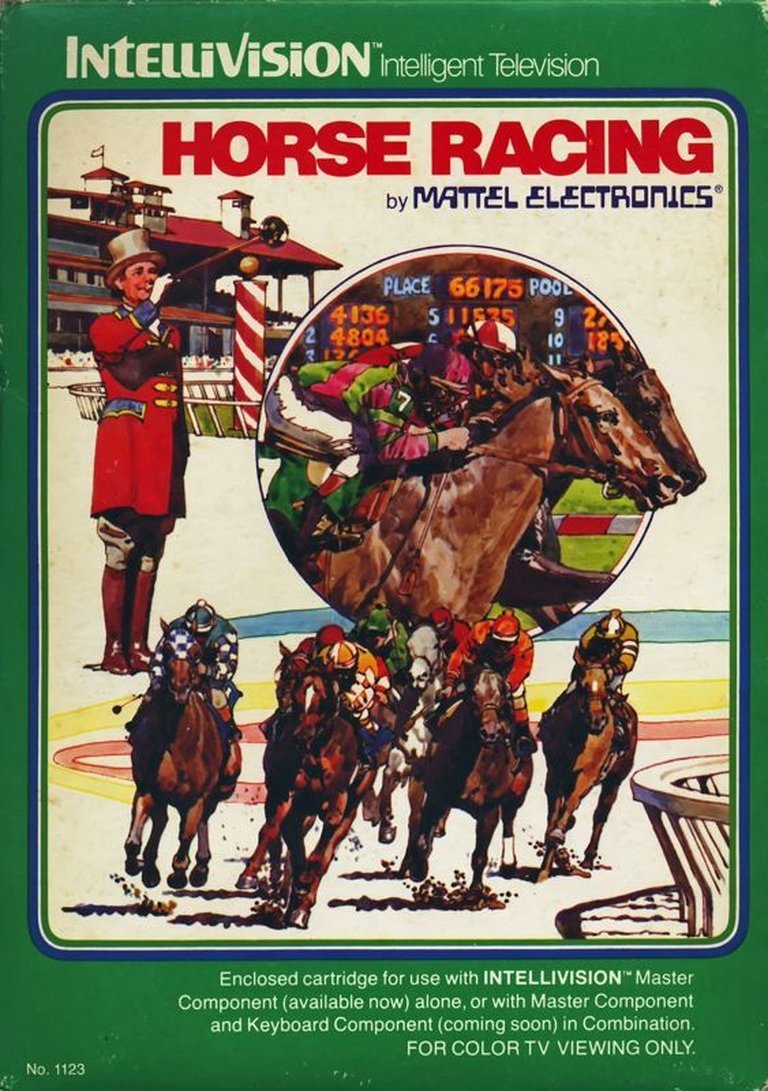
Horse Racing is a multiplayer sports and gambling game originally released for the Intellivision in 1980, allowing 1-6 players to bet on races and optionally control horses. Players can wager on winners or exactas, choose between player or CPU-controlled horses (with only the third and fourth horses playable), and race across varying terrain types like turf, mud, or dry tracks. Horses differ in speed, stamina, and performance under different conditions, while players use whips and coaxing to influence outcomes. Marketed as a party game, it blends strategic betting with competitive racing in a side-scrolling 2D format.
Gameplay Videos
Where to Buy Horse Racing
PC
Horse Racing Reviews & Reception
mobygames.com (88/100): This game, which sold over a quarter of a million copies, was marketed as a party game since up to six people could play at the same time.
myabandonware.com (100/100): My family would play this game, it was so exciting and so much fun!! for that time, the graphics were still amazing and even now I would play it because it let you see how each horse did on different turfs.
Horse Racing: A Galloping Glimpse into Early Sports Gaming
Introduction
In the annals of video game history, few titles capture the spirit of early multiplayer gaming quite like Horse Racing for the Intellivision. Released in 1980 by Mattel Electronics, this game was not just a sports simulation but a social experience, blending the thrill of horse racing with the strategic depth of parimutuel betting. At a time when video games were still finding their footing, Horse Racing stood out as a pioneering title that brought friends and families together around the television, transforming living rooms into bustling race tracks and betting parlors. This review will delve into the game’s development, mechanics, cultural impact, and lasting legacy, exploring why it remains a fascinating artifact of gaming’s formative years.
Development History & Context
The Birth of a Console Classic
Horse Racing was developed by APh Technological Consulting and published by Mattel Electronics for the Intellivision, a console that sought to compete with the Atari 2600 by offering more advanced graphics and gameplay. The game was designed by Chris Hawley, who would go on to work on other Intellivision titles, and it was released on October 3, 1980. The Intellivision, with its 16-bit processor and advanced graphics capabilities for the time, provided the perfect platform for a game that required both visual clarity and complex input mechanics.
The Intellivision’s unique controller, featuring a numeric keypad and side action buttons, was integral to Horse Racing‘s design. The keypad allowed players to input bets and select horses, while the side buttons were used to coax or whip horses during races. This controller layout was a double-edged sword—it offered precision and depth but also presented a steep learning curve for new players.
The Gaming Landscape of 1980
The late 1970s and early 1980s were a period of rapid evolution in the video game industry. Arcade games like Space Invaders and Pac-Man were dominating public spaces, while home consoles were beginning to carve out their own niche. The Intellivision, with its emphasis on sports and strategy games, positioned itself as a more sophisticated alternative to the Atari 2600. Horse Racing fit neatly into this strategy, offering a game that was both a sports simulation and a gambling experience, appealing to a broader audience than typical arcade fare.
The game’s release coincided with a growing interest in horse racing as a spectator sport in the United States. The Kentucky Derby, Preakness Stakes, and Belmont Stakes were cultural events, and the idea of bringing that excitement into the home was a compelling one. Mattel Electronics capitalized on this by marketing Horse Racing as a party game, emphasizing its multiplayer capabilities and the social interaction it facilitated.
Technological Constraints and Innovations
Developing a horse racing game for the Intellivision presented several technical challenges. The console’s hardware limitations meant that the game had to be designed with simplicity in mind, yet it still needed to capture the essence of horse racing. The solution was a side-scrolling 2D track with basic animations for the horses and a focus on the betting mechanics to add depth.
One of the most innovative aspects of Horse Racing was its use of the Intellivision’s numeric keypad for betting. Players could input their bets and select horses with precision, a feature that was not common in other sports games of the era. The game also included a variety of track conditions (dry, turf, and muddy) and horse attributes (speed, stamina, and racing style), which added layers of strategy to the betting process.
The game’s sound design was another area where it pushed the boundaries of the Intellivision’s capabilities. The “Call to the Post” fanfare and the cheering crowd sounds were simple by modern standards but immersive for the time, helping to create a sense of atmosphere that drew players into the experience.
Narrative & Thematic Deep Dive
The Fictional World of Plympton Downs
Horse Racing is set in the fictional Plympton Downs, a race track located in western Kentucky. The track is named after George Plimpton, a renowned sportscaster and writer who was also a prominent figure in Mattel’s marketing efforts for the Intellivision. The game’s horses are housed in the equally fictional Rainbow Thoroughbred Stables, a stable that serves as the backdrop for the game’s racing action.
The horses in Horse Racing are not named in the traditional sense but are instead identified by their colors, a design choice that reflects the game’s focus on accessibility and simplicity. Each horse has a unique personality and set of attributes, which are randomly assigned at the start of each race. This randomness ensures that no two races are the same, adding an element of unpredictability that mirrors real-life horse racing.
The Horses of Rainbow Thoroughbred Stables
The game features eight horses, each with distinct characteristics:
- Pink Lady (Pink) – A front-runner with strong early speed.
- Red Devil (Red) – A pace-setter known for its consistency.
- Sun Shine Shake (Orange) – A versatile horse that can adapt to different track conditions.
- Gold Torts (Yellow) – A come-from-behind horse with strong finishing speed.
- Green Goblin (Green) – A horse with balanced attributes, excelling in neither speed nor stamina.
- Blue Boy (Blue) – A horse that performs well on turf tracks.
- Grape Ghost (Violet/Purple) – A horse with unpredictable behavior, capable of surprising upsets.
- Snowy Guy (White) – A horse that replaces the originally planned “Black Maurauder,” excelling in muddy conditions.
The inclusion of these varied horse types allows players to develop strategies based on track conditions and race distances, adding depth to the betting mechanics.
Themes of Chance and Strategy
At its core, Horse Racing is a game about the interplay between chance and strategy. The random assignment of horse attributes ensures that luck plays a significant role in the outcome of each race, much like in real-life horse racing. However, the game also rewards players who take the time to study the horses’ past performances and track conditions, allowing them to make more informed bets.
The game’s betting mechanics are central to its thematic depth. Players can place win bets (betting on a single horse to win) or exacta bets (betting on two horses to finish first and second in the correct order). This system encourages players to think strategically about their bets, weighing the potential payouts against the likelihood of a horse winning.
The social aspect of the game is another key theme. Horse Racing was designed to be played with up to six players, making it one of the first multiplayer sports games to emphasize group interaction. The game’s party atmosphere, complete with betting and trash-talking, was a major selling point and contributed to its popularity as a social experience.
Gameplay Mechanics & Systems
The Betting Phase
The game begins with the betting phase, where players are given a simulated bankroll of $750. Each player inputs their player number (1-6) using the Intellivision’s numeric keypad and then places their bets. The betting options are limited to win and exacta bets, which are selected by pressing the [9] key on the keypad. Players can access past performance data for each horse by pressing the side action buttons, allowing them to make more informed decisions.
The betting phase is where much of the game’s strategy comes into play. Players must consider the odds, track conditions, and horse attributes when placing their bets. The game’s randomness ensures that no single horse is guaranteed to win, adding an element of unpredictability that keeps the betting phase exciting.
The Racing Phase
Once all bets are placed, the race begins with the “Call to the Post” fanfare. The starting gate opens, and the four horses (selected from the eight available) begin racing. Players who have chosen to control a horse (only the third and fourth horses can be player-controlled) use the Intellivision’s disk/joystick to guide their horse. The side action buttons are used to coax (top button) or whip (bottom button) the horse, which can help to spur it to greater speeds or recover from fatigue.
The racing phase is where the game’s simplicity becomes apparent. The track is a side-scrolling 2D environment with basic animations for the horses. The horses’ speeds vary based on their attributes and the track conditions, with some horses performing better on dry tracks and others excelling in muddy conditions. The races range in length from 3 to 10 furlongs, with the horses slowing down as they approach the finish line, mimicking the fatigue experienced by real racehorses.
The Results and Payouts
After the race concludes, the results are displayed on a tote board, showing the finishing order of the horses and the elapsed time. The game then returns to the betting phase for the next race. After all 10 races in the match program are completed, a “GAME OVER” screen appears, showing each player’s final bankroll. The player with the highest bankroll is declared the winner.
The payout system in Horse Racing is based on the odds assigned to each horse at the start of the race. Winning bets are paid out according to these odds, with exacta bets offering higher payouts due to their increased difficulty. The game’s betting mechanics are designed to be accessible to casual players while still offering enough depth to keep experienced players engaged.
Innovations and Flaws
Horse Racing introduced several innovations to the sports gaming genre. Its use of the Intellivision’s numeric keypad for betting was a novel approach that added a layer of strategy not seen in other sports games of the era. The inclusion of multiple track conditions and horse attributes also set it apart from simpler racing games, which often featured identical tracks and horses.
However, the game was not without its flaws. The racing mechanics were relatively simplistic, with limited player control over the horses. The races themselves were often not very close, which could lead to frustration for players who had placed bets on losing horses. Additionally, the game’s reliance on randomness meant that luck played a significant role in the outcome, which could be off-putting to players who preferred more skill-based gameplay.
Despite these flaws, Horse Racing was a groundbreaking title that pushed the boundaries of what was possible on the Intellivision. Its blend of sports simulation and gambling mechanics, combined with its multiplayer focus, made it a standout title in the early days of console gaming.
World-Building, Art & Sound
The Visual Design
Horse Racing features a simple but effective visual design that captures the essence of horse racing. The track is displayed in a side-scrolling 2D perspective, with the color of the track changing based on the conditions (khaki for dry, pine green for turf, and brown for muddy). The horses are represented as colorful sprites, with each horse’s color corresponding to its name (e.g., Pink Lady is pink, Red Devil is red).
The game’s visuals are functional rather than flashy, with a focus on clarity and readability. The horses are easily distinguishable from one another, and the track conditions are clearly indicated by the color of the track. The starting gate and finish line are also well-defined, ensuring that players can follow the action without confusion.
The Sound Design
The sound design in Horse Racing is minimal but effective. The game features a “Call to the Post” fanfare at the start of each race, which helps to build anticipation and immerse players in the experience. The sound of the cheering crowd as the horses cross the finish line adds to the excitement, while the sound of the horses’ hooves and the furlong markers provide auditory feedback during the race.
The Intellivision’s sound capabilities were limited compared to modern consoles, but Horse Racing makes the most of what was available. The game’s sound effects are simple but serve their purpose, enhancing the overall atmosphere without overwhelming the player.
The Atmosphere
Horse Racing succeeds in creating a lively and engaging atmosphere that captures the excitement of a day at the races. The combination of the betting mechanics, the randomness of the horse attributes, and the social interaction between players all contribute to this atmosphere. The game’s party-focused design ensures that it is as much about the experience of playing with friends as it is about the racing itself.
The fictional setting of Plympton Downs and the Rainbow Thoroughbred Stables adds a touch of charm to the game, giving it a distinct identity that sets it apart from other sports titles. The game’s focus on horse racing as a social event, rather than just a competitive sport, is one of its most enduring qualities.
Reception & Legacy
Critical and Commercial Reception
Horse Racing was well-received by critics upon its release, earning an average score of 88% based on three reviews. The French magazine Tilt gave the game a perfect score of 6/6, praising its faithful recreation of horse racing and its appeal to both casual and hardcore gamers. All Game Guide awarded it a 4.5/5, highlighting the game’s unique blend of betting and racing mechanics. The Video Game Critic gave it a 75/100, noting that while the races themselves were not always close, the game offered as much as could be expected from a horse racing title at the time.
Commercially, Horse Racing was a success, selling over a quarter of a million copies. Its popularity was due in large part to its multiplayer focus, which made it a hit at parties and social gatherings. The game’s inclusion in the Intellivision’s “Gaming Network” branding also helped to boost its profile, positioning it as a premium title in Mattel’s lineup.
Evolution of Reputation
Over the years, Horse Racing has maintained a positive reputation among retro gaming enthusiasts. While it may not be as well-remembered as some of the Intellivision’s other sports titles, such as Major League Baseball or NFL Football, it is still regarded as a pioneering title that pushed the boundaries of what was possible on the console. Its blend of sports simulation and gambling mechanics, combined with its multiplayer focus, has ensured that it remains a unique and interesting artifact of early gaming history.
The game’s legacy is also evident in its inclusion in the Intellivision Lives! compilation, which was released in 1998 for personal computers and modern consoles. This compilation introduced Horse Racing to a new generation of players, helping to preserve its place in gaming history.
Influence on Subsequent Games
Horse Racing was one of the first video games to successfully combine sports simulation with gambling mechanics, a formula that would be replicated in later titles. Games like Arlington Horse Racing (1990) and Horse Racing Simulator (1990) built on the foundation laid by Horse Racing, offering more detailed simulations and expanded betting options. The game’s multiplayer focus also influenced later sports titles, which increasingly emphasized social interaction and group play.
While Horse Racing may not have had the same level of influence as some of the Intellivision’s other sports titles, its unique blend of mechanics and its status as a party game have ensured that it remains a notable entry in the history of video games.
Conclusion
Horse Racing for the Intellivision is a fascinating snapshot of early sports gaming, blending the thrill of horse racing with the strategic depth of parimutuel betting. Its innovative use of the Intellivision’s numeric keypad for betting, combined with its multiplayer focus, made it a standout title in the console’s library. While its racing mechanics were relatively simplistic, the game’s emphasis on social interaction and its unique blend of chance and strategy ensured that it remained a popular choice for parties and gatherings.
Today, Horse Racing is remembered as a pioneering title that pushed the boundaries of what was possible on the Intellivision. Its legacy is evident in the many horse racing games that followed, as well as in the continued popularity of multiplayer sports titles. For retro gaming enthusiasts, Horse Racing offers a glimpse into the early days of console gaming, when simplicity and innovation went hand in hand.
Final Verdict: Horse Racing is a classic example of early sports gaming, offering a unique blend of betting and racing mechanics that set it apart from other titles of its era. While its gameplay may feel dated by modern standards, its historical significance and multiplayer focus make it a worthy addition to any retro gaming collection. 7.5/10