
- Release Year: 2012
- Platforms: Windows
- Publisher: dtp entertainment AG
- Genre: Compilation
- Game Mode: Single-player
- Setting: Haunted Mansion
Description
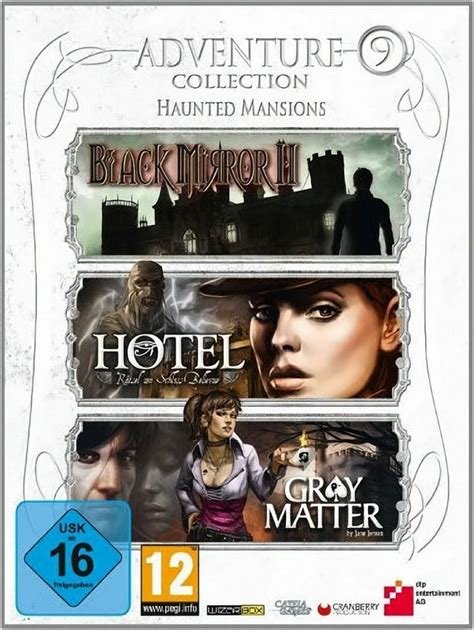
Adventure Collection 9: Haunted Mansions is a compilation of three adventure games—Black Mirror II: Reigning Evil, Gray Matter, and Hotel—each set in eerie, supernatural mansions. Players explore dark, atmospheric environments filled with mysteries, puzzles, and haunting narratives, uncovering secrets and confronting otherworldly forces. The collection offers a mix of psychological horror, investigative gameplay, and immersive storytelling, perfect for fans of gothic adventure games.
Adventure Collection 9: Haunted Mansions – A Comprehensive Retrospective
Introduction: The Allure of the Haunted Mansion Anthology
Few settings in gaming evoke as much atmospheric dread and gothic intrigue as the haunted mansion. Adventure Collection 9: Haunted Mansions, released in 2012 by dtp entertainment AG, is a curated trilogy of point-and-click adventures that leans into this timeless trope. This compilation—featuring Black Mirror II: Reigning Evil (2009), Gray Matter (2010), and Hotel (2010)—offers a masterclass in narrative-driven horror, psychological suspense, and supernatural mystery. While not a single cohesive experience, the collection serves as a snapshot of early 2010s adventure gaming, showcasing the genre’s strengths and idiosyncrasies. This review dissects the anthology’s development, narratives, gameplay mechanics, and legacy, arguing that Adventure Collection 9 is a flawed but fascinating artifact of its era, deserving of both critique and celebration.
Development History & Context: The Golden Age of Adventure Compilations
The Studio and the Vision
dtp entertainment AG, a German publisher with a long history in the adventure genre, spearheaded the Adventure Collection series as a budget-friendly way to introduce players to critically acclaimed but potentially overlooked titles. By 2012, the adventure game market was in a state of flux: the point-and-click revival of the late 2000s (spurred by The Secret of Monkey Island: Special Edition and Tales of Monkey Island) had plateaued, while indie developers and crowdfunding platforms like Kickstarter were beginning to reshape the landscape. dtp’s strategy was simple: bundle thematically linked games to appeal to niche audiences.
The Haunted Mansions theme was a shrewd choice. Haunted houses have been a staple of horror fiction since The Castle of Otranto (1764), and in gaming, they provide a contained, puzzle-rich environment perfect for adventure mechanics. The three games in this collection, while disparate in tone and setting, all explore the psychological and supernatural horrors lurking within opulent, decaying estates.
Technological Constraints and Design Philosophies
Each game in the compilation reflects the technical limitations and design philosophies of its time:
– Black Mirror II (2009) is a traditional 2D point-and-click adventure with pre-rendered backgrounds, harkening back to the Gabriel Knight era.
– Gray Matter (2010), developed by WizKid and written by Gabriel Knight creator Jane Jensen, uses a 3D engine with fixed camera angles, blending classic adventure mechanics with modern presentation.
– Hotel (2010), by German studio 3rd Sense, is a first-person adventure with a stronger emphasis on exploration and inventory puzzles, akin to Myst but with a darker, more linear narrative.
The compilation’s lack of a unified engine or art style is both its strength and weakness. While it offers variety, it also results in a disjointed experience, with each game demanding a different control scheme and cognitive approach.
Narrative & Thematic Deep Dive: Ghosts, Madness, and the Weight of History
Black Mirror II: Reigning Evil – The Curse of Blood and Memory
Black Mirror II continues the gothic horror saga begun in The Black Mirror (2003), drawing heavily from Victorian literature and folk horror. The story follows Darren Michaels, a physics student plagued by visions of a spectral woman and a sinister castle. His journey to Willow Creek unravels a centuries-old curse tied to the Black Mirror estate, where the past literally haunts the present.
Themes:
– Hereditary Sin: The Black Mirror curse is a metaphor for generational trauma, with each heir doomed to repeat the sins of their ancestors.
– The Unreliable Narrator: Darren’s visions blur the line between reality and hallucination, a trope that would later define games like Layers of Fear.
– Isolation and Madness: The mansion itself is a character, its labyrinthine halls reflecting Darren’s fracturing psyche.
Strengths:
– A densely layered narrative with multiple endings, rewarding replayability.
– Authentic gothic atmosphere, with eerie sound design and hand-painted backgrounds.
Weaknesses:
– Pacing issues, with lengthy dialogue sequences that disrupt momentum.
– Some puzzles rely on illogical moon logic, a common pitfall of the genre.
Gray Matter – The Intersection of Science and the Supernatural
Jane Jensen’s Gray Matter is a cerebral thriller that blends hard science fiction with supernatural horror. The protagonist, Samantha Everett, a street magician and Oxford student, becomes the assistant to reclusive neuroscientist Dr. David Styles. Their experiments with “neuroplasticity” and the human mind uncover a dark force lurking within Dread Hill House.
Themes:
– The Ethics of Experimentation: Styles’ research mirrors real-world debates about consciousness and the limits of scientific inquiry.
– Duality of Self: The game explores dissociative identity disorder and the idea of the mind as a “haunted house” of repressed memories.
– Gothic Feminism: Sam’s journey from outsider to empowered investigator subverts traditional horror tropes.
Strengths:
– Jensen’s signature dialogue, rich with wit and philosophical depth.
– A non-linear structure that allows players to tackle puzzles in multiple orders.
– Strong voice acting, particularly from David Warner as Dr. Styles.
Weaknesses:
– The 3D environments occasionally suffer from clunky navigation.
– Some puzzles feel arbitrarily difficult, requiring pixel-hunting.
Hotel – The Labyrinth of the Mind
Hotel is the most surreal and psychological of the three, following FBI agent Bridget Brightstone as she investigates a luxury hotel tied to an ancient Egyptian cult. The hotel, Schloss Bellevue, is a liminal space where time and reality warp, trapping Bridget in a nightmare of shifting corridors and doppelgängers.
Themes:
– The Uncanny: The hotel’s ever-changing layout evokes the dread of the unfamiliar within the familiar.
– Identity and Paranoia: Bridget’s investigation forces her to question her own memories and sanity.
– Occult Conspiracy: The game leans into Lovecraftian themes of forbidden knowledge and cosmic horror.
Strengths:
– A genuinely unsettling atmosphere, with distorted sound effects and glitchy visuals that heighten tension.
– Clever environmental puzzles that play with perspective and spatial reasoning.
Weaknesses:
– The first-person perspective can feel restrictive, limiting emotional connection to Bridget.
– Some puzzles devolve into trial-and-error frustration.
Gameplay Mechanics & Systems: The Evolution of Point-and-Click
Core Gameplay Loops
Each game adheres to the classic adventure game structure:
1. Exploration: Players navigate intricate environments, uncovering clues and interacting with objects.
2. Inventory Management: Items collected are combined or used in context-sensitive ways to solve puzzles.
3. Dialogue Trees: Conversations with NPCs provide exposition and occasionally branch the narrative.
4. Puzzle-Solving: Ranges from logic-based challenges (e.g., decoding ciphers) to environmental manipulation (e.g., rearranging objects to trigger events).
Innovations and Flaws
-
Black Mirror II:
- Innovation: The “vision” mechanic, where Darren’s hallucinations alter the environment, adding a layer of psychological horror.
- Flaw: The interface is outdated, with no hotspot highlighting, leading to aimless wandering.
-
Gray Matter:
- Innovation: The “mind palace” puzzles, where Sam visualizes abstract concepts as physical spaces, are a standout.
- Flaw: The 3D movement can be unwieldy, with fixed camera angles occasionally obscuring critical objects.
-
Hotel:
- Innovation: The hotel’s shifting architecture forces players to adapt, creating a dynamic puzzle box.
- Flaw: The lack of a map or journal makes navigation needlessly punishing.
UI and Quality-of-Life Features
The compilation’s age shows in its lack of modern conveniences:
– No unified UI across the three games, requiring players to relearn controls.
– Limited save slots and no autosave feature.
– Gray Matter and Hotel suffer from occasional bugs, such as stuck animations or untriggered events.
World-Building, Art & Sound: Crafting the Haunted Experience
Visual Design: From Gothic Grandeur to Surreal Nightmare
- Black Mirror II: The pre-rendered backgrounds are lush and detailed, evoking the paintings of Caspar David Friedrich. The mansion’s decay is rendered with loving attention, from peeling wallpaper to flickering candlelight.
- Gray Matter: The 3D models are serviceable but lack the charm of Black Mirror II. However, the game’s use of light and shadow—particularly in the “mind palace” sequences—is effective.
- Hotel: The first-person perspective immerses players in the hotel’s oppressive architecture. The surreal touches (e.g., doors that lead to impossible spaces) are reminiscent of P.T.’s psychological horror.
Sound and Music: The Symphony of Dread
- Black Mirror II: The score, composed by Knut Müller, is a haunting blend of orchestral and electronic elements, amplifying the gothic tone. Ambient sounds—creaking floorboards, distant whispers—are used to perfection.
- Gray Matter: The music is more subdued, with piano-driven melodies that underscore the game’s introspective themes. Voice acting is a highlight, particularly David Warner’s gravelly performance.
- Hotel: The sound design is the star, with distorted audio cues (e.g., echoes, sudden silences) creating an unsettling atmosphere. The lack of a traditional score heightens the isolation.
Reception & Legacy: A Mixed but Enduring Reputation
Critical and Commercial Reception
- Black Mirror II: Praised for its story and atmosphere but criticized for its dated mechanics. It holds a 78/100 on Metacritic.
- Gray Matter: Received acclaim for Jensen’s writing and ambition but was dinged for technical issues. It scored 75/100 on Metacritic.
- Hotel: The most divisive of the three, with some critics lauding its creativity while others found it frustrating. It has no Metacritic score but garnered a cult following.
Amazon Reviews (German Market):
The compilation holds a 4.0/5 rating, with players highlighting Black Mirror II as the standout. Common complaints include Hotel’s clunky controls and Gray Matter’s pacing.
Influence and Industry Impact
While none of the games redefined the genre, they contributed to the early 2010s adventure revival:
– Gray Matter proved that Jane Jensen’s storytelling could thrive in modern engines, paving the way for Gabriel Knight: Sins of the Fathers – 20th Anniversary Edition (2014).
– Black Mirror II’s success led to Black Mirror III (2011), though the series would later be rebooted in 2017.
– Hotel’s surreal horror influenced later games like The Vanishing of Ethan Carter (2014) and What Remains of Edith Finch (2017).
Conclusion: A Haunting, if Imperfect, Tribute to Adventure Gaming
Adventure Collection 9: Haunted Mansions is a time capsule of an era when adventure games were fighting for relevance in a market increasingly dominated by action and open-world titles. Its three games—Black Mirror II, Gray Matter, and Hotel—offer a masterclass in narrative depth, atmospheric horror, and puzzle design, even if their technical limitations and occasional design missteps hold them back.
Final Verdict:
– For Fans of: Gothic horror, psychological thrillers, and classic point-and-click adventures.
– Not For: Players who demand modern UI conveniences or seamless gameplay.
– Legacy: A vital artifact of the adventure genre’s evolution, deserving of preservation and study.
Score: 7.5/10 – A flawed but essential compilation for adventure aficionados.
In the pantheon of haunted mansion games, Adventure Collection 9 may not be the scariest or most polished, but it is one of the most interesting—a testament to the power of storytelling in gaming. As the genre continues to evolve, this anthology serves as a reminder of the magic that happens when developers dare to explore the darker corners of the human psyche.