
- Release Year: 2008
- Platforms: Windows
- Publisher: Slam Games Ltd.
- Developer: Slam Games Ltd.
- Genre: Action
- Perspective: Isometric
- Game Mode: Single-player
- Gameplay: Matching, Puzzle
- Setting: Futuristic, Sci-fi
- Average Score: 75/100
Description
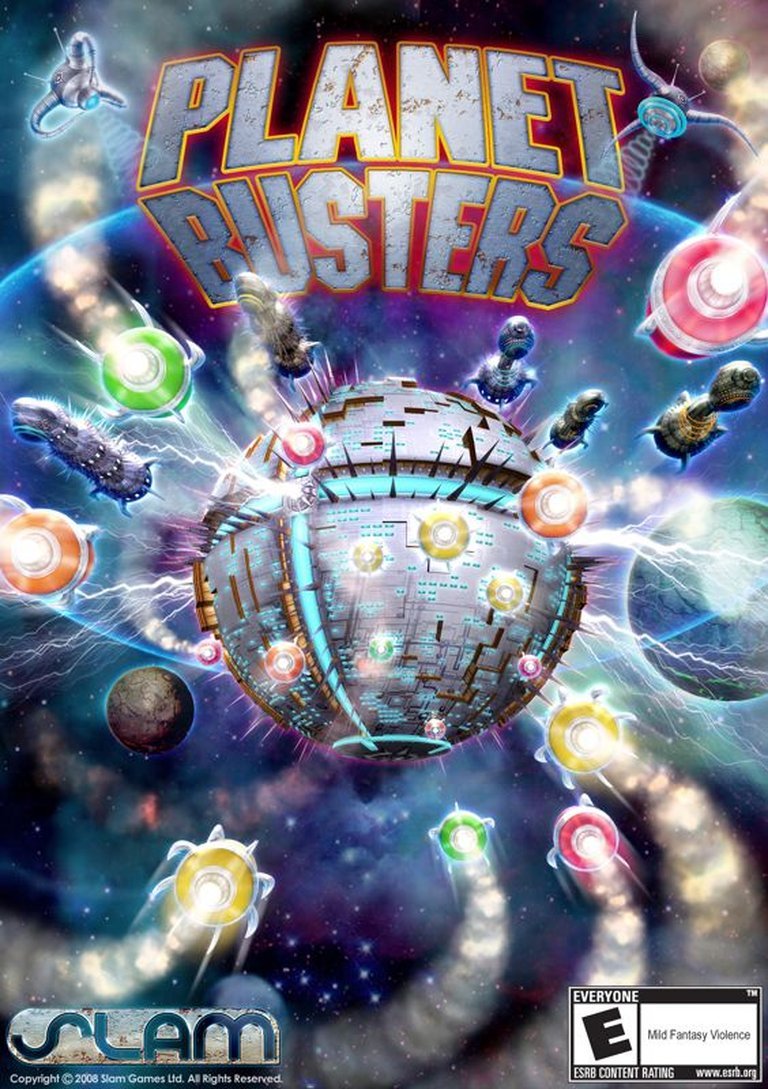
Planet Busters is a single-player puzzle-action game blending elements of Scrabble and Bejeweled, set in a sci-fi universe where Earth has been destroyed by the Scourge. Players seek revenge by strategically matching colored rockets in clusters of three horizontally or vertically to launch explosive attacks on enemy ships, moons, and planets. With 51 levels ranging from fast-paced challenges to intricate puzzles, the game combines quick reflexes and tactical thinking in an isometric, futuristic setting.
Where to Buy Planet Busters
PC
Planet Busters Patches & Updates
Planet Busters Reviews & Reception
gamesreviews2010.com (75/100): A thrilling and challenging puzzle-action game that will keep you on the edge of your seat from start to finish.
Planet Busters: A Forgotten Gem of Puzzle-Action Hybridity
Introduction: The Unlikely Marriage of Scrabble and Space Warfare
In the late 2000s, the casual gaming market was flooded with match-three puzzlers, from Bejeweled to Peggle, each vying for the attention of players seeking quick, addictive gameplay. Amid this crowded landscape, Planet Busters (2008) emerged as a curious hybrid—a game that dared to blend the cerebral satisfaction of word games with the visceral thrill of interstellar combat. Developed by the obscure but ambitious Slam Games Ltd., Planet Busters positioned itself as a “cross between Scrabble and Bejeweled, with added explosions,” a pitch that was as intriguing as it was baffling.
At its core, Planet Busters is a revenge fantasy set against the backdrop of a destroyed Earth, where the player—one of the last surviving ensigns of humanity—must match colored rockets on a tactical grid to obliterate alien ships, moons, and entire planets. It’s a premise that oscillates between the absurd and the oddly compelling, a game that never quite decided whether it wanted to be a brain-teasing puzzle or an action-packed shooter. Yet, in its awkward fusion of genres, Planet Busters carved out a niche that, while not revolutionary, remains a fascinating artifact of its time.
This review seeks to dissect Planet Busters in its entirety—its development, its mechanics, its narrative quirks, and its legacy (or lack thereof). Was it a bold experiment that deserved more attention, or a flawed curiosity that slipped through the cracks of gaming history? Let’s embark on this deep dive.
Development History & Context: The Birth of a Puzzle-Shooter Hybrid
The Studio Behind the Game: Slam Games Ltd.
Slam Games Ltd. was a small, relatively unknown developer based in the UK, specializing in casual and puzzle games. Before Planet Busters, the studio had dabbled in word games (Spinword) and racing titles (Master Rallye), but none of their previous works had garnered significant attention. The team behind Planet Busters was a mix of seasoned developers and newcomers, with key figures like Christian Erskine, Alan Grier, and David Thomson leading the charge.
The credits reveal a personal touch—dedications to family members, pets, and even religious figures (one developer thanks “Jesus [and the other long-haired one]”), hinting at a tight-knit, passionate team. The game’s development was likely a labor of love, but it was also constrained by the technological and financial limitations of a small studio in 2008.
The Gaming Landscape of 2008: A Market Saturated with Casual Titles
2008 was a pivotal year for gaming. The casual market was booming, thanks in part to the rise of digital distribution platforms like Steam and the proliferation of mobile gaming. Peggle, Plants vs. Zombies, and Audiosurf were dominating the scene, proving that simple, addictive mechanics could captivate audiences. Meanwhile, the puzzle genre was evolving, with games like Zuma and Luxor blending match-three mechanics with action elements.
Planet Busters arrived in this environment, attempting to stand out by merging two seemingly disparate genres: puzzle-solving and space combat. The game’s marketing leaned heavily into its unique hook—“Scrabble meets Bejeweled with explosions”—but whether this fusion resonated with players is another question entirely.
Technological Constraints and Design Choices
Given its modest budget, Planet Busters was built with simplicity in mind. The game employed an isometric visual style, a choice that likely helped streamline development while giving it a distinct aesthetic. The gameplay was confined to a tactical grid, where players manipulated clusters of colored rockets, matching them in groups of three or more to launch attacks.
The lack of complex 3D graphics or physics engines meant that Planet Busters relied entirely on its core mechanics to engage players. This was both a strength and a weakness—while the game avoided the pitfalls of overambitious design, it also struggled to deliver the kind of polish and depth that bigger studios could achieve.
Narrative & Thematic Deep Dive: Revenge in the Stars
The Premise: Earth’s Destruction and the Scourge’s Wrath
Planet Busters opens with a grim scenario: Earth has been obliterated by the Scourge, a mysterious alien force whose motives are never fully explained. The player assumes the role of one of the few surviving ensigns, tasked with exacting vengeance by hunting down the Scourge across the galaxy. It’s a classic revenge narrative, reminiscent of Star Control or Homeworld, but stripped of any real emotional weight or world-building.
The story is delivered in minimalist fashion—a few lines of text at the beginning, followed by mission briefings that do little to expand the lore. The Scourge are faceless villains, their destruction of Earth serving as little more than a justification for the player’s rampage. There are no characters to speak of, no dialogue, and no real sense of progression beyond the mechanical act of clearing levels.
Themes: Vengeance, Strategy, and the Futility of War
Despite its thin narrative, Planet Busters inadvertently touches on a few interesting themes:
- The Cost of Revenge – The player’s mission is framed as a righteous crusade, but the game never questions the morality of annihilating entire planets in the name of retribution. The Scourge are portrayed as irredeemable, but their lack of personality or backstory makes the conflict feel hollow.
- Strategy Over Brute Force – The game’s puzzle mechanics emphasize planning and precision over mindless aggression. This creates an interesting juxtaposition: the player is engaged in a genocidal campaign, but success requires careful, almost scholarly, matching of colored rockets.
- The Loneliness of Space Warfare – With no allies, no NPCs, and no real interaction beyond the tactical grid, Planet Busters inadvertently conveys the isolation of a lone warrior in a vast, indifferent universe.
Missed Opportunities in Storytelling
The game’s biggest narrative failing is its lack of personality. The Scourge could have been given distinct designs, behaviors, or even taunts to make them feel like a real threat. The destruction of Earth could have been framed as a personal tragedy for the player character, with flashbacks or voiceovers adding emotional depth. Instead, the story serves as little more than a flimsy pretext for gameplay, a common pitfall in puzzle-action hybrids.
Gameplay Mechanics & Systems: The Puzzle-Shooter Hybrid in Action
Core Gameplay Loop: Matching Rockets to Destroy the Galaxy
At its heart, Planet Busters is a match-three puzzle game with a twist. The player controls clusters of 1, 2, or 3 colored rockets, which must be arranged in horizontal or vertical lines of three or more to launch attacks. The mechanics are simple:
- Basic Attacks: Matching three rockets of the same color fires a volley at the target.
- Special Attacks: Matching four or more rockets triggers a more powerful strike.
- EMP Measures: Disables enemy shields, making them vulnerable.
- Missiles: More potent than rockets, used for heavily armored foes.
- Power-Ups: Temporary boosts like increased firepower or time slowdown.
The game’s 51 levels vary in difficulty, with some emphasizing speed and reflexes (rapidly matching rockets under time pressure) and others requiring strategic planning (carefully positioning rockets to maximize combos).
Combat and Progression: A Mix of Puzzle and Action
Planet Busters attempts to blend puzzle-solving with real-time combat, but the execution is uneven. Enemies fire back, moons orbit planets providing cover, and bosses have unique attack patterns, but the core gameplay remains static and grid-based. This creates a disconnect—the player is supposedly engaged in a dynamic space battle, but the action unfolds like a turn-based board game.
The progression system is similarly underdeveloped. There are no upgrades, no skill trees, and no persistent character growth. The only sense of advancement comes from unlocking new levels, each with slightly more complex puzzle setups.
UI and Controls: Functional but Uninspired
The game’s user interface is minimalist, with a tactical grid taking center stage. Controls are straightforward—mouse clicks to select and drag rockets, keyboard shortcuts for special abilities—but lack the tactile satisfaction of more polished puzzlers. The isometric perspective occasionally makes it difficult to judge rocket placement, leading to frustrating misclicks.
Innovations and Flaws
Innovations:
– Hybrid Genre Experimentation: Few games at the time attempted to merge match-three puzzles with action combat.
– Varied Level Design: Some levels require speed, others strategy, keeping the gameplay from feeling too repetitive.
Flaws:
– Lack of Depth: The core mechanics are fun but shallow, with little variation beyond “match rockets to shoot things.”
– Repetitive Structure: After a dozen levels, the formula grows stale.
– No Multiplayer: A missed opportunity—competitive or cooperative modes could have added longevity.
World-Building, Art & Sound: A Galaxy Lacking in Atmosphere
Setting and Atmosphere: A Sterile Cosmos
Planet Busters takes place in a sci-fi universe, but the world-building is virtually nonexistent. The player jumps from one abstract battlefield to another, with no sense of a living, breathing galaxy. Planets, moons, and ships are generic targets, devoid of personality or context.
The isometric visual style gives the game a clean, almost clinical appearance, which works for a puzzle game but fails to evoke the grandeur of space warfare. Explosions are satisfying, but the lack of visual feedback (e.g., debris, screen shake) makes them feel weightless.
Sound Design: Functional but Forgettable
The game’s audio is handled by SomaTone Interactive Audio, a studio known for casual game soundtracks. The music is upbeat and electronic, fitting the puzzle-action vibe but lacking memorability. Sound effects—rocket launches, explosions, shield impacts—are serviceable but fail to elevate the experience.
A Missed Opportunity for Immersion
Planet Busters could have benefited from:
– Dynamic camera angles to make battles feel more cinematic.
– Voice acting to give the Scourge and the player character personality.
– Environmental storytelling—wrecked Earth ships, alien ruins, or distress signals could have added depth.
Reception & Legacy: The Game That Time Forgot
Critical and Commercial Reception: A Quiet Release
Planet Busters launched on June 30, 2008, exclusively on Windows via Steam. It received little to no critical coverage—no major reviews, no Metacritic score, and no significant marketing push. The few player impressions that exist (such as the 7.5/10 from Games Reviews 2010) praise its addictive puzzle mechanics but criticize its lack of depth and repetition.
Commercially, the game was a niche product, appealing primarily to fans of puzzle-action hybrids. Its $9.99 price point was reasonable, but without word-of-mouth or critical acclaim, it struggled to find an audience.
Legacy: A Footnote in Gaming History
Planet Busters has had no discernible influence on the gaming industry. It didn’t spawn sequels, inspire imitators, or leave a lasting mark on the puzzle genre. Today, it’s remembered (if at all) as a curiosity—a game that tried something different but failed to execute its vision fully.
Why Did It Fade Into Obscurity?
Several factors contributed to Planet Busters’ obscurity:
1. Lack of Marketing: Slam Games was a small studio with limited resources.
2. Overcrowded Market: 2008 was a golden age for casual puzzlers, and Planet Busters didn’t stand out.
3. Shallow Gameplay: While innovative, the core mechanics weren’t deep enough to sustain long-term interest.
4. No Multiplayer: A competitive or cooperative mode could have extended its lifespan.
Conclusion: A Flawed but Fascinating Experiment
Planet Busters is a game of contradictions. It’s a puzzle game that wants to be an action shooter, a revenge story with no emotional weight, and a hybrid experiment that never fully commits to either genre. Yet, within its flaws lies a certain charm—a reminder of an era when developers were willing to take risks, even if those risks didn’t always pay off.
Final Verdict: 6.5/10 – A Cult Curiosity
The Good:
✅ Addictive match-three mechanics with a unique twist.
✅ Varied level design keeps gameplay engaging for a while.
✅ Satisfying explosions and a fun sci-fi premise.
The Bad:
❌ Shallow narrative with no character development.
❌ Repetitive structure that grows stale quickly.
❌ Lack of depth in progression and replayability.
Who Should Play It?
– Fans of puzzle-action hybrids looking for something offbeat.
– Players who enjoy match-three games but want a sci-fi twist.
– Retro gaming enthusiasts interested in obscure 2000s titles.
Who Should Avoid It?
– Those seeking deep storytelling or emotional engagement.
– Players who prefer fast-paced action over methodical puzzles.
– Anyone expecting long-term replay value.
Planet Busters’ Place in Gaming History
Planet Busters is not a masterpiece, nor is it a disaster. It’s a forgotten experiment, a game that dared to blend genres in a way few others had at the time. While it ultimately failed to leave a lasting impact, it remains a fascinating artifact—a testament to the creativity (and limitations) of indie development in the late 2000s.
For those willing to dig beneath the surface, Planet Busters offers a brief but enjoyable diversion—a reminder that sometimes, the most interesting games are the ones that don’t quite fit into any box.
Final Score: 6.5/10 – A Flawed Gem Worth Unearthing.