
- Release Year: 1997
- Platforms: Windows
- Publisher: Serges Medien GmbH
- Developer: Bitstream
- Genre: Compilation, Puzzle
- Perspective: 1st-person
- Game Mode: Single-player
- Gameplay: Cards, Point and select, Tiles
- Average Score: 59/100
Description
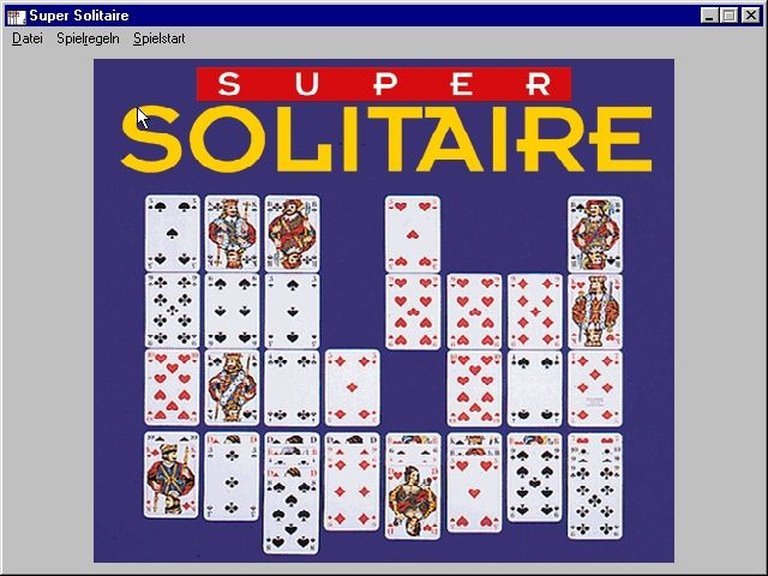
Super Solitaire is a compilation of 20 classic patience card game variations, originally released in 1994 for the Super Nintendo Entertainment System (SNES) and later adapted for Windows in 1997. The game features a diverse selection of solitaire styles, including Klondike, FreeCell, Pyramid, and Scorpion, each accompanied by customizable backgrounds, optional cartoon-style graphics, and soothing music. Players can access hints and skip cards via an options menu, enhancing accessibility for both casual and experienced players. With its straightforward point-and-select interface and top-down perspective, Super Solitaire offers a polished, single-player card-gaming experience tailored for fans of traditional solitaire.
Super Solitaire Free Download
Super Solitaire Reviews & Reception
en.wikipedia.org (52.5/100): GamePro praised the variety of games, the graphics, the music, and the ability to change the backgrounds, though they emphasized that the game would bore most children.
thegamerslibrary.com : This is a good game if you like solitaire games. While there is not much to do here besides play solitaire games, the game doesn’t try do sell itself as anything else.
opencritic.com (65/100): Super Solitaire is a solid entry into the Xbox store and whilst it is available on mobile and also Nintendo Switch, it is nice to sit and play with a controller to hand.
Super Solitaire: A Comprehensive Retrospective on the Classic Card Game Compilation
Introduction: The Enduring Appeal of Digital Solitaire
Few genres in video gaming are as universally accessible—or as often overlooked—as digital card games. Super Solitaire, released in 1994 for the Super Nintendo Entertainment System (SNES) and later adapted for Windows in 1997, stands as a fascinating artifact of this niche. At its core, it is a compilation of solitaire variants, a genre that has thrived since the earliest days of computing. Yet, Super Solitaire is more than just a digital deck of cards; it is a snapshot of gaming’s transitional era, bridging the gap between analog pastimes and interactive entertainment.
This review will dissect Super Solitaire in exhaustive detail, examining its development, gameplay mechanics, artistic choices, and legacy. We will explore how it fits into the broader history of solitaire games, why it resonated (or failed to resonate) with audiences, and what its existence tells us about the evolution of casual gaming. By the end, we will determine whether Super Solitaire is a forgotten gem, a relic of its time, or something in between.
Development History & Context: The Birth of a Digital Card Game
The Studio and Creators Behind the Game
Super Solitaire was developed by Beam Software, an Australian studio with a diverse portfolio spanning action, puzzle, and sports games. Beam Software was no stranger to adaptations of traditional games, having worked on titles like Shadowrun and NBA All-Star Challenge. Their experience in translating real-world mechanics into digital formats made them a natural fit for a solitaire compilation.
The game was published by Extreme Entertainment Group in North America and Pack-In-Video in Japan, where it was retitled Trump Island (トランプアイランド). The Japanese version featured a distinct aesthetic, incorporating suggestive anime artwork that was toned down for Western audiences—a common practice in the 1990s to avoid controversy.
Technological Constraints and Design Choices
The SNES was not the most obvious platform for a solitaire game. Unlike PCs, which had long been home to digital card games (including Microsoft’s iconic Solitaire in Windows 3.0), consoles were primarily associated with action, adventure, and RPG genres. However, the SNES’s Mode 7 graphics and mouse support (via the SNES Mouse peripheral) made it a viable candidate for a card game.
Key design challenges included:
– Input Limitations: Without a mouse, card selection had to be intuitive with a controller. The SNES version mapped actions to buttons (e.g., B to select, X to open menus), a solution that worked but felt less fluid than a mouse-driven interface.
– Visual Clarity: The SNES’s 256×224 resolution (in standard mode) made card details occasionally hard to read, a criticism echoed in contemporary reviews.
– Memory Constraints: The cartridge format limited the number of solitaire variants and the depth of their rule customization.
Despite these hurdles, Super Solitaire managed to include 12 distinct solitaire variants, a remarkable feat for the era.
The Gaming Landscape of the Mid-1990s
By 1994, solitaire was already a staple of personal computing, but console adaptations were rare. The SNES was dominated by titles like Donkey Kong Country, Super Metroid, and Final Fantasy VI—games that emphasized action, exploration, and narrative. Super Solitaire was an outlier, catering to a more casual audience.
Its release coincided with the rise of “edutainment” and “casual gaming” on consoles, a trend that would later explode with the Wii and mobile gaming. In this context, Super Solitaire was ahead of its time, offering a relaxed, pick-up-and-play experience in an era where most games demanded prolonged engagement.
Narrative & Thematic Deep Dive: The Story of a Game Without a Story
The Absence of Plot and Characters
Super Solitaire is, at its heart, a mechanics-driven experience. There is no overarching narrative, no characters to guide the player, and no dialogue beyond basic menu prompts. The “story” is the act of playing itself—the satisfaction of clearing a deck, the frustration of an unwinnable shuffle, the quiet focus required to strategize.
This minimalism is both a strength and a weakness:
– Strength: It allows players to engage with the game on their own terms, without distractions.
– Weakness: It offers no emotional or narrative hooks, making it easy to dismiss as “just solitaire.”
Themes: Patience, Strategy, and the Illusion of Control
While Super Solitaire lacks explicit storytelling, it is rich in implicit themes:
1. Patience and Persistence: Solitaire is a game of probability and strategy. The player must accept that some shuffles are unwinnable, teaching resilience.
2. The Illusion of Control: Despite the randomness of card draws, players often blame themselves for losses, a psychological quirk that Super Solitaire exploits subtly.
3. Solitude and Focus: The game’s quiet, repetitive nature makes it a meditative experience, appealing to those seeking a mental break.
Regional Differences: The Japanese “Trump Island” Aesthetic
The Japanese version, Trump Island, introduced a suggestive anime aesthetic, featuring scantily clad women as background art. This choice reflected the era’s trends in Japanese gaming, where “fan service” was often used to market niche titles.
However, this artistic direction also limited the game’s appeal:
– Western Localization: The anime art was replaced with generic, inoffensive backgrounds for the NA/EU releases, stripping away much of the visual personality.
– Gendered Marketing: The Japanese version’s focus on female characters as decorative elements reinforced stereotypes about card games being “for men,” a misstep that aged poorly.
Gameplay Mechanics & Systems: Deconstructing the Card-Playing Experience
Core Gameplay Loop: The Anatomy of a Solitaire Game
Super Solitaire follows the classic solitaire structure:
1. Deal the Cards: The game shuffles and deals cards according to the selected variant’s rules.
2. Player Interaction: The player moves cards between columns, foundations, and the waste pile using the controller or mouse.
3. Win/Lose Conditions: The game ends when either all cards are cleared (win) or no more moves are possible (loss).
The SNES version’s button mapping was as follows:
– B Button: Select/place a card.
– X Button: Open the menu (to access hints, undo, or restart).
– L/R Buttons: Hint/undo functions.
– Y Button: Cancel a selection.
While functional, this scheme felt less intuitive than a mouse, a complaint echoed in reviews.
The 12 Solitaire Variants: A Breakdown
Super Solitaire included the following variants, each with unique rules:
| Variant | Key Mechanics | Difficulty Level |
|---|---|---|
| Klondike | The classic “Windows Solitaire” ruleset (draw 1 or 3 cards). | Medium |
| FreeCell | All cards are dealt face-up; requires strategic use of free cells. | Hard |
| Golf | A single-column game where the goal is to clear the deck in as few moves as possible. | Easy |
| Cruel | A punishing variant where only the top card of the waste pile is usable. | Very Hard |
| Pyramid | Cards are arranged in a pyramid; pairs must sum to 13. | Medium |
| Stonewall | A hybrid of Klondike and FreeCell with restricted tableau movement. | Hard |
| Doesn’t Matter | A relaxed variant where any card can be placed on any other. | Easy |
| Aces Up | The goal is to remove all non-ace cards by stacking them on higher ranks. | Medium |
| Florentine | A two-deck variant with complex foundation rules. | Very Hard |
| Poker | A non-traditional variant where the goal is to form poker hands. | Medium |
| Canfield | A strategic game where the reserve pile is used to build foundations. | Hard |
| Scorpion | A three-deck variant with a sprawling tableau. | Very Hard |
Each variant offered optional rule tweaks, such as:
– Adjusting the number of cards drawn in Klondike (1 vs. 3).
– Enabling/disabling automatic foundation placement in Canfield.
Innovative Features
Despite its simplicity, Super Solitaire introduced several forward-thinking mechanics:
1. Password System: Players could save their progress via a random seed password, allowing them to revisit specific shuffles—a rare feature in early digital card games.
2. Tournament Mode: A scored challenge where players could chain multiple solitaire variants for a cumulative score.
3. Customization Options:
– Backgrounds: Players could switch between classic art and cartoonish designs.
– Music: Composed by Marshall Parker, the soundtrack featured soft, looping melodies tailored to each variant.
– Sound Effects: Options included arcade-style bleeps or comic-book “pow” sounds.
Flaws and Missed Opportunities
While Super Solitaire was competent, it suffered from several design oversights:
1. Lack of Visual Feedback:
– The game did not adjust the deck height to indicate remaining cards, a crucial visual cue in physical solitaire.
– In Scorpion, cards became unreadably compressed when stacks grew too large.
2. Questionable AI Decisions:
– Canfield forced automatic foundation placement, even when disadvantageous.
– Florentine prevented peeking under placed cards, an unnecessary restriction.
3. Repetitive Presentation:
– Victory/loss screens were identical across all variants, diminishing the sense of progression.
– The three-song soundtrack grew tedious quickly.
World-Building, Art & Sound: Crafting a Digital Card Table
Visual Design: From Clip Art to Anime
Super Solitaire’s art direction varied by region:
– Western Version:
– Backgrounds: Generic, clip-art-style illustrations (e.g., castles, gardens) that lacked personality.
– Cards: Functional but low-resolution, making suits and numbers occasionally hard to distinguish.
– Japanese Version (Trump Island):
– Backgrounds: Featured suggestive anime women in various poses, a choice that aged poorly but gave the game a distinct (if controversial) identity.
– Cards: Slightly more detailed, with cleaner outlines.
Neither version pushed the SNES’s graphical capabilities, a missed opportunity given the system’s Mode 7 and high-resolution modes.
Sound Design: The Ambience of Solitude
Marshall Parker’s soundtrack was soft, unobtrusive, and forgettable—by design. The music served as background ambiance, avoiding distraction while maintaining a pleasant atmosphere. Tracks included:
– A light jazz piece for Klondike.
– A piano-driven melody for FreeCell.
– A synth-heavy loop for Pyramid.
The sound effects were more divisive:
– Default: Featured an annoying buzzer for invalid moves.
– Alternate Options: Included arcade bleeps and comic-book sounds, which some players found charming.
Atmosphere: The Digital Card Table
Super Solitaire succeeded in replicating the feel of a physical card game:
– The slow, methodical pace encouraged focus.
– The lack of distractions (no story, no cutscenes) kept the experience pure.
– The optional hints mimicked the experience of playing with a patient tutor.
However, it failed to elevate the experience beyond its analog counterpart, a common critique of early digital card games.
Reception & Legacy: How the World Responded
Critical Reception: Mixed but Respectful
Super Solitaire received moderate praise from critics, who acknowledged its depth but questioned its appeal:
| Publication | Score | Key Praise/Criticism |
|---|---|---|
| Famicom Tsūshin | 21/40 | “A competent but unexciting adaptation.” |
| GamePro | Positive | “Great variety, but likely to bore children.” |
| Allgame | 2.5/5 | “A solid collection, but lacks innovation.” |
| TheAlmightyGuru | 5/10 | “Functional but uninspired; better played with real cards.” |
Common criticisms included:
– Repetitive gameplay (even for solitaire fans).
– Uninspired presentation.
– Controller-based input feeling clunky.
Commercial Performance: A Niche Success
Super Solitaire was not a major commercial hit, but it found an audience among:
– Casual gamers looking for a relaxed experience.
– Solitaire enthusiasts eager to try new variants.
– SNES collectors drawn to its rarity (especially the Japanese Trump Island version).
Its Windows 1997 version (developed by Bitstream) was bundled in GamePack 2, a budget compilation, further cementing its status as a bargain-bin curiosity.
Legacy: The Evolution of Digital Solitaire
Super Solitaire’s influence is subtle but notable:
1. Proving the Viability of Console Card Games: It demonstrated that solitaire could work on consoles, paving the way for later titles like Clubhouse Games (DS) and Pokémon Trading Card Game.
2. Password Saves in Card Games: Its random seed system was ahead of its time, later adopted by mobile solitaire apps.
3. The Rise of Compilation Titles: It contributed to the trend of multi-variant card game collections, a staple of modern app stores.
However, it was ultimately overshadowed by:
– Microsoft Solitaire (1990), which became the default digital solitaire experience.
– Mobile solitaire apps (2000s–present), which offered superior convenience and polish.
Conclusion: The Final Verdict on Super Solitaire
Super Solitaire is a competent but unremarkable entry in the solitaire genre. It succeeded in its core mission—delivering a variety of solitaire variants in a functional digital package—but failed to innovate or excite beyond that. Its regional differences (particularly the Japanese Trump Island version) add historical intrigue, but the Western release feels sterile and forgettable.
Strengths:
✅ Wide variety of solitaire variants (12 in total).
✅ Password save system (ahead of its time).
✅ Tournament mode (added replayability).
✅ Controller input worked surprisingly well for a card game.
Weaknesses:
❌ Uninspired presentation (clip-art backgrounds, repetitive music).
❌ Controller input still felt clunky compared to mouse-driven solitaire.
❌ Lack of visual feedback (e.g., no deck height indicator).
❌ No real innovation—it didn’t improve upon physical solitaire.
Final Score: 6/10 – A Serviceable but Unessential Classic
Super Solitaire is worth experiencing for solitaire enthusiasts and retro gaming historians, but it is not a must-play. Its greatest value lies in its historical context—as a bridge between analog card games and the digital solitaire boom of the 2000s.
For modern players, mobile solitaire apps or Microsoft’s classic version offer superior experiences. But for those curious about how solitaire transitioned from physical decks to consoles, Super Solitaire remains a fascinating time capsule.
Verdict: A decent digital deck of cards, but nothing more.