
- Release Year: 2004
- Platforms: Windows
- Publisher: WildTangent, Inc.
- Developer: WildTangent, Inc.
- Genre: Driving, Racing
- Perspective: 1st-person
- Game Mode: Online PVP, Single-player
- Gameplay: Racing, Tricks, Vehicle upgrades
- Setting: Cities, Deserts, Jungles
- Average Score: 30/100
Description
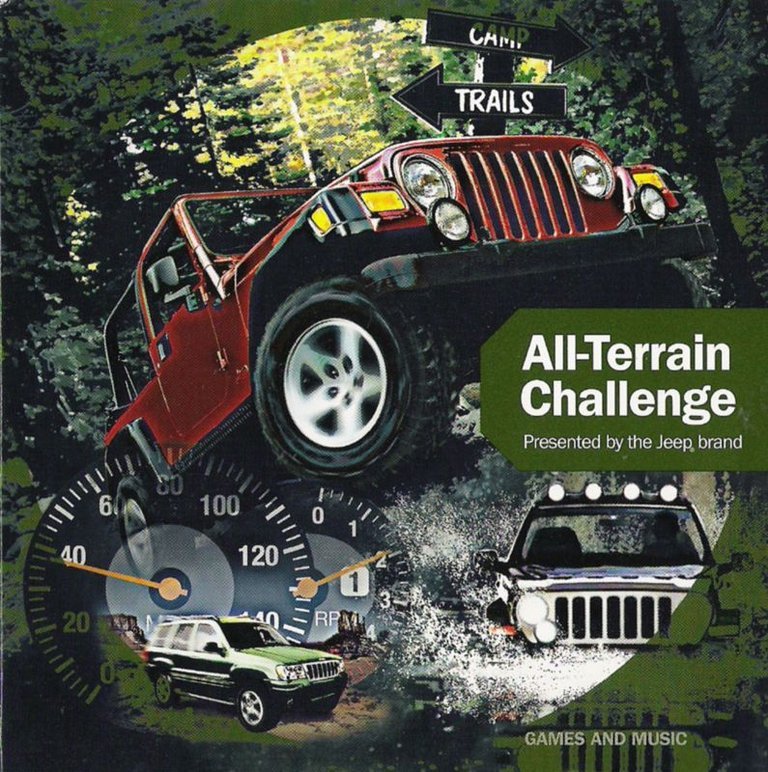
Jeep 4×4 Adventure is a freeware off-road racing game released in 2004, where players compete in various Jeep models like the Wrangler, Liberty, and Grand Cherokee across diverse environments such as cities, deserts, and jungles. The game features a unique upgrade system where players earn credits by performing tricks during races, with the percentage of usable credits determined by their finishing position. As a streaming online game, it includes an online scoreboard for competitive play.
Jeep 4×4 Adventure Reviews & Reception
mobygames.com (30/100): A triumphant return to form for the series.
retro-replay.com : Jeep 4×4 Adventure delivers an exhilarating racing experience by putting players behind the wheels of iconic Jeep models like the Wrangler, Liberty, and Grand Cherokee.
Jeep 4×4 Adventure Cheats & Codes
Dreamcast
At the start screen push the following button sequence.
| Code | Effect |
|---|---|
| L, R, R, DOWN, RIGHT, RIGHT, RIGHT, RIGHT, RIGHT, RIGHT, RIGHT, RIGHT, L, L, L, L, R, UP | Unlock Jeep CJ7 |
PlayStation 2
Enter any of the following codes at the title screen.
| Code | Effect |
|---|---|
| L1, L2, R1, R2, L1, R1 | Unlock all cheat trucks |
| L1, square, R1, square, R1, square, R1, L1, square, L2, square, R2, square, R1 | Start with $1,000,000 |
| L1, L2, R1, R2, square (2) | Slow-mo mode |
| L1, L2, R1, R2, square (2) | Warp speed mode |
Jeep 4×4 Adventure: A Forgotten Relic of Early 2000s Off-Road Racing
Introduction: The Jeep That Couldn’t
In the annals of video game history, Jeep 4×4 Adventure (2004) stands as a curious footnote—a licensed racing game that arrived during the golden age of off-road simulators, only to be swiftly buried beneath the weight of its own mediocrity. Developed and published by WildTangent, Inc., this Windows-exclusive title promised the thrill of piloting iconic Jeep models—the Wrangler, Liberty, and Grand Cherokee—across exotic locales, from neon-lit cities to sun-scorched deserts. Yet, despite its ambitious premise and the allure of its real-world branding, Jeep 4×4 Adventure failed to capture the imagination of gamers or critics alike. With a paltry 1.5/5 average score on MobyGames and scant contemporary reviews, it faded into obscurity, remembered only by a handful of retro enthusiasts and Jeep aficionados.
This review seeks to exhume Jeep 4×4 Adventure from the digital graveyard, examining its development, mechanics, and legacy with the rigor it deserves. Was it a misunderstood gem, or a cynical cash-grab riding the coattails of the Jeep brand? By dissecting its design, context, and reception, we can uncover why this game remains a cautionary tale about the perils of licensed racing titles in an era dominated by Need for Speed and Colin McRae Rally.
Development History & Context: The WildTangent Experiment
The Studio Behind the Wheel
WildTangent, Inc., the developer and publisher of Jeep 4×4 Adventure, was not a traditional game studio but a company specializing in online gaming platforms and ad-supported software. Founded in 1998, WildTangent carved a niche in the early 2000s by distributing free-to-play games bundled with advertisements—a model that often prioritized accessibility over depth. Their portfolio included a mix of casual titles, arcade games, and branded experiences, with Jeep 4×4 Adventure falling squarely into the latter category.
The game’s development was likely a collaborative effort between WildTangent and DaimlerChrysler (Jeep’s parent company at the time), aimed at leveraging the Jeep brand’s rugged, adventurous image to attract gaming audiences. This partnership explains the game’s freeware business model, which allowed players to download and play it for free, albeit with the caveat of WildTangent’s proprietary software installation—a practice that later drew criticism for its intrusiveness.
Technological Constraints of 2004
Jeep 4×4 Adventure launched in February 2004, a period when racing games were undergoing a seismic shift. Titles like Burnout 3: Takedown (2004) and Gran Turismo 4 (2004) were pushing the boundaries of visual fidelity and physics simulation, while Richard Burns Rally (2004) set new standards for off-road realism. In contrast, Jeep 4×4 Adventure was a modest affair, built on a streaming online framework that prioritized quick load times over graphical prowess.
The game’s minimum system requirements—an Intel Pentium III CPU, 128 MB of RAM, and DirectX 8.0—reflect its modest ambitions. These specs were typical for mid-tier PC games of the era, but they also limited the game’s potential for advanced physics or detailed environments. The result was a title that felt technologically anemic compared to its contemporaries, lacking the polish or innovation to stand out.
The Gaming Landscape: A Crowded Off-Road Circuit
The early 2000s were a boom time for off-road racing games. Test Drive: Off-Road 3 (1999) had already established a template for rugged, terrain-based racing, while 4×4 Evo (2000) and Screamer 4×4 (2000) offered more hardcore simulations. Even Mike’s Monstrous Adventure (2002), a spin-off of the Monsters, Inc. franchise, managed to deliver a surprisingly competent off-road experience.
Into this crowded field stepped Jeep 4×4 Adventure, a game that struggled to differentiate itself. Its licensed Jeep vehicles were its primary selling point, but without the mechanical depth or narrative ambition of its competitors, it risked being seen as little more than a branded tech demo. The inclusion of an online scoreboard—a novel feature at the time—hinted at WildTangent’s desire to foster a competitive community, but the game’s lackluster execution ensured that this vision never materialized.
Narrative & Thematic Deep Dive: The Road Less Traveled (And Less Interesting)
Plot: A Journey Without a Destination
Jeep 4×4 Adventure is, at its core, a narrative-free experience. There are no characters to meet, no villains to defeat, and no overarching story to uncover. Instead, the game presents itself as a series of disconnected races, each set in a different environment—cities, deserts, jungles—with the player’s sole objective being to finish in first place and earn credits for upgrades.
This lack of narrative is not inherently a flaw; many racing games thrive on pure gameplay. However, Jeep 4×4 Adventure fails to compensate with compelling world-building or thematic depth. The game’s “story” is reduced to a progression system where players advance from “rookie” races to more challenging global competitions. Brief cutscenes and event introductions attempt to contextualize each locale (e.g., a montage of desert hazards before a dune race), but these moments are perfunctory, offering little more than a superficial excuse to race.
Themes: The Illusion of Adventure
The game’s title—Jeep 4×4 Adventure—evokes images of exploration, danger, and discovery. Yet, the actual experience is far more mundane. The “adventure” is limited to repeating races in the same environments, with the only tangible progression being vehicle upgrades. There is no sense of journey or discovery; the tracks are static, and the challenges are repetitive.
This disconnect between the game’s thematic aspirations and its mechanical reality is striking. The Jeep brand is synonymous with rugged individualism and off-road freedom, but Jeep 4×4 Adventure reduces this ethos to a series of timed laps. The game’s exotic locales—jungles, deserts, cities—are little more than backdrops, devoid of interactivity or environmental storytelling. Even the “tricks” system, which allows players to earn credits by performing jumps and drifts, feels tacked on, serving as a shallow incentive rather than a meaningful gameplay mechanic.
Characters and Dialogue: The Silence of the Engine
Unsurprisingly, Jeep 4×4 Adventure features no dialogue or character interactions. The player’s avatar is a faceless driver, and the opponents are anonymous rivals with no personalities or backstories. This absence of human elements further underscores the game’s mechanical focus, but it also robs the experience of any emotional or narrative stakes.
The closest the game comes to “characterization” is through its upgrade system, which allows players to customize their Jeep’s performance and appearance. However, this is a purely functional feature, lacking the personalization or attachment seen in games like Need for Speed: Underground (2003), where car customization was tied to a broader culture of street racing and self-expression.
Gameplay Mechanics & Systems: The Engine That Couldn’t
Core Gameplay Loop: Race, Upgrade, Repeat
Jeep 4×4 Adventure’s gameplay is straightforward: race, earn credits, upgrade your Jeep, and race again. The core loop is simple, but its execution is marred by a lack of depth and polish.
-
Racing Mechanics: The game offers two perspectives—first-person and behind-view—with direct control over the vehicle. The handling model is arcade-like, with loose physics that prioritize accessibility over realism. This approach is not inherently bad, but the lack of nuance makes the driving feel floaty and imprecise. The Jeeps, despite their real-world reputations for ruggedness, handle more like generic racing cars, with little differentiation between the Wrangler, Liberty, and Grand Cherokee models.
-
Tricks and Credits: The game’s primary innovation is its “tricks” system, which rewards players for performing jumps, drifts, and other stunts during races. These tricks earn credits, which can then be spent on upgrades. However, the system is poorly implemented. The tricks themselves are simplistic—often requiring little more than driving over a ramp—and the credits earned feel arbitrary. Worse, the percentage of credits retained is tied to the player’s finishing position, creating a frustrating feedback loop where poor performance in one race hampers progress in the next.
-
Upgrade System: Upgrades are divided into performance enhancements (engine, suspension, tires) and cosmetic changes. While the idea of customizing a Jeep is appealing, the upgrades have minimal impact on gameplay. The differences between a stock Wrangler and a fully upgraded one are subtle, and the lack of visual feedback—such as damage or wear—further diminishes the sense of progression.
Combat and Multiplayer: The Ghost of Competition
Jeep 4×4 Adventure features no combat mechanics, a curious omission given the aggressive nature of off-road racing. There are no rival takedowns, no environmental hazards that require strategic avoidance, and no dynamic weather or track conditions to contend with. The races are straightforward time trials, with the only challenge being the AI opponents, who are aggressively rubber-banded to ensure a “competitive” experience.
The game’s online multiplayer component, touted as a major feature, is equally underwhelming. The streaming online infrastructure allows for real-time races and a global leaderboard, but the lack of a robust matchmaking system or community features means that multiplayer feels like an afterthought. Reports from the time suggest that the online component was plagued by connectivity issues and a lack of active players, further undermining its appeal.
UI and Controls: A Clunky Dashboard
The game’s user interface is functional but uninspired. Menus are sparse, with little visual flair or feedback. The HUD during races is minimal, displaying only the essentials—speed, position, and lap times—without any of the stylistic flourishes seen in contemporary racing games.
Controls are similarly barebones. The game supports keyboard, mouse, and racing wheel inputs, but the lack of customization options (such as adjustable sensitivity or control schemes) makes the driving feel stiff and unresponsive. The first-person perspective, in particular, suffers from a lack of immersion, with no cockpit view or interactive elements to enhance the sense of being behind the wheel.
World-Building, Art & Sound: A Scenic Drive with No Scenery
Setting and Atmosphere: Postcards from Nowhere
Jeep 4×4 Adventure’s environments are its most ambitious feature, offering a variety of locales that range from urban streets to desert dunes. However, these settings are poorly realized, lacking the detail and atmosphere needed to make them feel alive.
- Cities: The urban tracks are generic, with repetitive buildings and uninspired layouts. There is no sense of place or culture; the cities could be anywhere, devoid of landmarks or distinctive features.
- Deserts: The desert tracks fare slightly better, with rolling dunes and dust effects that evoke a sense of vastness. However, the lack of dynamic lighting or weather effects makes them feel static and lifeless.
- Jungles: The jungle environments are the most visually interesting, with lush foliage and ambient wildlife sounds. Yet, the tracks themselves are linear and uninspired, with little opportunity for exploration or off-road detours.
The game’s streaming technology, while innovative for the time, also limits its visual ambition. Textures are muddy, and draw distances are short, creating a sense of claustrophobia that undermines the “adventure” premise.
Art Direction: A Jeep Without a Soul
The Jeep models themselves are the game’s most detailed assets, with accurate representations of the Wrangler, Liberty, and Grand Cherokee. However, the lack of damage modeling or dynamic effects (such as mud splatter or dust accumulation) makes them feel sterile and lifeless. The environments, meanwhile, are a mixed bag—some tracks feature decent lighting and particle effects, but others are marred by low-resolution textures and repetitive geometry.
The game’s color palette is muted, with a reliance on browns and grays that reflects its off-road theme but also contributes to a drab, uninspiring visual style. There is little attempt to create a distinct artistic identity; the game looks like a generic racing title, with none of the personality or flair of its contemporaries.
Sound Design: The Silence of the Engine
The audio design in Jeep 4×4 Adventure is functional but forgettable. Engine sounds are generic, with little variation between the different Jeep models. The lack of dynamic audio—such as tire screeches, environmental echoes, or opponent taunts—further diminishes the sense of immersion.
The game’s soundtrack, if it can be called that, consists of a handful of forgettable loops that play during races. There is no attempt to match the music to the environment or the tone of the race, resulting in a sonic experience that is as generic as the visuals.
Reception & Legacy: The Road to Obscurity
Critical Reception: A Resounding Thud
Jeep 4×4 Adventure was met with near-universal indifference upon its release. The game’s MobyGames score—a dismal 1.5/5 based on a single rating—speaks volumes about its reception. Contemporary reviews, where they exist, are equally damning. SquakeNet’s retrospective describes it as “a singularly unimpressive title that is best avoided,” citing its “cripplingly slow” pace, “dodgy handling,” and “less than impressive visuals.”
The game’s freeware model, while innovative, also worked against it. WildTangent’s reputation for bundling adware with their games led to skepticism among players, many of whom were wary of installing the necessary software. This, combined with the game’s lackluster execution, ensured that it never gained traction in the competitive racing game market.
Commercial Performance: A Flash in the Pan
There is little data available on Jeep 4×4 Adventure’s commercial performance, but it is safe to assume that it was a minor blip in WildTangent’s portfolio. The game’s lack of marketing, combined with its technical limitations and poor reception, likely resulted in minimal downloads and engagement. The online scoreboard, once a selling point, is now a relic of a bygone era, with no active players or records to speak of.
Legacy: A Cautionary Tale
Jeep 4×4 Adventure’s legacy is one of missed opportunities. It arrived at a time when off-road racing games were evolving rapidly, yet it failed to innovate or distinguish itself. Its licensed Jeep branding, while a potential draw, was not enough to overcome its mechanical and technical shortcomings.
The game’s most enduring impact may be as a cautionary tale about the dangers of licensed games. Jeep 4×4 Adventure demonstrates how even a strong real-world brand cannot salvage a game that lacks depth, polish, or ambition. It serves as a reminder that successful racing games require more than just recognizable cars—they need compelling gameplay, immersive worlds, and a sense of progression that keeps players engaged.
Conclusion: The Jeep That Stalled
Jeep 4×4 Adventure is a game that promises much but delivers little. Its premise—a globe-trotting off-road racing adventure featuring iconic Jeep models—is undeniably appealing, but its execution is fatally flawed. From its shallow gameplay mechanics to its uninspired visuals and sound design, the game feels like a half-hearted attempt to cash in on the Jeep brand rather than a genuine labor of love.
In the pantheon of racing games, Jeep 4×4 Adventure occupies a forgotten corner, remembered only by those who stumble upon it in the digital archives. It is neither a classic nor a cult favorite, but a relic of an era when licensed games were often little more than cynical marketing exercises. For historians and retro enthusiasts, it serves as a fascinating case study in how not to design a racing game—a lesson in the importance of depth, polish, and ambition.
Final Verdict: 3/10 – A Forgotten Relic, Best Left in the Dust
Jeep 4×4 Adventure is not without its charms. The idea of racing Jeeps through exotic locales is inherently fun, and the upgrade system, while flawed, offers a glimmer of progression. However, these positives are overwhelmed by the game’s myriad shortcomings. Poor handling, repetitive tracks, and a lack of narrative or atmospheric depth make it a chore to play. In a genre defined by speed, excitement, and competition, Jeep 4×4 Adventure feels slow, tedious, and ultimately forgettable.
For completists and Jeep enthusiasts, it may hold a certain nostalgic appeal. For everyone else, it is a game best left in the past—a reminder of a time when not every racing game could be a winner, no matter how iconic the cars.