
- Release Year: 2001
- Platforms: Windows
- Publisher: Ben Croshaw
- Developer: Ben Croshaw
- Genre: Adventure, Graphic adventure, Puzzle
- Perspective: Side view
- Game Mode: Single-player
- Gameplay: Point and select, Puzzle elements
- Setting: Comedy, Zombies
- Average Score: 62/100
Description
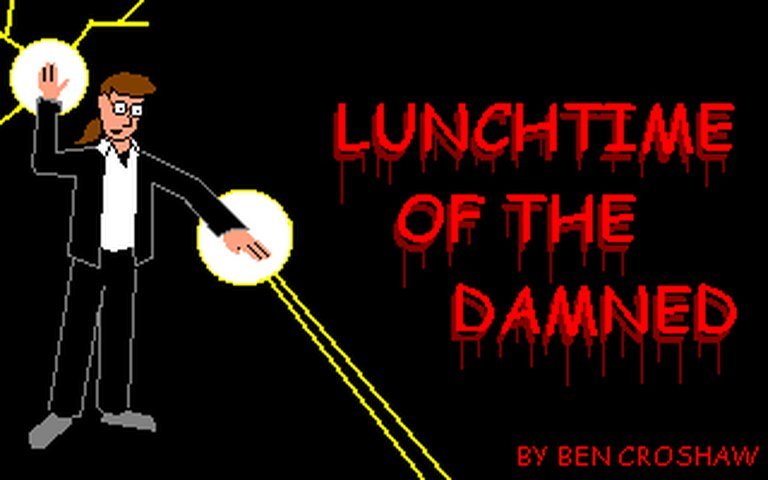
Lunchtime of the Damned is a comedic point-and-click adventure game where teenage magician Davy Jones and his girlfriend Elandra accidentally unleash a brain-craving zombie during a botched resurrection ritual. Set in a quirky, 2D side-scrolling world, players must navigate puzzles and interactions to stop the undead menace before it’s too late. The game features a classic mouse-driven interface, reminiscent of titles like Sam & Max Hit The Road, with right-click actions and a top-screen menu for inventory and controls.
Gameplay Videos
Lunchtime of the Damned Free Download
Lunchtime of the Damned Guides & Walkthroughs
Lunchtime of the Damned Reviews & Reception
virtualmoose.org : It’s alright! It’s hard to be critical of it because it’s a game created by a community that was not only learning how to make adventure games, but also learning a new tool.
mobygames.com (50/100): Average score: 50% (based on 1 ratings)
homeoftheunderdogs.net (74/100): Overall, the unique series gets a “Recommended!”
retro-replay.com : The puzzles in Lunchtime of the Damned strike a fine balance between logic and whimsy.
Lunchtime of the Damned: A Darkly Comic Masterpiece of Amateur Adventure Gaming
Introduction: The Birth of a Cult Classic
Few games capture the spirit of early 2000s indie adventure gaming quite like Lunchtime of the Damned. Released in 2001 by Ben “Yahtzee” Croshaw, this point-and-click adventure is a charming, if rough-around-the-edges, gem that emerged from the burgeoning Adventure Game Studio (AGS) community. At a time when commercial adventure games were fading, Lunchtime of the Damned stood as a testament to the creativity of amateur developers, blending dark humor, zombie apocalypse tropes, and a surprisingly heartfelt narrative about responsibility and consequence.
This review will dissect the game’s development, narrative depth, gameplay mechanics, artistic choices, and lasting legacy. While it may not have achieved mainstream success, Lunchtime of the Damned remains a fascinating artifact of a transitional era in gaming—one where passion projects could thrive outside corporate constraints.
Development History & Context: The Rise of AGS and the Reality-on-the-Norm Universe
The AGS Revolution
The late 1990s and early 2000s were a turbulent time for adventure games. Sierra On-Line, once a titan of the genre, was collapsing under financial strain, while LucasArts shifted focus away from its beloved Monkey Island and Sam & Max series. Into this void stepped Adventure Game Studio (AGS), a free, user-friendly engine that empowered aspiring developers to create their own point-and-click adventures.
Ben Croshaw, then an unknown but ambitious creator, seized this opportunity. Lunchtime of the Damned was his first major project, and it laid the foundation for what would become the Reality-on-the-Norm (RON) series—a shared universe where multiple developers could contribute interconnected stories.
The Reality-on-the-Norm Experiment
RON was more than just a game; it was a collaborative storytelling experiment. The idea was simple yet revolutionary: multiple developers could create games set in the same fictional town, sharing characters, locations, and lore. This meant that an NPC in one game could become the protagonist of another, creating a living, breathing world.
Lunchtime of the Damned was the first official entry in this universe, introducing players to the quirky town of Reality-on-the-Norm and its eccentric inhabitants. The game’s success (or at least its cult following) inspired dozens of sequels, spin-offs, and even text-based adventures, all expanding the lore.
Technological Constraints & Creative Workarounds
Developed in AGS 2.0, Lunchtime of the Damned was constrained by the limitations of early 2000s indie tools:
– 2D side-scrolling visuals with hand-drawn, MS Paint-esque artwork.
– No voice acting—dialogue was entirely text-based.
– Simple MIDI soundtracks, with only a brief original theme song.
– A compact, self-contained world due to file size limitations.
Yet, these constraints bred creativity. The game’s minimalist aesthetic became part of its charm, and the lack of voice acting forced Croshaw to refine his writing, resulting in sharp, witty dialogue that carried the narrative.
Narrative & Thematic Deep Dive: A Dark Comedy of Errors
Plot Summary: When Necromancy Goes Wrong
The story follows Davy Jones, a teenage magician with more enthusiasm than skill, and his skeptical girlfriend Elandra. In a bid to impress (or possibly just to mess around), they attempt a resurrection ritual in a graveyard. Naturally, things go horribly wrong, and instead of reviving a beloved townsfolk, they accidentally create a brain-hungry zombie.
What follows is a frantic, darkly comedic quest to undo their mistake before the zombie devours the entire town. Along the way, they encounter:
– A undead Bill Cosby (yes, that Bill Cosby), a bizarre cameo that underscores the game’s irreverent tone.
– Paranoid conspiracy theorists who blame the government for the zombie outbreak.
– A town on the brink of panic, with NPCs ranging from terrified villagers to opportunistic looters.
Themes: Responsibility, Consequence, and Dark Humor
Beneath its zombie slapstick exterior, Lunchtime of the Damned explores surprisingly mature themes:
1. The Weight of Irresponsibility – Davy’s reckless necromancy forces him to confront the consequences of his actions. The game subtly critiques the idea of playing with forces beyond one’s understanding.
2. The Absurdity of Horror – The zombie apocalypse is treated with deadpan humor, undercutting traditional horror tropes. The game’s tone is closer to Shaun of the Dead than Resident Evil.
3. Found Family & Partnership – Davy and Elandra’s dynamic is the emotional core. Their bickering, teamwork, and eventual solidarity make their journey engaging.
Dialogue & Character Writing
The writing is sharp, self-aware, and occasionally edgy (a product of its early 2000s internet culture roots). Some jokes haven’t aged well, but the banter between Davy and Elandra remains genuinely funny. The game’s humor thrives on:
– Meta-commentary (e.g., characters acknowledging how ridiculous their situation is).
– Absurdist NPCs (like the zombie Bill Cosby, a surreal gag that somehow works).
– Dry, British-style wit, a hallmark of Croshaw’s later work (e.g., Zero Punctuation).
Gameplay Mechanics & Systems: A Love Letter to Classic Adventures
Point-and-Click Perfection (With Some Rough Edges)
Lunchtime of the Damned wears its influences on its sleeve, particularly LucasArts’ Sam & Max Hit the Road. The control scheme is nearly identical:
– Right-click cycling between actions (Walk, Look, Interact, Talk).
– Inventory-based puzzles with occasional moon logic (a staple of the genre).
– A top-down menu for saving, loading, and managing items.
Puzzle Design: Clever but Occasionally Obtuse
The puzzles are logical but not always intuitive, a common trait in early AGS games. Some highlights:
– Early-game challenges (e.g., gathering ritual components) ease players in.
– Later puzzles require lateral thinking, such as distracting the zombie with Elandra while Davy searches for a solution.
– A few pixel-hunting moments, where crucial items blend into the background.
The Good & The Flawed
✅ Pros:
– Tight, focused design – The game is short (1-2 hours), ensuring no padding.
– Character-switching mechanics – Playing as both Davy and Elandra adds variety.
– No unintentional deaths – Unlike Sierra’s punishing adventures, failure is rare.
❌ Cons:
– No hint system – Some puzzles may stump players without external guides.
– Occasional clunkiness – AGS’s limitations lead to some awkward interactions.
– Limited replayability – Once solved, the puzzles lose their magic.
World-Building, Art & Sound: A Gothic Cartoon Aesthetic
Visual Style: MS Paint Meets Tim Burton
The art direction is deliberately lo-fi, with:
– Hand-drawn, cartoonish sprites that evoke Monkey Island’s charm.
– Gothic but playful environments—graveyards, crypts, and a town square that feels alive despite its 2D limitations.
– Expressive character animations (e.g., Davy’s exaggerated frustration, the zombie’s lurching gait).
Sound & Music: MIDI Magic
- The soundtrack is minimal, relying on public-domain MIDI tracks (a common cost-saving measure in AGS games).
- The Reality-on-the-Norm theme is catchy but short.
- Ambient sounds (e.g., creaking doors, zombie groans) enhance immersion.
Atmosphere: Spooky Yet Silly
The game strikes a perfect balance between horror and comedy:
– Moonlit graveyards feel eerie, but the over-the-top zombie design keeps things light.
– Daylight scenes contrast sharply with the horror, reinforcing the game’s self-aware tone.
Reception & Legacy: The Little Game That Could
Critical & Commercial Reception
- MobyGames: 50% (critics), 3.3/5 (players) – A mixed but generally positive response.
- Home of the Underdogs: 7.41/10 – Praised for its humor and puzzle design.
- Retro Replay: Called it a “charming, if flawed, love letter to classic adventures.”
Cult Following & Influence
Despite its niche appeal, Lunchtime of the Damned had a lasting impact:
– Inspired the RON series, which grew to include dozens of games by different developers.
– Proved that AGS could produce compelling narratives, paving the way for future indie adventures.
– Launched Ben Croshaw’s career, who later became famous for Zero Punctuation and The Consuming Shadow.
Where It Stands Today
- A historical curiosity – A snapshot of early 2000s indie gaming.
- A must-play for adventure fans – Especially those interested in AGS’s evolution.
- Still available for free on the Reality-on-the-Norm website.
Conclusion: A Flawed but Endearing Classic
Lunchtime of the Damned is not a perfect game, but it doesn’t need to be. It’s a passionate, humorous, and surprisingly deep adventure that punches far above its weight. Its legacy lies not in sales or awards, but in its role as a pioneer—proof that even amateur developers could craft memorable experiences.
Final Verdict: 7.5/10 – “A Cult Classic Worth Unearthing”
- For fans of: Sam & Max, Monkey Island, Day of the Tentacle.
- Best enjoyed by: Adventure game historians, AGS enthusiasts, and anyone who loves dark comedy with heart.
- Play it if: You want a short, charming, and slightly edgy adventure with clever writing and nostalgic gameplay.
In the end, Lunchtime of the Damned is more than just a game—it’s a time capsule of an era when creativity thrived in the cracks of the gaming industry. And for that alone, it deserves to be remembered.
Where to Play:
🔗 Download for free on Reality-on-the-Norm
💡 Pro Tip: Use a Windows 98 VM or DOSBox for the best experience, as modern AGS support is spotty.
Would you dare to resurrect the dead? Or will you leave Davy Jones to clean up his own mess? The choice is yours.