
- Release Year: 2000
- Platforms: Windows
- Publisher: BufoProject GmbH
- Developer: BufoProject GmbH
- Genre: Action, Sports
- Perspective: 1st-person
- Game Mode: Single-player
- Gameplay: Hunting, Rail shooter, Shooter
- Average Score: 59/100
Description
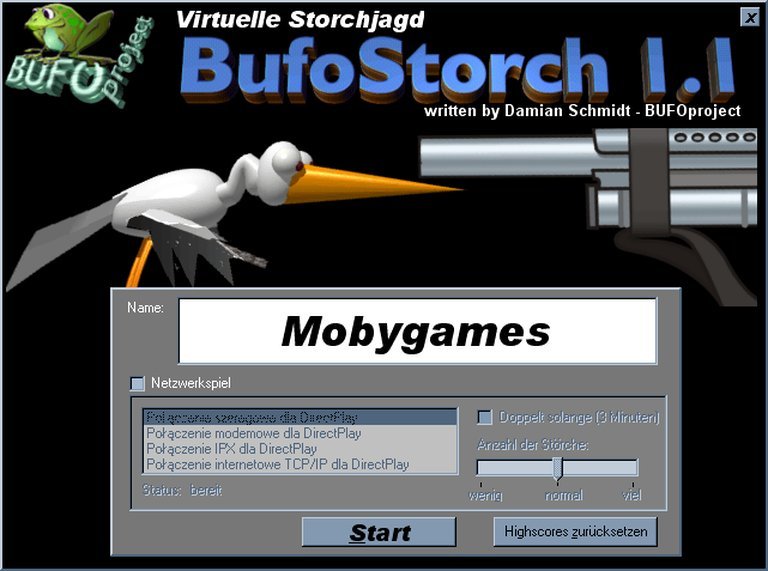
BufoStorch is a first-person shooting game released in 2000, drawing inspiration from the popular Moorhuhn series. Players assume the role of a hunter tasked with shooting down storks within a 90-second time limit, using a mouse to aim and fire a rifle while reloading with the right mouse button. Points are awarded for hitting storks, but penalties are incurred for shooting passing planes, adding a layer of challenge. The game features simple, fast-paced gameplay and supports both single-player and multiplayer modes via internet or modem.
BufoStorch Reviews & Reception
mobygames.com (38/100): A shooting game very similar to Moorhuhn.
myabandonware.com (80/100): An action and sports game, set in a hunting, shooter and rail shooter themes.
BufoStorch Cheats & Codes
PlayStation (PSX)
At the versus screen, press Turbo, Jump, and Pass to change the icons below the helmets. The numbers indicate the number of times each button is pressed. After changing the icons, press the D-pad in the indicated direction to enable the code.
| Code | Effect |
|---|---|
| 5-1-4 Up | Infinite turbo |
| 2-2-3 Right | Unlimited throwing distance |
| 0-3-2 Left | Fast turbo running |
| 3-1-2 Up | Power-up offense |
| 4-2-1 Up | Power-up defense |
| 2-3-3 Up | Power-up teammates |
| 3-1-2 Left | Power-up blockers |
| 0-4-5 Up | Super blitzing |
| 1-2-3 Left | Super field goals |
| 3-4-4 Up | No interceptions |
| 4-2-3 Down | No random fumbles |
| 2-1-0 Up | No first downs |
| 1-5-1 Up | No punting |
| 2-1-1 Left | Allow stepping out of bounds |
| 2-5-0 Left | Fast passes |
| 0-0-1 Down | Show field goal % |
| 0-0-1 Right | Show punt hang meter |
| 1-0-2 Right | Hide receiver name |
| 3-3-3 Left | Invisible receiver highlight |
| 4-3-3 Up | Invisible |
| 3-2-3 Left | Red, white and blue football |
| 0-5-0 Right | Big football |
| 2-0-0 Right | Big head |
| 0-4-0 Up | Huge head |
| 3-2-1 Left | No head |
| 1-2-3 Right | Headless team |
| 3-1-0 Right | Team tiny players |
| 1-4-1 Right | Team big players |
| 2-0-3 Right | Team big heads |
| 1-1-5 Left | No play selection |
| 0-2-1 Right | Show more field |
| 0-1-2 Down | No CPU assistance |
| 4-0-4 Left | Power-up speed |
| 5-5-5 Up | Hyper blitz |
| 3-1-4 Down | Smart CPU opponent |
| 2-1-2 Down | Deranged blitz mode |
| 3-2-3 Up | Ultra hard mode |
| 4-2-3 Right | Super passing mode |
| 4-4-4 Up | Super blitz mode |
| 1-1-1 Down | Tournament mode |
| 2-2-2 Left | Always quarterback |
| 2-2-2 Right | Always receiver |
| 5-0-1 Up | Old day stadium |
| 5-0-1 Down | Day stadium |
| 5-0-1 Left | City stadium |
| 5-0-2 Up | Old night stadium |
| 5-0-2 Down | Night stadium |
| 5-0-2 Left | Future stadium |
| 5-0-3 Up | Old snow stadium |
| 5-0-3 Down | Snow stadium |
| 5-0-3 Left | Roman stadium |
| 3-0-0 Up | Grass field |
| 3-0-1 Up | Asphalt field |
| 3-0-2 Up | Dirt field |
| 3-0-3 Up | Astroturf field |
| 3-0-4 Up | Snow field |
| 2-1-2 Left | Weather: clear |
| 5-2-5 Down | Weather: snow |
| 5-5-5 Right | Weather: rain |
| 1-0-1 Left | Arizona Cardinals playbook |
| 1-0-2 Left | Atlanta Falcons playbook |
| 1-0-3 Left | Baltimore Ravens playbook |
| 1-0-4 Left | Buffalo Bills playbook |
| 1-0-5 Left | Carolina Panthers playbook |
| 1-1-0 Left | Chicago Bears playbook |
| 1-1-2 Left | Cincinnati Bengals playbook |
| 1-1-3 Left | Cleveland Browns playbook |
| 1-1-4 Left | Dallas Cowboys playbook |
| 1-1-5 Right | Denver Broncos playbook |
| 1-2-1 Left | Detroit Lions playbook |
| 1-2-2 Left | Green Bay Packers playbook |
| 1-2-3 Up | Indianapolis Colts playbook |
| 1-2-4 Left | Jacksonville Jaguars playbook |
| 1-2-5 Left | Kansas City Chiefs playbook |
| 1-3-1 Left | Miami Dolphins playbook |
| 1-3-2 Left | Minnesota Vikings playbook |
| 1-3-3 Left | New England Patriots playbook |
| 1-3-4 Left | New Orleans Saints playbook |
| 1-3-5 Left | New York Giants playbook |
| 1-4-1 Left | New York Jets playbook |
| 1-4-2 Left | Oakland Raiders playbook |
| 1-4-3 Left | Philadelphia Eagles playbook |
| 1-4-4 Left | Pittsburgh Steelers playbook |
| 1-4-5 Left | San Diego Chargers playbook |
| 1-5-1 Left | San Francisco 49ers playbook |
| 1-5-2 Left | Seattle Seahawks playbook |
| 1-5-3 Left | St. Louis Rams playbook |
| 1-5-4 Left | Tampa Bay Buccaneers playbook |
| 1-5-5 Left | Tennessee Titans playbook |
| 2-0-1 Left | Washington Redskins playbook |
BufoStorch: A Forgotten Relic of the Early 2000s Shooter Craze
Introduction: The Curious Case of BufoStorch
In the annals of gaming history, few titles are as enigmatic as BufoStorch, a 2000 Windows shooter that emerged during the height of the Moorhuhn (Crazy Chicken) phenomenon. Developed and published by the obscure BufoProject GmbH, this game is a fascinating artifact of early 2000s casual gaming—a time when simple, addictive shooters dominated office PCs and internet cafés. Yet, despite its niche appeal, BufoStorch remains a footnote, overshadowed by its more famous predecessor and largely forgotten by modern audiences.
This review seeks to resurrect BufoStorch from the digital abyss, examining its development, gameplay, cultural context, and legacy. Was it a shameless clone, a misunderstood gem, or merely a product of its time? By dissecting its mechanics, aesthetics, and reception, we aim to determine its rightful place in gaming history.
Development History & Context: The Rise of the Casual Shooter
The Studio Behind the Game
BufoProject GmbH was a small, relatively unknown developer based in Poland, with BufoStorch being one of its few documented releases. The studio’s lack of a significant portfolio suggests it was either a short-lived venture or a passion project by a lone developer—Damian Schmidt, the sole credited creator. Schmidt’s involvement in 12 other games (per MobyGames) hints at a prolific but underrecognized career in indie development.
The Moorhuhn Phenomenon
BufoStorch was explicitly designed as a Moorhuhn clone, a genre that exploded in popularity in the late 1990s and early 2000s. Moorhuhn (1999), developed by Phenomedia, was a simple yet addictive rail shooter where players hunted grouse (or “crazy chickens” in later iterations). Its success spawned countless imitators, from Deer Avenger to Shoot the Roach, each attempting to capitalize on the formula’s accessibility and replayability.
Technological Constraints & Design Philosophy
Released in 2000, BufoStorch was constrained by the hardware of its era. Running on early Windows systems, it relied on basic 2D sprites and minimalist sound design. The game’s simplicity was both a strength and a limitation:
– Strengths: Low system requirements made it widely accessible, ideal for office breaks or casual play.
– Limitations: The lack of depth or innovation meant it struggled to stand out in an oversaturated market.
The Gaming Landscape of 2000
The year 2000 was a transitional period for gaming. While AAA titles like Deus Ex and The Sims pushed boundaries, casual and browser-based games thrived in the shadows. BufoStorch catered to this secondary audience—players seeking quick, mindless entertainment rather than immersive experiences. Its freeware model (or public domain status) further ensured its spread, though it also meant limited commercial viability.
Narrative & Thematic Deep Dive: The Absurdity of Stork Hunting
Plot (or Lack Thereof)
BufoStorch is a game of pure, unadulterated absurdity. There is no narrative, no lore, and no justification for the player’s actions. You are a hunter (or perhaps a toad, as suggested by the title’s portmanteau of “Bufo” (toad) and “Storch” (stork in German)), and your sole objective is to shoot storks out of the sky. The game’s premise is as barebones as it gets, yet this minimalism is part of its charm—or its downfall, depending on one’s perspective.
Themes: Satire or Senselessness?
The game’s themes are open to interpretation:
1. Absurdist Humor: The sheer randomness of shooting storks (and the penalty for shooting planes) suggests a tongue-in-cheek approach, mocking the mindlessness of casual shooters.
2. Environmental Commentary: Some might read it as a dark satire on hunting culture, though this seems unlikely given its lack of contextual depth.
3. Pure Gameplay: More plausibly, BufoStorch exists solely as a mechanical exercise, stripping away all pretense of storytelling to focus on score-chasing.
Characters & Dialogue
There are no characters in the traditional sense. The storks are faceless targets, the planes are obstacles, and the player is a disembodied rifle. The absence of dialogue or personality reinforces the game’s utilitarian design—it is a tool for killing time, nothing more.
Gameplay Mechanics & Systems: The Moorhuhn Formula Refined (or Repeated)
Core Gameplay Loop
BufoStorch adheres rigidly to the Moorhuhn template:
1. Shooting Mechanics: Players use the mouse to aim and shoot storks mid-flight. The right mouse button reloads, adding a minor layer of strategy.
2. Scoring System: Each stork hit awards points, while shooting a plane deducts them. The 90-second timer creates a sense of urgency.
3. Repetition: After the timer expires, the score is tallied, and the player can restart immediately, encouraging high-score competition.
Innovations (or Lack Thereof)
The game introduces no meaningful innovations. Its only distinguishing feature is the stork theme, which replaces Moorhuhn’s grouse with a slightly more exotic target. The inclusion of planes as hazards is a minor tweak but does little to elevate the experience.
Multiplayer & Replayability
BufoStorch supported multiplayer via modem or internet, a rare feature for such a simple game. This added a competitive edge, allowing players to challenge friends or strangers. However, the lack of persistent leaderboards or unlockable content meant replayability was limited to personal or social competition.
UI & Controls
The UI is functional but unremarkable:
– Mouse Controls: Intuitive for aiming and shooting.
– Keyboard Input: Arrow keys for scrolling (though the need for this is unclear, given the game’s static background).
– Minimalist HUD: Score and timer are displayed prominently, with no unnecessary clutter.
Flaws & Frustrations
- Repetitive Gameplay: The absence of variety in enemies, environments, or objectives makes extended play sessions tedious.
- Lack of Depth: No power-ups, upgrades, or progression systems exist to reward long-term engagement.
- Visual Monotony: The static background and repetitive stork animations grow stale quickly.
World-Building, Art & Sound: Aesthetic Minimalism
Setting & Atmosphere
BufoStorch takes place in a nondescript outdoor environment—a blue sky with occasional clouds, serving as a backdrop for the storks’ flight. There is no world-building; the setting is purely functional, designed to avoid distractions from the core gameplay.
Visual Design
- Sprite Work: The storks and planes are simple, cartoonish sprites, lacking the polish of Moorhuhn’s more refined art style.
- Color Palette: Bright and cheerful, with a focus on high contrast to ensure visibility.
- Animation: Basic and repetitive, with storks flapping their wings in a loop.
Sound Design
- Gunfire: A generic shooting sound, neither satisfying nor immersive.
- Ambient Noise: Minimal, with no background music to speak of.
- Feedback: A simple “ding” for hits and a “buzz” for misses—functional but uninspired.
Contribution to the Experience
The game’s aesthetic choices reinforce its casual, no-frills nature. The lack of atmospheric depth is intentional, prioritizing gameplay over immersion. However, this also means the game fails to leave a lasting impression beyond its mechanical loop.
Reception & Legacy: The Forgotten Clone
Critical & Commercial Reception
BufoStorch received almost no critical attention. MobyGames lists a paltry 1.9/5 average score from two player ratings, with no written reviews. Metacritic has no critic or user reviews, and MyAbandonware’s 4/5 rating (from two votes) is the sole positive outlier. This suggests the game was either:
1. Overlooked: Buried under the avalanche of Moorhuhn clones.
2. Disliked: Seen as a lazy cash-in with nothing new to offer.
3. Niche Appeal: Enjoyed by a small audience but never breaking into mainstream consciousness.
Cultural Impact & Influence
BufoStorch had no discernible influence on the gaming industry. It was one of hundreds of casual shooters that flooded the market in the early 2000s, most of which have since faded into obscurity. Its legacy, if any, is as a curiosity—a relic of a time when simple, repetitive games could find an audience.
Modern Relevance
Today, BufoStorch is primarily of interest to retro gaming enthusiasts and historians. Its availability as abandonware ensures it remains playable, but its lack of depth or innovation means it holds little appeal beyond nostalgia. Comparisons to modern indie shooters (e.g., Shooty Fruity or Blasters of the Universe) highlight how far the genre has evolved.
Conclusion: A Relic of Its Time
BufoStorch is a game of contradictions. It is simultaneously a product of its era and a victim of it—a clone that failed to differentiate itself in a sea of clones. Its strengths (accessibility, simplicity, multiplayer) are outweighed by its weaknesses (repetition, lack of innovation, forgettable presentation).
Final Verdict: BufoStorch is a historical footnote, a minor blip in the early 2000s casual gaming boom. It is not a bad game by the standards of its time, but it is also not a good one—merely an adequate one, destined to be remembered only by those who seek out gaming’s most obscure artifacts.
Score: 4/10 – A functional but forgettable clone, best experienced as a curiosity rather than a must-play classic.
For modern audiences, BufoStorch serves as a reminder of how far gaming has come—and how even the simplest ideas can find an audience, if only for a fleeting moment.