
- Release Year: 1998
- Platforms: Windows
- Publisher: Interplay Entertainment Corp.
- Developer: FlatCat
- Genre: Strategy, Tactics
- Perspective: Top-down
- Game Mode: Hotseat, LAN, Online PVP, Single-player
- Gameplay: Base building, Real-time combat, Resource Management, Turn-based combat
- Setting: Futuristic, Sci-fi
- Average Score: 73/100
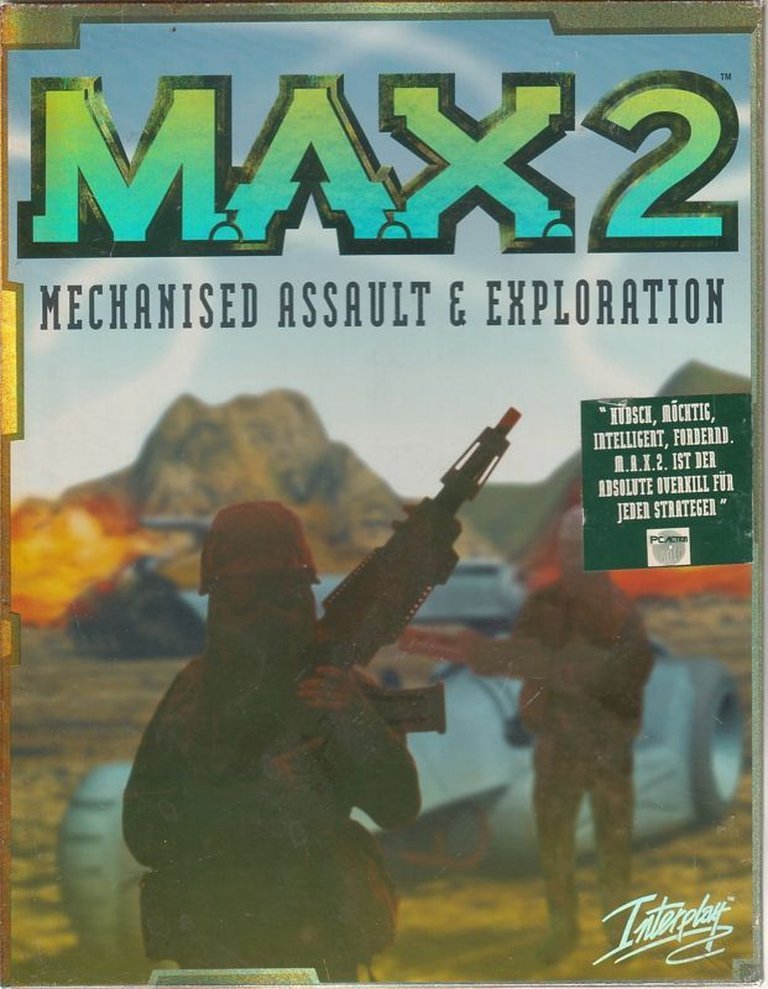
Description
M.A.X. 2: Mechanized Assault & Exploration is a real-time strategy game set in a sci-fi futuristic world where players colonize and defend a new planet. With your brain wired directly to a command center, you must build infrastructure, manage resources, construct combat vehicles, and eliminate enemies using tactical turn-based elements. The game blends strategic depth with isometric visuals and supports multiplayer modes, including LAN and internet play.
Gameplay Videos
Where to Buy M.A.X. 2: Mechanized Assault & Exploration
M.A.X. 2: Mechanized Assault & Exploration Free Download
M.A.X. 2: Mechanized Assault & Exploration Patches & Updates
M.A.X. 2: Mechanized Assault & Exploration Guides & Walkthroughs
M.A.X. 2: Mechanized Assault & Exploration Reviews & Reception
myabandonware.com (90/100): A triumphant return to form for the series.
en.wikipedia.org (57/100): Will the new M.A.X. satisfy die-hard fans of the original? Probably not. Some players may be hoping for more than the new game delivers. But with or without die-hards, M.A.X. 2 is a solid combat/strategy game that is bound to make numerous new friends.
retrolorean.com : The game stands as a curio from era of PC strategy where competition encouraged experimentation. Players praised its breadth and the tension of slow rolling decisions, while critics sometimes lamented a steep learning curve and a user interface that demanded patience.
M.A.X. 2: Mechanized Assault & Exploration Cheats & Codes
PC
Press ‘[‘ and enter one of the following codes.
| Code | Effect |
|---|---|
| maxammo | Full Ammo |
| maxsurvey | Reveal the Location of All Resources |
| maxspy | Reveals the Location of All Enemies |
| maxsuper | Allows Chosen Unit to be Upgraded to Level 30 |
| maxstorage | Fills Raw Material Units Cargo Completely |
M.A.X. 2: Mechanized Assault & Exploration: A Flawed but Fascinating Hybrid Strategy Game
Introduction
In the late 1990s, the real-time strategy (RTS) genre was dominated by titans like Command & Conquer, StarCraft, and Total Annihilation. Amidst this competitive landscape, M.A.X. 2: Mechanized Assault & Exploration emerged as a bold experiment—a hybrid of turn-based and real-time strategy that promised depth, flexibility, and innovation. Developed by FlatCat and published by Interplay in 1998, M.A.X. 2 was the sequel to the critically acclaimed M.A.X.: Mechanized Assault & Exploration, which had carved a niche for itself by blending turn-based tactics with real-time execution. However, while the original was praised for its strategic depth and unique gameplay, M.A.X. 2 arrived in a state that left many fans disappointed. This review explores the game’s ambitious design, its technical shortcomings, and its enduring legacy as a cult classic that could have been so much more.
Development History & Context
The Studio and Vision
M.A.X. 2 was developed by FlatCat, a studio under the Interplay umbrella known for its work on strategy games. The team included veterans like Gus Smedstad (Lead Designer and AI Programmer) and Dave Boulanger (Lead Programmer), who had also worked on the original M.A.X. and other Interplay titles like Baldur’s Gate. The vision for M.A.X. 2 was to refine and expand upon the hybrid gameplay of its predecessor, offering players three distinct modes: turn-based, simultaneous turn-based, and real-time.
The original M.A.X. had been a critical darling, praised for its tactical depth and innovative “simultaneous turn-based” mode, which allowed players to issue orders in real-time but executed them in turns. This mode struck a balance between the methodical planning of turn-based games and the dynamic action of RTS titles. M.A.X. 2 aimed to build on this foundation by adding a full real-time mode, streamlining base-building, and introducing new factions and units.
Technological Constraints and Market Pressures
The late 1990s were a period of rapid evolution in PC gaming. Graphics were transitioning from 2D sprites to 3D acceleration, and games like StarCraft and Total Annihilation were setting new standards for RTS design. M.A.X. 2 was developed during this transitional period, and its engine reflected the limitations of the time. The game used pre-rendered 2D terrain with isometric projection, allowing for elevation and line-of-sight mechanics but lacking the deformable landscapes of more advanced engines.
Interplay, facing financial pressures and competition from larger studios, reportedly rushed M.A.X. 2 to market. This haste resulted in a game plagued by bugs, unstable multiplayer, and an interface that felt clunky compared to contemporaries. The decision to include a real-time mode—likely a response to market trends—further complicated development, as the game’s systems were originally designed around turn-based mechanics.
The Gaming Landscape in 1998
1998 was a banner year for RTS games:
– StarCraft (Blizzard) redefined the genre with its polished gameplay and deep multiplayer.
– Total Annihilation (Cavedog) introduced large-scale warfare and customizable units.
– Age of Empires (Ensemble Studios) brought historical RTS to the masses.
M.A.X. 2 entered this crowded field with a unique selling point: its hybrid gameplay. However, its technical issues and lack of polish made it difficult to compete with the more refined experiences offered by its rivals.
Narrative & Thematic Deep Dive
Plot and Setting
M.A.X. 2 is set in a sci-fi universe where humanity has joined the Concord, an intergalactic alliance of advanced alien races. The game’s campaign follows the human factions as they face a new threat: the Sheevat, a hostile alien species seeking to disrupt the Concord’s dominance. Players take on the role of a Mission Commander, tasked with colonizing new worlds, harvesting resources, and defending against Sheevat incursions.
The narrative is minimalist, serving primarily as a backdrop for the gameplay. Unlike contemporaries like StarCraft, which wove deep storytelling into their campaigns, M.A.X. 2 focuses on tactical and strategic gameplay over lore. The Sheevat are portrayed as a faceless enemy, and the human factions (or “clans”) are differentiated mainly by their unit bonuses rather than distinct personalities or motivations.
Themes
- Colonization and Resource Exploitation: The game’s core loop revolves around expanding colonies, mining resources, and building military forces. This reflects the broader theme of humanity’s struggle to survive and thrive in a hostile universe.
- Asymmetrical Warfare: The Sheevat units are designed to counter human strategies, forcing players to adapt their tactics. This asymmetry adds depth but is underutilized in the campaign.
- Technological Progress: Research and upgrades play a key role, allowing players to customize their units and gain strategic advantages.
Characters and Dialogue
M.A.X. 2 lacks the memorable characters of other RTS games. The Mission Commander is a silent protagonist, and the Sheevat are voiceless adversaries. The game’s unit voice lines (e.g., “We have already tried everything!”) add flavor but are repetitive and lack the charm of StarCraft’s iconic quips.
The dialogue is functional, providing mission briefings and objectives but little in the way of storytelling. This was a missed opportunity, as a stronger narrative could have elevated the game’s campaign mode.
Gameplay Mechanics & Systems
Core Gameplay Loop
M.A.X. 2 is a hybrid strategy game that blends base-building, resource management, and tactical combat. The gameplay can be broken down into three phases:
- Resource Gathering: Players deploy mining units to extract metal and energy from the map. Unlike other RTS games, M.A.X. 2 simplifies resource collection by eliminating fuel as a separate resource.
- Base Construction: Players build structures such as power plants, factories, and research labs. The original M.A.X. featured a complex “connector” system for base-building, but M.A.X. 2 streamlined this, making construction more accessible but less strategic.
- Unit Production and Combat: Players train military units (tanks, aircraft, infantry) and engage in battles. The game’s unit variety is impressive, with over 50 land, sea, and air units, each with unique stats for speed, armor, firepower, and range.
Time Modes: The Game’s Defining Feature
M.A.X. 2’s most innovative feature is its three time modes, each offering a distinct gameplay experience:
-
Turn-Based Mode:
- Players take turns issuing orders.
- Units have movement points and attack points, limiting their actions per turn.
- Opportunity fire allows units to attack enemies that move into range.
- Pros: Deep tactical planning, ideal for methodical players.
- Cons: Slow-paced, can feel tedious in large battles.
-
Simultaneous Turn-Based Mode (the original M.A.X.’s signature mode):
- Players issue orders in real-time, but all actions are resolved simultaneously at the end of each turn.
- Units freeze after expending their movement/attack points.
- Pros: Combines the strategy of turn-based with the excitement of real-time.
- Cons: Can be chaotic in multiplayer due to desync issues.
-
Real-Time Mode:
- A traditional RTS experience where actions are executed immediately.
- Pros: Faster-paced, more dynamic.
- Cons: The game’s systems were not optimized for real-time, leading to clunky controls and unresponsive units.
Combat and Unit Design
M.A.X. 2’s combat is stat-driven, with each unit having attributes like:
– Scan Range: How far a unit can detect enemies.
– Attack Range: How far a unit can fire.
– Armor: Defense against damage.
– Speed: Movement rate.
This creates a rock-paper-scissors dynamic where no single unit is overpowered. For example:
– Scouts have high scan range but weak firepower.
– Missile Crawlers have long attack range but slow movement.
– Tanks are balanced but vulnerable to air units.
Terrain plays a crucial role in combat:
– Elevation affects line-of-sight.
– Forests and craters provide cover.
– Water restricts land units but allows naval warfare.
Research and Upgrades
Players can research upgrades to improve their units’ stats (e.g., +armor, +speed). This adds a progression system but is overshadowed by the game’s other mechanics.
Multiplayer
M.A.X. 2 supports up to 6 players via LAN, modem, or internet. However, the multiplayer mode was notoriously unstable, with desync issues and visibility bugs rendering it nearly unplayable at launch. Patches improved stability, but the damage to the game’s reputation was already done.
World-Building, Art & Sound
Visual Design
M.A.X. 2’s art style is retro-futuristic, with chunky mecha designs and industrial color palettes. The isometric perspective and pre-rendered terrain give the game a distinct look, though the graphics were not cutting-edge for 1998. Compared to Total Annihilation’s smooth 3D landscapes, M.A.X. 2’s visuals feel grainy and dated.
Key visual features:
– Zoom and Tilt: Players can zoom in/out and tilt the camera for better tactical oversight.
– Spycams: Deployable cameras allow players to scout enemy positions.
– Unit Tags: Optional labels display unit names, health, and allegiance.
Sound Design
The soundtrack is dramatic and atmospheric, with orchestral scores that enhance the game’s sci-fi setting. Voice acting is clear but limited, with units providing generic battle cries rather than memorable lines.
Sound effects include:
– Mechanical clanks for unit movement.
– Explosions and gunfire during combat.
– Ambient engine hums for vehicles.
While competent, the audio design lacks the polish of contemporaries like StarCraft.
Reception & Legacy
Critical Reception
M.A.X. 2 received mixed reviews, with critics praising its ambition and depth but criticizing its bugs and unpolished execution. Aggregate scores reflect this divide:
– MobyGames: 6.7/10 (based on 21 critic reviews).
– GameRankings: 57% (based on 11 reviews).
– Steam User Reviews: Mixed (48% positive).
Positive Aspects Highlighted by Critics:
– Innovative hybrid gameplay (especially simultaneous turn-based mode).
– Deep tactical combat with varied unit types.
– Flexible playstyles (three time modes, multiple factions).
Negative Aspects Criticized:
– Buggy and unstable, particularly in multiplayer.
– Clunky real-time controls.
– Lack of polish compared to competitors.
– Weak narrative and presentation.
Notable Review Quotes:
– PC Jeux (91%): “Beautiful, it breaks bricks and also blows your hair back. Perfect!”
– IGN (3.7/10): “A frustrating experience… not a finished product.”
– Computer Gaming World (50%): “Lacks innovation and is plagued by problems.”
Commercial Performance
M.A.X. 2 underperformed commercially, failing to match the success of its predecessor or competitors like StarCraft. Its rushed release and technical issues likely contributed to its poor sales.
Legacy and Influence
Despite its flaws, M.A.X. 2 has endured as a cult classic among strategy fans. Its hybrid gameplay influenced later titles like:
– Frozen Synapse (2011), which refined simultaneous turn-based mechanics.
– Wargroove (2019), which blended turn-based strategy with real-time execution.
The game’s modding community kept it alive, with fans creating custom maps and scenarios. Today, M.A.X. 2 is available on GOG and Steam, where it attracts nostalgia-driven players and strategy enthusiasts willing to overlook its rough edges.
Conclusion: A Flawed Gem Worth Revisiting
M.A.X. 2: Mechanized Assault & Exploration is a game of contradictions. It is ambitious yet unfinished, innovative yet flawed, deep yet inaccessible. Its hybrid gameplay remains a unique experiment in strategy design, offering a level of tactical depth rarely seen in RTS games. However, its technical issues, clunky interface, and lack of polish prevent it from reaching the heights of its contemporaries.
Final Verdict:
– For Strategy Purists: M.A.X. 2 is a hidden gem worth exploring for its simultaneous turn-based mode and deep unit customization.
– For Casual Players: The game’s steep learning curve and bugs make it a hard sell compared to more polished alternatives.
– For Multiplayer Enthusiasts: The unstable netcode renders multiplayer nearly unplayable without extensive patching.
Score: 6.5/10 – A flawed but fascinating strategy game that could have been a classic with more time in development.
M.A.X. 2 stands as a testament to the risks of innovation in game design. It dared to blend genres in ways few games have attempted, and while it stumbled in execution, its ideas continue to inspire. For those willing to endure its rough edges, it offers a rewarding and unique strategy experience that remains unmatched even decades later.