
- Release Year: 2016
- Platforms: Linux, Macintosh, Nintendo Switch, PlayStation 4, PlayStation 5, Windows, Xbox One, Xbox Series
- Publisher: Pixel Maniacs
- Developer: Pixel Maniacs
- Genre: Driving, Racing
- Perspective: Top-down
- Game Mode: Co-op, Online Co-op, Online PVP, Single-player
- Gameplay: Arcade, Cooperative, Puzzle
- Average Score: 66/100
Description
Can’t Drive This is a chaotic, top-down racing game that blends puzzle-solving and driving mechanics into a fast-paced cooperative experience. Players must work together to build tracks in real-time while navigating obstacles, creating a frantic and unpredictable gameplay loop. With support for local and online multiplayer, the game emphasizes teamwork and quick thinking, though its minimalist visuals and limited content may leave some wanting more.
Gameplay Videos
Where to Buy Can’t Drive This
PC
Can’t Drive This Cracks & Fixes
Can’t Drive This Mods
Can’t Drive This Guides & Walkthroughs
Can’t Drive This Reviews & Reception
ign.com : A clever and compulsive co-op puzzle racer.
metacritic.com (67/100): Can’t Drive This is that rare thing: a very simple concept, but one that’s so well-executed that it creates absolute carnage and hilarity.
monstercritic.com (68/100): Can’t Drive This is that rare thing: a very simple concept, but one that’s so well-executed that it creates absolute carnage and hilarity.
opencritic.com (63/100): Can’t Drive This takes the typical driving game and twists it into this insane, chaotic, ultra-fun couch co-op that honestly makes me wonder where this game has been all my life.
Can’t Drive This: A Chaotic Masterpiece of Cooperative Racing
Introduction
In the vast landscape of multiplayer party games, few titles manage to carve out a niche as uniquely chaotic and hilariously frustrating as Can’t Drive This. Developed by the German indie studio Pixel Maniacs, this game is a delightful fusion of racing and puzzle mechanics, where one player drives a monster truck while another frantically builds the road ahead. The catch? If the driver slows down too much, the truck explodes. It’s a premise that sounds absurd on paper but translates into one of the most inventive and side-splitting co-op experiences of the past decade.
Can’t Drive This is not just a game; it’s a social experiment in teamwork, communication, and sheer pandemonium. It thrives in the same ecosystem as titles like Overcooked and Moving Out, where the joy comes not from mastery but from the shared chaos of failure and the occasional, hard-won triumph. Yet, despite its brilliance, the game’s limited content and occasional technical hiccups prevent it from reaching the upper echelons of party game greatness. This review will dissect Can’t Drive This in exhaustive detail, exploring its development, mechanics, reception, and legacy to determine its place in the pantheon of multiplayer gaming.
Development History & Context
The Birth of a Concept
Can’t Drive This traces its origins to the Ludum Dare game jam in April 2016, where developers Andi, Joe, and Steve crafted a prototype in just 72 hours. The initial concept was simple yet revolutionary: one player builds a track in real-time while another drives on it, with the ever-present threat of explosion looming if the vehicle slows down. This prototype quickly garnered attention, particularly after being featured on Kotaku, which propelled it through Steam Greenlight in a matter of days.
The game’s development was far from smooth. Pixel Maniacs, a small studio based in Nuremberg, Germany, faced the daunting task of expanding a game jam prototype into a full-fledged commercial product. The original codebase, hastily assembled during the jam, proved unreliable as the scope of the project grew. This necessitated a complete rebuild from the ground up, delaying updates during the Early Access phase but ultimately ensuring a more stable final product.
Funding and Expansion
A significant turning point came in 2017 when Can’t Drive This received funding from the FFF-Bayern, a Bavarian fund supporting film, television, and game development. This financial boost allowed Pixel Maniacs to refine the game’s mechanics, overhaul its visual design, and introduce new features such as four-player modes and enhanced vehicle controls. The studio’s commitment to iterative improvement is evident in the game’s evolution, from its humble beginnings to its eventual release on multiple platforms, including PlayStation 4, PlayStation 5, Xbox One, Nintendo Switch, and PC.
The Indie Landscape
Can’t Drive This emerged during a golden age for indie party games, a genre that had seen a resurgence thanks to titles like Overcooked (2016) and Lovers in a Dangerous Spacetime (2015). These games emphasized cooperative chaos, often requiring players to communicate and coordinate under pressure. Can’t Drive This distinguished itself by blending the precision of puzzle games with the adrenaline of racing, creating a hybrid experience that felt fresh and exhilarating.
The game’s development also coincided with the rise of local multiplayer as a selling point, particularly as online gaming became more dominant. Can’t Drive This capitalized on this trend by offering both local and online co-op, ensuring that it could be enjoyed whether players were in the same room or continents apart.
Narrative & Thematic Deep Dive
The Premise: Speed Meets Creativity
At its core, Can’t Drive This is a game about collaboration under duress. The narrative, such as it is, revolves around the absurdity of its central mechanic: a monster truck hurtling forward on a track that doesn’t yet exist, with the driver’s survival hinging on the builder’s ability to lay down tiles quickly and coherently. The game’s humor is derived from this inherent tension, as well as from its self-aware references to pop culture. The Steam description, for instance, compares the premise to the 1994 film Speed, in which Sandra Bullock’s character must keep a bus moving above a certain speed to prevent it from exploding. The comparison is apt, albeit with a twist—here, the “bomb” is the player’s own incompetence.
Characters and Customization
While Can’t Drive This lacks a traditional narrative or cast of characters, it compensates with a robust customization system. Players can unlock and equip a variety of vehicle parts, from ridiculous hats to outlandish paint jobs, allowing for a degree of personal expression. This customization, while purely cosmetic, adds a layer of personality to the game, encouraging players to invest in their virtual avatars even as they scream at each other over a botched track layout.
The game’s tone is consistently lighthearted and irreverent. The tutorial voice-over, provided by Richie Ammons, delivers instructions with a mix of enthusiasm and sarcasm, setting the stage for the chaotic fun to come. The absence of a serious narrative is not a flaw but a deliberate choice, as the game’s appeal lies in its emergent storytelling—the spontaneous moments of triumph and disaster that arise from player interaction.
Themes: Teamwork and Control
The underlying themes of Can’t Drive This revolve around trust, communication, and the illusion of control. The driver must place absolute faith in the builder, while the builder must anticipate the driver’s movements and react in real-time. This dynamic creates a fascinating power struggle, where neither player is entirely in control, and success depends on mutual understanding and quick thinking.
The game also explores the theme of chaos as entertainment. Much like Overcooked or Moving Out, Can’t Drive This thrives on the tension between order and disorder. The builder’s attempts to create a coherent path are constantly undermined by the driver’s speed and the randomness of the tile selection, leading to moments of sheer pandemonium that are as frustrating as they are hilarious.
Gameplay Mechanics & Systems
Core Gameplay Loop
The gameplay of Can’t Drive This is deceptively simple. One player, the driver, controls a monster truck using standard racing controls (accelerate, brake, steer). The other player, the builder, is tasked with placing track tiles in front of the truck to create a path. The tiles appear randomly and must be rotated and placed quickly to keep the truck moving. If the truck slows below a certain speed, it explodes, ending the run.
This core loop is where the game’s brilliance shines. The driver cannot stop or even slow down significantly, meaning the builder must work at a frenetic pace to ensure the track is always ahead of the truck. The randomness of the tiles adds an element of unpredictability, forcing both players to adapt on the fly. A well-placed boost pad can save a run, while a poorly timed obstacle can spell disaster.
Game Modes
Can’t Drive This offers several game modes, each with its own twist on the core mechanic:
-
Yardage: The primary mode, where up to three drivers and one builder attempt to travel as far as possible before all trucks explode. This mode is the purest expression of the game’s chaos, as the builder must constantly extend the track while the drivers navigate obstacles and hazards.
-
Game of Drones: A cooperative mode where two drivers and two builders work together to collect floating cubes scattered across the map. This mode introduces a strategic element, as players must build in multiple directions to reach all the cubes while avoiding EMP mines that can disable trucks.
-
Capture the Egg: A competitive mode where two teams (each consisting of a driver and a builder) face off in a capture-the-flag-style contest. This mode adds a layer of rivalry, as teams must not only build and drive but also sabotage their opponents.
-
Lone Racer: A single-player mode where one player must both drive and build the track. While this mode is a technical achievement, it lacks the chaotic fun of the multiplayer experience and feels more like a chore than a challenge.
Vehicle and Track Customization
One of the game’s standout features is its deep customization system. Players can unlock a wide variety of vehicle parts, from engines and wheels to decorative items like hats and stickers. The vehicle editor allows for extensive personalization, enabling players to create trucks that reflect their personalities. Similarly, the track editor lets players design custom tracks, adding replayability and creativity to the experience.
However, while the customization is impressive, it doesn’t significantly impact gameplay. The unlocks are purely cosmetic, and the lack of mechanical variety in the vehicles means that customization is more about aesthetics than strategy. This is a missed opportunity, as introducing different vehicle types with unique handling characteristics could have added depth to the game.
Controls and Handling
The monster trucks in Can’t Drive This handle with a satisfying sense of weight and momentum. They are responsive without being twitchy, striking a balance between arcade-style accessibility and simulation-like physics. The builder’s controls are equally intuitive, with tiles snapping into place and rotating with ease. The game supports both keyboard/mouse and controller inputs, making it accessible to a wide range of players.
Multiplayer Dynamics
Can’t Drive This is at its best when played with friends, whether locally or online. The game supports up to four players in local split-screen and two players online, with cross-platform play ensuring that friends on different systems can join in the fun. The local multiplayer experience is particularly engaging, as the physical proximity of players amplifies the chaos and camaraderie.
However, the online multiplayer is not without its issues. Some reviews, such as the one from GameQuarter, highlight problems with online functionality, noting that the online mode was non-functional at launch. While these issues have likely been addressed in subsequent updates, they underscore the challenges of implementing seamless online play in a game that relies so heavily on real-time coordination.
Technical Issues and Glitches
Despite its polished mechanics, Can’t Drive This suffers from occasional technical hiccups. Players have reported instances where trucks become stuck in track tiles or clip through obstacles, leading to frustrating moments where the only solution is to manually restart the run. These glitches are particularly problematic in modes with multiple drivers, where a single stuck truck can ruin the experience for the entire group.
The game’s physics can also be unpredictable at times. The hydraulic press obstacle, for example, has been criticized for its inconsistent behavior, sometimes knocking trucks off the track without direct contact. While these quirks can add to the game’s chaotic charm, they can also feel unfair, especially in competitive modes.
World-Building, Art & Sound
Visual Design
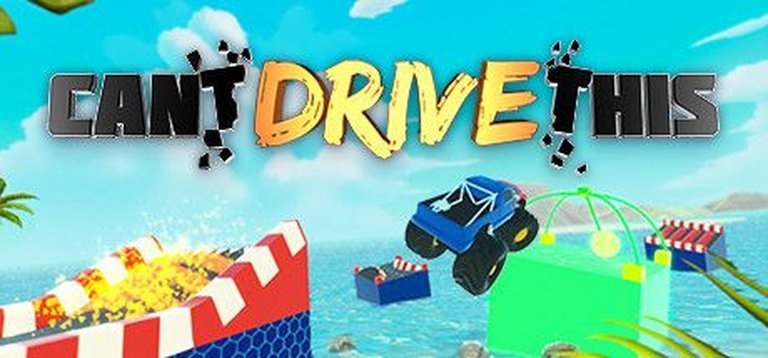
Can’t Drive This adopts a vibrant, cartoonish art style that complements its lighthearted tone. The monster trucks are colorful and exaggerated, with a toy-like aesthetic that enhances the game’s playful atmosphere. The track tiles are equally whimsical, featuring a variety of obstacles and hazards that range from swinging hammers to mud pits.
The game’s visual design is functional as well as appealing. The top-down perspective ensures that both the driver and builder have a clear view of the track, while the bright colors and distinct shapes make it easy to differentiate between tiles. The absence of a detailed environment (the game takes place against a simple skybox) keeps the focus squarely on the action, preventing distractions and ensuring that players can react quickly to changing conditions.
Sound Design and Music
The sound design in Can’t Drive This is minimal but effective. The roar of the monster truck’s engine, the crunch of tires on gravel, and the explosive sound of a truck crashing all contribute to the game’s immersive chaos. The soundtrack, composed by Goomin Nam, Jake Lizzio, and Bobby Cole, is upbeat and energetic, perfectly matching the game’s frantic pace.
The tutorial voice-over, delivered with humor and enthusiasm, sets the tone for the entire experience. While the game lacks a traditional narrative, the voice acting and sound effects combine to create a sense of personality and charm that enhances the overall experience.
Atmosphere and Immersion
Can’t Drive This excels in creating an atmosphere of controlled chaos. The combination of vibrant visuals, energetic music, and frantic gameplay ensures that players are constantly engaged, even when things go wrong. The game’s humor and self-awareness further contribute to its immersive quality, making it feel like a shared experience rather than a solitary challenge.
However, the game’s lack of environmental variety is a notable weakness. All modes take place against the same skybox, which can make the experience feel repetitive over time. The absence of distinct settings or themes limits the game’s visual appeal and reduces its long-term replayability.
Reception & Legacy
Critical Reception
Can’t Drive This received mixed but generally positive reviews upon its full release in 2021. Critics praised its innovative gameplay and chaotic multiplayer fun but criticized its limited content and occasional technical issues.
- PC Games (Germany) awarded the game an 80%, highlighting its innovative concept and strong local multiplayer experience.
- Sector gave it a 70%, noting its fun gameplay but criticizing its lack of audiovisual polish and limited content.
- IGN scored it a 7/10, calling it “a highly imaginative and fresh driving game” but lamenting its thin selection of modes.
- Nintendo Life and GameQuarter both gave the game a 50%, citing its repetitive gameplay and technical issues as major drawbacks.
The game’s Metacritic score of 67 reflects this mixed reception, with critics acknowledging its creativity but noting its limitations.
Player Reception
Player reception, as seen on Steam, has been overwhelmingly positive, with 81% of user reviews recommending the game. Players praise its chaotic fun, customization options, and the sheer hilarity of its multiplayer experience. Many reviews highlight the game’s ability to create memorable moments of shared laughter and frustration, making it a favorite for game nights and social gatherings.
However, some players echo the critics’ concerns about the game’s limited content and occasional glitches. The lack of variety in modes and environments is a common complaint, with many players noting that the game’s appeal diminishes after a few sessions.
Legacy and Influence
Can’t Drive This occupies a unique niche in the party game genre. While it hasn’t achieved the same level of mainstream success as titles like Overcooked or Mario Kart, it has carved out a dedicated fanbase and earned recognition for its innovative gameplay. The game’s influence can be seen in its inclusion in lists of the best co-op and party games, as well as in its nomination for awards such as the Indie Arena Booth’s “Best Multiplayer Game.”
The game’s legacy is also tied to its development journey. As a project that began as a game jam prototype and evolved into a fully realized commercial product, Can’t Drive This serves as an example of how indie developers can iterate on simple ideas to create something truly special. Its success has likely inspired other developers to explore similar mechanics, blending different genres to create fresh and engaging experiences.
Conclusion
Can’t Drive This is a game that defies easy categorization. It is equal parts racing game, puzzle game, and party game, blending these elements into a chaotic and hilarious experience that thrives on player interaction. Its innovative mechanics, vibrant visuals, and energetic soundtrack make it a standout title in the indie gaming landscape, while its limited content and occasional technical issues prevent it from achieving true greatness.
At its best, Can’t Drive This is a riotous celebration of teamwork and chaos, a game that turns failure into fun and frustration into laughter. It is a testament to the power of simple, well-executed ideas, and a reminder that sometimes the most memorable gaming experiences come not from polished perfection but from the shared joy of screaming at your friends as your monster truck explodes for the tenth time in a row.
For those seeking a fresh and inventive multiplayer experience, Can’t Drive This is a must-play. However, its lack of depth and variety means that it is best enjoyed in short bursts rather than as a long-term staple of your gaming library. In the pantheon of party games, Can’t Drive This may not be a classic, but it is certainly a cult favorite—a chaotic, colorful, and utterly unique experience that deserves a place in any collection of multiplayer gems.
Final Verdict: 7.5/10 – A chaotic and inventive multiplayer experience that shines in short bursts but lacks the depth to sustain long-term play.