
- Release Year: 2007
- Platforms: Windows
- Publisher: Game Factory Interactive Ltd., Russobit-M
- Developer: VZ.lab
- Genre: Puzzle
- Perspective: Side view
- Game Mode: Single-player
- Gameplay: Point and select, Real-time strategy (RTS)
- Setting: Contemporary
- Average Score: 45/100
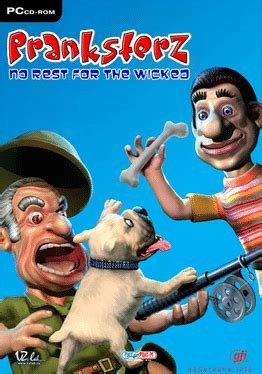
Description
Pranksterz: No Rest for the Wicked is a comedic puzzle game where players take on the role of a mischievous prankster aiming to ruin the vacation of their unsuspecting victims. Set in a contemporary, cartoonish world, the game features side-view, 2D scrolling environments where players must strategically interact with objects to execute elaborate pranks—such as mixing lemonade with oil or sabotaging hammocks—while recording their antics for a reality TV show. With 15 missions offering multiple ways to torment targets, the game blends real-time strategy and humor, though its short length and repetitive gameplay have drawn criticism.
Pranksterz: No Rest for the Wicked Cracks & Fixes
Pranksterz: No Rest for the Wicked Reviews & Reception
ign.com : 20 dollars, 15 missions, 2 hours, and 1 minor headache later I feel… bored. Again.
gamepressure.com (55/100): The game uses an almost identical play pattern as in the JoWood’s Neighbours from Hell of Rhodium series.
mobygames.com (30/100): Non-stop antics, great cartoon-style graphics, various holiday settings and crazy animations will have you laughing for hours.
sockscap64.com (50/100): This Game has no review yet, please come back later…
Pranksterz: No Rest for the Wicked: A Comprehensive Retrospective
Introduction: The Art of the Prank in Gaming
Few genres in gaming are as niche—or as delightfully mischievous—as the “prank simulator.” Pranksterz: No Rest for the Wicked (2007), developed by VZ.lab and published by Game Factory Interactive, is a curious artifact of this subgenre, a sequel to Pranksterz: Off Your Boss (2006) and a spiritual successor to JoWood’s Neighbours from Hell series. Set against the backdrop of a vacation gone wrong, the game tasks players with sabotaging their neighbor’s holiday through a series of increasingly elaborate pranks, all while evading detection and maximizing comedic chaos.
At its core, Pranksterz is a puzzle game disguised as a slapstick comedy, blending real-time strategy, stealth, and environmental interaction. Yet, despite its ambitious premise, the game remains an obscure footnote in gaming history, overshadowed by its inspirations and hampered by technical limitations. This review seeks to dissect Pranksterz: No Rest for the Wicked in exhaustive detail—exploring its development, narrative, mechanics, reception, and legacy—to determine whether it deserves rediscovery or is best left as a relic of its time.
Development History & Context: A Russian Prankster’s Legacy
The Studio and the Series
Pranksterz: No Rest for the Wicked was developed by VZ.lab, a Russian studio with a focus on casual and puzzle games. The title is the second entry in the Pranksterz series, following Pranksterz: Off Your Boss (2006), which itself was an unofficial sequel to Neighbours from Hell (2003). The Russian gaming market of the mid-2000s was fertile ground for such clones, with developers often creating localized or rebranded versions of Western hits. In Russia, the Pranksterz series was marketed under the title Как достать соседа (“How to Frazzle a Neighbor”), positioning it as a direct continuation of the Neighbours from Hell franchise.
The game was published by Game Factory Interactive (GFI) and Russobit-M, both of which specialized in budget-friendly, family-oriented titles. GFI, in particular, had a reputation for distributing games with broad appeal, often leveraging humor and simplicity to attract casual gamers.
Technological Constraints and Design Philosophy
Released in October 2007, Pranksterz was built for the technological standards of its era. The minimum system requirements—Pentium III 800 MHz, 256 MB RAM, and a 64 MB graphics card—reflect a game designed for mid-range PCs of the time. The visuals, while an improvement over its predecessor, were still constrained by 2D scrolling side-view perspectives and a fixed camera system, limiting the depth of interaction.
The development team’s primary goal was to iterate on the Neighbours from Hell formula while introducing new environments and pranks. However, the game’s short development cycle (likely under a year) and budget constraints resulted in reused assets, repetitive level design, and a lack of innovation. The Russian origins of the game also introduced localization challenges, with the English version suffering from poor translations, placeholder text, and even untranslated Cyrillic in some instances.
The Gaming Landscape of 2007
2007 was a transitional year for gaming. The Xbox 360 and PlayStation 3 were gaining traction, while PC gaming was dominated by MMOs (World of Warcraft), FPS titles (Half-Life 2, Call of Duty 4), and strategy games (Supreme Commander, Command & Conquer 3). Casual and puzzle games, however, were carving out a niche, particularly on digital platforms like Big Fish Games and GamersGate.
Pranksterz entered this market as a budget-priced ($20) casual title, competing with other comedy-driven games like Pat & Mat: The Game and The Good Soldier Schweik. Its appeal was largely limited to younger audiences and fans of slapstick humor, but it struggled to stand out in an increasingly crowded field.
Narrative & Thematic Deep Dive: A Vacation from Hell
Plot and Premise
Pranksterz: No Rest for the Wicked follows an unnamed protagonist (presumably the same from Off Your Boss) who is obsessed with tormenting their neighbor during his vacation. The game’s framing device is a reality TV show, where the player’s pranks are recorded for an audience’s amusement. The neighbor, a hapless everyman, moves through 15 missions set across various holiday locations—a lodge, a beach, a pond, and a campsite—while the player sabotages his relaxation.
The narrative is minimalist, with no substantial backstory explaining the protagonist’s vendetta. The neighbor’s actions are scripted and predictable, moving in fixed patterns that allow the player to anticipate and exploit his routines. The game’s humor relies on visual gags and exaggerated animations, such as:
– Mixing vinegar into lemonade
– Rigging a hammock to collapse
– Luring ants into a bed
– Electrocuting the neighbor via puddles and faulty wiring
Characters and Dialogue
The game features only two primary characters:
1. The Prankster (Player Character): A silent, cartoonish figure whose motivations are never explained. Their role is purely functional—to set traps, avoid detection, and document the chaos.
2. The Neighbor: A stereotypical “everyman” victim, designed to be sympathetic yet ridiculous. His reactions are over-the-top, with flailing limbs, exaggerated screams, and comedic facial expressions.
Dialogue is virtually nonexistent. The neighbor occasionally emits grunts, yelps, or thought bubbles indicating his next action (e.g., “I’m going to sit in the hammock”), but there are no spoken lines or meaningful interactions. The game’s humor is entirely visual and situational, relying on the player’s creativity in chaining pranks for maximum effect.
Themes: Schadenfreude and the Joy of Mischief
Pranksterz taps into schadenfreude—the pleasure derived from others’ misfortune—as its central theme. The game rewards the player for cruelty, with higher scores awarded for more elaborate or humiliating pranks. Yet, the tone remains lighthearted and cartoonish, avoiding genuine malice.
Other underlying themes include:
– The Illusion of Control: The neighbor’s rigid, predictable behavior reinforces the idea that life is a scripted routine, and the player’s role is to disrupt it.
– Voyeurism and Reality TV Culture: The game’s framing as a TV show mirrors the rise of prank-based reality programming (e.g., Punk’d, Jackass), where humiliation is commodified for entertainment.
– Power Fantasy: The player embodies the trickster archetype, outsmarting a clueless authority figure (the neighbor) in a way that appeals to childish rebellion.
Narrative Weaknesses
While the premise is amusing, the game suffers from:
– A lack of narrative progression: The neighbor’s suffering is repetitive, with no escalation or payoff.
– No character development: The protagonist and neighbor are one-dimensional, with no depth or motivation.
– Missed comedic potential: The pranks, while visually funny, lack variety and quickly become predictable.
Gameplay Mechanics & Systems: The Art of the Prank
Core Gameplay Loop
Pranksterz is structured around 15 missions, each set in a different vacation locale. The player’s objective is to:
1. Observe the neighbor’s routine (via thought bubbles).
2. Identify interactive objects (e.g., lemonade, hammocks, electrical outlets).
3. Set traps by combining objects (e.g., pouring water near a wire to create an electrocution hazard).
4. Execute pranks while avoiding detection.
5. Record the chaos with an in-game camera for bonus points.
The game employs a point-and-click interface, with the player directing the prankster via mouse commands. The neighbor follows a fixed path, allowing for trial-and-error planning.
Stealth and Detection Mechanics
- Line of Sight: If the neighbor spots the prankster, he chases and attacks, resulting in a mission failure.
- Hiding Spots: The player can duck behind objects or flee to safe zones to avoid detection.
- Sound Cues: Some pranks (e.g., breaking glass) alert the neighbor, requiring quick escapes.
Prank Chaining and Scoring
The game encourages combining multiple pranks for higher scores. For example:
– Sabotaging a chair → placing a banana peel nearby → electrocuting the neighbor when he falls.
Each successful prank fills a “laughter meter”, which determines the mission’s rating (Bronze, Silver, Gold).
Flaws in Gameplay Design
Despite its simplicity, Pranksterz suffers from several mechanical issues:
1. Repetitive Level Design: Environments are reused with minor variations, leading to monotony.
2. Poor Pathfinding: The prankster often gets stuck on objects or runs into the neighbor due to faulty AI.
3. Pixel Hunting: Some interactive objects are hard to spot, leading to frustration.
4. Lack of Difficulty Scaling: The game is too easy once the neighbor’s routine is memorized.
5. Bugs and Glitches: Reports of missing sound, crashes, and untranslated text plagued the release.
Innovation (or Lack Thereof)
Pranksterz does not evolve the Neighbours from Hell formula. While it introduces outdoor environments and new pranks, the core mechanics remain identical to its predecessor. The absence of new gameplay systems, puzzles, or narrative depth makes it feel like a reskin rather than a true sequel.
World-Building, Art & Sound: A Cartoonish Holiday Nightmare
Visual Design and Aesthetics
The game adopts a colorful, cartoonish art style, reminiscent of Saturday morning cartoons. Characters are exaggerated and rubbery, with oversized reactions to pranks. The environments, while limited in variety, are bright and cheerful, contrasting with the chaos unfolding within them.
Improvements over Off Your Boss:
– Higher resolution (up to 1600×1200).
– More detailed backgrounds (e.g., beaches, forests).
– Smoother animations for pranks.
Limitations:
– No widescreen support.
– Reused assets (e.g., the same lodge interior appears multiple times).
– Stiff character models outside of prank animations.
Sound Design and Music
The game’s audio is severely lacking:
– No voice acting.
– Minimal sound effects (e.g., laughter, screams, environmental noises).
– No background music in most levels.
– Bugs preventing sound from working in some versions.
The absence of audio feedback makes the game feel sterile, despite its comedic intentions.
Atmosphere and Immersion
Pranksterz fails to create a cohesive atmosphere. The vacation setting is underutilized, with no ambient sounds (e.g., waves, birds, wind) to enhance immersion. The reality TV framing is also underdeveloped, with no commentary, audience reactions, or narrative payoff.
Reception & Legacy: A Forgotten Prank
Critical Reception
The game received overwhelmingly negative reviews, with IGN awarding it a 3/10 and describing it as:
“A short puzzle game that doesn’t hold enough joy to recommend on any level.”
Common criticisms included:
– Repetitive gameplay.
– Technical issues (bugs, missing sound).
– Lack of innovation.
– Poor value for money ($20 for 2 hours of content).
Commercial Performance
Pranksterz was a commercial flop, failing to gain traction outside of Russia and Eastern Europe. Its budget pricing and niche appeal limited its reach, and it was quickly overshadowed by more polished casual games.
Legacy and Influence
The Pranksterz series faded into obscurity, though it spawned a few sequels:
– Fiese Freunde 2: Letzte Party in Paris (2009).
– Pranksterz: From Russia with Love (2011).
Its only lasting impact is as a curiosity in the history of prank simulators, a genre that has since evolved with titles like Goat Simulator and Untitled Goose Game. Unlike those games, however, Pranksterz lacks the charm, polish, or meme-worthy appeal to endure.
Conclusion: A Prank That Didn’t Land
Pranksterz: No Rest for the Wicked is a flawed but fascinating relic of mid-2000s casual gaming. It captures the childish joy of mischief but fails to deliver a compelling or lasting experience. While its cartoonish pranks and simple mechanics may have appealed to a younger audience at the time, its repetitive design, technical issues, and lack of innovation ensure it remains forgotten.
Final Verdict: 4/10 – “A Mildly Amusing, But Ultimately Forgettable Prank”
- Strengths:
- Funny, exaggerated animations.
- Simple, accessible gameplay.
- Colorful, cartoonish visuals.
- Weaknesses:
- Repetitive and shallow.
- Plagued by bugs and poor localization.
- No lasting appeal or replay value.
Pranksterz is not a bad game, but it is not a good one either. It exists in a limbo of mediocrity, neither offensive nor memorable. For fans of prank simulators, Untitled Goose Game or Neighbours from Hell are far superior alternatives. For historians of obscure casual games, Pranksterz offers a brief, curious diversion—but little more.
Final Recommendation: Only for the most devoted prank enthusiasts or retro gaming completists. Everyone else should look elsewhere for their mischief.