
- Release Year: 2001
- Platforms: Windows
- Publisher: Play-It
- Genre: Special edition
- Game Mode: Single-player
- Average Score: 87/100
Description
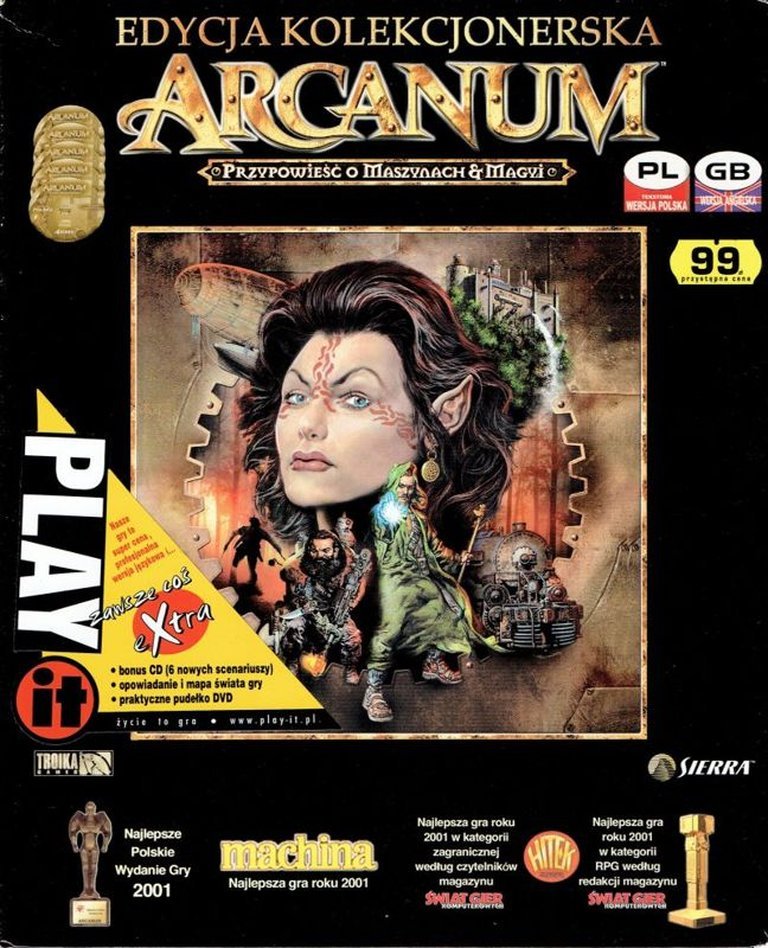
Arcanum: Of Steamworks & Magick Obscura (Collector’s Edition) is a role-playing game set in a fantasy world undergoing an Industrial Revolution, where magic and technology clash. Players assume the role of a zeppelin crash survivor uncovering a plot by an ancient power to return and wreak havoc. The game features isometric open-world exploration, character customization with diverse skills (magic or technology), and multiple quest solutions, including combat, persuasion, or stealth. The Collector’s Edition includes a Polish translation patch, bonus quests, a soundtrack, a world map, a 196-page manual, and a 50-page novel.
Gameplay Videos
Where to Buy Arcanum: Of Steamworks & Magick Obscura (Collector’s Edition)
PC
Arcanum: Of Steamworks & Magick Obscura (Collector’s Edition) Patches & Updates
Arcanum: Of Steamworks & Magick Obscura (Collector’s Edition) Mods
Arcanum: Of Steamworks & Magick Obscura (Collector’s Edition) Guides & Walkthroughs
Arcanum: Of Steamworks & Magick Obscura (Collector’s Edition) Reviews & Reception
store.steampowered.com (89/100): A triumphant return to form for the series.
mobygames.com (80/100): A unique world where magic and technology coexist in an uneasy balance.
gog.com (92/100): An Industrial Revolution in a World of Magick.
Arcanum: Of Steamworks & Magick Obscura (Collector’s Edition): A Masterpiece of Steampunk Fantasy
Introduction
Arcanum: Of Steamworks & Magick Obscura (Collector’s Edition) is a landmark title in the realm of role-playing games (RPGs), blending the enchantment of fantasy with the grit of industrial revolution-era technology. Released in 2001 by Troika Games, a studio founded by former Interplay Entertainment developers Tim Cain, Leonard Boyarsky, and Jason Anderson, Arcanum stands as a testament to innovative game design and rich storytelling. This review delves into the game’s development history, narrative depth, gameplay mechanics, world-building, and its enduring legacy.
Development History & Context
Troika Games, the brainchild of the creators behind the critically acclaimed Fallout series, set out to craft a unique RPG experience with Arcanum. The game’s development was marked by a vision to merge traditional fantasy elements with steampunk aesthetics, creating a world where magic and technology coexist in a delicate balance. The game’s public beta testing commenced in September 2000, and it was released in August 2001 to both commercial success and critical acclaim.
The gaming landscape at the time was dominated by titles like Diablo II and The Sims, but Arcanum carved its niche with its distinctive setting and gameplay mechanics. Despite initial technical issues, including compatibility problems with certain video cards and sound cards, the game’s innovative design and engaging narrative quickly garnered a dedicated fanbase.
Narrative & Thematic Deep Dive
Arcanum’s narrative is a rich tapestry of intrigue, mystery, and adventure. The game begins with the crash of the luxury zeppelin IFS Zephyr, leaving the player as the sole survivor tasked with uncovering the truth behind the attack. The story unfolds in a world where magic and technology are at odds, reflecting the broader themes of progress and tradition.
The game’s setting is a continental mainland and three islands, each with its unique political entities and cultural dynamics. The Unified Kingdom, rapidly industrializing, stands in stark contrast to the elven city of Qintarra, which remains untouched by technological advancements. This dichotomy is central to the game’s narrative, influencing character interactions and quest outcomes.
The game’s dialogue and character interactions are deeply influenced by the player’s choices, making each playthrough a unique experience. The narrative’s nonlinear structure allows for multiple solutions to quests, ranging from combat to diplomacy, thievery, or bribery. This flexibility is a hallmark of Arcanum’s design, offering players unprecedented freedom in shaping their character’s journey.
Gameplay Mechanics & Systems
Arcanum’s gameplay mechanics are a blend of traditional RPG elements and innovative features. The game offers a classless, point-based attribute system, allowing for limitless creativity in character development. Players can choose from a variety of races, including humans, elves, dwarves, gnomes, halflings, and hybrid races like half-orcs and half-ogres.
The game’s combat system is versatile, offering real-time, turn-based, and fast-paced turn-based modes. This flexibility caters to different playstyles, although the combat has been criticized for being poorly balanced and frantic. The game’s skill system is extensive, with 16 primary skills, 80 spells across 16 colleges of magic, and 56 technological degrees within 8 disciplines.
The game’s user interface, while functional, has been noted for its lack of intuitiveness. However, the game’s depth and complexity more than make up for this minor drawback. The inclusion of an editor, WorldEdit, allows players to create their own maps, campaigns, and NPCs, adding a layer of customization and replayability.
World-Building, Art & Sound
Arcanum’s world-building is a masterclass in creating a immersive and believable fantasy setting. The game’s art direction blends traditional fantasy elements with steampunk aesthetics, creating a unique visual identity. The game’s soundtrack, composed by Ben Houge, is a standout feature, scored almost entirely for string quartet and praised for its emotional depth and atmospheric quality.
The game’s sound design enhances the overall experience, with ambient noises and voice work that bring the world to life. The game’s visuals, while dated by modern standards, are functional and contribute to the game’s atmospheric quality. The game’s setting, with its mix of Victorian-era technology and fantasy elements, creates a rich and engaging world that players can explore at their leisure.
Reception & Legacy
Arcanum was a commercial success, selling over 200,000 copies and generating revenue of over $8.8 million. The game received generally favorable reviews from critics, with praise for its character creation system, open-ended gameplay, and rich narrative. However, the game’s graphics and user interface were criticized for being dated and unintuitive.
Despite these criticisms, Arcanum has endured as a cult classic, with a dedicated fanbase that continues to celebrate its innovative design and engaging storytelling. The game’s influence can be seen in subsequent RPGs, which have adopted its open-ended gameplay and character customization features. The game’s legacy is further cemented by its inclusion in various “best of” lists and its continued availability on platforms like GOG and Steam.
Conclusion
Arcanum: Of Steamworks & Magick Obscura (Collector’s Edition) is a landmark title in the RPG genre, offering a unique blend of fantasy and steampunk aesthetics. The game’s rich narrative, innovative gameplay mechanics, and immersive world-building have ensured its place in video game history. While the game’s graphics and user interface may be dated, its depth and complexity more than make up for these minor drawbacks. Arcanum is a must-play for fans of RPGs and a testament to the enduring appeal of innovative game design.