
- Release Year: 2007
- Platforms: Windows
- Publisher: Adventure’s Planet Srl, Akella, Iceberg Interactive B.V., Lighthouse Interactive Game Publishing BV
- Developer: Zoetrope Interactive
- Genre: Adventure
- Perspective: 1st-person
- Game Mode: Single-player
- Gameplay: Graphic adventure, Puzzle elements
- Setting: Horror
- Average Score: 51/100
Description
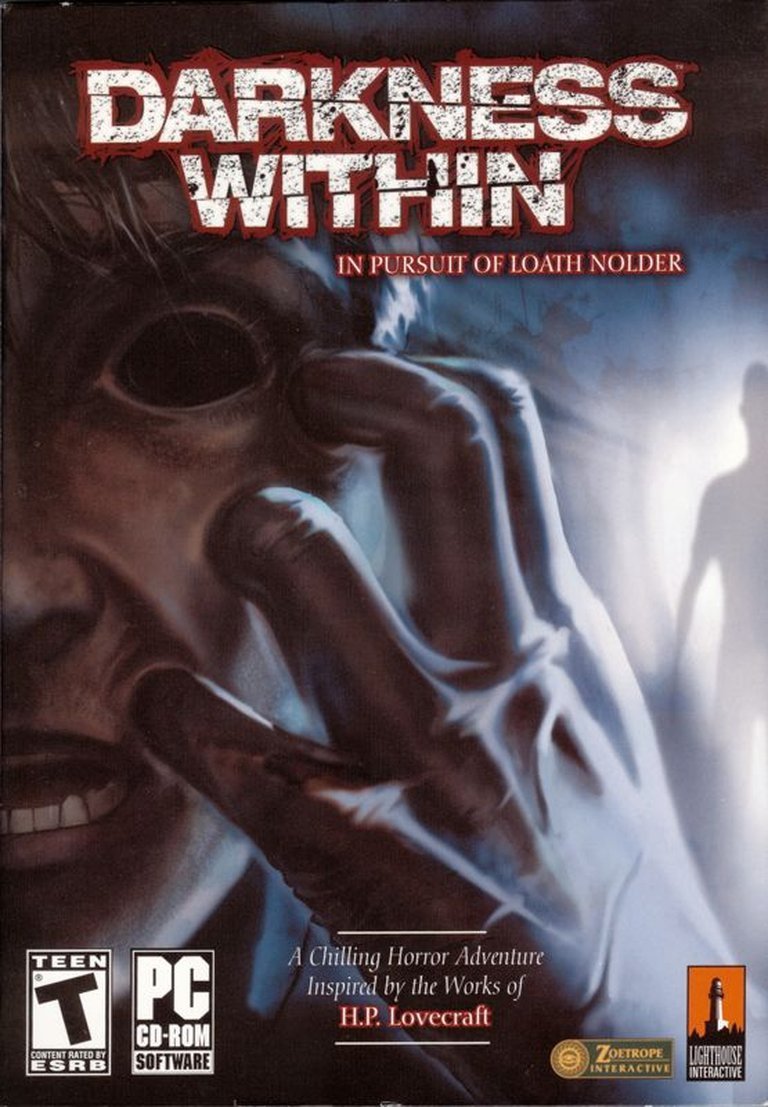
Darkness Within: In Pursuit of Loath Nolder is a first-person horror adventure game where players assume the role of Howard E. Loreid, a police officer tasked with tracking down the enigmatic Loath Nolder, a former private investigator who vanished after a disturbing occult case. Set in the eerie town of Wellsmoth, the game blends puzzle-solving and exploration with a unique ‘thinking’ interaction system, allowing players to manipulate clues and ideas to uncover the truth behind Nolder’s disappearance and the dark secrets he uncovered.
Gameplay Videos
Darkness Within: In Pursuit of Loath Nolder Patches & Updates
Darkness Within: In Pursuit of Loath Nolder Guides & Walkthroughs
Darkness Within: In Pursuit of Loath Nolder Reviews & Reception
metacritic.com (52/100): Darkness Within is a good detective adventure made in the spirit of H.P. Lovecraft.
ign.com (51/100): Darkness Within is a slow-paced, methodical, conventional adventure with point-and-click gameplay and lots of cursor scrolling to find objects and curiosities.
en.wikipedia.org (52/100): Darkness Within: In Pursuit of Loath Nolder received mixed reviews upon its original release.
mysterymanor.net : Darkness Within: In Pursuit of Loath Nolder is a horror adventure game.
gamewatcher.com : The results were mixed with some brilliant moments, but others that didn’t satisfy.
Darkness Within: In Pursuit of Loath Nolder: A Lovecraftian Descent into Madness
Introduction
In the annals of horror-themed adventure games, few titles have dared to tread as deeply into the psychological abyss as Darkness Within: In Pursuit of Loath Nolder. Released in 2007 by Turkish indie studio Zoetrope Interactive, this first-person adventure game is a haunting love letter to the works of H.P. Lovecraft, blending detective noir with cosmic horror. While it may not have achieved mainstream acclaim, its atmospheric depth, innovative mechanics, and unrelenting commitment to Lovecraftian themes make it a cult classic worth dissecting. This review will explore the game’s development, narrative intricacies, gameplay systems, and its lasting impact on the adventure genre.
Development History & Context
The Birth of Zoetrope Interactive
Darkness Within was the debut title from Zoetrope Interactive, a small Turkish studio founded by brothers Onur and Oral Şamlı, along with Galip Kartoğlu. The team’s ambition was to create a game that captured the essence of Lovecraft’s cosmic horror, a niche but passionate subgenre of horror that had seen limited exploration in video games at the time. The studio’s name itself—a nod to the early film technique that creates the illusion of motion—hints at their cinematic aspirations for the game.
Technological Constraints and Innovations
Developed using the proprietary CPAGE engine, Darkness Within faced the limitations of its era. The game’s pre-rendered 3D environments, while visually impressive for an indie title, were often criticized for their static nature. However, the engine allowed for dynamic lighting effects, such as flickering torches and moths fluttering around light sources, which enhanced the game’s eerie atmosphere. The decision to use a node-based movement system (where players click on predetermined points to navigate) was a double-edged sword—it streamlined interaction but also restricted exploration, a common critique among players accustomed to free-roaming 3D adventures.
The Gaming Landscape of 2007
The late 2000s were a transitional period for adventure games. The genre, once dominated by LucasArts and Sierra, had waned in popularity, overshadowed by the rise of first-person shooters and open-world RPGs. Yet, indie developers like Zoetrope Interactive were reviving the genre with fresh ideas. Darkness Within arrived alongside titles like The Witcher (2007) and BioShock (2007), which also explored dark, narrative-driven experiences. However, unlike these action-heavy games, Darkness Within was unapologetically a point-and-click adventure, relying on puzzle-solving and storytelling rather than combat or reflexes.
Publishing Challenges
The game’s journey to release was fraught with obstacles. Originally published by Lighthouse Interactive, Darkness Within faced uncertainty when the publisher went out of business. Iceberg Interactive acquired the rights in 2009, ensuring the game’s survival and eventual re-release on Steam with enhanced graphics. This resilience speaks to the game’s niche appeal and the dedication of its creators.
Narrative & Thematic Deep Dive
Plot Overview: A Detective’s Descent
Players assume the role of Howard E. Loreid, a police detective in the fictional town of Wellsmoth, tasked with investigating the murder of Clark Field, a wealthy occultist. The prime suspect is Loath Nolder, a once-respected private investigator who vanished for five years after his last case—only to resurface as a fugitive. As Howard delves deeper into the mystery, he uncovers a web of occult rituals, ancient cults, and supernatural phenomena that begin to erode his sanity. The game’s narrative is framed as Howard’s retrospective account from an asylum, a classic Lovecraftian trope that blurs the line between reality and madness.
Themes: Cosmic Horror and Psychological Unraveling
Darkness Within is steeped in Lovecraftian themes, particularly the idea of forbidden knowledge driving individuals to insanity. The game’s title itself is a play on this concept—Howard’s pursuit of Loath Nolder becomes a metaphor for his descent into the “darkness within” his own mind. Key themes include:
– The Fragility of Sanity: Howard’s psychological state deteriorates as he encounters increasingly bizarre and terrifying phenomena. The game’s dream sequences, where time distorts and reality warps, reinforce this theme.
– The Unknown and the Unknowable: Like Lovecraft’s protagonists, Howard is confronted with truths that defy human comprehension. The game’s cryptic journals and occult symbols hint at a larger, incomprehensible cosmic order.
– Isolation and Paranoia: Howard’s investigation is a solitary journey. His interactions with other characters are sparse, and his only lifeline is his cell phone, which he uses to contact his disinterested colleague, Arthur. This isolation amplifies the game’s sense of dread.
Characters: Shadows of the Occult
- Howard E. Loreid: The protagonist is a flawed and increasingly unreliable narrator. His voice acting, while serviceable, lacks the emotional depth needed to fully convey his unraveling psyche. This detachment may have been intentional, as it mirrors Lovecraft’s protagonists, who often serve as passive observers to horrors beyond their control.
- Loath Nolder: The enigmatic antagonist is more of a symbol than a fully realized character. His name alone—”Loath”—evokes revulsion, and his mysterious disappearance and reappearance drive the plot. However, his motivations remain obscure, leaving players to speculate about his true nature.
- Clark Field: The murdered occultist is a classic Lovecraftian figure—a man who delved too deeply into forbidden knowledge. His journals and belongings provide critical clues, but his character is explored primarily through environmental storytelling.
Dialogue and Writing
The game’s writing is a mixed bag. The journals and documents Howard encounters are rich in Lovecraftian lore, filled with references to ancient cults and eldritch horrors. However, the dialogue between characters is often stilted and lacks emotional weight. The voice acting, while competent, does little to elevate the script. This disparity between the atmospheric writing and the flat character interactions is one of the game’s most significant weaknesses.
Gameplay Mechanics & Systems
Core Gameplay Loop: Investigation and Puzzle-Solving
Darkness Within is a classic point-and-click adventure at its core. Players explore environments, collect items, and solve puzzles to progress. The game’s pacing is deliberate, often requiring players to meticulously examine every object and document. This methodical approach aligns with the detective theme but can feel tedious, especially during extended sequences of reading and underlining text.
The “Thinking” System: A Double-Edged Sword
The game’s most innovative feature is its “thinking” system, which allows players to manipulate ideas and clues as if they were inventory items. For example, to extract clues from books or journals, players must underline relevant passages. These underlined sections are then added to Howard’s “thought inventory,” where they can be combined to form new insights. While this system is thematically appropriate—mirroring the process of detective work—it is also one of the game’s most frustrating elements. The lack of feedback when combining thoughts can lead to trial-and-error guesswork, and the system’s rigidity often feels at odds with the player’s intuition.
Puzzle Design: Logic and Obscurity
The puzzles in Darkness Within range from straightforward inventory-based challenges to more complex mechanical puzzles. Some standout examples include:
– The Paintbrush Puzzle: A multi-step puzzle requiring players to prepare a paintbrush to collect evidence. While logically sound, its complexity can feel arbitrary.
– The Well Sequence: Players must use a rope to descend into a well, but the solution requires tying the rope to the rafters—a detail that isn’t immediately obvious and can lead to frustration.
– Dream Sequences: These segments offer a break from the game’s slower pacing, presenting surreal challenges that test the player’s ability to interpret abstract clues.
Difficulty and Hint System
The game offers three difficulty levels:
– Senior Detective: Provides frequent hints and simplifies puzzle-solving.
– Detective: Offers occasional hints but requires more independent thinking.
– Standard: Removes most hints, forcing players to rely on their wits.
The hint system is a welcome addition, but its implementation is uneven. Early hints often state the obvious, while later puzzles can leave players stranded without guidance. The game’s lack of a hotspot indicator (a feature that highlights interactive objects) exacerbates this issue, leading to pixel-hunting in dimly lit environments.
Movement and Exploration
The node-based movement system is functional but restrictive. Players click on predetermined points to navigate, which can feel clunky compared to free-roaming alternatives. The game’s environments, while beautifully rendered, are often reused, leading to a sense of déjà vu as players traverse the same locations multiple times.
World-Building, Art & Sound
Setting: Wellsmoth and Beyond
Wellsmoth, the game’s primary setting, is a masterclass in Lovecraftian world-building. The town is a grim, rain-soaked locale filled with decaying mansions, eerie catacombs, and sinister ruins. The game’s environments are meticulously detailed, with peeling wallpaper, flickering candles, and occult symbols adorning every surface. The attention to detail extends to the game’s outdoor areas, where fog, rain, and snow create a palpable sense of isolation.
Visual Direction: A Study in Shadows
The game’s visual style is a blend of illustrated realism and gothic horror. The pre-rendered backgrounds are rich in texture, with dynamic lighting effects that cast long, ominous shadows. The color palette is dominated by muted browns, grays, and blacks, reinforcing the game’s oppressive atmosphere. While the character models are less impressive, their simplicity ensures that the focus remains on the environments and the horrors they conceal.
Sound Design: The Symphony of Dread
The sound design is one of Darkness Within’s strongest assets. The ambient soundtrack, composed by Onur and Oral Şamlı, is a haunting blend of dissonant strings, eerie chants, and unsettling silence. The game’s sound effects—creaking floorboards, distant whispers, and the occasional heartbeat—are used to great effect, heightening tension during key moments. The voice acting, while not exceptional, is serviceable, with Howard’s narration providing a consistent thread through the game’s fragmented story.
Atmosphere: The Heart of the Experience
The game’s true strength lies in its atmosphere. From the moment players step into Wellsmoth, they are enveloped in a sense of foreboding. The combination of visual and auditory elements creates an immersive experience that lingers long after the game is turned off. The dream sequences, in particular, are a standout feature, using distorted visuals and sound to disorient players and blur the line between reality and hallucination.
Reception & Legacy
Critical Reception: A Divided Response
Darkness Within received mixed reviews upon release, with critics praising its atmosphere and innovation while criticizing its gameplay flaws. Aggregate scores on Metacritic (52/100) and GameRankings (55.50%) reflect this divide. Positive reviews highlighted the game’s Lovecraftian ambiance, puzzle design, and soundscapes, while negative critiques focused on its clunky mechanics, repetitive environments, and lack of scares.
Player Reception: A Cult Following
Despite its lukewarm critical reception, Darkness Within developed a dedicated fanbase. Players who appreciated its slow-burn horror and intricate puzzles found much to love, while others were frustrated by its antiquated design. The game’s Steam re-release in 2014 introduced it to a new audience, with user reviews leaning toward the positive (74% approval rating).
Influence and Legacy
Darkness Within’s influence can be seen in subsequent Lovecraftian games, such as Conarium (2017) and The Sinking City (2019). Its “thinking” system, while flawed, inspired later adventure games to experiment with abstract puzzle-solving mechanics. The game’s commitment to atmospheric horror also paved the way for indie titles like Amnesia: The Dark Descent (2010), which similarly prioritized psychological terror over combat.
The Darkness Within Series
The game was intended as the first in a trilogy, with Darkness Within 2: The Dark Lineage released in 2010. While the sequel improved upon many of the original’s flaws, it failed to achieve the same cult status. A third installment was planned but never materialized, leaving the series’ narrative unresolved.
Conclusion: A Flawed Masterpiece
Darkness Within: In Pursuit of Loath Nolder is a game of contradictions. It is simultaneously ambitious and flawed, atmospheric and clunky, innovative and antiquated. Its strengths—its Lovecraftian world-building, haunting sound design, and commitment to psychological horror—are undeniable. Yet, its weaknesses—its rigid puzzle mechanics, repetitive environments, and lack of character depth—hold it back from greatness.
For fans of Lovecraftian horror and classic adventure games, Darkness Within is a must-play. Its flaws are outweighed by its ambition and the sheer audacity of its vision. It is a game that lingers in the mind, much like the cosmic horrors it seeks to emulate. While it may not be a masterpiece in the traditional sense, it is a testament to the power of indie development and the enduring appeal of Lovecraft’s themes.
Final Verdict: 7.5/10 – A haunting, flawed gem that deserves its place in the pantheon of Lovecraftian horror games.
Additional Resources
- Official Website: Darkness Within
- Steam Page: Darkness Within on Steam
- MobyGames Entry: Darkness Within on MobyGames
For those willing to brave its depths, Darkness Within offers a journey into madness that is as rewarding as it is unsettling.