
- Release Year: 2005
- Platforms: Windows
- Publisher: Akella, Auran Games Pty Ltd., Blue Sky Interactive, Focus Multimedia Ltd., Merscom LLC, NBG EDV Handels- und Verlags GmbH & Co. KG
- Developer: Auran Games Pty Ltd.
- Genre: Simulation
- Perspective: 1st-person
- Game Mode: Single-player
- Gameplay: Map creation, Scenario creation, Train driving
- Setting: Railroad, Train
- Average Score: 72/100
Description
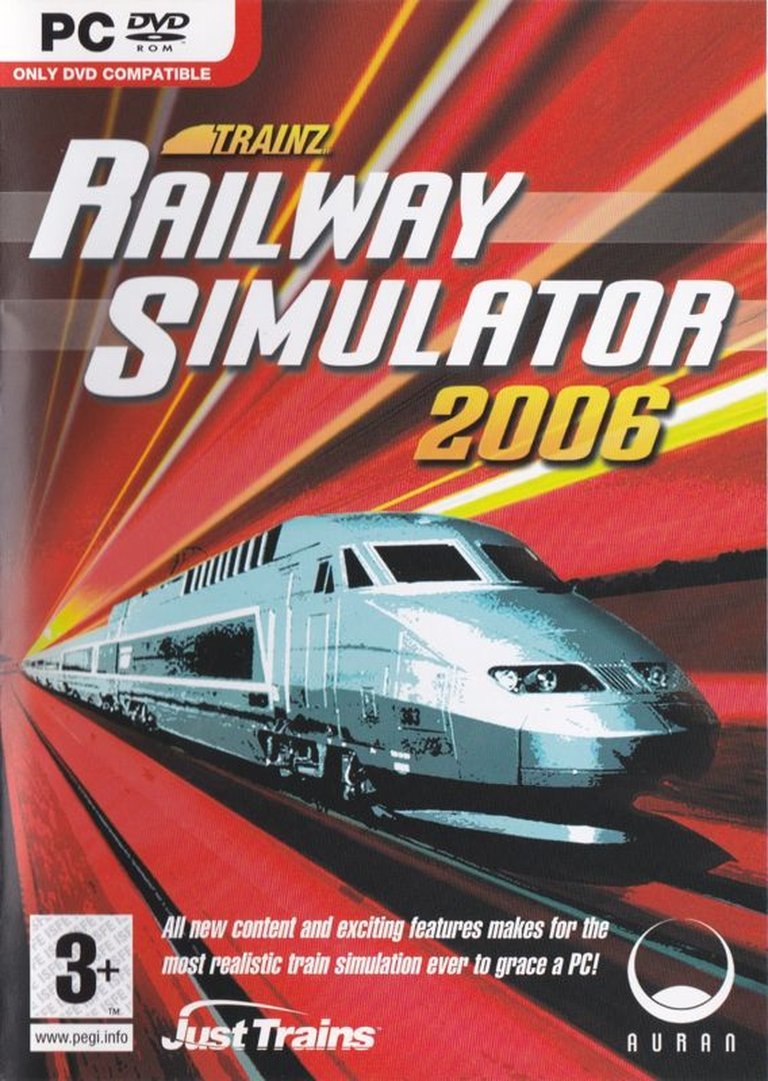
Trainz Railroad Simulator 2006 is a detailed 3D railroad simulation game that offers players the chance to operate trains in a realistic environment. The game features interactive tutorials, 21 challenging scenarios involving cargo and passenger transport, and a creative atelier for designing custom maps and routes. With over 150 locomotives and 7,500 objects, players can build and explore intricate rail networks, while an online portal provides additional content. The game supports both a full simulation mode for experienced players and a simplified mode for beginners, catering to a wide range of skill levels.
Gameplay Videos
Trainz Railroad Simulator 2006 Mods
Trainz Railroad Simulator 2006 Guides & Walkthroughs
Trainz Railroad Simulator 2006 Reviews & Reception
metacritic.com (65/100): A sim that is not for everybody. A smorgasbord of pleasure for train geeks. The cure for insomnia for the rest of us.
mobygames.com (73/100): Trainz Railroad Simulator 2006 is a 3D railroad simulator. The game comes with a series of ingame workshops to teach you all the basics of riding trains and everything around that.
impulsegamer.com (80/100): One of the first things one has to take into consideration when playing this title is that if you are not into trains then you might as well back off right now.
Trainz Railroad Simulator 2006 Cheats & Codes
TRS2006
Enter codes in Surveyor mode.
| Code | Effect |
|---|---|
| Alt-FLY | Takes you up in the sky and allows steering in any direction. |
| Alt-WALK | Puts you at ground level and allows walking in any direction. |
| Alt-SMITE | Click on an object to strike it with lightning, creating a hole in the ground. |
| Alt-MMMG | Generates a new route on a new set of train boards. |
| Alt-LUCYINTHESKYWITHDIAMONDS | Turns the sky into a kaleidoscope. |
| Ctrl+Alt+Shift+CARZ | Allows you to click on a moving car and drive it. |
Trainz Railroad Simulator 2006: A Comprehensive Retrospective
Introduction
In the annals of train simulation history, few titles have left as indelible a mark as Trainz Railroad Simulator 2006. Released during a golden age of niche simulations, this game didn’t just cater to railroad enthusiasts—it redefined what a train simulator could be. With its unprecedented depth, robust content creation tools, and a thriving community ecosystem, TRS2006 became more than a game; it became a platform, a creative sandbox, and a cultural phenomenon within the train simulation genre.
This review will dissect Trainz Railroad Simulator 2006 with surgical precision, exploring its development, gameplay mechanics, world-building, reception, and enduring legacy. We’ll examine why, despite its technical limitations and mixed critical reception, it remains a beloved title among a dedicated fanbase and a cornerstone of the Trainz franchise.
Development History & Context
The Studio and Vision
Trainz Railroad Simulator 2006 was developed by Auran, an Australian studio founded in 1995 by Greg Lane. Auran’s vision for the Trainz series was ambitious from the outset: to create a train simulator that was not only realistic but also accessible and deeply customizable. The studio’s philosophy revolved around empowering players to become creators, a radical departure from the static, pre-scripted experiences offered by competitors like Microsoft Train Simulator.
By 2005, Auran had already established itself as a pioneer in the genre with Trainz (2001) and Trainz Railway Simulator 2004. These titles introduced groundbreaking features such as interactive industries, dynamic loading systems, and user-generated content support. TRS2006 was poised to build on this foundation, refining existing mechanics while introducing new tools to enhance creativity and realism.
Technological Constraints of the Era
The mid-2000s were a transitional period for PC gaming. Hardware was rapidly evolving, but many developers were still grappling with the limitations of 32-bit architectures and DirectX 9. TRS2006 was no exception. The game’s Auran Jet engine, while capable, struggled with the demands of large, open-world routes and high-polygon-count models.
One of the most significant challenges was memory management. The game’s reliance on a 32-bit architecture meant it could only address up to 4GB of RAM, a constraint that became increasingly problematic as players created larger and more complex routes. This limitation would later become a defining issue for the series, culminating in the shift to 64-bit architectures in Trainz: A New Era (2015).
The Gaming Landscape in 2005
The simulation genre in 2005 was a fragmented landscape. Microsoft Train Simulator (2001) had set a high bar for realism but was showing its age, with no sequel in sight. Meanwhile, flight simulators like Microsoft Flight Simulator 2004 dominated the market, leaving train enthusiasts with few alternatives.
TRS2006 entered this void with a unique value proposition: a blend of simulation depth and creative freedom. While other train simulators focused solely on driving mechanics, TRS2006 offered players the tools to design their own routes, create custom content, and share their creations with a global community. This approach resonated deeply with hobbyists, model railroaders, and simulation enthusiasts who craved more than just a passive driving experience.
The Birth of a Community
Auran’s decision to embrace user-generated content was revolutionary. The Download Station (DLS), a centralized repository for player-created assets, became the lifeblood of the Trainz community. By 2006, the DLS hosted thousands of locomotives, rolling stock, scenery objects, and entire routes, all created by passionate fans.
This community-driven model was not without its challenges. Quality control was decentralized, leading to a mix of high-quality and poorly optimized assets. However, the sheer volume of content ensured that TRS2006 remained fresh and engaging long after its release. The game’s longevity was a testament to Auran’s foresight in fostering a collaborative ecosystem.
Narrative & Thematic Deep Dive
The Absence of a Traditional Narrative
Trainz Railroad Simulator 2006 is, at its core, a sandbox experience. Unlike narrative-driven games, it does not feature a traditional plot, characters, or dialogue. Instead, its “story” emerges from the player’s interactions with the game’s systems and the routes they explore.
This absence of a linear narrative is not a flaw but a deliberate design choice. TRS2006 is less about telling a story and more about enabling players to create their own. Whether it’s managing a bustling freight yard, driving a passenger train through scenic landscapes, or meticulously crafting a custom route, the game’s appeal lies in its ability to facilitate personal narratives.
Themes of Creativity and Mastery
The game’s overarching themes revolve around creativity, mastery, and exploration. The Surveyor mode, where players design their own routes, embodies the spirit of creation. Here, players are not just consumers of content but active participants in the game’s evolution.
The Driver mode, on the other hand, emphasizes mastery. Operating a train in CAB mode (the game’s realistic driving mode) requires an understanding of physics, signaling, and operational procedures. The learning curve is steep, but the sense of accomplishment upon successfully navigating a complex route is unparalleled.
The Role of Realism
Realism in TRS2006 is a double-edged sword. On one hand, the game’s physics engine simulates real-world train dynamics, including wheelslip, coupler breakage, and gradient resistance. These mechanics add depth and challenge, appealing to hardcore simulation enthusiasts.
On the other hand, the game’s visual fidelity was a point of contention. Critics often cited the blocky textures, low-resolution models, and dated lighting as detracting from the immersion. However, for many players, the game’s charm lay not in its graphics but in its functional realism—the way it captured the feel of operating a train, even if the visuals were lacking.
Cultural Impact: The Thomas & Friends Phenomenon
One of the most fascinating aspects of TRS2006‘s legacy is its unexpected role in the Thomas & Friends fandom. The game’s robust content creation tools allowed fans to recreate characters and scenarios from the beloved children’s series. This led to a proliferation of fan-made Thomas & Friends content, including entire routes, locomotives, and even scripted episodes.
This phenomenon highlights the game’s versatility. While TRS2006 was designed for serious train simulation, its open-ended nature allowed it to transcend its original purpose, becoming a platform for creativity in ways Auran could not have anticipated.
Gameplay Mechanics & Systems
Core Gameplay Loops
TRS2006 offers two primary gameplay modes: Driver and Surveyor.
-
Driver Mode:
- DCC Mode: A simplified control scheme designed for beginners or managing multiple trains simultaneously. It abstracts many of the complexities of real-world train operation, making it accessible to casual players.
- CAB Mode: A hardcore simulation mode that places the player in the cab of the locomotive. Here, players must manage throttle, brakes, couplers, and other systems manually. The physics engine simulates real-world behaviors, including wheelslip on steep gradients and coupler breakage under excessive strain.
-
Surveyor Mode:
- A route and session editor that allows players to design custom landscapes, lay tracks, place scenery, and create interactive industries. Surveyor is where the game’s creative potential shines, offering tools for terrain sculpting, object placement, and session scripting.
Combat? Not Here.
Unlike action or strategy games, TRS2006 does not feature combat mechanics. The closest analogue to “conflict” is the challenge of managing complex operations, such as avoiding coupler breakages, navigating tight schedules, or troubleshooting derailments. The game’s tension arises from logistical and operational challenges rather than traditional gameplay conflicts.
Character Progression
TRS2006 does not include a traditional progression system with levels or experience points. Instead, progression is organic and player-driven. Mastery comes from:
– Learning the intricacies of train operation (e.g., managing gradients, signaling, and switching).
– Expanding one’s route-building skills in Surveyor mode.
– Engaging with the community to download and integrate new content.
User Interface: A Mixed Bag
The game’s UI is functional but clunky by modern standards. Key elements include:
– Content Manager Plus (CMP): A centralized hub for managing assets, downloading content, and organizing routes. While powerful, CMP’s interface is dense and intimidating for newcomers.
– Driver HUD: Displays critical information such as speed, coupler forces, and signal states. The HUD is customizable but can be overwhelming due to the sheer volume of data presented.
– Mini-Map: A dynamic overview of the route, allowing players to monitor train movements and issue orders. The mini-map’s functionality was a significant improvement over TRS2004, but its small size and limited zoom capabilities hindered usability.
Innovative Systems
-
iTrainz and iPortal:
- iTrainz: An in-game messaging system that allowed players to communicate in real-time. This feature was ahead of its time, fostering a sense of community and collaboration.
- iPortal: A system for sending trains between players’ routes, even when offline. This innovative mechanic enabled multiplayer-like interactions without requiring synchronous play.
-
Physics Customization:
- Players could adjust physics parameters for individual locomotives or entire classes. This level of customization allowed for fine-tuning the simulation experience, catering to both casual players and hardcore enthusiasts.
-
Animated Turnouts and Backdrops:
- Animated turnouts added visual realism to track switching, while backdrop assets allowed route builders to create distant scenery (e.g., mountains, skylines) that remained visible regardless of view distance settings.
Flawed Systems
Despite its strengths, TRS2006 suffered from several technical and design flaws:
– Performance Issues: The game’s engine struggled with large routes, leading to stuttering, long load times, and occasional crashes. The 32-bit architecture was a significant bottleneck.
– Asset Management: The sheer volume of user-generated content led to bloat and compatibility issues. Poorly optimized assets could destabilize the game, and managing thousands of files was cumbersome.
– Lack of Tutorial Depth: While the game included tutorials, they were inadequate for newcomers. The learning curve was steep, and many players relied on community guides and forums to grasp advanced mechanics.
World-Building, Art & Sound
Setting and Atmosphere
TRS2006 offers a diverse array of routes, each with its own distinct atmosphere:
– Marias Pass Approach (USA): A rugged, mountainous route featuring steep gradients and challenging freight operations.
– Hawes Junction (UK): A picturesque branch line set in the Yorkshire countryside, evoking the charm of British steam railroading.
– Toronto Rail Lands 1954 (Canada): A historical recreation of a bustling yard, blending steam and diesel operations.
– Dresden to Nuernberg (Germany): A modern route showcasing high-speed ICE trains and regional services.
– Wadalbavale Line (Australia): A scenic outback route with a focus on light freight and passenger services.
Each route is meticulously detailed, with interactive industries, dynamic weather, and era-appropriate rolling stock. The game’s strength lies in its authenticity—routes are not just pretty backdrops but living, breathing worlds with their own operational logic.
Visual Direction: A Product of Its Time
Graphically, TRS2006 was a step forward from TRS2004 but still lagged behind contemporary titles. Key visual features included:
– Terrain Engine: The game’s terrain system allowed for dynamic landscape sculpting, with tools for raising/lowering ground, adding water bodies, and painting textures. However, the low-resolution textures and lack of advanced shading made landscapes appear flat and artificial.
– Locomotive and Rolling Stock Models: The game included over 150 locomotives, ranging from historic steam engines to modern diesels. While the models were detailed, their polygon counts were limited, and animations (e.g., pantographs, couplers) were rudimentary.
– Lighting and Weather: The game featured dynamic weather effects, including rain and snow, which impacted visibility and track conditions. However, the lighting engine was basic, with harsh shadows and limited ambient occlusion.
Despite these limitations, the game’s visuals were functional rather than flashy. The focus was on operational realism rather than graphical fidelity, a trade-off that resonated with the core audience.
Sound Design: The Unsung Hero
One of TRS2006‘s most underrated aspects is its sound design. The game features:
– Authentic Locomotive Sounds: Each locomotive has unique engine, horn, and brake sounds, recorded from real-world counterparts. The attention to detail is remarkable, with subtle variations in diesel engine notes and steam whistle pitches.
– Ambient Environmental Sounds: Routes are filled with background noises, from the clatter of tracks to the distant hum of industries. These sounds contribute to the immersion, making the world feel alive.
– Dynamic Audio: Sounds change based on the player’s actions. For example, wheelslip is accompanied by the screech of metal on metal, and coupler breakages produce a satisfying clang.
The sound design is a masterclass in simulation audio, elevating the gameplay experience beyond what the visuals alone could achieve.
Reception & Legacy
Critical Reception: A Divided Response
TRS2006 received mixed reviews upon release, with critics praising its depth and content but criticizing its technical shortcomings.
-
Positive Aspects:
- Abundance of Content: Critics lauded the game’s vast library of locomotives, routes, and customization options. GameSpot called it “the most complete railroad simulator ever developed.”
- Improved Physics: The additions of wheelslip and coupler breakage were highlighted as significant steps forward in realism.
- Community Features: The iTrainz and iPortal systems were praised for their innovation, fostering a sense of connection among players.
-
Negative Aspects:
- Visual Fidelity: Many reviews criticized the game’s dated graphics, with PC Zone calling it “much the same as before” compared to TRS2004.
- Technical Issues: Performance problems, crashes, and asset management issues were common complaints. Out Of Eight noted that “bugs and arduous labor” detracted from the experience.
- Steep Learning Curve: The game’s complexity was a barrier to entry for casual players. Worth Playing warned that it appealed to “a very esoteric niche group.”
Commercial Performance
Despite the mixed reviews, TRS2006 was a commercial success, particularly within its niche. The game’s collector’s edition, which included additional tools and content, sold out quickly. Its longevity was ensured by the thriving modding community, which continued to produce content years after release.
Evolution of the Franchise
TRS2006 served as a bridge between the early Trainz titles and the modern era. Key developments that trace their roots to TRS2006 include:
– Content Manager Plus (CMP): The foundation for all subsequent asset management systems in the Trainz series.
– Surveyor Enhancements: Many of the route-building tools introduced in TRS2006 became standard features in later iterations.
– Physics Customization: The ability to tweak physics parameters laid the groundwork for the advanced simulation options in Trainz: A New Era and beyond.
Cultural Legacy
Beyond its technical contributions, TRS2006 left a lasting cultural impact:
– Thomas & Friends Community: The game became a hub for Thomas & Friends fan content, with creators using its tools to recreate the series’ characters and scenarios. This unexpected crossover introduced the game to a younger audience and expanded its reach.
– Modding Scene: The game’s open-ended design inspired a generation of modders, many of whom went on to contribute to later Trainz titles and other simulation games.
– Niche Appeal: TRS2006 proved that a deeply niche game could thrive if it catered passionately to its audience. Its success demonstrated the viability of community-driven content models, influencing later titles like Railworks and Dovetail Games’ Train Simulator.
Conclusion: A Flawed Masterpiece
Trainz Railroad Simulator 2006 is a flawed masterpiece—a game that, despite its technical limitations and steep learning curve, achieved something remarkable. It was not just a train simulator but a platform for creativity, a hub for community, and a testament to the power of player-driven content.
Its enduring appeal lies in its depth and flexibility. For those willing to invest the time, TRS2006 offered an unparalleled simulation experience, blending realistic train operation with boundless creative potential. The game’s legacy is evident in the continued success of the Trainz franchise and the vibrant communities that still thrive around it.
Final Verdict
Score: 8.5/10 – A Landmark in Train Simulation
Trainz Railroad Simulator 2006 is not for everyone. Its clunky UI, dated graphics, and steep learning curve make it inaccessible to casual players. However, for train enthusiasts, model railroaders, and simulation aficionados, it remains one of the most rewarding and immersive experiences in the genre.
Its true genius lies in its community-driven ethos. By empowering players to create, share, and collaborate, TRS2006 transcended the limitations of its technology, becoming a living, evolving world shaped by its fans. In this regard, it is not just a game but a cultural artifact—a snapshot of a time when simulation games began to embrace the power of player creativity.
For those willing to dive into its depths, Trainz Railroad Simulator 2006 offers an experience that is as rich and rewarding today as it was in 2005. It is a testament to the enduring appeal of well-crafted simulation design and a reminder that, sometimes, the most memorable games are those that invite us to create our own stories.