
- Release Year: 2009
- Platforms: Linux, Macintosh, Windows
- Publisher: Sakura River Interactive
- Developer: Sakura River Interactive
- Genre: Adventure, Visual novel
- Perspective: 1st-person
- Game Mode: Single-player
- Gameplay: Moral choices, RPG elements, Visual novel
- Setting: Fantasy
- Average Score: 67/100
Description
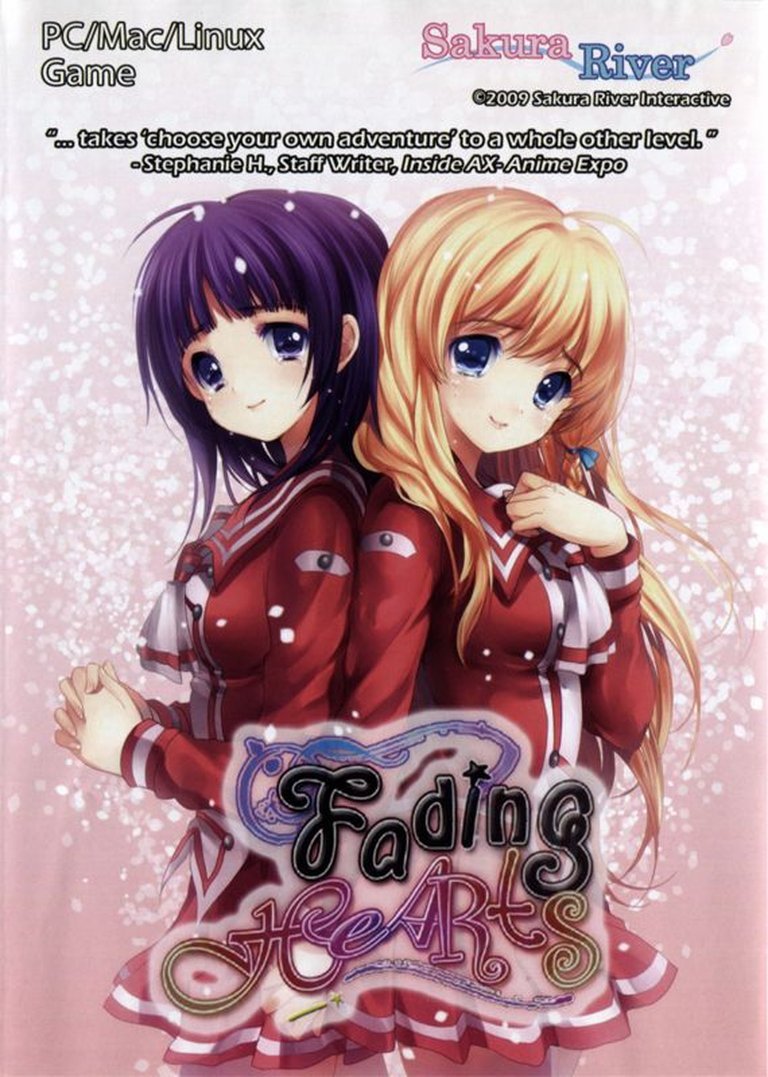
Fading Hearts is a visual novel and dating sim with RPG elements, set in a fantasy world blending everyday life with supernatural intrigue. Players assume the role of Ryou, navigating relationships, school, work, and mysterious events like the magical girl Mystica, with choices shaping multiple story outcomes. Developed by Sakura River Interactive and released in 2009, the game offers high replayability through branching narratives, anime-style artwork, and a mix of realistic and fantastical scenarios.
Where to Buy Fading Hearts
PC
Fading Hearts Mods
Fading Hearts Guides & Walkthroughs
Fading Hearts Reviews & Reception
metacritic.com (75/100): Fading Hearts is certainly a good visual novel game, managing to innovate in the genre by adding some big choices and by allowing characters to be more than just 2D people.
mobygames.com (78/100): A visual novel pretty much lives and dies by its story, and Fading Hearts has one that kept me hooked.
steamcommunity.com (55/100): I feel the rating for Fading Hearts should be about 5.5/10 – 6/10.
rpgfan.com : A visual novel pretty much lives and dies by its story, and Fading Hearts has one that kept me hooked.
pixelpacas.com (60/100): I had a lot of fun playing through Fading Hearts and will definitely be checking more alternative paths soon!
Fading Hearts: A Surreal Journey Through Love, Magic, and Self-Discovery
Introduction
In the vast landscape of visual novels, Fading Hearts stands as a peculiar yet captivating anomaly. Released in 2009 by the Canadian indie studio Sakura River Interactive, this game defies easy categorization, blending elements of romance, fantasy, and psychological drama into a surreal narrative experience. At its core, Fading Hearts is a story about choices—choices that shape not only the protagonist’s relationships but also the very genre of the story itself. With its unique blend of life simulation, RPG mechanics, and branching narratives, Fading Hearts offers a refreshing take on the visual novel genre, challenging players to question the nature of reality, trust, and the consequences of their actions.
Development History & Context
Sakura River Interactive, a small Canadian studio, emerged in the late 2000s with a mission to redefine the visual novel genre. Fading Hearts was their debut title, and it reflected their ambition to create a game that was both familiar and innovative. The studio drew inspiration from classic Japanese visual novels and anime but infused their work with a Western perspective, resulting in a game that felt both nostalgic and fresh.
The game was developed using the Ren’Py engine, a popular tool for creating visual novels. This choice allowed the team to focus on storytelling and gameplay mechanics rather than engine development. The technological constraints of the era, particularly in terms of graphics and sound, were evident, but the studio leveraged these limitations to create a game that was more about substance than spectacle.
At the time of its release, the visual novel genre was still niche in the West, with most titles being imports from Japan. Fading Hearts stood out as one of the few Western-developed visual novels, offering a unique blend of Eastern and Western storytelling sensibilities. The game’s release on platforms like Steam helped it reach a broader audience, contributing to the growing popularity of the genre outside Japan.
Narrative & Thematic Deep Dive
Fading Hearts follows the story of Ryou, an ordinary high school student in the fictional country of Sorayama. Ryou’s life is anything but ordinary, however, as he finds himself entangled in a web of mysteries, magical powers, and complex relationships. The game’s narrative is structured around Ryou’s interactions with his two best friends, Claire and Rina, as well as a cast of supporting characters, each with their own secrets and motivations.
Plot Overview
The story begins with Ryou navigating the complexities of high school life, balancing his academic responsibilities with his social relationships. Early on, players are introduced to the game’s central conflict: Ryou’s unrequited love for Claire, who is already in a relationship, and Rina’s feelings for Ryou, which she keeps hidden to preserve their friendship. This love triangle serves as the emotional core of the game, driving much of the narrative tension.
As the story progresses, Ryou begins to experience vivid dreams and visions of a past life as a prince with magical powers. These visions are intertwined with the game’s supernatural elements, including the appearance of shadow monsters and the revelation of Ryou’s own magical abilities. The game’s plot takes a dramatic turn when Ryou learns that Claire’s boyfriend is verbally abusive, prompting him to take action to protect her.
Themes
Fading Hearts explores a variety of themes, each contributing to the game’s rich narrative tapestry. One of the most prominent themes is the idea that things are not always what they seem. This is reflected in the game’s characters, who often harbor hidden motivations and secrets. For example, Ryou’s friend Alex, an otaku with a penchant for anime and manga, is rumored to be an ex-member of a legendary group of womanizers. Similarly, Claire’s tough exterior hides her vulnerability and the abuse she endures in her relationship.
Another key theme is the power of choice and its consequences. The game’s branching narrative structure emphasizes the impact of Ryou’s decisions, both on his relationships and the broader story. Players are constantly faced with moral dilemmas, such as whether to pursue a romantic relationship with Rina or focus on saving Claire from her abusive boyfriend. These choices are not just about personal relationships but also about the kind of person Ryou wants to be.
The game also delves into the concept of escapism, particularly through the lens of manga and anime. Ryou’s dreams and visions of his past life as a prince serve as a form of escapism, allowing him to retreat from the complexities of his real life. This theme is further explored through the game’s various manga, which Ryou can read to gain new magical abilities. These manga not only provide gameplay benefits but also offer insights into the game’s lore and characters.
Characters
The characters in Fading Hearts are well-developed and multifaceted, each with their own strengths, flaws, and secrets. Ryou, the protagonist, is a relatable and sympathetic character, whose journey of self-discovery forms the heart of the game. His internal struggles, particularly his conflicted feelings for Claire and Rina, make him a compelling protagonist.
Claire is a strong and independent character, but her tough exterior hides her vulnerability. Her relationship with her abusive boyfriend is a central plot point, and her eventual breakdown and transformation into a Dark Magical Girl is one of the game’s most dramatic moments. Rina, on the other hand, is a more introverted and socially awkward character, whose feelings for Ryou are a source of both joy and pain. Her secret identity as the magical girl Mystica adds another layer of complexity to her character.
Supporting characters like Alex, Sophia, and Tracy also play significant roles in the story. Alex, Ryou’s otaku friend, provides comic relief and serves as a source of advice and support. Sophia, a school newspaper reporter, is a mysterious figure with her own agenda, while Tracy, a meido at a cosplay café, adds a touch of whimsy to the game’s otherwise serious tone.
Gameplay Mechanics & Systems
Fading Hearts is not just a visual novel; it is a hybrid game that incorporates elements of life simulation and RPG mechanics. This blend of genres creates a unique gameplay experience that sets it apart from traditional visual novels.
Core Gameplay Loop
The game’s core gameplay loop revolves around Ryou’s daily life, which is divided into a series of activities and choices. Players must balance Ryou’s academic responsibilities, social engagements, and personal interests, such as reading manga, exercising, and working part-time jobs. These activities not only affect Ryou’s stats but also influence the story’s progression and the relationships he develops with other characters.
Combat and Magic
One of the game’s most innovative features is its combat system, which allows Ryou to fight shadow monsters using magical spells. These spells are learned by reading manga, which also provide insights into the game’s lore. The combat is turn-based and relatively simple, but it adds a layer of depth to the gameplay, allowing players to engage with the game’s supernatural elements in a more interactive way.
Character Progression
Ryou’s progression is tied to his activities and choices. For example, reading manga increases his magical abilities, while exercising improves his physical stats. These stats affect his performance in combat and his ability to navigate the game’s social dynamics. The game’s progression system is designed to be flexible, allowing players to tailor Ryou’s development to their preferred playstyle.
UI and Navigation
The game’s user interface is straightforward and intuitive, with a menu-driven system that allows players to easily navigate Ryou’s daily activities and interactions. The game’s visual style, which features anime-inspired character portraits and detailed background art, complements the UI, creating a cohesive and immersive experience.
World-Building, Art & Sound
Fading Hearts is set in the fictional country of Sorayama, a place that feels both familiar and alien. The game’s world is richly detailed, with a variety of locations, including Ryou’s high school, the cosplay café where Tracy works, and the forest where Ryou battles shadow monsters. Each location is brought to life through the game’s art and sound design, creating a vivid and immersive setting.
Visual Direction
The game’s visual style is heavily influenced by anime and manga, with character designs that are both expressive and detailed. The character portraits are particularly well-done, capturing the emotions and personalities of the game’s cast. The background art is also impressive, with detailed and atmospheric environments that enhance the game’s narrative.
Sound Design
The game’s sound design is another standout feature, with a soundtrack that complements the game’s tone and themes. The music, composed by Ameet Sharma, is a blend of slice-of-life subtlety and dramatic intensity, perfectly capturing the game’s emotional range. The opening theme, “Forget Your Memories With Me,” is particularly memorable, setting the tone for the game’s surreal and emotional journey.
Reception & Legacy
Fading Hearts received generally positive reviews upon its release, with critics praising its innovative gameplay mechanics, rich narrative, and unique blend of genres. The game’s reception was not without its criticisms, however, with some reviewers noting its occasional clunky writing and outlandish plot twists. Despite these flaws, the game was widely regarded as a refreshing and ambitious take on the visual novel genre.
Critical Reception
Critics praised Fading Hearts for its depth and complexity, particularly its branching narrative and life simulation elements. The game’s ability to shift genres based on player choices was also highlighted as a standout feature. Reviewers from sites like RPGFan and Operation Rainfall commended the game’s storytelling and character development, while others, like Pixel Pacas, noted its occasional flaws but ultimately found it to be an enjoyable experience.
Commercial Performance
While Fading Hearts did not achieve mainstream commercial success, it developed a dedicated fanbase and contributed to the growing popularity of visual novels in the West. The game’s release on Steam helped it reach a broader audience, and its unique blend of genres attracted players who might not have otherwise been interested in visual novels.
Influence and Legacy
Fading Hearts has had a lasting impact on the visual novel genre, particularly in the West. Its innovative gameplay mechanics and branching narrative structure have influenced subsequent titles, and its success has helped pave the way for other Western-developed visual novels. The game’s legacy is also evident in the continued interest in its lore and characters, with fans still discussing and analyzing its themes and plot twists years after its release.
Conclusion
Fading Hearts is a game that defies easy categorization, blending elements of romance, fantasy, and psychological drama into a surreal and captivating narrative experience. Its innovative gameplay mechanics, rich character development, and thought-provoking themes make it a standout title in the visual novel genre. While it is not without its flaws, its ambition and creativity have earned it a place in the hearts of fans and critics alike. For those willing to embrace its surreal journey, Fading Hearts offers a unique and unforgettable experience that challenges the boundaries of storytelling in video games.