
- Release Year: 2024
- Platforms: Macintosh, Windows
- Publisher: Quarantine Interactive
- Developer: Quarantine Interactive
- Genre: Adventure
- Perspective: Side view
- Game Mode: Single-player
- Gameplay: Detective, Graphic adventure, Mystery, Point and select
- Setting: Detective, Noir
- Average Score: 81/100
Description
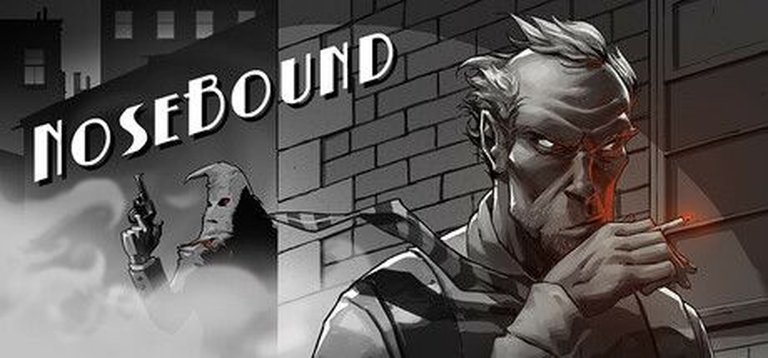
NoseBound is a noir detective adventure game set in a gritty, morally ambiguous world where the natural and supernatural collide. Players take on the role of Ray Hammond, a determined gumshoe investigating the mysterious disappearance of his friend Smithy. The game features striking black-and-white graphics with selective splashes of color to highlight key elements, a sinister soundscape, and a mix of point-and-click puzzles, character interrogations, and timed challenges. As Ray delves deeper into the case, he uncovers a tale of love, danger, and occult intrigue, all while navigating a world filled with tough confrontations and hard-nosed characters.
Gameplay Videos
Where to Buy NoseBound
PC
NoseBound Guides & Walkthroughs
NoseBound Reviews & Reception
steambase.io (91/100): NoseBound has earned a Player Score of 91 / 100.
theurbanadventurist.com : A thoroughly enjoyable combination of an excellent story and great black-and-white graphics, Quarantine Interactive’s NoseBound is a point-and-click noir thriller.
adventuregamers.com : A thoroughly enjoyable combination of an excellent story and great black-and-white graphics, Quarantine Interactive’s NoseBound is a point-and-click noir thriller.
store.steampowered.com (91/100): Quarantine Interactive brings us a graphic adventure built on the genre’s foundations to tell a story filled with blood, mystery, and supernatural elements.
mobygames.com (62/100): NoseBound is a modern style point and click adventure game that proposes an entangling detective story.
NoseBound: A Noir Detective Adventure That Defies Convention
Introduction
In the crowded landscape of modern adventure games, NoseBound emerges as a bold, unapologetic love letter to classic noir detective fiction, infused with Lovecraftian horror and a dash of the occult. Developed by the Argentine studio Quarantine Interactive and released in December 2024, this point-and-click adventure dares to blend the gritty realism of Raymond Chandler’s hard-boiled detectives with the cosmic dread of H.P. Lovecraft’s mythos. The result is a game that is as much a tribute to the past as it is a daring experiment in narrative and atmosphere.
At its core, NoseBound is a story about Ray Hammond, a private investigator with a morally ambiguous past, who is drawn into a mystery that spirals from the mundane to the supernatural. The game’s premise is simple: Ray’s friend, Smithy, disappears under mysterious circumstances, and Ray must navigate a labyrinth of deception, violence, and otherworldly horrors to uncover the truth. Yet, the execution is anything but simple. NoseBound is a game that thrives on its contradictions—it is both a celebration of classic adventure game mechanics and a subversion of them, a tale of friendship and betrayal, and a journey into the unknown that leaves players questioning their own perceptions.
This review will delve deep into NoseBound, examining its development history, narrative depth, gameplay mechanics, artistic design, and its place in the broader context of adventure gaming. By the end, we will determine whether NoseBound is a triumphant revival of the noir detective genre or a flawed but fascinating experiment that pushes the boundaries of what a point-and-click adventure can be.
Development History & Context
The Studio Behind the Game
Quarantine Interactive, the Buenos Aires-based studio behind NoseBound, is a relatively small but ambitious team with a clear passion for narrative-driven games. The studio’s name itself—Quarantine—hints at a thematic preoccupation with isolation, confinement, and the unseen forces that lurk beyond the edges of reality. This is a studio that is not afraid to tackle dark, mature themes, and NoseBound is a testament to that ethos.
The development of NoseBound was driven by a desire to create a game that would stand out in the modern adventure game landscape. In an era where many adventure games lean toward either retro nostalgia or hyper-modern aesthetics, Quarantine Interactive sought to carve out a niche that was both timeless and fresh. The studio’s influences are worn proudly on its sleeve: the hard-boiled detective fiction of Raymond Chandler and Dashiell Hammett, the cosmic horror of H.P. Lovecraft, and the occult writings of figures like Aleister Crowley and Eliphas Levi. These influences are not merely superficial; they are woven into the very fabric of the game’s narrative, aesthetics, and gameplay.
Technological Constraints and Design Choices
NoseBound was developed using the Unity engine, a choice that allowed the team to focus on the game’s artistic and narrative ambitions without being bogged down by technical limitations. The game’s visual style—a striking black-and-white aesthetic with selective splashes of color—was a deliberate choice to evoke the look and feel of classic noir films from the 1940s. This stylistic decision was not just about aesthetics; it was about immersing players in a world where the boundaries between reality and the supernatural are blurred.
The game’s 2D scrolling perspective and side-view presentation are reminiscent of classic adventure games, but Quarantine Interactive infused these traditional elements with modern sensibilities. The use of film noise, scratches, and grainy textures further enhances the game’s retro-noir atmosphere, making it feel like a lost artifact from a bygone era. This commitment to atmosphere is one of the game’s greatest strengths, but it also presented challenges. The lack of a hotspot indicator, for instance, was a deliberate design choice to encourage players to explore and engage with the environment more deeply. However, as we will discuss later, this choice also led to some frustrations among players.
The Gaming Landscape at Release
NoseBound was released in December 2024, a time when the adventure game genre was experiencing a renaissance. Games like Disco Elysium, Return of the Obra Dinn, and The Case of the Golden Idol had demonstrated that there was still a hunger for narrative-driven experiences that challenged players intellectually and emotionally. However, NoseBound arrived at a moment when the market was also saturated with indie titles vying for attention. Standing out required more than just a compelling story; it required a unique voice and a willingness to take risks.
Quarantine Interactive’s decision to blend noir detective fiction with Lovecraftian horror was a gamble, but it was one that paid off in terms of critical attention. The game’s mature themes—including violence, sexual content, and adult language—ensured that it was not for everyone, but it also meant that NoseBound carved out a distinct identity for itself. The game’s USK 18 rating (no youth rating) underscored its commitment to delivering an unflinching, adult-oriented experience.
Narrative & Thematic Deep Dive
The Plot: A Descent into Madness
NoseBound begins with a simple premise: Ray Hammond, a private investigator with a checkered past, receives a phone call that sets him on the trail of his missing friend, Smithy. What starts as a routine missing persons case quickly spirals into something far more sinister. As Ray delves deeper into the mystery, he uncovers a web of deception that involves occult rituals, otherworldly entities, and a conspiracy that threatens to unravel the very fabric of reality.
The narrative structure of NoseBound is non-linear, with the story unfolding in a series of flashbacks and present-day investigations. This approach allows the game to explore themes of memory, perception, and the unreliable nature of truth. Ray’s investigation takes him through a variety of locations, from the gritty streets of a decaying city to the eerie interiors of abandoned buildings, each of which is steeped in atmosphere and dread.
One of the most compelling aspects of NoseBound’s narrative is its exploration of moral ambiguity. Ray Hammond is not a traditional hero; he is a flawed, morally gray character who operates in a world where the lines between right and wrong are blurred. His friend Smithy is similarly complex—a man whose devotion to love leads him into dangerous territory, but whose intentions remain fundamentally honest. This moral ambiguity extends to the game’s supporting cast, many of whom are equally enigmatic and unpredictable.
Themes: Love, Betrayal, and the Unknown
At its heart, NoseBound is a story about the power of love and the dangers of obsession. Smithy’s disappearance is tied to his relationship with a woman, and it is this relationship that sets the events of the game in motion. The game explores how love can be both a source of strength and a catalyst for destruction, a theme that is reinforced by the game’s supernatural elements. The occult forces that Ray encounters are not merely external threats; they are manifestations of the darker aspects of human nature.
The game also delves deeply into themes of betrayal and deception. As Ray uncovers the truth behind Smithy’s disappearance, he is forced to confront the possibility that those he trusts may not be who they seem. This theme is reflected in the game’s puzzles, many of which require players to question their assumptions and look beyond the obvious.
Perhaps the most pervasive theme in NoseBound is the unknown. The game’s Lovecraftian influences are evident in its exploration of cosmic horror—the idea that there are forces in the universe that are beyond human comprehension. This theme is reinforced by the game’s visual and auditory design, which creates a sense of unease and dread that permeates every aspect of the experience.
Characters and Dialogue
The characters in NoseBound are one of its greatest strengths. Ray Hammond is a compelling protagonist, a man whose tough exterior belies a deep sense of loyalty and vulnerability. His interactions with other characters are filled with sharp, noir-inspired dialogue that crackles with tension and wit. The supporting cast is equally well-developed, with each character bringing their own motivations and secrets to the table.
The game’s dialogue is a standout feature, blending the hard-boiled cynicism of classic detective fiction with a modern sensibility. The voice acting is top-notch, with each character’s performance adding depth and nuance to their interactions. The writing is sharp and evocative, with a keen ear for the rhythms of noir dialogue.
The Supernatural and the Mundane
One of the most intriguing aspects of NoseBound is its blending of the supernatural with the mundane. The game’s world is one where occult rituals and otherworldly entities exist alongside the everyday realities of a decaying city. This juxtaposition is reflected in the game’s visual design, which uses black-and-white imagery to ground the experience in reality, while selective splashes of color highlight the moments where the supernatural intrudes.
For example, Ray’s office is rendered in stark black-and-white, but a green light shines through the window as he receives the phone call that sets the story in motion. This subtle use of color serves as a visual cue that something is amiss, a technique that is repeated throughout the game. Similarly, Smithy’s apartment is filled with occult artifacts that are rendered in vivid colors, contrasting with the otherwise monochrome environment.
This blending of the supernatural and the mundane is not just a visual technique; it is a narrative device that reinforces the game’s themes. The supernatural elements in NoseBound are not just external threats; they are reflections of the characters’ inner struggles and the darker aspects of the human psyche.
Gameplay Mechanics & Systems
Core Gameplay Loop
NoseBound is, at its core, a classic point-and-click adventure game. Players take on the role of Ray Hammond, navigating a series of environments, interacting with objects and characters, and solving puzzles to progress the story. The game’s core gameplay loop is familiar to anyone who has played a classic adventure game: explore, interact, solve, and advance.
However, NoseBound distinguishes itself through its commitment to atmosphere and its willingness to experiment with traditional adventure game mechanics. The game’s puzzles are varied and often inventive, ranging from inventory-based challenges to environmental puzzles that require players to think outside the box. One standout example is a puzzle in Smithy’s apartment that involves analyzing Tarot cards and occult imagery, a challenge that is both thematically appropriate and intellectually engaging.
Combat and Action Sequences
While NoseBound is primarily a puzzle-driven adventure game, it also incorporates elements of action and combat. At certain points in the story, Ray is forced to defend himself using a firearm, and these sequences are handled through a simple but effective point-and-click shooting mechanic. Players must access their inventory, equip their weapon, and aim at their target using a crosshair. While these sequences are not as deep or complex as those in a dedicated action game, they serve to heighten the tension and reinforce the game’s noir aesthetic.
The inclusion of combat sequences is a double-edged sword. On the one hand, they add variety to the gameplay and create moments of heightened drama. On the other hand, they can feel somewhat jarring in a game that is otherwise focused on exploration and puzzle-solving. Some players may find these sequences to be a welcome change of pace, while others may see them as a distraction from the game’s core strengths.
Inventory and Puzzle Design
The inventory system in NoseBound is straightforward and intuitive. Players can collect items by clicking on them in the environment, and these items are stored in an inventory bar at the top of the screen. Using items is equally simple: players click on an item in their inventory and then click on the object or character they wish to interact with. The game provides feedback to indicate whether an interaction is successful, which helps to prevent frustration.
The puzzles in NoseBound are generally well-designed, with a focus on logical thinking and environmental interaction. Many of the puzzles are tied to the game’s narrative themes, such as the Tarot card puzzle mentioned earlier. Others involve more traditional adventure game mechanics, such as combining items or using them in specific ways to progress. The game strikes a good balance between challenge and accessibility, ensuring that players are engaged without becoming overly frustrated.
Interface and Usability
The interface in NoseBound is clean and intuitive, with a context-sensitive command wheel that appears when players click on a hotspot. This wheel contains options for looking at, interacting with, or talking to objects and characters, depending on the context. The lack of a hotspot indicator is a deliberate design choice that encourages players to explore the environment more thoroughly, but it can also lead to frustration when players are unsure of what to do next.
One of the game’s most significant usability issues is its save system. While NoseBound does include an autosave feature and four manual save slots, the lack of a task list or notepad makes it difficult for players to keep track of their progress. This is particularly problematic in a game that encourages exploration and non-linear progression. The inability to label save files with custom names is another minor but noticeable oversight.
Exploration and World Design
The world of NoseBound is richly detailed and immersive, with each location designed to evoke a specific mood or atmosphere. From the grimy streets of the city to the eerie interiors of abandoned buildings, the game’s environments are filled with clues and secrets that reward careful exploration. The game’s side-view perspective and 2D scrolling mechanics create a sense of depth and scale, while the black-and-white visual style reinforces the noir aesthetic.
However, the game’s linear structure can sometimes feel restrictive. While NoseBound encourages exploration, it ultimately funnels players toward a predetermined path. This linearity is not necessarily a flaw, but it does mean that the game lacks the open-endedness of some other adventure games.
World-Building, Art & Sound
Visual Design: A Noir Masterpiece
The visual design of NoseBound is one of its most striking features. The game’s black-and-white aesthetic, inspired by classic noir films, creates a sense of timelessness and atmosphere that is rare in modern games. The use of selective color—such as the green light in Ray’s office or the vivid hues of occult artifacts—serves to highlight key moments and draw the player’s attention to important details.
The game’s art style is further enhanced by the use of film noise, scratches, and grainy textures, which give the game a cinematic quality. These visual effects are not merely decorative; they serve to immerse players in the game’s world and reinforce its themes of decay and uncertainty.
Sound Design: A Symphony of Dread
The sound design in NoseBound is equally impressive. The game’s soundtrack is a haunting blend of jazz and ambient music, evoking the mood of classic noir films while adding a modern twist. The use of sound effects—such as creaking doors, clanking footsteps, and the explosive bang of gunfire—further enhances the game’s atmosphere, creating a sense of tension and unease that permeates every moment.
The voice acting in NoseBound is top-notch, with each character’s performance adding depth and nuance to their interactions. The gruff, world-weary tone of Ray Hammond’s voice is particularly effective, capturing the essence of the hard-boiled detective archetype.
World-Building: A City of Secrets
The world of NoseBound is a decaying city filled with secrets and dangers. From the grimy streets to the shadowy interiors of abandoned buildings, every location is designed to evoke a sense of mystery and dread. The game’s environments are richly detailed, with clues and secrets hidden in every corner.
One of the most impressive aspects of the game’s world-building is its use of occult imagery and Lovecraftian themes. The game’s supernatural elements are not just window dressing; they are integral to the story and the world, creating a sense of unease and uncertainty that keeps players on edge.
Reception & Legacy
Critical Reception
NoseBound received a mixed but generally positive reception from critics. Adventure Gamers praised the game for its “suspenseful, blood-curdling story” and “creative black-and-white locales with discrete splashes of color,” awarding it a score of 70%. Adventure Game Hotspot was more critical, describing the game as “graphically intriguing” but “linear and unpolished,” giving it a score of 54%.
Despite these mixed reviews, NoseBound has developed a cult following among fans of noir detective fiction and Lovecraftian horror. The game’s unique blend of genres and its commitment to atmosphere have earned it a place in the hearts of adventure game enthusiasts.
Commercial Performance
NoseBound was released as a commercial title on Steam, with a price point of $14.99. While the game has not achieved blockbuster success, it has found a niche audience that appreciates its unique blend of genres and its mature themes. The game’s positive reception on Steam—with a 91% positive rating from 34 user reviews—indicates that it has resonated with players who are looking for something different in the adventure game genre.
Influence and Legacy
While it is too early to determine NoseBound’s long-term legacy, the game has already made an impact on the adventure game community. Its willingness to blend noir detective fiction with Lovecraftian horror has inspired other developers to experiment with genre conventions, and its commitment to atmosphere and storytelling has set a high bar for future adventure games.
Conclusion
NoseBound is a flawed but fascinating experiment in narrative and atmosphere. It is a game that wears its influences proudly on its sleeve, blending the hard-boiled cynicism of classic detective fiction with the cosmic dread of Lovecraftian horror. The result is a game that is as much a tribute to the past as it is a bold step forward for the adventure game genre.
The game’s strengths lie in its compelling narrative, richly detailed world, and striking visual and auditory design. Its weaknesses—such as its linear structure, lack of a hotspot indicator, and somewhat clunky save system—are minor but noticeable. Ultimately, NoseBound is a game that will appeal to fans of noir detective fiction, Lovecraftian horror, and classic adventure games. It is not a perfect game, but it is a memorable one, and it deserves to be remembered as a unique and ambitious entry in the adventure game canon.
Final Verdict: 7.5/10 – A bold and atmospheric noir adventure that pushes the boundaries of the genre, despite its flaws.