
- Release Year: 2005
- Platforms: Macintosh, Windows
- Publisher: Pamplin Entertainment
- Developer: Covenant Studios, Inc., Good Faith Ministries, LLC
- Genre: Action
- Perspective: Isometric
- Game Mode: Single-player
- Gameplay: Arcade, Character Switching, Direct control, Item collection, Time limit
- Setting: Contemporary
- Average Score: 95/100
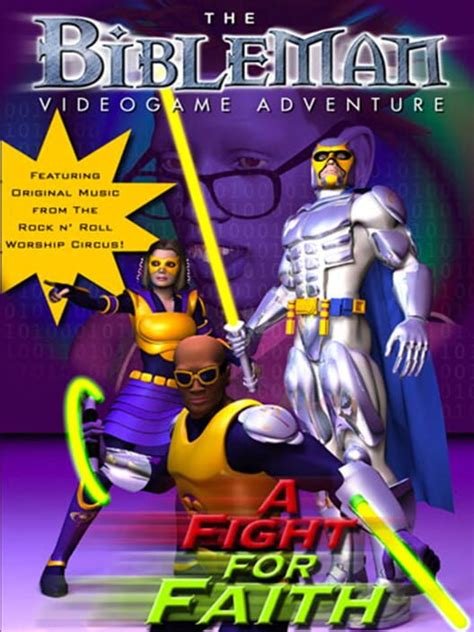
Description
The Bibleman Videogame Adventure: A Fight for Faith is a 2005 action game where players take on the roles of Bibleman, Biblegirl, or Cypher to rescue Gabriel, Olivia, and the children of Andersonville from the villainous Wacky Protester and his henchmen. Set in a contemporary world and played from an isometric perspective, the game features nine missions where players must defeat enemies within time limits using the Full Armor of God and biblical scriptures. Players can switch between characters, summon allies, and collect hidden bibles and crosses to boost their spiritual strength and combat foes.
Gameplay Videos
The Bibleman Videogame Adventure: A Fight for Faith Reviews & Reception
familyfriendlygaming.com (95/100): Bibleman is one major behemoth. This reviewer was humbled to be able to take the time to play such a well known brand name.
The Bibleman Videogame Adventure: A Fight for Faith: A Comprehensive Retrospective
Introduction: The Unlikely Hero of Christian Gaming
Few video games occupy as peculiar a niche in gaming history as The Bibleman Videogame Adventure: A Fight for Faith. Released in 2005, this title is a digital artifact of early 2000s Christian media, a time when evangelical pop culture sought to carve out its own space in entertainment. Based on the Bibleman live-action series—a low-budget, superhero-themed Christian franchise—this game is both a relic of its era and a fascinating case study in how faith-based media attempted to engage with interactive storytelling.
At its core, A Fight for Faith is an isometric action-adventure game where players take on the role of Bibleman, Biblegirl, or Cypher to combat the nefarious Wacky Protester and his henchmen. The premise is as earnest as it is absurd: using the “Full Armor of God” and biblical scriptures, players must rescue kidnapped children from a virtual reality trap designed to convert them to atheism. The game’s existence alone is a testament to the ambition of its creators, who sought to merge Sunday school lessons with the mechanics of a Diablo-lite dungeon crawler.
This review will dissect The Bibleman Videogame Adventure in exhaustive detail, examining its development, narrative, gameplay, and cultural impact. Was it a noble experiment in faith-based gaming, or a well-intentioned misfire? Let’s dive in.
Development History & Context: The Birth of a Christian Action Game
The Studio and the Vision
The Bibleman Videogame Adventure was developed by Covenant Studios, Inc. and Good Faith Ministries, LLC, two entities deeply embedded in Christian media. Covenant Studios was a newcomer to game development, with A Fight for Faith marking its debut title. The studio’s primary goal was to create an interactive experience that aligned with the Bibleman franchise’s mission: to entertain children while reinforcing Christian values.
The game was published by Pamplin Entertainment, a company with ties to religious media, ensuring that the project remained true to its evangelical roots. The development team faced a unique challenge: how to translate the campy, live-action heroics of Bibleman into a playable format without alienating its core audience of young Christian families.
Technological Constraints and Design Choices
Released in 2005, A Fight for Faith was constrained by the technological limitations of its time. The game employs an isometric perspective, a popular choice for action-RPGs in the early 2000s (Baldur’s Gate, Diablo II). However, unlike its contemporaries, A Fight for Faith lacks the polish and depth of those titles. The engine is rudimentary, with simple collision detection and basic AI pathfinding.
The mouse-controlled movement was an unusual design choice, likely intended to simplify controls for younger players. This decision, however, led to clunky navigation, as characters often struggled to pathfind around obstacles. The game’s nine missions are linear, with little in the way of open-ended exploration—a far cry from the sprawling dungeons of Diablo or Neverwinter Nights.
The Gaming Landscape of 2005
2005 was a transitional year for gaming. The Xbox 360 had just launched, heralding the next generation of consoles, while PC gaming was dominated by World of Warcraft, Half-Life 2, and The Sims 2. In this environment, A Fight for Faith was an anomaly—a single-player, isometric action game with no multiplayer, no mod support, and no replayability beyond its three difficulty settings.
The Christian gaming market was still in its infancy. Titles like Pilgrim: Faith as a Weapon (1998) and Faith Fighter (2008) had attempted to blend faith with gameplay, but none had achieved mainstream success. A Fight for Faith was an ambitious attempt to change that, though it ultimately remained a niche product.
Narrative & Thematic Deep Dive: A Battle for Souls (Literally)
Plot Summary: The Wacky Protester’s Atheist VR Trap
The game’s story is directly adapted from the Bibleman episode “A Fight for Faith”, which aired in 2004. The premise is as follows:
- The Wacky Protester (a recurring villain in the Bibleman series) has developed a virtual reality game called “ART” (presumably short for “Atheist Reality Trap”) designed to brainwash children into rejecting faith.
- The villain kidnaps Gabriel, Olivia, and the children of Andersonville, trapping them in this digital dimension.
- Bibleman, Biblegirl, and Cypher must enter the game, defeat the Wacky Protester’s henchmen, and rescue the children using the “Full Armor of God” (a metaphorical concept from Ephesians 6:11-17, representing truth, righteousness, peace, faith, salvation, and the Word of God).
The narrative is unapologetically didactic, framing atheism as an existential threat to children’s souls. The Wacky Protester is not just a villain—he’s a symbol of secularism, and his defeat is framed as a moral victory for Christianity.
Characters: Heroes of the Faith
- Bibleman (Josh Carpenter): The new Bibleman (replacing Miles Peterson from earlier seasons), Josh is a devout Christian who dons the mantle of the superhero. His role in the game is that of the primary warrior, though players don’t unlock him until Level 3.
- Biblegirl: A female counterpart to Bibleman, she serves as a playable character from the start. Her inclusion was likely an attempt to appeal to young girls in the audience.
- Cypher: The tech-savvy member of the team, Cypher provides gadgets and support. In the game, he is one of the starting characters.
- U.N.I.C.E.: A sentient computer (think a Christian version of Knight Rider’s KITT) that assists the team with information and guidance.
- The Wacky Protester: The game’s antagonist, a caricature of an atheist activist who spouts lines like, “The belief that there is no god, no faith, no hope, or no future!” His design and mannerisms are exaggerated to the point of parody.
Themes: Faith vs. Secularism
The game’s central theme is the spiritual warfare between faith and unbelief. Every mechanic reinforces this:
– Bibles as weapons: Players collect Bibles to “vanquish” enemies, literally using scripture as a tool of combat.
– Crosses as power-ups: Finding crosses increases “spiritual strength,” a stat that enhances the player’s abilities.
– The “Full Armor of God”: A recurring motif, where each piece of armor (helmet of salvation, breastplate of righteousness, etc.) grants protection.
The game’s unabashedly evangelical tone is both its defining feature and its greatest limitation. For its target audience—devout Christian families—it serves as an interactive sermon. For secular players, it’s a bizarre, almost surreal experience, where the stakes aren’t just life and death, but eternal salvation.
Dialogue and Writing: Preaching Through Gameplay
The writing in A Fight for Faith is heavily derivative of the Bibleman TV series, which was itself a mix of Power Rangers and VeggieTales with a Christian twist. Lines like:
– “Put on the full armor of God!”
– “We must fight the good fight of faith!” (1 Timothy 1:18)
– “The Word of God is our weapon!”
are repeated ad nauseam. The Wacky Protester’s dialogue is particularly over-the-top, with him gleefully declaring his plans to eradicate faith. The game’s climax involves a sing-off between Cypher and the Wacky Protester, a moment so absurd it borders on self-parody.
Gameplay Mechanics & Systems: A Simplified Action-Adventure
Core Gameplay Loop
A Fight for Faith is structured as a linear, mission-based action game with light puzzle elements. The gameplay can be broken down as follows:
- The Bible Cave (Hub Area): Players start in a central hub where they can switch characters, check stats, and prepare for missions.
- Nine Missions: Each mission tasks the player with:
- Defeating all henchmen within a time limit.
- Finding hidden Bibles and crosses to power up.
- Solving simple puzzles (e.g., finding keys, navigating mazes).
- Combat: The game’s most unique (and flawed) mechanic.
- Enemies shoot projectiles at the player.
- The player cannot attack directly; instead, they must deflect shots back at enemies using their character’s “shield of faith.”
- This creates a passive combat system where the player’s primary interaction is blocking and countering.
Character Progression and Abilities
- Spiritual Strength: The game’s equivalent of “EXP.” Collected by finding Bibles and crosses.
- Character Switching: Players can summon companions or switch between Bibleman, Biblegirl, and Cypher mid-mission.
- Unlocking Bibleman: The titular hero is locked until Level 3, a strange design choice that forces players to start with the “sidekicks.”
Flaws in the Combat System
The game’s biggest mechanical failure is its combat:
– No direct attacks: Players cannot strike enemies; they can only deflect projectiles. This makes combat tedious and unrewarding.
– Poor hit detection: The isometric perspective and mouse controls lead to frustrating moments where attacks miss or characters get stuck.
– Repetitive enemy encounters: Henchmen respawn in predictable patterns, making battles feel like a chore.
Puzzle and Exploration Elements
Some missions incorporate light puzzle-solving, such as:
– Finding hidden items to progress.
– Navigating mazes (though these are extremely basic).
– The “unbeatable level”, a meta-joke where the game acknowledges its own difficulty spikes.
UI and Controls
- Mouse-only controls: While accessible for kids, this leads to imprecise movement.
- Minimal HUD: The UI is sparse, with only a health bar and mission timer.
- No save system: Players must complete missions in one sitting, a strange omission for a 2005 game.
World-Building, Art & Sound: A Sunday School Aesthetic
Visual Design: Bright, Simple, and Symbolic
The game’s art style is colorful and cartoonish, befitting its target audience. Key visual elements include:
– Isometric environments: Levels are designed with a top-down perspective, reminiscent of The Sims or Ultima Online.
– Symbolic imagery: Crosses, Bibles, and stained-glass windows are scattered throughout.
– Character designs: Bibleman’s costume is a blue-and-gold superhero suit, while the Wacky Protester is dressed in a clownish, villainous outfit.
The game’s lack of graphical fidelity is evident—textures are basic, animations are stiff, and environments lack detail. However, for a low-budget Christian game, it’s serviceable.
Sound Design and Music
- Voice acting: The game features full voice acting from the Bibleman TV cast, which adds authenticity but is hammy and overacted.
- Original music: Composed by the Rock n’ Roll Worship Circus, a Christian rock band. The soundtrack is upbeat and energetic, though repetitive.
- Sound effects: Basic, with no standout audio design.
Atmosphere: A Digital Sunday School
The game’s world is wholesome to a fault. There’s no blood, no violence—enemies simply vanish when defeated. The tone is unrelentingly positive, with every victory reinforcing a Christian moral lesson.
Reception & Legacy: A Niche Classic or a Forgotten Oddity?
Critical and Commercial Reception
A Fight for Faith received little mainstream attention, as it was marketed almost exclusively to Christian audiences. Reviews from faith-based outlets were overwhelmingly positive:
– Family Friendly Gaming gave it a 95/100, praising its moral lessons and accessibility.
– Christian parents appreciated its safe, educational content.
However, secular critics (where they existed) found the game clunky and preachy. The lack of depth in gameplay and repetitive mechanics made it a hard sell outside its niche.
Cultural Impact and Legacy
- First Christian action game: A Fight for Faith was one of the first attempts to create a faith-based action-adventure game, paving the way for later titles like Faith: The Unholy Trinity (2017).
- Cult following: The game has developed a small but dedicated fanbase, particularly among those who grew up with the Bibleman series.
- Memes and irony: In recent years, the game has been rediscovered by irony-loving gamers, who appreciate its unintentional campiness.
Influence on Later Games
While A Fight for Faith didn’t spawn a franchise, it proved that Christian games could exist outside of edutainment. Later titles like:
– Faith Fighter (2008) – A satirical fighting game.
– The Last Faith (2023) – A Metroidvania with religious themes.
– Bleak Faith: Forsaken (2023) – A dark, soulslike RPG.
owe a debt to Bibleman’s willingness to blend faith with interactive storytelling.
Conclusion: A Flawed but Fascinating Relic
The Bibleman Videogame Adventure: A Fight for Faith is a time capsule of early 2000s Christian media—earnest, well-intentioned, and deeply flawed. It succeeds as a novelty and a cultural artifact, but fails as a compelling game by modern standards.
Final Verdict: 5/10 – “A Noble Experiment”
- For Christian families in 2005: A valuable tool for teaching faith through play.
- For secular gamers: A bizarre, so-bad-it’s-good curiosity.
- For game historians: A fascinating case study in niche game development.
While A Fight for Faith will never be remembered as a classic, it deserves recognition for its ambition and its role in expanding the boundaries of faith-based gaming. In a world where games like The Last of Us and Elden Ring dominate, Bibleman stands as a reminder that not all heroes wear capes—some wear the Full Armor of God.
Final Score:
– Gameplay: 4/10
– Story & Themes: 7/10 (for its audience)
– Graphics & Sound: 5/10
– Replayability: 3/10
– Historical Significance: 8/10
Recommendation: Play it for the experience, not the gameplay. And maybe keep a Bible handy—you’ll need it.