
- Release Year: 2008
- Platforms: Windows
- Publisher: CITY interactive Sp. z o.o., Noviy Disk
- Developer: CITY interactive Sp. z o.o.
- Genre: Action
- Perspective: 1st-person
- Game Mode: Online PVP, Single-player
- Gameplay: Shooter
- Setting: Middle East
- Average Score: 57/100
Description
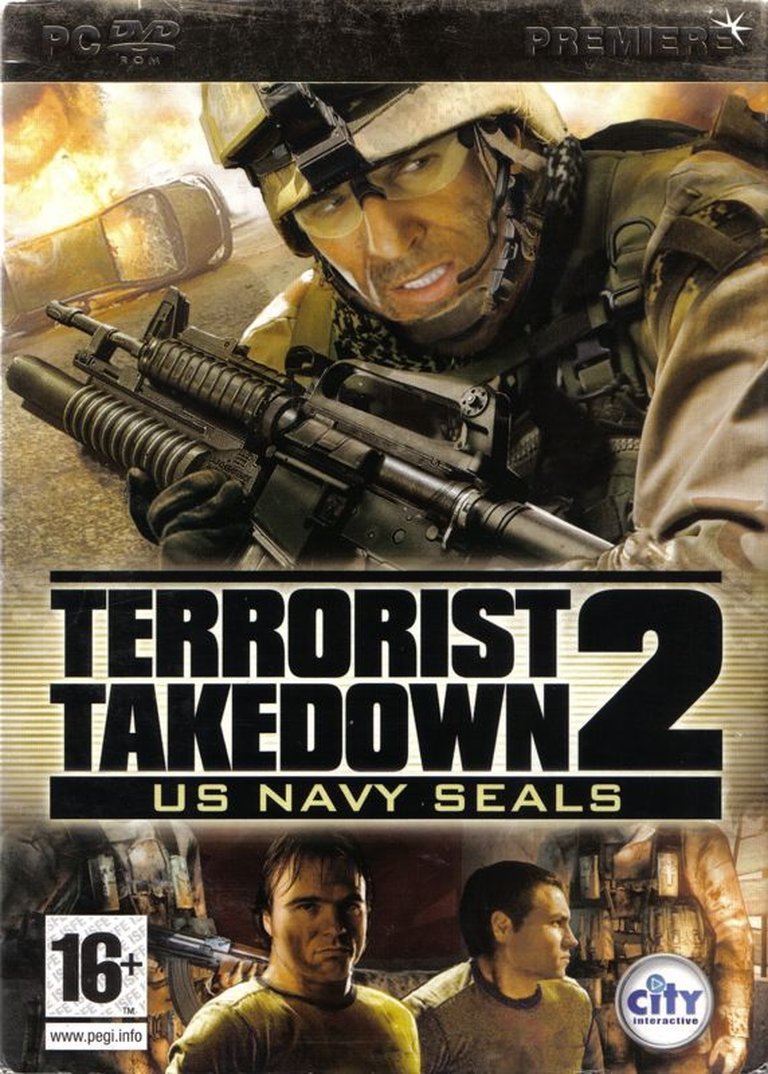
Terrorist Takedown 2: US Navy SEALs is a first-person shooter set in the Middle East, where players take on the role of a Navy SEAL tasked with resolving a hostage crisis amid the ‘War on Terror.’ The game features standard FPS mechanics, including mouse-aimed shooting and keyboard movement, with a variety of weapons like rifles, pistols, and grenades. Health regenerates over time, eliminating the need for medpacks. While the single-player campaign is criticized for its short length and poor AI, the multiplayer mode offers improved gameplay, supporting 2-16 players online or via LAN. The game uses the LithTech Jupiter EX engine, delivering decent graphics for its time, though its narrative and voice acting are often panned as lackluster.
Gameplay Videos
Terrorist Takedown 2: US Navy SEALs Guides & Walkthroughs
Terrorist Takedown 2: US Navy SEALs Reviews & Reception
en.wikipedia.org (53/100): A low-budget first-person shooter video game developed and published by City Interactive.
mobygames.com (50/100): A standard first-person shooter with basic controls and typical weapons.
metacritic.com (36/100): Graphics are ok. The AI are not the best. Guns are good. A short game.
myabandonware.com (89/100): One of my childhood games and one of the first fps games I played so I’m pretty biased.
Terrorist Takedown 2: US Navy SEALs Cheats & Codes
PC
Press [T] (talk button) while playing, type any of the following codes and press [Enter]:
| Code | Effect |
|---|---|
| god | God Mode |
| guns | All Weapons |
| kfa | All Weapons, Full Ammo |
| ammo | Full Ammo |
| tears | Unlimited Ammo |
| poltergeist | Ghost Mode |
| maphole | Skip Level |
Terrorist Takedown 2: US Navy SEALs – A Flawed but Fascinating Relic of Budget FPS History
Introduction: The Forgotten Foot Soldier of the FPS Boom
In the late 2000s, the first-person shooter genre was dominated by titans like Call of Duty 4: Modern Warfare, Crysis, and Half-Life 2. Amidst this golden age, Terrorist Takedown 2: US Navy SEALs (2008) emerged as a curious footnote—a low-budget, unapologetically janky FPS that dared to tread the same thematic ground as its AAA contemporaries. Developed by Polish studio City Interactive (now CI Games), this sequel to Terrorist Takedown: Covert Operations (2006) positioned itself as a no-frills, high-octane military shooter, leveraging the LithTech Jupiter EX engine (of F.E.A.R. fame) to deliver a visually passable but mechanically uneven experience.
This review dissects Terrorist Takedown 2 not as a masterpiece, but as a fascinating artifact of its time—a game that, despite its glaring flaws, offers a raw, unfiltered glimpse into the challenges and compromises of budget game development during the FPS renaissance. Through an exhaustive analysis of its development, narrative, gameplay, and legacy, we’ll explore why this game remains a cult curiosity rather than a forgotten failure.
Development History & Context: The Rise of City Interactive and the Budget FPS Wave
The Studio Behind the Game: City Interactive’s Ambitions
City Interactive, founded in 2002, was a Polish developer and publisher specializing in budget-priced games, often targeting niche markets with military-themed shooters. By the mid-2000s, the studio had carved out a reputation for churning out titles like Terrorist Takedown, Sniper: Art of Victory, and Army Ranger: Mogadishu—games that prioritized quantity over polish. Terrorist Takedown 2 was part of this strategy, aiming to capitalize on the post-9/11 fascination with counterterrorism narratives while keeping production costs low.
The game’s development was constrained by:
– A modest budget, forcing reliance on the LithTech Jupiter EX engine (licensed from Monolith Productions), which, while capable, was already showing its age by 2008.
– A tight schedule, with the game releasing just two years after its predecessor, leaving little room for innovation.
– A focus on multiplayer, as evidenced by the inclusion of LAN and online modes supporting up to 16 players—a rare feature for budget shooters at the time.
The Gaming Landscape of 2008: A Crowded Battlefield
Terrorist Takedown 2 launched into a market saturated with military shooters. Call of Duty 4 had redefined the genre in 2007, while Crysis and Battlefield: Bad Company raised the bar for visuals and gameplay depth. Meanwhile, Rainbow Six Vegas 2 and Ghost Recon Advanced Warfighter 2 offered tactical alternatives. In this environment, Terrorist Takedown 2 was doomed to be overshadowed, but its existence speaks to a broader trend: the proliferation of budget FPS titles attempting to ride the coattails of bigger franchises.
The game’s use of the LithTech engine was a double-edged sword. While it allowed for decent lighting and physics (thanks to Havok integration), it also meant that Terrorist Takedown 2 would inevitably be compared to F.E.A.R., a game that had pushed the engine to its limits in 2005. The result was a visual identity that felt simultaneously familiar and outdated.
The Shareware Phenomenon and Brief Popularity
One of the game’s few claims to fame was its demo, which gained “brief but widespread popularity across Europe” (Wikipedia) as shareware. This suggests that, despite its flaws, the game had a certain so-bad-it’s-good appeal, or at least enough novelty to attract curious players. The demo’s success likely contributed to the game’s eventual full release, though it failed to translate into lasting commercial or critical acclaim.
Narrative & Thematic Deep Dive: A Paper-Thin Plot with Geopolitical Pretensions
The Story: Hostages, Terrorists, and SEALs
Terrorist Takedown 2’s narrative is as barebones as they come. The player assumes the role of a US Navy SEAL (or, in some regional versions, a German special forces operative) tasked with resolving a hostage crisis in the Middle East. The plot unfolds across eight missions, each involving variations of:
– Infiltrating terrorist strongholds
– Rescuing hostages
– Eliminating high-value targets
There is no overarching narrative complexity here. The game’s story is delivered through pre-mission briefings and in-game radio chatter, neither of which are particularly memorable. The dialogue is functional at best, with voice acting that ranges from serviceable to outright laughable (a common criticism in reviews).
Themes: War on Terror as a Backdrop
The game’s setting and themes are deeply rooted in the post-9/11 “War on Terror” zeitgeist, a trope that dominated military shooters in the 2000s. However, unlike Call of Duty 4 or Rainbow Six, Terrorist Takedown 2 makes no attempt at nuance or moral ambiguity. The terrorists are faceless, one-dimensional villains, and the player’s role is purely that of a heroic enforcer of justice.
This lack of depth is both a weakness and, in a strange way, a strength. The game doesn’t pretend to be anything more than a power fantasy, and in that regard, it delivers—albeit clumsily. The absence of a compelling narrative allows the gameplay to take center stage, for better or worse.
Regional Differences: Censorship and Localization
One of the more interesting aspects of Terrorist Takedown 2 is its regional variations, particularly in Germany, where strict video game censorship laws were in effect. The German version:
– Removed blood splatter from environments (though enemies still bled when shot).
– Replaced the red screen effect from grenade hits with smoke.
– Eliminated death cries from enemies.
These changes highlight the game’s struggle to balance its violent content with regional sensibilities, a common challenge for military shooters of the era.
Gameplay Mechanics & Systems: A Study in Budget Constraints
Core Gameplay Loop: Run, Gun, Repeat
Terrorist Takedown 2 is, at its heart, a linear, corridor-based shooter with occasional open areas. The gameplay loop is straightforward:
1. Receive a mission briefing (usually involving hostage rescue or terrorist elimination).
2. Infiltrate the area, clearing rooms and corridors of enemies.
3. Complete objectives, often under a time limit.
4. Extract or move to the next zone.
The game’s level design is functional but uninspired, with repetitive textures, bland environments, and predictable enemy placements. Missions occasionally branch, but these detours rarely offer meaningful rewards beyond extra ammo or health pickups.
Combat and Weaponry: A Mixed Bag
The game’s combat is a hit-or-miss affair, with several notable quirks:
– Weapon Handling: The arsenal includes standard FPS fare—pistols, assault rifles, shotguns, and grenades—but the gunplay lacks the weight and precision of contemporaries like Call of Duty 4. Recoil is exaggerated, and hit detection can feel inconsistent.
– Health System: Unlike many shooters of the era, Terrorist Takedown 2 eschews medkits in favor of a regenerating health system, where waiting briefly restores the player’s vitality. This was a controversial choice, as it clashed with the game’s otherwise tactical pretensions.
– Enemy AI: The AI is notoriously dumb, with enemies often standing in the open, failing to take cover, or getting stuck on geometry. This makes the game easier than intended, though it also leads to moments of unintentional comedy.
Stealth and Tactics: A Half-Hearted Attempt
The game occasionally hints at tactical gameplay, with missions that encourage silent takedowns and stealthy approaches. However, these mechanics are poorly implemented:
– Stealth is unreliable, with enemies sometimes detecting the player from impossible distances.
– Takedowns are clunky, lacking the fluidity of games like Splinter Cell or Rainbow Six.
– Team AI is useless, with squadmates often failing to follow orders or getting in the player’s way.
Multiplayer: The Game’s Saving Grace?
While the single-player campaign was widely panned, the multiplayer mode received mild praise from reviewers. Supporting 2-16 players via LAN or internet, the multiplayer offered standard modes like Deathmatch, Team Deathmatch, and Capture the Flag.
Critics noted that the multiplayer was surprisingly fun, thanks to:
– Decent map design (better than the single-player levels).
– Fast-paced, chaotic gameplay that embraced the game’s jankiness.
– A low barrier to entry, making it accessible for casual players.
However, the multiplayer’s longevity was limited by the game’s small player base and lack of post-launch support.
UI and Controls: Functional but Unremarkable
The game’s user interface is minimalist, with a HUD that displays health, ammo, and objectives. The controls are standard for an FPS, with mouse aiming and keyboard movement, though some reviewers criticized the lack of customization options.
World-Building, Art & Sound: A Budget Aesthetic
Visuals: The LithTech Engine’s Last Gasp
Terrorist Takedown 2’s visuals are a mixed bag, reflecting both the strengths and limitations of the LithTech Jupiter EX engine:
– Lighting and Shadows: The engine’s dynamic lighting is one of its strongest features, creating moody, atmospheric environments in indoor levels. However, outdoor areas suffer from bland textures and repetitive assets.
– Character Models: Enemy and player models are rigid and poorly animated, with stiff movements that break immersion.
– Environmental Detail: The game’s Middle Eastern settings (abandoned buildings, desert outposts) are functional but uninspired, lacking the environmental storytelling of games like Call of Duty 4.
Sound Design: A Missed Opportunity
The game’s audio design is adequate but forgettable:
– Gunfire and explosions sound decent, though they lack the punch of AAA titles.
– Voice acting is hit-or-miss, with some lines delivered competently and others sounding wooden or overacted.
– Music is sparse, with a generic action score that does little to enhance the atmosphere.
Atmosphere: A Failed Attempt at Grit
Terrorist Takedown 2 aspires to be a gritty, realistic military shooter, but its budget constraints and technical limitations prevent it from achieving this goal. The game’s atmosphere is undermined by:
– Poor enemy AI that breaks immersion.
– Repetitive level design that feels more like a shooting gallery than a warzone.
– A lack of tension, due to the regenerating health system and easy difficulty.
Reception & Legacy: A Game That Couldn’t Compete
Critical Reception: A Lukewarm Response
Terrorist Takedown 2 received mixed-to-negative reviews, with critics highlighting its technical flaws, weak AI, and lack of innovation. Aggregate scores paint a clear picture:
– MobyGames: 5.4/10 (based on 19 critic reviews).
– Metacritic: No official Metascore, but user reviews average 3.6/10.
– GameSpot: 5.3/10, calling it “a shooter for people with very low quality thresholds” (Eurogamer).
Common Criticisms:
– “Dated and uninspired” (GameStar, 40%).
– “A budget FPS with rough edges” (Gamigo, 59%).
– “Only worth it if you’re desperate for a cheap shooter” (gameZine UK, 50%).
Praise (Where It Existed):
– “The multiplayer is surprisingly fun” (Shooterplanet, 68%).
– “Adequate graphics for a budget title” (Games Machine Italy, 55%).
– “A guilty pleasure for FPS fans on a budget” (PC Action Germany, 62%).
Commercial Performance: A Niche Audience
The game failed to make a significant commercial impact, overshadowed by bigger, better-funded shooters. However, it found a small but dedicated audience among:
– Budget-conscious gamers looking for a cheap alternative to AAA titles.
– Multiplayer enthusiasts who enjoyed its fast-paced, chaotic matches.
– Retro gamers who appreciate its so-bad-it’s-good charm.
Legacy: A Footnote in FPS History
Terrorist Takedown 2’s legacy is minor but noteworthy:
– It represents City Interactive’s peak as a budget FPS developer before the studio shifted toward more ambitious (but still flawed) projects like Sniper: Ghost Warrior.
– It’s a time capsule of late-2000s gaming trends, reflecting the obsession with military shooters and the challenges of low-budget development.
– It remains a cult favorite among fans of janky, unpolished shooters, who appreciate its unintentional humor and chaotic multiplayer.
Conclusion: A Flawed but Fascinating Relic
Terrorist Takedown 2: US Navy SEALs is not a good game by conventional standards. It’s clunky, repetitive, and visually dated, with poor AI, weak storytelling, and uninspired level design. Yet, it’s also a fascinating artifact—a snapshot of a time when budget FPS games tried (and often failed) to compete with AAA powerhouses.
Final Verdict:
– For hardcore FPS fans: A curiosity worth experiencing for its multiplayer chaos and retro charm.
– For casual players: Skip it—there are far better shooters from the era (Call of Duty 4, Crysis, Rainbow Six Vegas).
– For retro collectors: A quirky addition to any budget FPS library, best enjoyed with friends in multiplayer.
Score: 5/10 – “A Flawed but Fun Relic”
Terrorist Takedown 2 doesn’t deserve to be remembered as a classic, but it doesn’t deserve to be forgotten either. It’s a testament to the ambition (and limitations) of budget game development, and in that regard, it’s oddly endearing. If you approach it with low expectations and a sense of humor, you might just find a diamond in the rough—or at least a fun way to waste an afternoon.