
- Release Year: 2007
- Platforms: iPad, iPhone, Macintosh, Windows
- Publisher: Aisle 5 Games, Inc., Big Fish Games, Inc, eGames, Inc., Noviy Disk, Reflexive Entertainment Inc.
- Developer: Aisle 5 Games, Inc.
- Genre: Adventure
- Perspective: 1st-person
- Game Mode: Single-player
- Gameplay: Hidden object
- Setting: Haunted house, Horror
- Average Score: 74/100
Description
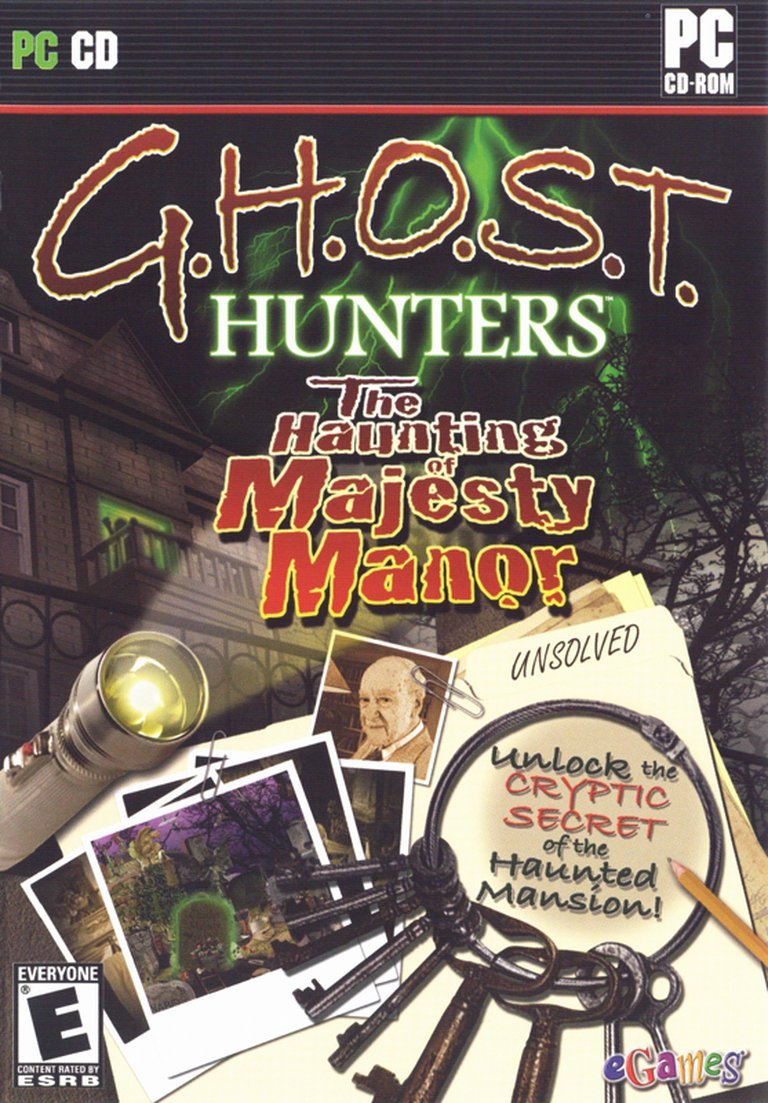
G.H.O.S.T. Hunters: The Haunting of Majesty Manor is a first-person hidden object adventure game set in a haunted estate. Players take on the role of paranormal investigators tasked by Viola Majesty to uncover the supernatural mysteries plaguing her family manor. Across fifteen days, players explore cluttered rooms, searching for items on a list within a time limit, aided by a multi-scanner wand that helps locate hidden objects. The game blends horror and puzzle-solving as players navigate the eerie manor, collecting batteries to recharge their scanner while unraveling the estate’s ghostly secrets.
Gameplay Videos
G.H.O.S.T. Hunters: The Haunting of Majesty Manor Free Download
G.H.O.S.T. Hunters: The Haunting of Majesty Manor Reviews & Reception
g-h-o-s-t-hunters-the-haunting-of-majesty-manor.en.softonic.com (74/100): G.H.O.S.T. Hunters is an enjoyable puzzle investigation game, perfect to get into the Halloween spirit.
G.H.O.S.T. Hunters: The Haunting of Majesty Manor: A Comprehensive Retrospective
Introduction: A Hauntingly Good Hidden Object Game
In the mid-2000s, the hidden object genre was experiencing a renaissance, with titles like Mystery Case Files: Ravenhearst setting the standard for atmospheric, puzzle-driven gameplay. Amidst this landscape, G.H.O.S.T. Hunters: The Haunting of Majesty Manor emerged as a standout entry, blending detective work, supernatural intrigue, and a unique hint system into a cohesive and engaging experience. Developed by Aisle 5 Games and released in 2007, this game carved a niche for itself by offering a more structured narrative and innovative mechanics than many of its contemporaries. While it may not have achieved the same level of mainstream recognition as some of its peers, G.H.O.S.T. Hunters remains a cult favorite among hidden object enthusiasts, thanks to its eerie atmosphere, clever gameplay twists, and a mystery that keeps players invested until the very end.
This review will delve deeply into the game’s development history, narrative and thematic elements, gameplay mechanics, world-building, and its lasting legacy. By examining these aspects, we can better understand why G.H.O.S.T. Hunters stands as a noteworthy example of the hidden object genre and how it has influenced subsequent games in the field.
Development History & Context: The Birth of a Hidden Object Classic
The Studio Behind the Game: Aisle 5 Games
G.H.O.S.T. Hunters: The Haunting of Majesty Manor was developed by Aisle 5 Games, a small but ambitious studio founded by Mike and Heather Wright. The studio was known for its focus on casual and family-friendly games, often blending puzzle-solving with engaging narratives. Aisle 5 Games’ portfolio included titles like Scrapbook Paige and G.H.O.S.T. Chronicles: Phantom of the Renaissance Faire, but G.H.O.S.T. Hunters remains one of their most well-regarded works.
The Wrights’ background in game design and programming allowed them to create a game that was both accessible and innovative. Mike Wright handled the game and graphic design, while Heather Wright took on sound design and programming. Their collaboration resulted in a game that was polished, atmospheric, and mechanically sound, despite the technological constraints of the era.
Technological Constraints and the Gaming Landscape of 2007
The mid-2000s were a transitional period for PC gaming. While high-end titles were pushing the boundaries of 3D graphics and complex gameplay systems, the casual gaming market was booming, thanks in part to the rise of digital distribution platforms like Big Fish Games and GameHouse. Hidden object games, in particular, were gaining popularity due to their accessibility and the growing demand for games that could be played in short bursts.
G.H.O.S.T. Hunters was developed using the Torque Game Builder, a tool that allowed for rapid prototyping and development of 2D games. This engine was well-suited for the hidden object genre, as it provided the necessary tools for creating detailed, interactive environments without requiring extensive 3D modeling or complex physics systems. However, the engine’s limitations also meant that the game’s visuals, while detailed, were not as dynamic or immersive as those found in more technically advanced titles.
Despite these constraints, Aisle 5 Games managed to create a game that was visually appealing and mechanically engaging. The use of pre-rendered backgrounds and static images allowed for a high level of detail in the game’s environments, while the Torque Game Builder’s scripting capabilities enabled the developers to implement a robust hint system and other innovative features.
The Vision Behind G.H.O.S.T. Hunters
The Wrights’ vision for G.H.O.S.T. Hunters was to create a hidden object game that stood out from the crowd by offering a more structured narrative and a unique gameplay twist. Unlike many hidden object games of the time, which often relied on abstract or nonsensical object lists, G.H.O.S.T. Hunters grounded its gameplay in a coherent mystery. Players were not just searching for random items; they were investigating a haunting, gathering clues, and eliminating suspects.
This narrative-driven approach was a breath of fresh air in a genre that was often criticized for its lack of depth. By tying the hidden object gameplay to a larger mystery, Aisle 5 Games gave players a sense of purpose and progression that was lacking in many of their competitors’ titles. The game’s use of a “Spectre-Scan Mate” hint system further reinforced this investigative theme, making the gameplay feel more like a detective’s toolkit than a simple list of items to find.
Narrative & Thematic Deep Dive: Unraveling the Mystery of Majesty Manor
Plot Summary: A Haunting or a Hoax?
G.H.O.S.T. Hunters: The Haunting of Majesty Manor begins with a call for help from Viola Majesty, the owner of the eponymous manor. Strange and unexplained supernatural occurrences have been plaguing the estate, and Viola has turned to the paranormal investigation agency G.H.O.S.T. Hunters for answers. As a newly hired investigator, the player is tasked with determining whether the haunting is genuine or an elaborate hoax.
The game is structured around a 15-day investigation, with each day consisting of several locations within the manor that must be searched for clues. The player’s goal is to collect items that contain “residual psychic energy,” which are then used to identify and eliminate suspects. The narrative unfolds gradually, with each day’s findings bringing the player closer to the truth behind the haunting.
Characters and Dialogue: A Cast of Suspects
While G.H.O.S.T. Hunters does not feature a large cast of characters, the ones that are present are well-defined and serve to drive the narrative forward. Viola Majesty, the manor’s owner, is the primary client and the player’s main point of contact. Her desperation and fear are palpable, adding a layer of urgency to the investigation. The suspects, while not deeply developed, are given enough personality to make the process of eliminating them engaging.
The dialogue in G.H.O.S.T. Hunters is functional rather than flourished, serving primarily to advance the plot and provide context for the player’s actions. However, the game’s use of sound design—including whispers, creaking hinges, and eerie music—helps to create an atmosphere that is both immersive and unsettling. This auditory experience compensates for the lack of deep character interactions, making the manor feel alive with supernatural activity.
Themes: The Blurring of Reality and Supernatural
At its core, G.H.O.S.T. Hunters explores the tension between the rational and the supernatural. The game’s central question—whether the haunting is real or a hoax—mirrors the player’s own journey of discovery. As the investigation progresses, the line between the two becomes increasingly blurred, forcing the player to question their own assumptions about what is possible.
This theme is reinforced by the game’s mechanics. The “Spectre-Scan Mate” hint system, for example, is presented as a paranormal detection device, further blurring the line between technology and the supernatural. The game’s use of “residual psychic energy” as a narrative device also serves to bridge the gap between the mundane and the otherworldly, making the supernatural feel tangible and real.
The Ending: A Race Against Time
The climax of G.H.O.S.T. Hunters takes place in the manor’s attic, where the player must use the clues they have gathered to identify the culprit behind the haunting. This final sequence is a race against time, with the player rushing between the attic and the haunted rooms to piece together the final clues. The ending is satisfying, if somewhat predictable, and provides a sense of closure to the mystery.
One of the game’s most innovative features is its use of randomized culprits and object lists, which adds a layer of replayability. While the items themselves remain stationary, the fact that the culprit can change between playthroughs encourages players to revisit the game and experience the mystery anew.
Gameplay Mechanics & Systems: The Art of Hidden Object Investigation
Core Gameplay Loop: Search, Scan, and Solve
The core gameplay of G.H.O.S.T. Hunters revolves around the hidden object mechanic, which is the foundation of the genre. Players are given a list of items to find within a cluttered environment, and they must locate and click on each item to progress. The game is divided into 15 days, with each day consisting of several locations that must be searched.
What sets G.H.O.S.T. Hunters apart from other hidden object games is its use of the “Spectre-Scan Mate” hint system. This device, which is presented as a paranormal detection tool, allows players to scan the environment for hidden items. The scanner has four buttons that light up when near a required object, and it emits a clicking sound that increases in frequency as the player gets closer to the item. This system is both intuitive and immersive, making the process of finding hidden objects feel more like an investigation than a simple scavenger hunt.
The Hint System: A Clever Twist on a Genre Staple
The hint system in G.H.O.S.T. Hunters is one of the game’s most innovative features. Unlike many hidden object games, which often rely on a simple “highlight the next item” mechanic, G.H.O.S.T. Hunters’ hint system is integrated into the game’s narrative and theme. The “Spectre-Scan Mate” is presented as a piece of paranormal investigation equipment, complete with a battery that must be recharged by finding hidden batteries within the environment.
This system adds a layer of strategy to the gameplay, as players must decide when to use their limited hints and when to rely on their own observation skills. The scanner’s use of auditory and visual cues also makes the process of finding hidden objects more engaging, as players must actively listen and watch for clues rather than simply clicking randomly.
Time Management and Penalties: A Balancing Act
G.H.O.S.T. Hunters introduces a time management element to its gameplay, with players given a limited amount of time to complete each day’s investigation. While the time limits are generous, the game does penalize players for clicking randomly by deducting 30 seconds from the clock. This penalty encourages players to be methodical in their searches, adding a layer of challenge to the gameplay.
The game’s time management system is well-balanced, ensuring that players feel a sense of urgency without becoming frustrated. The ability to revisit locations to find missed items also provides a safety net for players who struggle with the time constraints, making the game accessible to a wide range of skill levels.
Replayability: Randomized Culprits and Object Lists
One of the standout features of G.H.O.S.T. Hunters is its replayability. While the items themselves remain in the same locations between playthroughs, the game randomizes the culprit and the object lists, ensuring that each playthrough feels fresh. This feature is particularly impressive given the game’s relatively small scope, and it adds significant value to the overall experience.
The randomized culprit system also encourages players to pay close attention to the clues they gather, as the identity of the culprit can change between playthroughs. This adds a layer of depth to the narrative, making the mystery feel more dynamic and engaging.
World-Building, Art & Sound: Crafting an Eerie Atmosphere
Setting and Atmosphere: The Haunted Majesty Manor
The setting of G.H.O.S.T. Hunters is one of its strongest assets. Majesty Manor is a sprawling, gothic estate filled with cluttered rooms, shadowy corridors, and eerie nooks and crannies. The game’s environments are richly detailed, with each location offering a unique atmosphere that contributes to the overall sense of unease.
The manor’s design is reminiscent of classic haunted house tropes, with locations like the Billiard Room, Carriage House, Garden Shed, Graveyard, and Library each offering their own distinct flavor of horror. The use of pre-rendered backgrounds allows for a high level of detail, with each room filled with a cacophony of objects that feel both mundane and unsettling.
Visual Direction: A Study in Gothic Aesthetics
The visual direction of G.H.O.S.T. Hunters is heavily influenced by gothic aesthetics, with a color palette dominated by dark, muted tones. The game’s environments are cluttered but not overwhelming, with each object carefully placed to create a sense of realism. The use of lighting and shadow is particularly effective, with dimly lit rooms and flickering candles adding to the game’s eerie atmosphere.
The game’s character designs, while simple, are effective in conveying the personalities of the suspects and the desperation of Viola Majesty. The use of static images for characters is a limitation of the Torque Game Builder engine, but the developers make up for this with strong visual storytelling and atmospheric design.
Sound Design: The Symphony of the Supernatural
The sound design of G.H.O.S.T. Hunters is one of its most impressive aspects. The game’s audio is a carefully crafted symphony of eerie whispers, creaking hinges, thunderous storms, and haunting melodies. These sounds are used to great effect, creating an atmosphere that is both immersive and unsettling.
The game’s use of sound is particularly notable in its hint system. The “Spectre-Scan Mate” emits a clicking sound that increases in frequency as the player gets closer to a hidden item, adding an auditory layer to the gameplay. This use of sound not only makes the hint system more engaging but also reinforces the game’s paranormal theme.
The game’s soundtrack, composed by Heather Wright, is a mix of ambient tracks and haunting melodies that perfectly complement the game’s gothic aesthetic. The music is subtle but effective, adding to the overall atmosphere without overpowering the gameplay.
Reception & Legacy: A Cult Classic in the Making
Critical Reception: A Mixed but Positive Response
Upon its release in 2007, G.H.O.S.T. Hunters: The Haunting of Majesty Manor received a mixed but generally positive response from critics. The game was praised for its innovative hint system, atmospheric design, and engaging narrative, but it was also criticized for its lack of difficulty settings and repetitive gameplay.
Out Of Eight gave the game a score of 75%, praising its well-designed hidden object mechanics and atmospheric theme. The reviewer noted that the game’s hint system was particularly effective, making the gameplay more approachable without being too obvious. GameZebo awarded the game a 70%, highlighting its suspenseful atmosphere and enjoyable gameplay, though it noted that the game’s system requirements were higher than average for the genre.
Inside Mac Games (IMG) gave the game a 58%, criticizing its technical issues, such as the game forgetting full-screen settings, but ultimately recommending it for its enjoyable gameplay and value for money. The reviewer noted that the game was a worthwhile experience for both children and adults, despite its flaws.
Commercial Performance: A Niche Success
While G.H.O.S.T. Hunters did not achieve mainstream success, it found a dedicated audience among hidden object enthusiasts. The game was released on multiple platforms, including Windows, Macintosh, iPhone, and iPad, and it was included in several compilation packs, such as Die große Familienspiele-Box and Mystery Masterpiece: The Moonstone.
The game’s shareware model, which allowed players to try a portion of the game for free before purchasing the full version, helped to attract a wider audience. This model was particularly effective in the casual gaming market, where players were often hesitant to commit to a full purchase without first experiencing the gameplay.
Legacy and Influence: Paving the Way for Future Hidden Object Games
G.H.O.S.T. Hunters: The Haunting of Majesty Manor may not have been a commercial juggernaut, but its influence on the hidden object genre is undeniable. The game’s innovative hint system, narrative-driven gameplay, and atmospheric design set a new standard for the genre, inspiring subsequent titles to incorporate similar elements.
The game’s use of a structured narrative and investigative theme paved the way for later hidden object games that sought to blend puzzle-solving with storytelling. Titles like Mystery Case Files: Ravenhearst and Dark Parables owe a debt to G.H.O.S.T. Hunters, as they similarly use hidden object mechanics to drive a larger mystery.
The game’s legacy is also evident in its replayability. The randomized culprit and object list system was a novel feature at the time of the game’s release, and it has since become a staple of the genre. Many modern hidden object games now include similar systems to encourage multiple playthroughs and add depth to the gameplay.
Conclusion: A Hidden Gem in the Hidden Object Genre
G.H.O.S.T. Hunters: The Haunting of Majesty Manor is a game that defies easy categorization. It is at once a hidden object game, a detective story, and a supernatural thriller, blending these elements into a cohesive and engaging experience. While it may not have achieved the same level of mainstream recognition as some of its contemporaries, it remains a cult favorite among hidden object enthusiasts, thanks to its innovative mechanics, atmospheric design, and compelling narrative.
The game’s development history reflects the creativity and ambition of its developers, who managed to create a polished and engaging experience despite the technological constraints of the era. The narrative and thematic elements of G.H.O.S.T. Hunters elevate it above many of its peers, offering a mystery that is both intriguing and satisfying to unravel. The gameplay mechanics, particularly the hint system, are cleverly designed and add a layer of depth to the hidden object formula.
The world-building and sound design of G.H.O.S.T. Hunters are particularly noteworthy, creating an atmosphere that is both immersive and unsettling. The game’s gothic aesthetic and eerie soundtrack contribute to its unique identity, making it a standout title in the hidden object genre.
While the game’s reception was mixed, its legacy is undeniable. G.H.O.S.T. Hunters paved the way for future hidden object games by demonstrating the potential of narrative-driven gameplay and innovative mechanics. Its influence can be seen in many subsequent titles, and its replayability ensures that it remains a worthwhile experience for modern players.
In the end, G.H.O.S.T. Hunters: The Haunting of Majesty Manor is a hidden gem in the hidden object genre. It is a game that rewards patience, observation, and deduction, offering a mystery that is as engaging as it is eerie. For fans of hidden object games, detective stories, and supernatural thrillers, G.H.O.S.T. Hunters is a must-play experience that stands the test of time.