
- Release Year: 2006
- Platforms: Windows
- Publisher: Frogster Interactive Pictures AG
- Developer: Plastic Reality Technologies, s.r.o.
- Genre: Action
- Perspective: 3rd-person
- Game Mode: Single-player
- Gameplay: Shooter
- Setting: Law enforcement
- Average Score: 65/100
- Adult Content: Yes
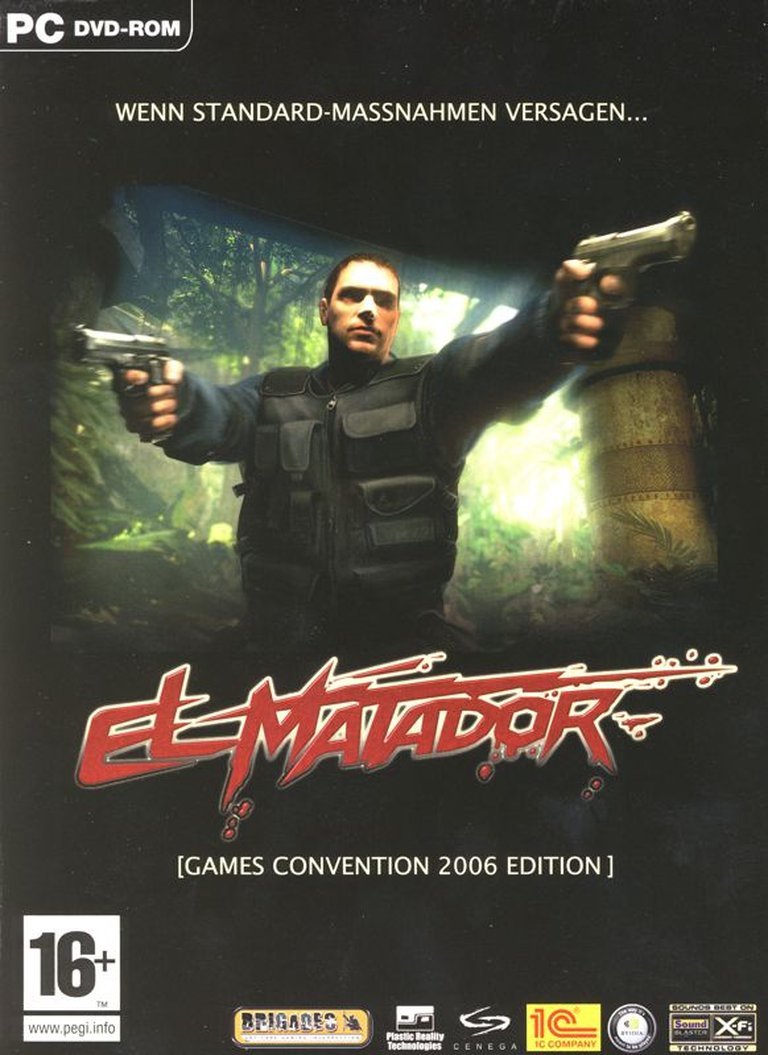
Description
El Matador (Games Convention 2006 Edition) is a third-person shooter developed by Plastic Reality Technologies, where players take on the role of DEA agent Victor Corbet in a gritty, action-packed mission to dismantle the La Valedora Cartel in Colombia. The game features intense gunfights, bullet-time mechanics, and destructible environments, all powered by the Max Payne 2 engine. This limited edition, released exclusively at the Games Convention 2006, is the uncut German version, offering a more violent and unfiltered experience compared to the later censored release.
Where to Buy El Matador (Games Convention 2006 Edition)
PC
El Matador (Games Convention 2006 Edition) Cracks & Fixes
El Matador (Games Convention 2006 Edition) Patches & Updates
El Matador (Games Convention 2006 Edition) Mods
El Matador (Games Convention 2006 Edition) Guides & Walkthroughs
El Matador (Games Convention 2006 Edition) Reviews & Reception
cultclassiccornervideogames.wordpress.com : A Direct-To-DVD feeling game with a mix of Michael Mann movies and what a 16 year old thinks a John Woo movie is.
metacritic.com (78/100): Everything about the game is over-the-top, including the story, and in our book that’s no bad thing.
ign.com (53/100): It’s been done before – and far better.
El Matador (Games Convention 2006 Edition) Cheats & Codes
PC
Press ‘~’ during gameplay to open the console, then enter one of the following codes.
| Code | Effect |
|---|---|
| health | God mode |
| ammo | Unlimited ammunition |
| rambo | Unlimited ammunition |
| weapons | All weapons |
| ninja | High jump |
| heal | Set health to 100 |
| grenades | Unknown |
| bullet_time | Unknown |
| map | Unknown |
| leki | Infinite health + infinite ammo + etc |
| normal_velocity | Set velocity to 18 km/h |
| 45 | Set velocity to 45 km/h |
| 60 | Set velocity to 60 km/h |
| cam_back | Camera mode: back |
| cam_front | Camera mode: front |
| cam_left | Camera mode: left |
| cam_right | Camera mode: right |
| cam_dist1 | Camera mode: distance 1 |
| cam_dist2 | Camera mode: distance 2 |
| 16_9 | Camera mode: 16:9 aspect ratio |
| 4_3 | Camera mode: 4:3 aspect ratio |
| normal_camera_mode_new | Stand camera |
| normal_camera_mode_new_nonintepolating | Stand camera – noninterpolating |
| shoulder_camera_mode_new | Shoulder camera mode |
| sniper_mode_new | Sniper mode |
| normal_camera_mode | Normal camera mode |
| shoulder_camera_mode | Shoulder camera mode |
| sniper_mode | Sniper mode |
| sniper_mode2 | Sniper mode 2 |
| far_camera_mode | Far camera mode |
| near_camera_mode | Near camera mode |
| close_area_camera | Close area camera |
| cam_follow | Camera follow mode |
| pop_cam | Pop camera mode |
| spectator | Spectator mode |
| spectator_off | Disable spectator mode |
| push_fps_camera | Push FPS camera mode |
| pop_fps_camera | Pop FPS camera mode |
| leki_camera | Leki camera mode |
| invert_mouse | Invert mouse |
| normal_mouse | Normal mouse |
| sneak_player_cfg | Sneak player configuration |
| render_ui_on | Render UI on |
| render_ui_off | Render UI off |
| pepe_voice_on | Enable Pepe voice |
| pepe_voice_off | Disable Pepe voice |
| facial | Play facial animation to agent |
| nofacial | Disable facial animation |
| console_rows | Console rows |
| console_rows_2 | Console rows 2 |
| boolean | Boolean |
| boolean_2 | Boolean 2 |
| boolean_3 | Boolean 3 |
| agent_log_on | Enable agent log |
| show_time | Show time |
| fps | Show FPS |
| show_ui | Show UI |
| hide_ui | Hide UI |
| kill_bodies | Kill bodies |
| kill_bitches | Kill bitches |
| autoswap_on | Enable autoswap |
| autoswap_off | Disable autoswap |
| check_subdiv | Check subdivision |
| subdiv_checking_on | Enable subdivision checking |
| subdiv_checking_off | Disable subdivision checking |
| resave_scenes | Resave scenes |
| max_fps_5 | Max FPS: 5 |
| max_fps_10 | Max FPS: 10 |
| max_fps_20 | Max FPS: 20 |
| max_fps_30 | Max FPS: 30 |
| max_fps_40 | Max FPS: 40 |
| max_fps_50 | Max FPS: 50 |
| max_fps_60 | Max FPS: 60 |
| no_fps_limit | No FPS limit |
| dump_inventory | Dump inventory |
| teleport1 | Teleport to location 1 |
| teleport2 | Teleport to location 2 |
| teleport3 | Teleport to location 3 |
| teleport4 | Teleport to location 4 |
| teleport5 | Teleport to location 5 |
| chuze | Player: Chuze |
| superman | Player: Superman |
| kota | Player: Kota |
| pidimuz | Player: Pidimuz |
El Matador (Games Convention 2006 Edition): A Rare Glimpse into a Forgotten Era of Action Shooters
Introduction: The Legend of the Uncut Matador
In the annals of gaming history, few titles embody the spirit of a bygone era quite like El Matador (Games Convention 2006 Edition). This limited-release, uncut German version of the 2006 third-person shooter is a relic of a time when physical media reigned supreme, and exclusivity was not just a marketing gimmick but a tangible rarity. With only 2,000 copies ever produced and sold exclusively at two Saturn stores in Leipzig during the Games Convention 2006, this edition stands as a testament to the game’s turbulent development, its controversial themes, and the unfiltered vision of its Czech developers, Plastic Reality Technologies.
El Matador is often dismissed as a Max Payne 2 clone—a label that, while not entirely unfair, oversimplifies its ambitions. Built on the same engine as Remedy Entertainment’s noir masterpiece, El Matador attempts to carve its own identity as a hyper-violent, pulp-inspired romp through the drug wars of Colombia. Yet, its legacy is marred by censorship, mixed reviews, and a reputation as a “direct-to-DVD” action game. The Games Convention 2006 Edition, however, offers a unique opportunity to experience the game as it was originally intended—uncensored, uncompromised, and unapologetically brutal.
This review seeks to dissect El Matador in its rawest form, exploring its development history, narrative depth, gameplay mechanics, and the cultural context that shaped its reception. By examining this rare edition, we can better understand not just the game itself, but the broader landscape of mid-2000s shooters, the challenges of game localization, and the enduring appeal of physical collectibles in an increasingly digital world.
Development History & Context: The Birth of a Controversial Shooter
The Studio Behind the Game: Plastic Reality Technologies
Plastic Reality Technologies, a Czech development studio, was no stranger to ambitious projects when it took on El Matador. Founded in the late 1990s, the studio had previously worked on titles like Korea: Forgotten Conflict and Switchfire, games that showcased their knack for military-themed action. However, El Matador represented a significant departure—a foray into the cinematic, slow-motion gunplay popularized by Max Payne.
The decision to license the Max Payne 2 engine was both pragmatic and strategic. The engine, known for its robust physics, bullet time mechanics, and atmospheric lighting, provided a solid foundation for a third-person shooter. For Plastic Reality, it was an opportunity to leverage existing technology to create a game that could compete in a crowded market. However, this choice also invited inevitable comparisons, with critics and players alike questioning whether El Matador was merely riding the coattails of Remedy’s success.
The Vision: A Gritty, Pulpy Action Thriller
El Matador was conceived as a high-octane, over-the-top action game that blended the aesthetic of Michael Mann’s crime thrillers with the exaggerated heroics of a John Woo flick. The developers aimed to create a game that was unapologetically violent, stylish, and fast-paced, with a narrative that drew inspiration from the war on drugs and the moral ambiguities of law enforcement.
The game’s protagonist, DEA agent Victor Corbet, was designed to be a quintessential action hero—tough, resourceful, and driven by a personal vendetta. The story’s setting in Colombia, with its drug cartels and corrupt officials, provided a backdrop ripe for explosive set-pieces and dramatic confrontations. The developers sought to create a game that felt like a B-movie action flick, complete with one-liners, dramatic slow-motion shootouts, and a healthy dose of cheese.
Technological Constraints and Innovations
While the Max Payne 2 engine provided a strong technical foundation, it also imposed certain limitations. The engine’s age—originally released in 2003—meant that El Matador lacked some of the graphical polish of newer titles. Textures could appear muddy, character models were somewhat stiff, and the game’s physics, while impressive for the time, occasionally led to janky ragdoll effects.
However, the engine’s strengths were undeniable. The bullet time mechanic, a hallmark of the Max Payne series, was seamlessly integrated into El Matador, allowing players to slow down time and perform acrobatic shootdodges. The game’s destructible environments, while not as extensive as those in modern shooters, added a layer of tactical depth, enabling players to blow through walls or shatter windows to gain the upper hand.
One of the most notable technical achievements was the game’s AI, which, while not groundbreaking, was competent enough to provide a challenge. Enemies would take cover, flank the player, and coordinate attacks, creating a dynamic combat experience. The game’s level design, overseen by lead designer Michael Lekovski, was similarly praiseworthy, with environments that encouraged exploration and tactical play.
The Gaming Landscape of 2006
El Matador arrived at a pivotal moment in the evolution of the shooter genre. The mid-2000s saw the rise of games like Gears of War, Call of Duty 4: Modern Warfare, and Rainbow Six: Vegas, titles that pushed the boundaries of graphical fidelity, narrative depth, and multiplayer innovation. In this context, El Matador was something of an anachronism—a single-player, story-driven shooter that relied heavily on the mechanics of a three-year-old game.
Yet, the market was not entirely inhospitable to such titles. Games like F.E.A.R. and Condemned: Criminal Origins proved that there was still an audience for atmospheric, single-player shooters with a strong narrative focus. El Matador, however, struggled to find its footing. Its lack of multiplayer, combined with its derivative gameplay and short length, made it a tough sell in an era where players increasingly expected more bang for their buck.
Censorship and the German Index
The most infamous aspect of El Matador’s development history is its troubled release in Germany. The country’s strict censorship laws, particularly those governing depictions of violence and Nazi imagery, led to significant alterations in the game’s official German release. The Games Convention 2006 Edition, however, was the uncut version, preserving the game’s original vision in all its gory, unfiltered glory.
The censored version of El Matador saw numerous changes:
– Weapon Alterations: The MP5 submachine gun was replaced with a tranquilizer gun, and other firearms were similarly modified to reduce their lethality.
– Removed Ragdoll Physics: The game’s physics engine, which allowed for realistic (and often gruesome) death animations, was disabled.
– No Corpse Shooting: Players could no longer shoot at the bodies of fallen enemies, a feature that, while morbid, was a staple of the Max Payne series.
– Blood Removal: All depictions of blood were excised, further sanitizing the game’s violence.
– Nazi References: The game’s antagonist, Helmut Koch, was a former SS officer, and all references to his Nazi past were removed in the censored version.
These changes were not merely cosmetic; they fundamentally altered the game’s tone and gameplay. The Games Convention 2006 Edition, by contrast, retained all of these elements, offering players a glimpse into the developers’ original, uncompromised vision.
The Aftermath: A Game Caught in the Crossfire
El Matador’s development was fraught with challenges, from the pressures of working with an aging engine to the complexities of navigating international censorship laws. The game’s mixed reception upon release—with critics praising its action but criticizing its lack of innovation—further compounded its struggles. Yet, the Games Convention 2006 Edition stands as a testament to the game’s potential, a rare artifact that preserves the uncut, unfiltered experience that Plastic Reality Technologies originally envisioned.
Narrative & Thematic Deep Dive: A Tale of Revenge, Corruption, and Moral Ambiguity
Plot Summary: The Rise of “El Matador”
El Matador follows the story of Victor Corbet, a DEA agent with a personal vendetta against the La Valedora Cartel, the drug syndicate responsible for the death of his brother. The game begins with Victor leading a successful raid on a nightclub owned by drug lord Alberto Entiendez, rescuing the daughter of a district attorney in the process. His success earns him a transfer to Colombia, where he joins forces with local law enforcement to dismantle the cartel.
Victor’s first major assignment in Colombia is to infiltrate a secret meeting of the La Valedora Cartel at the Hotel Paradiso in Bogotá. The meeting, hosted by a drug lord known as “El Corsario,” quickly turns into a bloodbath when the cartel ambushes Victor’s team. As the sole survivor, Victor is forced to fight his way through the hotel, ultimately killing El Corsario. His heroic actions earn him the nickname “El Matador” from his comrades, a moniker that sticks with him throughout the game.
From there, Victor’s mission takes him across Colombia, from abandoned drug factories to jungle training camps, as he systematically dismantles the cartel’s operations. Along the way, he uncovers a web of corruption that extends to the highest levels of law enforcement, culminating in a dramatic confrontation with the cartel’s leader, Helmut Koch—a former SS officer hiding in an island fortress.
The game’s climax is a tense showdown aboard a freighter, where Victor discovers that his own allies, including Captain Carlos Enterrador, have been secretly working to steal the cartel’s drug shipment for themselves. In a final act of betrayal, Victor is forced to confront Enterrador, who justifies his actions by claiming that the justice system is controlled by men even worse than the drug lords. The game ends ambiguously, with a gunshot ringing out as the screen fades to black, leaving Victor’s fate uncertain.
Themes: Revenge, Corruption, and the Cost of Justice
At its core, El Matador is a story about revenge and the moral ambiguities of the war on drugs. Victor Corbet is not a traditional hero; he is a man consumed by his desire for vengeance, willing to bend the rules and cross ethical lines to achieve his goals. This theme is reinforced by the game’s setting, which paints Colombia as a lawless land where corruption is rampant and the line between good and evil is blurred.
The game’s antagonists are not merely faceless drug lords but complex figures with their own motivations. Helmut Koch, the cartel’s leader, is a former Nazi, a detail that adds a layer of historical weight to the narrative. His presence serves as a reminder of the enduring legacy of fascism and the ways in which power and violence can persist across generations.
Perhaps the most compelling theme in El Matador is the idea that the justice system itself is corrupt. Captain Enterrador’s betrayal is not just a plot twist but a commentary on the systemic failures of law enforcement. His argument—that the men pulling the strings are worse than the drug lords—challenges the player to question the morality of Victor’s mission. Is he truly fighting for justice, or is he merely a pawn in a larger, more sinister game?
Characters: Archetypes and Stereotypes
El Matador’s characters are, for the most part, archetypal action heroes and villains. Victor Corbet is the quintessential lone wolf, a tough-as-nails DEA agent with a personal vendetta. His allies—Captain Carlos Enterrador, ADA Mia Rodriguez, Sergeant Gabriel Montego, and Ricardo “Rico” Altemetra—are similarly one-dimensional, each fulfilling a specific role in the narrative.
- Victor Corbet: The protagonist, Victor is a classic action hero—stoic, determined, and unyielding in his pursuit of justice. His backstory, which involves the death of his brother at the hands of the cartel, provides motivation for his actions, but his character lacks depth beyond this basic premise.
- Captain Carlos Enterrador: The leader of the local police force, Enterrador is initially presented as a tough but fair commander. However, his true nature is revealed in the game’s climax, where he is exposed as a corrupt official seeking to profit from the drug trade.
- Mia Rodriguez: The game’s lone female character, Mia serves as Victor’s ally and love interest. Her role is largely peripheral, and she is given little agency or development beyond her function as a plot device.
- Ricardo “Rico” Altemetra: Victor’s closest friend and ally, Rico is a loyal and capable officer. His death at the hands of Montego serves as a catalyst for the game’s final act, but like the other characters, he is underdeveloped.
- Helmut Koch: The game’s primary antagonist, Koch is a former SS officer who has reinvented himself as a drug lord. His Nazi past adds a layer of historical context to the narrative, but his character is ultimately one-dimensional, serving as little more than a symbol of evil.
The game’s dialogue is similarly archetypal, filled with cheesy one-liners and over-the-top declarations of vengeance. Lines like “I need to shoot some scum” and “And knowing is half the battle!” (a nod to the G.I. Joe PSA) underscore the game’s B-movie sensibilities. While this approach may not appeal to players seeking a more nuanced narrative, it fits well with the game’s pulp-inspired aesthetic.
Narrative Strengths and Weaknesses
El Matador’s narrative is, at its best, a fast-paced, action-packed thriller that keeps players engaged with its constant stream of set-pieces and betrayals. The game’s pacing is brisk, with each mission introducing new challenges and revelations. The story’s twists—particularly the revelation of Enterrador’s corruption—are effective, if not entirely surprising.
However, the game’s narrative is also hampered by its lack of depth. The characters are thinly drawn, and the dialogue often feels stilted and unnatural. The game’s attempt to tackle themes of corruption and moral ambiguity is admirable, but it ultimately falls short due to its reliance on stereotypes and clichés.
Despite these flaws, El Matador’s story is undeniably entertaining. It embraces its B-movie roots, delivering a narrative that is equal parts ridiculous and thrilling. For players who approach the game with the right expectations—namely, that it is a pulp action flick in video game form—El Matador delivers a satisfying, if not groundbreaking, experience.
Gameplay Mechanics & Systems: A Familiar Yet Flawed Experience
Core Gameplay Loop: Shoot, Dodge, Repeat
El Matador’s gameplay is heavily indebted to the Max Payne series, and this influence is evident in nearly every aspect of its design. The game is a third-person shooter that emphasizes stylish, slow-motion gunplay, with a heavy focus on bullet time mechanics and acrobatic shootdodges. Players take on the role of Victor Corbet, navigating a series of linear levels filled with enemies, cover points, and environmental hazards.
The core gameplay loop revolves around engaging in firefights, using bullet time to gain the upper hand, and progressing through the level by overcoming scripted encounters. The game’s missions are varied, ranging from stealthy infiltration sequences to all-out assaults on cartel strongholds. Each level is designed to encourage tactical play, with multiple paths and cover points that allow players to approach encounters in different ways.
Combat: Bullet Time and Dual-Wielding
The game’s combat system is its strongest feature, offering a satisfying blend of tactical depth and over-the-top action. The bullet time mechanic, lifted directly from Max Payne, allows players to slow down time and perform precise shots or evasive maneuvers. This feature is essential for surviving the game’s more challenging encounters, as it gives players the opportunity to thin out enemy ranks before they can overwhelm the player.
In addition to bullet time, El Matador allows players to dual-wield weapons, a feature that adds a layer of chaos and excitement to the combat. The game’s arsenal includes a variety of firearms, from pistols and submachine guns to shotguns and assault rifles. Each weapon has its own strengths and weaknesses, encouraging players to experiment with different loadouts.
The game’s physics engine also plays a role in combat, allowing for environmental interactions that can turn the tide of battle. Players can shoot through walls, shatter windows, and even use explosives to create new paths or eliminate enemies. These mechanics, while not as robust as those in modern shooters, add a layer of tactical depth that keeps the combat engaging.
Character Progression: A Missed Opportunity
One of the most notable weaknesses of El Matador’s gameplay is its lack of meaningful character progression. Unlike many modern shooters, which feature extensive skill trees and upgrade systems, El Matador offers little in the way of player customization. Victor Corbet’s abilities remain largely static throughout the game, with the only form of progression coming from unlocking new weapons.
This lack of depth is particularly evident in the game’s boss battles, which are among its weakest elements. The bosses in El Matador are little more than bullet sponges—enemies with inflated health bars and slightly more aggressive AI. These encounters lack the creativity and spectacle of the game’s regular combat, often devolving into tedious slugfests that test the player’s patience rather than their skill.
UI and Controls: Functional but Uninspired
The game’s user interface is functional but unremarkable, with a straightforward HUD that displays health, ammo, and bullet time meters. The controls are similarly adequate, with a standard keyboard-and-mouse setup that will be familiar to fans of third-person shooters. However, the game’s lack of controller support—a notable omission for a 2006 title—limits its accessibility for players who prefer gamepads.
One of the more frustrating aspects of the UI is the lack of a proper tutorial. The game’s bullet time mechanic, for example, is not explained in any meaningful way, leaving players to discover its existence through trial and error. This oversight is particularly egregious given the mechanic’s central role in the gameplay.
Innovative or Flawed Systems?
El Matador’s gameplay is a mixed bag of borrowed mechanics and missed opportunities. On the one hand, the game’s combat is undeniably fun, with a satisfying blend of tactical play and over-the-top action. The bullet time mechanic, in particular, is a highlight, offering a level of spectacle that few games of the era could match.
On the other hand, the game’s lack of innovation is glaring. Nearly every aspect of its design—from its combat mechanics to its level structure—feels like a retread of ideas that had already been explored in Max Payne and other shooters. The game’s short length (roughly 2-3 hours for a skilled player) further exacerbates this issue, leaving players with the impression that El Matador is little more than a budget knockoff of its inspirations.
Despite these flaws, El Matador is not without its charms. The game’s pacing is tight, with each mission offering a new challenge or set-piece. The level design is competent, with environments that encourage exploration and tactical play. And while the boss battles are lackluster, the regular combat encounters are generally well-balanced and engaging.
Ultimately, El Matador’s gameplay is a testament to the strengths and limitations of its engine. The Max Payne 2 engine provides a solid foundation for a third-person shooter, but Plastic Reality Technologies’ lack of innovation prevents the game from rising above its influences. For players who approach El Matador as a budget action game—a “direct-to-DVD” shooter in video game form—the experience is enjoyable, if not groundbreaking.
World-Building, Art & Sound: Crafting a Gritty, Pulpy Aesthetic
Setting and Atmosphere: Colombia as a Character
El Matador’s setting is one of its strongest assets, with a vividly realized depiction of Colombia that serves as both a backdrop and a character in its own right. The game takes players through a variety of locations, from the neon-lit streets of Bogotá to the dense jungles of the Colombian countryside. Each environment is designed to evoke a sense of place, with detailed textures, atmospheric lighting, and environmental storytelling that immerses players in the world.
The game’s depiction of Colombia is not merely aesthetic; it is integral to the narrative. The country’s reputation as a hotbed of drug trafficking and political corruption is woven into the game’s themes, with the La Valedora Cartel serving as a stand-in for the real-world drug lords who have plagued the region. The game’s levels reflect this reality, with locations ranging from cartel-controlled nightclubs to abandoned drug factories and jungle training camps.
Visual Direction: A Mix of Grit and Style
El Matador’s visual style is a blend of gritty realism and pulp-inspired exaggeration. The game’s character models are detailed, with facial animations that convey emotion and personality. The environments, while occasionally repetitive, are richly textured, with a level of detail that belies the game’s budget constraints.
The game’s use of lighting is particularly effective, with dynamic shadows and atmospheric effects that enhance the sense of immersion. The bullet time mechanic is visually stunning, with slow-motion effects that highlight the chaos of combat. Explosions, muzzle flashes, and particle effects are all rendered with a level of polish that makes the game’s action sequences feel cinematic.
However, El Matador’s visuals are not without their flaws. The game’s textures can appear muddy, particularly in outdoor environments, and the character models occasionally suffer from stiff animations. The game’s physics engine, while impressive for the time, can lead to janky ragdoll effects that detract from the overall experience.
Sound Design: A Pulse-Pounding Soundtrack
The game’s sound design is a standout feature, with a pulse-pounding soundtrack that complements the action. The music, composed by Tomas Hubacek and Michal Szlávik, is a mix of electronic and orchestral tracks that evoke the tension and excitement of the game’s set-pieces. The soundtrack is dynamic, shifting in intensity to match the on-screen action, and it plays a crucial role in maintaining the game’s pacing.
The sound effects are similarly well-executed, with realistic gunfire, explosions, and environmental sounds that enhance the sense of immersion. The game’s voice acting, while occasionally stilted, is competent, with performances that convey the game’s over-the-top tone. The dialogue, while cheesy, is delivered with a level of enthusiasm that fits well with the game’s B-movie aesthetic.
Contributions to the Overall Experience
El Matador’s world-building, art, and sound design all contribute to its status as a pulp-inspired action thriller. The game’s setting, visuals, and soundtrack work together to create a cohesive aesthetic that immerses players in its world. While the game’s technical limitations are evident, its strengths in these areas help to elevate the overall experience, making El Matador a memorable, if flawed, entry in the third-person shooter genre.
Reception & Legacy: A Mixed Bag of Praise and Criticism
Critical Reception: “Mixed or Average”
El Matador’s reception upon release was decidedly mixed, with critics praising its action-packed gameplay but criticizing its lack of innovation and short length. The game holds a Metacritic score of 54/100, indicating “mixed or average” reviews. Critics were divided on the game’s merits, with some hailing it as a fun, if derivative, shooter, while others dismissed it as a shallow Max Payne clone.
Positive reviews highlighted the game’s fast-paced combat, satisfying bullet time mechanics, and engaging set-pieces. Critics at Jolt Online Gaming UK and GamingExcellence praised the game’s over-the-top action and cinematic presentation, with the former declaring, “Everything about the game is over-the-top, including the story, and in our book that’s no bad thing.” Similarly, RewiredMind noted that the game’s fun factor was difficult to pin down, but ultimately enjoyable.
Negative reviews, however, focused on the game’s lack of originality and technical shortcomings. Eurogamer and PC Zone criticized the game’s derivative gameplay, with the latter calling it “a run-of-the-mill shooter with nothing new to offer.” IGN’s Mark Birnbaum summed up the general consensus with his verdict: “It’s been done before—and far better.”
Commercial Performance: A Budget Title in a Crowded Market
El Matador’s commercial performance was similarly underwhelming. Released in an era dominated by blockbuster shooters like Gears of War and Call of Duty 4, the game struggled to find an audience. Its lack of multiplayer, combined with its short length and derivative gameplay, made it a tough sell for players who expected more from their shooters.
The game’s budget pricing—often available for as little as $1 during sales—reflected its status as a lower-tier title. While this made it accessible to a wider audience, it also reinforced the perception that El Matador was a “direct-to-DVD” game, lacking the polish and depth of its more expensive counterparts.
Legacy: A Cult Classic or a Forgotten Relic?
In the years since its release, El Matador has developed a modest cult following, particularly among fans of pulp action games and collectors of rare physical media. The Games Convention 2006 Edition, with its uncut content and limited availability, has become a sought-after item, fetching high prices on the secondary market.
The game’s legacy is also tied to its status as one of the few titles to use the Max Payne 2 engine. While this connection has led to comparisons with Remedy’s masterpiece, it has also ensured that El Matador remains a footnote in the history of third-person shooters. The game’s influence on subsequent titles is minimal, but its existence serves as a reminder of the challenges faced by mid-tier developers in an increasingly competitive market.
Influence on Subsequent Games
El Matador’s impact on the shooter genre is negligible, but its development history offers valuable lessons for future game creators. The game’s struggles with censorship, particularly in Germany, highlight the challenges of navigating international content regulations. Its mixed reception underscores the importance of innovation in a genre that is constantly evolving.
Perhaps the most enduring lesson from El Matador is the value of embracing one’s influences while striving to carve out a unique identity. While the game’s derivative gameplay and lack of originality were criticized, its pulp-inspired aesthetic and over-the-top action resonated with a niche audience. For developers working with limited resources, El Matador serves as a case study in the importance of playing to one’s strengths while acknowledging one’s limitations.
Conclusion: A Flawed but Fascinating Artifact of Gaming History
El Matador (Games Convention 2006 Edition) is a game that defies easy categorization. It is simultaneously a derivative Max Payne clone and a unique artifact of its time, a pulp-inspired action thriller that embraces its B-movie roots while struggling to rise above its influences. Its uncut German edition, with its preserved violence and Nazi references, offers a rare glimpse into the developers’ original vision, unfiltered by the constraints of censorship.
The game’s strengths—its fast-paced combat, satisfying bullet time mechanics, and vividly realized setting—are undeniable. Yet, its weaknesses—its lack of innovation, underdeveloped characters, and short length—are equally apparent. For players who approach El Matador with the right expectations, it is a fun, if flawed, experience, a “direct-to-DVD” shooter that delivers on its promise of over-the-top action.
In the broader context of gaming history, El Matador serves as a reminder of the challenges faced by mid-tier developers in the mid-2000s. Caught between the rising expectations of players and the limitations of aging technology, the game struggled to find its footing in a market dominated by blockbuster titles. Yet, its existence as a physical collectible—a rare, uncut edition sold exclusively at a gaming convention—ensures its place in the annals of gaming history.
Ultimately, El Matador (Games Convention 2006 Edition) is a game that is best appreciated by collectors and fans of pulp action. It is not a masterpiece, nor is it a forgotten gem. Instead, it is a fascinating artifact, a snapshot of a moment in time when the shooter genre was evolving, and developers were grappling with the challenges of creating something new in a sea of familiarity. For those willing to look past its flaws, El Matador offers a glimpse into a world of unfiltered violence, cheesy one-liners, and over-the-top action—a world that, for better or worse, is uniquely its own.
Final Verdict: 6.5/10 – A Flawed but Fun Relic of a Bygone Era