
- Release Year: 2009
- Platforms: Windows
- Publisher: Kalypso Media Digital Ltd., Kalypso Media GmbH
- Genre: Compilation
- Game Mode: Single-player
- Average Score: 82/100
Description
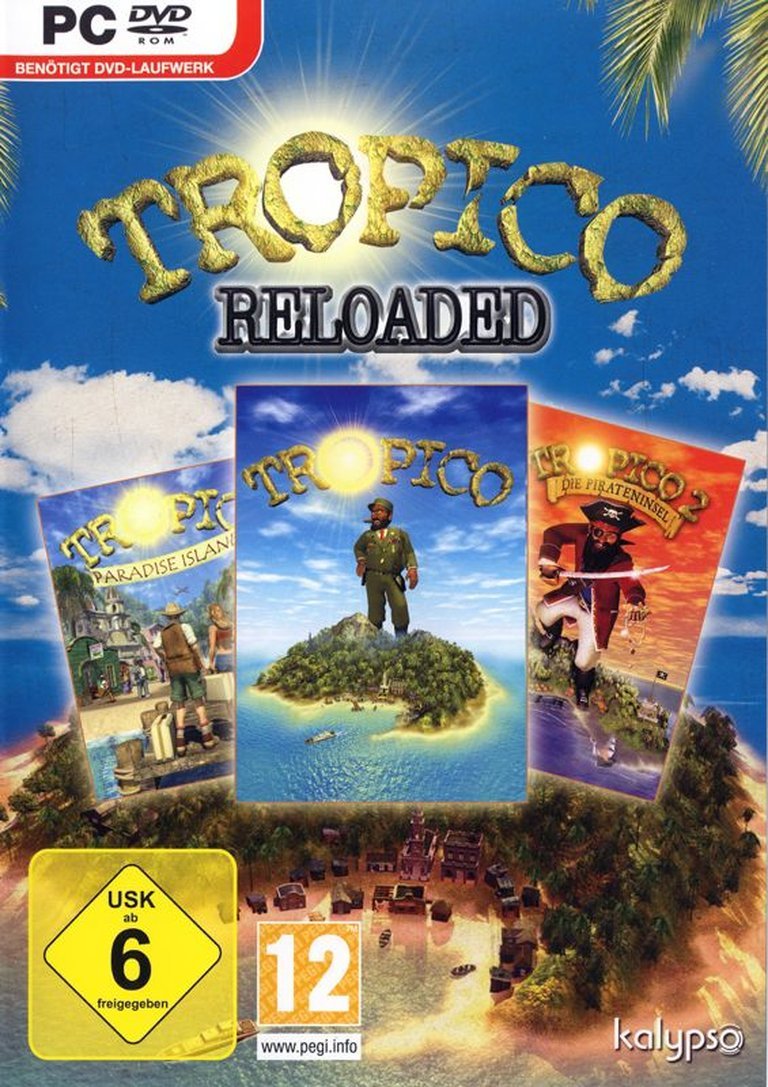
Tropico: Reloaded is a compilation that bundles three classic simulation games—Tropico, Tropico: Paradise Island, and Tropico 2: Pirate Cove—into one package. Set in a fictional Caribbean island during the Cold War era, the games task players with ruling as ‘El Presidente,’ balancing political intrigue, economic management, and social dynamics in a satirical take on banana republic governance. With humor and strategy, players navigate challenges like electoral fraud, superpower interventions, and island development while keeping their populace content to retain power.
Gameplay Videos
Where to Buy Tropico: Reloaded
Tropico: Reloaded Cracks & Fixes
Tropico: Reloaded Guides & Walkthroughs
Tropico: Reloaded Reviews & Reception
steambase.io (88/100): A triumphant return to form for the series.
metacritic.com (78/100): Generally Favorable based on user ratings.
niklasnotes.com (87/100): Celebrated for its nostalgic charm, humor, and addictive gameplay, though criticized for aging graphics and clunky controls.
mobygames.com (80/100): Average score: 4.0 out of 5 based on player ratings.
steamscore.io (80/100): Tropico Reloaded has an 8/10 rating.
Tropico: Reloaded Cheats & Codes
PC – Windows
Hold down the CTRL key and type the following codes during gameplay.
| Code | Effect |
|---|---|
| contento | Increase Happiness by 10 points |
| pesos | Add $20,000 to treasury |
| rapido | Toggle instant building on/off |
| exacto # | Set treasury to specified amount |
| muerte | Kill selected unit |
| respecto | Chop down all trees |
| economicdifficulty | Change economic difficulty level |
| politicaldifficulty | Change political difficulty level |
| rateddifficulty | Change map difficulty rating |
| removepeople | Remove all people from map |
| onemonth | Advance date by one month |
| sixmonths | Advance date by six months |
| oneyear | Advance date by one year |
| fiveyears | Advance date by five years |
| tenyears | Advance date by ten years |
| twentyyears | Advance date by twenty years |
| thirtyyears | Advance date by thirty years |
| editor | Toggle map editor on/off |
| importmap | Import map from PCX format image |
| respeto | Adds 5 respect in all factions (disappears next month) |
Tropico: Reloaded: A Comprehensive Retrospective on a Dictator’s Playground
Introduction: The Banana Republic Simulator That Stood the Test of Time
Few games capture the dark humor and political satire of ruling a Caribbean island quite like Tropico: Reloaded. Released in 2009, this compilation bundles three seminal titles—Tropico (2001), Tropico: Paradise Island (2002), and Tropico 2: Pirate Cove (2003)—into a single package, offering players the chance to step into the shoes of El Presidente, a dictator balancing power, economics, and the whims of a restless populace. Developed by PopTop Software and published by Kalypso Media, Tropico: Reloaded is more than just a re-release; it’s a time capsule of early 2000s simulation gaming, blending city-building mechanics with sharp political commentary and tongue-in-cheek humor.
This review will dissect Tropico: Reloaded from every angle—its development history, narrative depth, gameplay systems, artistic direction, and lasting legacy. We’ll explore why it remains a beloved classic despite its age, and how its unique blend of satire, strategy, and simulation continues to resonate with players nearly two decades later.
Development History & Context: The Birth of a Banana Republic Simulator
The Vision Behind Tropico
The original Tropico was conceived by PopTop Software, a studio known for Railroad Tycoon II. The team, led by designer Phil Steinmeyer and artist Franz Felsl, sought to create a city-building game that diverged from the SimCity and Civilization formulas. As Steinmeyer noted in his development diary, Inside the Sausage Factory, the goal was to craft a game where “building a prosperous country in and of itself is not enough—you’ve got to bribe your generals and repress your dissidents to avoid a coup-d’etat or a mass uprising.” This vision was radical for its time, blending urban planning with political intrigue in a way few games had attempted.
The game’s development took 23 months, with a team of just ten people—seven artists and three programmers. The Latin American setting was chosen for its rich political and cultural backdrop, allowing the game to tackle themes like totalitarianism, electoral fraud, and Cold War interventions with a satirical edge. The inclusion of real-life figures like Fidel Castro and Che Guevara, alongside fictional leaders and even pop musician Lou Bega (of Mambo No. 5 fame), added a layer of absurdity that set Tropico apart from its peers.
The Gaming Landscape of the Early 2000s
When Tropico launched in April 2001, the gaming world was dominated by titles like The Sims, Civilization III, and Age of Empires II. City-builders and strategy games were thriving, but few dared to inject humor and political satire into the genre. Tropico’s release was met with critical acclaim, praised for its originality and depth. It sold over 67,000 copies in the U.S. within its first six months and eventually surpassed 1 million copies worldwide by 2007.
The expansion, Tropico: Paradise Island, arrived in 2002, adding new buildings, edicts, and tourism mechanics. It also served as a patch, fixing bugs and improving quality-of-life features like building rotation and faster construction. Tropico 2: Pirate Cove, developed by Frog City Software, took a different approach, shifting the setting to a 17th-century pirate den. While it retained the series’ humor, it strayed from the political satire that defined the original.
The Reloaded Compilation
By 2009, the Tropico series had lain dormant for years. Kalypso Media, recognizing the franchise’s potential, acquired the rights from Take-Two Interactive and released Tropico: Reloaded as a budget-friendly compilation. This move was strategic—it reintroduced the series to a new generation of players while capitalizing on nostalgia. The compilation’s release coincided with the announcement of Tropico 3, which would modernize the series with 3D graphics and console support.
Narrative & Thematic Deep Dive: Satire, Power, and the Art of Dictatorship
The Plot: A Dictator’s Rise and Fall
Tropico’s narrative is less about a linear story and more about the player’s journey as El Presidente. The game drops you into a fictional Caribbean island during the Cold War, where you must navigate the complexities of ruling a banana republic. Your goal? Stay in power by any means necessary—whether through benevolent leadership, brutal repression, or cunning manipulation.
The game’s scenarios and custom campaigns frame this narrative. Some missions task you with specific objectives, like surviving a rebellion or appeasing foreign powers, while others let you shape your own destiny. The writing is sharp, filled with witty dialogue and exaggerated stereotypes that lampoon real-world politics. For example, the United States and Soviet Union act as meddling superpowers, offering aid or launching invasions based on your alignment. The United Fruit Company (a thinly veiled reference to real-life corporate exploitation) exerts its own influence, demanding favorable trade deals.
Themes: Power, Corruption, and Satire
Tropico is a masterclass in political satire. It doesn’t just simulate governance—it critiques it. The game explores themes like:
– The Illusion of Democracy: Players can hold elections, but rigging them is often easier (and more entertaining). The game’s “democracy expectations vs. democracy results” mechanic highlights the disconnect between rhetoric and reality.
– Economic Exploitation: The island’s economy relies on exports like bananas, tobacco, and rum, mirroring the real-world exploitation of developing nations by global powers.
– Military Rule vs. Populism: Do you rule with an iron fist, risking coups and rebellions, or do you pander to factions, risking economic collapse? The game forces players to confront these moral dilemmas.
– Foreign Intervention: The U.S. and USSR are ever-present threats, ready to invade if you displease them. This reflects Cold War-era geopolitics, where smaller nations were often pawns in superpower struggles.
Characters and Factions: The Puppeteers of Tropico
The game’s factions are its lifeblood, each with distinct agendas:
– Communists: Demand housing, healthcare, and pro-Soviet policies.
– Capitalists: Want luxury goods, low taxes, and pro-American policies.
– Religious: Seek moral purity, often at the expense of liberty (e.g., banning birth control or books).
– Militarists: Crave a strong army and will coup you if neglected.
– Intellectuals: Value education and freedom, making them a thorn in authoritarian regimes.
– Environmentalists: Oppose industry and pollution, often clashing with capitalists.
Each faction’s leader can be bribed, imprisoned, or assassinated, adding layers of political maneuvering. The game’s humor shines in its edicts—like the “Book BBQ” (burning literature to appease the religious) or “Prohibition” (banning alcohol, much to the chagrin of tourists).
Gameplay Mechanics & Systems: The Art of Balancing a Banana Republic
Core Gameplay Loop: Build, Manage, Survive
Tropico’s gameplay revolves around three pillars:
1. Economic Management: Build farms, factories, and tourist attractions to generate income. Balance budgets, set taxes, and trade with foreign powers.
2. Political Manipulation: Keep factions happy through edicts, propaganda, and occasional repression. Hold elections (or rig them) to maintain legitimacy.
3. Military Control: Train soldiers, build forts, and suppress rebellions. A weak military risks coups; a strong one risks tyranny.
The game’s scenarios and custom modes offer different challenges. Scenarios have predefined goals (e.g., survive 20 years without a coup), while custom games let you tweak difficulty, island size, and victory conditions.
Combat and Conflict: Rebels, Coups, and Invasions
Conflict in Tropico is asymmetrical. Rebels emerge from dissatisfied citizens, attacking buildings and spreading unrest. If left unchecked, they’ll storm your palace. The military can stage coups if underpaid or undermanned. Foreign powers may invade if you align too closely with their rivals.
Combat is simple—soldiers vs. rebels—but the tension lies in prevention. Do you invest in police stations to quell dissent? Build prisons to imprison troublemakers? Or bribe faction leaders to keep them loyal? The game’s lack of direct combat focus (unlike Civilization or Age of Empires) makes these political decisions all the more critical.
Character Progression: The Rise of El Presidente
Before starting a game, you design El Presidente, choosing traits, background, and even appearance. Traits like “Charismatic” or “Corrupt” affect faction relations and gameplay. For example, a corrupt leader might embezzle more funds but face higher rebellion risks.
Your Swiss bank account—where you stash retirement funds—serves as a secondary victory condition. The more you siphon, the richer you become, but at the cost of public happiness. This mechanic reinforces the game’s themes of greed and exploitation.
UI and Innovation: A Product of Its Time
Tropico’s UI is functional but dated. The isometric view, while charming, can be clunky for modern players. Building placement requires precision, and the lack of modern QOL features (like undo buttons) can frustrate. However, the game’s depth compensates for its rough edges.
Innovations like the edict system (e.g., “Martial Law,” “Tax Holiday”) and faction dynamics were groundbreaking. The ability to rotate buildings (added in Paradise Island) and the random map generator added replayability.
World-Building, Art & Sound: The Aesthetic of a Caribbean Dictatorship
Visual Design: A Vibrant, Satirical Caribbean
Tropico’s art style is a mix of cartoonish charm and political caricature. The island’s lush landscapes, colonial architecture, and exaggerated character designs reinforce its satirical tone. The Presidential Palace, modeled after Cuba’s Palacio de Valle, is a standout, oozing with dictatorial opulence.
The game’s isometric perspective, while limiting, allows for detailed environments. Cities feel alive, with citizens commuting to work, protesting, or lounging at beaches. The visuals hold up surprisingly well, thanks to their stylized approach.
Sound and Music: A Latin-Inspired Masterpiece
Daniel Indart’s soundtrack is a highlight, blending Latin rhythms, Caribbean beats, and orchestral flourishes. Tracks like “Tropico Theme” and “Banana Republic” evoke the island’s vibe while reinforcing the game’s satirical edge. The music won multiple awards, including the Outstanding Achievement in Original Musical Composition at the 5th Annual Interactive Achievement Awards.
Sound effects—from protest chants to gunfire—add immersion. The voice acting, though minimal, is memorable, with El Presidente’s exaggerated accent and bombastic speeches.
Reception & Legacy: From Cult Classic to Enduring Franchise
Critical and Commercial Success
Tropico was a hit, praised for its humor, depth, and innovation. Critics lauded its satire and gameplay, though some found it slow-paced. Game Informer called it “an absolute must-have for anyone who found anything from SimCity to Zeus even moderately interesting.” The expansion, Paradise Island, received similar acclaim, with reviewers appreciating its new content and fixes.
Commercially, the game sold over 1 million copies, cementing its place as a cult classic. Tropico 2: Pirate Cove was less successful, criticized for straying from the original’s formula.
Evolution of the Franchise
Tropico: Reloaded’s release in 2009 was a strategic move by Kalypso Media, setting the stage for Tropico 3’s modernized take. Subsequent entries (Tropico 4, 5, 6) refined the formula, adding 3D graphics, new mechanics, and expanded diplomacy. However, none captured the raw charm of the original.
The series’ legacy is undeniable. It inspired games like Banished and Cities: Skylines (in terms of political simulation) and remains a benchmark for satirical city-builders.
Conclusion: A Timeless Satire That Still Resonates
Tropico: Reloaded is more than a compilation—it’s a testament to the power of satire in gaming. Its blend of city-building, political intrigue, and humor remains unmatched, even as modern titles offer shinier graphics and deeper mechanics. The game’s themes—corruption, foreign intervention, and the illusion of democracy—are as relevant today as they were in 2001.
While its age shows in clunky controls and dated UI, Tropico: Reloaded’s heart and soul endure. It’s a game that rewards patience, cunning, and a dark sense of humor. For fans of strategy, simulation, and political satire, it’s an essential experience—one that proves great gameplay, like a good dictatorship, never truly fades away.
Final Verdict: 9/10 – A Masterpiece of Satirical Strategy
Tropico: Reloaded isn’t just a relic; it’s a reminder of how games can entertain, educate, and critique—all while letting you build a paradise (or a prison) of your own design. Long live El Presidente.