
- Release Year: 2001
- Platforms: Windows
- Publisher: EMME Interactive SA, Global Software Publishing Ltd.
- Developer: Hyptique
- Genre: Educational, Pre-school, toddler
- Perspective: Third-person
- Game Mode: Single-player
- Gameplay: Color correction, Mini-games
- Setting: Fantasy
- Average Score: 60/100
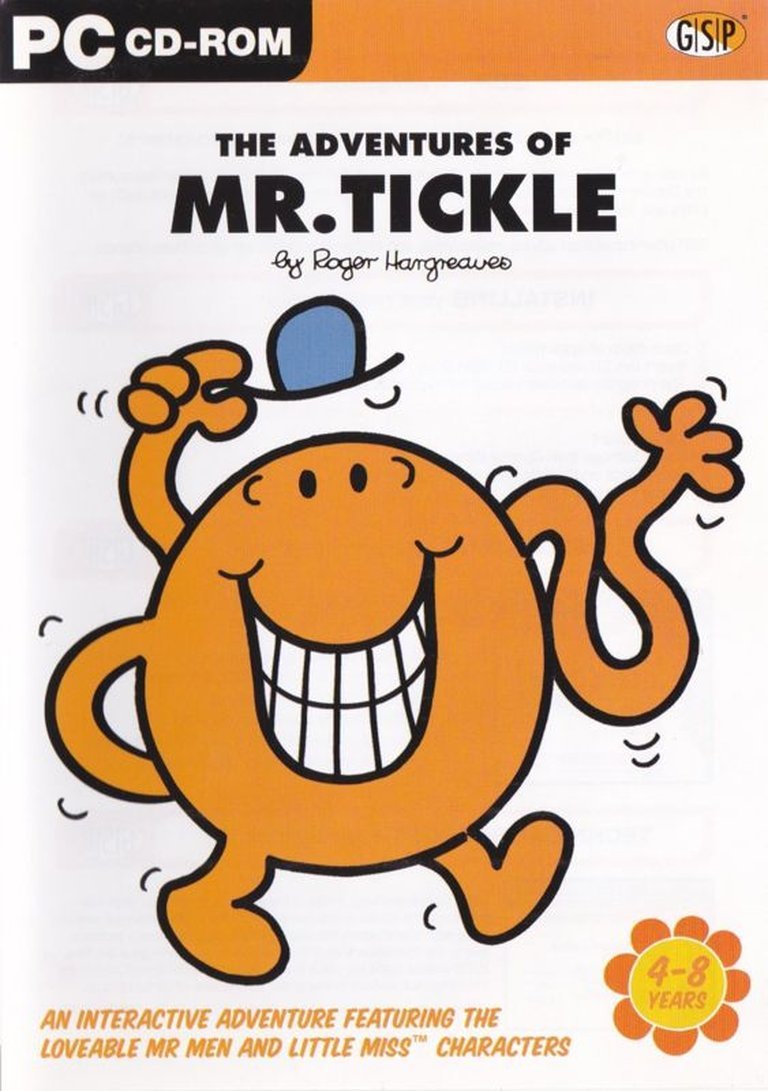
Description
The Adventures of Mr. Tickle is an educational platform game for young children, featuring the beloved Mr. Men and Little Miss characters. The game follows Mr. Tickle and his friends as they investigate strange occurrences in their world, such as mixed-up colors and animals speaking different languages. Players engage in a series of mini-games, including coloring objects and solving puzzles, to restore order and uncover the mystery behind the chaos.
Gameplay Videos
The Adventures of Mr. Tickle Free Download
The Adventures of Mr. Tickle Reviews & Reception
mobygames.com (36/100): Players Average score: 1.8 out of 5
myabandonware.com (84/100): I’m so glad to play this game that I played as a kid and prove that the Mr Men and Little Miss Song that’s burned in my memory was real!
retro-replay.com : The Adventures of Mr. Tickle offers a delightful suite of mini-games designed to entertain and educate young players.
The Adventures of Mr. Tickle: A Whimsical Journey Through Chaos and Color
Introduction: A Tickle of Nostalgia and Discovery
In the vast, often overlooked landscape of early 2000s educational gaming, The Adventures of Mr. Tickle (2001) stands as a charming relic—a digital playground where the beloved Mr. Men and Little Miss characters leap from the pages of Roger Hargreaves’ iconic books into a world of interactive chaos. Developed by Hyptique and published by EMME Interactive SA and Global Software Publishing Ltd., this Windows-exclusive title is a delightful anomaly: a game that embraces absurdity as its core mechanic, wrapping it in the warm, pastel embrace of preschool-friendly design.
At its heart, The Adventures of Mr. Tickle is a game about restoration. The premise is as simple as it is surreal: one day, the world of Mr. Tickle and his friends awakens to find itself in disarray. Colors are scrambled—trees glow purple, sheep sport polka dots, and the sun has lost its golden hue. Birds moo like cows, cows chirp in Chinese, and the very fabric of reality seems to have been tickled into disorientation. It’s a premise that feels like a fever dream concocted by a child’s imagination, and that’s precisely its genius. The game doesn’t just teach; it invites—into a world where the rules of logic are bent, but never broken, and where every absurdity is an opportunity for discovery.
This review aims to dissect The Adventures of Mr. Tickle with the rigor it deserves, exploring its development, narrative quirks, gameplay mechanics, and the indelible mark it left on the landscape of early childhood edutainment. Far from being a mere footnote in gaming history, this title is a testament to the power of simplicity, the importance of accessibility, and the enduring appeal of characters who feel like old friends.
Development History & Context: Crafting Chaos for Little Hands
The Studio and the License
Hyptique, the French development studio behind The Adventures of Mr. Tickle, was no stranger to the world of licensed educational games. By the early 2000s, the studio had carved a niche for itself in creating interactive experiences tailored for young children, often leveraging beloved intellectual properties to ensure instant recognition and appeal. The Mr. Men and Little Miss series, created by Roger Hargreaves in the 1970s, was a natural fit. With its bright colors, simple shapes, and universally relatable characters, the franchise had already transcended its literary roots, appearing in animated series, merchandise, and, by the turn of the millennium, digital media.
The involvement of Adam Hargreaves, Roger’s son and the steward of the Mr. Men legacy, ensured that the game remained faithful to the spirit of the original books. Under his supervision, the development team at Hyptique—led by art directors Michaël Douaud and Mikaël Cixous—crafted a visual style that mirrored the hand-drawn charm of Hargreaves’ illustrations. The result is a game that feels like a living storybook, where every character and environment is rendered with the same round, friendly lines that defined the source material.
Technological Constraints and Design Philosophy
Released in 2001, The Adventures of Mr. Tickle was a product of its time, constrained by the technological limitations of early Windows-based educational software. The game ran on CD-ROM, a medium that was rapidly becoming the standard for multimedia experiences but still posed challenges in terms of storage and performance. The development team had to balance rich visuals and audio with the need for smooth, lag-free gameplay—a critical consideration for an audience with limited patience for technical hiccups.
The game’s design philosophy was rooted in accessibility. The input scheme was deliberately simplified, relying almost entirely on mouse-based interactions. This was a conscious decision to accommodate the motor skills of preschoolers, who might struggle with more complex control schemes. The absence of keyboard commands or intricate button combinations ensured that even the youngest players could navigate the game’s world with minimal frustration.
The Gaming Landscape of 2001
The early 2000s were a golden age for educational gaming, particularly on the PC. Titles like Reader Rabbit, JumpStart, and The ClueFinders dominated the market, offering a blend of entertainment and learning that appealed to parents and children alike. The Adventures of Mr. Tickle entered this crowded field with a unique selling point: its reliance on the Mr. Men license, which gave it an instant advantage in terms of brand recognition.
However, the game’s true innovation lay in its embrace of absurdity as a teaching tool. While many educational games of the era focused on rote learning—math drills, spelling tests, and memory games—The Adventures of Mr. Tickle took a different approach. It used humor and surrealism to engage young minds, turning the act of learning into a playful, almost subversive experience. In a market saturated with serious-minded edutainment, Mr. Tickle dared to be silly, and that silliness became its greatest strength.
Narrative & Thematic Deep Dive: The World Turned Upside Down
Plot: A Mystery of Mixed-Up Reality
The narrative of The Adventures of Mr. Tickle is deceptively simple. The game opens with Mr. Tickle and his friends—including familiar faces like Little Miss Sunshine and Mr. Bump—awakening to a world that has gone topsy-turvy. Colors are wrong: trees are purple, sheep are striped, and the sun has turned a sickly shade of green. Animals are behaving oddly: birds moo, cows chirp in Chinese, and the entire ecosystem seems to have been thrown into disarray. The premise is never explained in explicit terms, nor does it need to be. The game’s narrative thrives on its own absurdity, inviting players to accept the chaos and take joy in restoring order.
The lack of a traditional villain or overarching conflict is notable. There is no malevolent force behind the world’s disarray, no dark wizard or mischievous gremlin to blame. Instead, the game presents the chaos as a natural, almost whimsical occurrence—a temporary glitch in the universe that Mr. Tickle and his friends are uniquely equipped to fix. This narrative choice reinforces the game’s themes of curiosity and problem-solving. The world isn’t broken because of malice; it’s broken because it’s funny, and fixing it is just as enjoyable.
Characters: Familiar Faces in Unfamiliar Circumstances
The cast of The Adventures of Mr. Tickle is drawn directly from the Mr. Men and Little Miss series, with each character retaining their distinctive personalities and quirks. Mr. Tickle, the protagonist, is as mischievous and inquisitive as ever, his long arms reaching out to interact with the world around him. Little Miss Sunshine, with her perpetually optimistic demeanor, serves as a cheerful guide, offering encouragement and praise. Mr. Bump, ever the klutz, provides comic relief, stumbling through the game’s environments with his signature bandages and bruises.
What’s remarkable about the game’s characterization is how faithfully it adheres to the source material while adapting it for an interactive medium. The characters don’t just appear in the game; they behave like their book counterparts. Mr. Tickle’s arms stretch to solve puzzles, Little Miss Sunshine’s dialogue is peppered with upbeat exclamations, and Mr. Bump’s animations are filled with slapstick humor. This consistency ensures that the game feels like a natural extension of the Mr. Men universe, rather than a cynical cash-in on a beloved license.
Themes: Chaos, Creativity, and the Joy of Restoration
At its core, The Adventures of Mr. Tickle is a game about restoration. The central mechanic—fixing the world’s mixed-up colors and sounds—is a metaphor for the process of learning itself. The game teaches children that the world is not always as it seems, that things can be out of place, and that it’s their job to set them right. This theme is reinforced through the game’s mini-games, which often require players to identify what’s wrong before they can fix it. A tree that’s supposed to be green but is currently purple, for example, prompts the player to recognize the discrepancy and take action.
But the game’s themes run deeper than simple problem-solving. The absurdity of the premise—the idea that birds could moo or that cows could speak Chinese—is a celebration of creativity and imagination. It suggests that the world is a place of endless possibilities, where the rules can be bent, and where laughter is the ultimate reward. This is a powerful message for young children, who are often encouraged to conform to rigid expectations of how things should be. The Adventures of Mr. Tickle dares to ask: what if they weren’t?
The game also touches on themes of teamwork and community. Mr. Tickle is not alone in his quest; he’s accompanied by his friends, each of whom contributes to the effort in their own way. Little Miss Sunshine offers moral support, Mr. Bump provides comic relief, and other characters chime in with encouragement and advice. This reinforces the idea that solving problems is a collaborative effort, and that even the smallest contributions can make a difference.
Dialogue and Voice Acting: A Symphony of Simplicity
The dialogue in The Adventures of Mr. Tickle is minimal but effective. The game’s script, written by Kathy Gemmels, is tailored for a preschool audience, with short, simple sentences that are easy to understand. The voice acting, performed by Patricia Kessler Caffrey and Paul Bandey, is similarly understated, with a focus on clarity and warmth. The characters’ voices are friendly and inviting, never condescending or overly saccharine.
The game’s sound design, overseen by Jean-Jacques Birgé, plays a crucial role in reinforcing its themes. The music is light and cheerful, with a playful, almost carnival-like quality that complements the game’s whimsical tone. Sound effects are used sparingly but effectively—whether it’s the splat of a paint spray hitting a tree or the moo of a bird that’s forgotten how to chirp. These auditory cues help to immerse players in the game’s world, making the absurdity feel tangible and real.
Gameplay Mechanics & Systems: The Art of Fixing a Broken World
Core Gameplay Loop: Identify, Interact, Restore
The gameplay of The Adventures of Mr. Tickle is built around a simple but effective loop: identify what’s wrong, interact with the environment to fix it, and move on to the next challenge. This loop is repeated across a series of mini-games, each of which focuses on a different aspect of the world’s disarray.
The game’s structure is nonlinear, allowing players to tackle challenges in any order they choose. This open-ended approach is a deliberate design choice, catering to the short attention spans and exploratory instincts of young children. There’s no penalty for skipping a mini-game or returning to it later, and no time pressure to complete tasks. The game’s world is a sandbox of sorts, where players are free to wander and experiment at their own pace.
Mini-Games: A Toolbox of Whimsy
The mini-games in The Adventures of Mr. Tickle are the heart of the experience, each one designed to address a specific aspect of the world’s chaos. Some of the most memorable include:
-
Color Correction: Using a virtual spray can, players must restore objects to their proper colors. A purple tree, for example, must be sprayed green, while a striped sheep must be returned to its natural white. This mini-game teaches color recognition and fine motor skills, as players must aim the spray can with precision.
-
Animal Sounds: In this challenge, players must match animals to their correct sounds. A bird that’s mooing like a cow must be clicked to revert to its proper chirp, while a cow that’s speaking Chinese must be coaxed back into its usual moo. This mini-game reinforces auditory discrimination and association skills.
-
Object Placement: Some mini-games require players to drag and drop objects into their correct positions. A sun that’s fallen out of the sky, for example, must be placed back in its proper location. This teaches spatial reasoning and hand-eye coordination.
-
Puzzle Solving: Occasionally, players must solve simple puzzles to progress. These might involve matching shapes, completing patterns, or arranging objects in a specific order. These challenges are designed to be intuitive, with visual cues that guide players toward the solution.
Each mini-game is accompanied by cheerful feedback—animations, sound effects, and verbal praise—that reinforces the player’s sense of accomplishment. There’s no fail state; even if a player struggles with a task, the game offers gentle hints and encouragement rather than punishment.
User Interface: Simplicity as a Virtue
The user interface in The Adventures of Mr. Tickle is a masterclass in minimalism. The game’s menus are sparse, with large, easily clickable buttons and clear visual indicators. The cursor is designed to be highly visible, often changing shape to indicate interactive elements—a hand for clickable objects, a spray can for colorable surfaces, and so on.
The absence of text-heavy instructions is notable. Instead, the game relies on visual and auditory cues to guide players. A glowing outline around an object, for example, might indicate that it needs to be interacted with, while a character’s voice might offer a simple hint like, “Hmm, that tree looks funny!” This approach ensures that even pre-readers can navigate the game without assistance.
Progression and Rewards: The Joy of Small Victories
Progression in The Adventures of Mr. Tickle is measured not in levels or points, but in the gradual restoration of the game’s world. As players complete mini-games, the environment around them becomes more orderly—trees regain their green hue, animals return to their proper sounds, and the sky brightens with the correct shade of blue. This visual feedback is immensely satisfying, offering a tangible sense of progress that’s easy for young players to understand.
The game also includes a reward system in the form of digital stickers and badges. These are awarded for completing tasks and can be viewed in a virtual “sticker book” that players can access at any time. While these rewards have no mechanical benefit, they serve as a powerful motivator, giving players a sense of ownership and achievement.
Multiplayer and Replayability: A Limited but Charming Experience
The Adventures of Mr. Tickle includes a modem-based multiplayer option, though this feature is largely vestigial. Given the game’s target audience and the technological limitations of the era, it’s unlikely that many players ever engaged with this mode. The game is, at its core, a single-player experience, designed to be enjoyed in short bursts rather than extended sessions.
Replayability is similarly limited. Once all the mini-games have been completed and the world has been restored, there’s little incentive to return. However, the game’s open-ended structure and the joy of experimentation ensure that players can revisit their favorite challenges without feeling like they’re repeating content. For young children, the act of restoring the world—even for the tenth time—can be a source of endless delight.
World-Building, Art & Sound: A Living Storybook
Setting: A World of Whimsy and Wonder
The world of The Adventures of Mr. Tickle is a direct extension of the Mr. Men and Little Miss universe, rendered in the same bright, pastel hues that defined the original books. The game’s environments are simple but effective, with rolling hills, quaint villages, and lush forests that feel like they’ve been lifted straight from the pages of a storybook.
What sets the game’s world apart is its embrace of absurdity. The mixed-up colors and sounds aren’t just a narrative device; they’re a fundamental part of the environment’s design. A purple tree isn’t just wrong—it’s funny, and that humor is reflected in the way the world is presented. The game’s art style leans into the surreal, with exaggerated proportions and playful distortions that make the chaos feel intentional rather than sloppy.
Visual Direction: Faithful to the Source
The visual direction of The Adventures of Mr. Tickle is a triumph of faithful adaptation. The game’s art team, led by Michaël Douaud and Mikaël Cixous, worked closely with Adam Hargreaves to ensure that the characters and environments remained true to the original Mr. Men aesthetic. The result is a game that looks and feels like a living, breathing version of the books.
The character designs are particularly noteworthy. Mr. Tickle’s long, stretchy arms are animated with a rubbery fluidity that makes them feel almost tactile, while Little Miss Sunshine’s round, cheerful face is rendered with the same simplicity that made her iconic in print. The backgrounds, too, are a feast for the eyes, with soft watercolor textures and gentle gradients that evoke the hand-painted charm of the source material.
Sound Design: A Symphony of Silly
The sound design in The Adventures of Mr. Tickle is a perfect complement to its visual style. The game’s original music, composed by Jean-Jacques Birgé and Bernard Vitet, is light, cheerful, and unobtrusive, with a playful, almost music-box quality that enhances the game’s storybook feel. The soundtrack is sparse, with short loops that repeat unobtrusively, ensuring that the audio never becomes overwhelming or distracting.
The sound effects are where the game’s humor truly shines. The moo of a bird, the chirp of a cow, and the splat of a paint spray hitting a tree are all rendered with a cartoonish exaggeration that makes them instantly memorable. These auditory cues are not just functional—they’re funny, and that humor is a crucial part of the game’s appeal.
The voice acting, performed by Patricia Kessler Caffrey and Paul Bandey, is similarly understated but effective. The characters’ voices are warm and friendly, with a gentle, almost parental tone that reassures young players without talking down to them. The dialogue is minimal, but every line is delivered with a sense of genuine enthusiasm that makes the world feel alive.
Reception & Legacy: A Forgotten Gem of Edutainment
Critical and Commercial Reception
The Adventures of Mr. Tickle was released to little fanfare in 2001, a time when the educational gaming market was already crowded with established franchises. The game’s reception was muted, with few reviews or critical analyses available. On MobyGames, the title holds an average player score of 1.8 out of 5, though this is based on a single rating and no written reviews—a testament to its obscurity rather than its quality.
Despite its lack of commercial success, the game found a small but dedicated audience among parents and educators who appreciated its unique blend of humor and learning. For many children, The Adventures of Mr. Tickle was a gateway into the world of gaming, offering a gentle, non-threatening introduction to interactive media. Its lack of pressure, its emphasis on exploration, and its reliance on familiar characters made it a standout in a genre often criticized for being dry or overly didactic.
Evolution of Reputation: From Obscurity to Nostalgia
In the years since its release, The Adventures of Mr. Tickle has faded into obscurity, remembered primarily by those who played it as children or discovered it through abandonware archives. However, its reputation has undergone a subtle shift in recent years, as retro gaming enthusiasts and educators have begun to reevaluate its merits.
On platforms like MyAbandonware, the game has garnered a modest but positive reception, with users praising its charm and simplicity. One reviewer, liah, wrote in 2023: “I’m so glad to play this game that I played as a kid and prove that the Mr Men and Little Miss Song that’s burned in my memory was real!” This sentiment is echoed by others who remember the game fondly, not for its technical prowess or innovative mechanics, but for the joy it brought to their childhoods.
Influence on Subsequent Games
While The Adventures of Mr. Tickle did not spawn a direct sequel or inspire a wave of imitators, its influence can be seen in the broader landscape of educational gaming. The game’s emphasis on humor, absurdity, and open-ended exploration paved the way for later titles that sought to make learning fun rather than tedious. Games like Putt-Putt and Freddi Fish, which also embraced whimsy and storytelling, owe a debt to Mr. Tickle’s pioneering approach.
The game’s use of a beloved license to create an immersive, interactive experience also set a precedent for future educational titles. Today, games based on properties like Paw Patrol and Peppa Pig follow a similar formula, leveraging familiar characters to engage young players. The Adventures of Mr. Tickle was ahead of its time in recognizing the power of nostalgia and brand recognition in educational media.
Conclusion: A Tickle of Genius in a Sea of Edutainment
The Adventures of Mr. Tickle is not a game that will appear on lists of the greatest video games of all time. It lacks the technical ambition of Super Mario 64, the narrative depth of The Legend of Zelda, or the mechanical complexity of Tetris. What it offers instead is something far rarer: a game that understands its audience with almost uncanny precision.
For young children, The Adventures of Mr. Tickle is a world of wonder—a place where the rules of reality can be bent, where laughter is the ultimate reward, and where even the smallest actions can make a difference. For parents and educators, it’s a tool for teaching color recognition, problem-solving, and fine motor skills, wrapped in a package that’s as engaging as it is educational. And for retro gaming enthusiasts, it’s a reminder of a time when games didn’t need to be epic to be memorable.
In the grand tapestry of video game history, The Adventures of Mr. Tickle is a small but vibrant thread—a game that dared to be silly in a world that often takes itself too seriously. It’s a testament to the power of simplicity, the importance of accessibility, and the enduring appeal of characters who feel like old friends. And in that, it’s nothing short of a masterpiece.
Final Verdict: 8/10 – A delightful, whimsical adventure that stands as a high-water mark for early childhood edutainment.