
- Release Year: 2003
- Platforms: Windows
- Publisher: Russobit-M, Strategy First, Inc.
- Developer: Made By KIDDIES, Inc.
- Genre: Action
- Perspective: 1st-person
- Game Mode: Single-player
- Gameplay: Arcade, Shooter
- Setting: Futuristic, Sci-fi
- Average Score: 48/100
Description
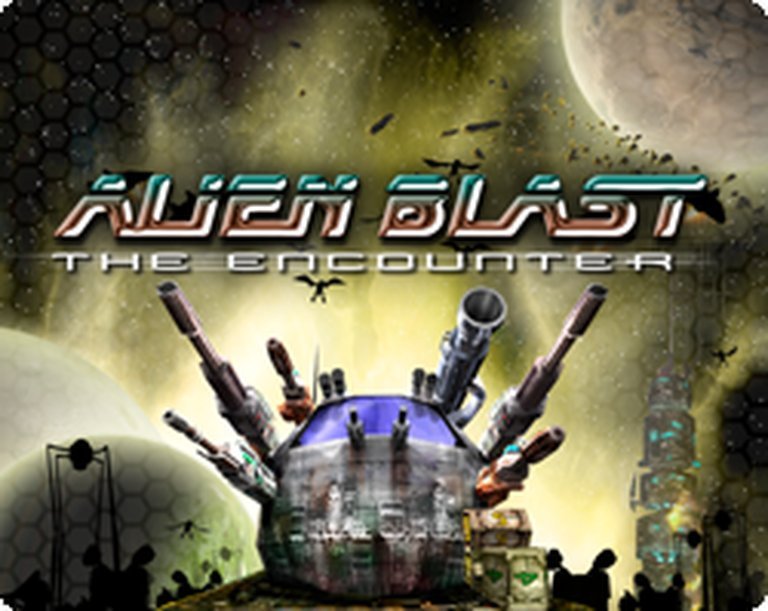
Alien Blast: The Encounter is a first-person stationary shooter set on the distant planet Rexus, where an Allied Forces freighter responds to a distress call only to discover the planet abandoned and under imminent alien attack. Players must defend the planet by manning stationary turrets with a 360-degree view, fending off waves of alien creatures arriving by land and air. The game features arcade-style gameplay, with occasional support from a friendly spaceship, the UMBK, which drops power-ups like shields, ammo, and new weapons to aid in the battle.
Gameplay Videos
Alien Blast: The Encounter Free Download
Alien Blast: The Encounter Patches & Updates
Alien Blast: The Encounter Reviews & Reception
metacritic.com (60/100): A simple straightforward shoot ’em up extravaganza.
mobygames.com (38/100): Reviews towards it were so unfavorable that development on sequels has been abandoned.
gamepressure.com (30/100): A futuristic shooter set in 2060, somewhere in a distant part of the cosmos.
metacritic.com (41/100): Generally Unfavorable based on 10 Critic Reviews.
myabandonware.com (73/100): It’s an action game, set in an arcade, sci-fi / futuristic and shooter themes.
Alien Blast: The Encounter Cheats & Codes
PC
Press [F9] while playing then type:
| Code | Effect |
|---|---|
| god | Unlimited Shield |
| allweapons | All Weapons |
| allammo | Unlimited Ammo |
| load level ## | Load Level ## |
| killall | Kill All Enemies |
| gravity | Gravity Off |
Alien Blast: The Encounter – A Retrospective on a Forgotten Relic of Early 2000s Arcade Shooters
Introduction: The Curious Case of a Game That Shouldn’t Exist
In the vast, ever-expanding universe of video games, some titles emerge as shining stars, while others flicker briefly before vanishing into the void. Alien Blast: The Encounter (2003) is one such flicker—a game so unremarkable, so aggressively mediocre, that it defies the very notion of being “forgotten” because it was barely remembered in the first place. Developed by the obscure studio Made By KIDDIES, Inc. and published by Strategy First, this first-person stationary turret shooter is a relic of an era when the industry was still grappling with the transition from arcade simplicity to modern complexity. It is a game that, by all accounts, should have been lost to time, yet persists as a cautionary tale, a museum piece, and—dare we say—a perverse fascination for those who study the fringes of gaming history.
At its core, Alien Blast: The Encounter is a game about defending a doomed planet from waves of alien invaders using a stationary turret. It is, in essence, a spiritual successor to classic arcade shooters like Space Invaders or Galaga, but rendered in early 2000s 3D graphics and stripped of nearly all innovation. The premise is simple: you are a lone soldier on the planet Rexus, manning a turret after your allies have either fled or perished. Your mission? Survive. That’s it. No deep narrative, no character development, no moral dilemmas—just you, a turret, and an endless horde of aliens that seem to have been designed by a committee that had never seen an alien before.
The game’s legacy, if it can be called that, is one of infamy. It is a title that critics universally panned, players swiftly abandoned, and developers likely regretted. Yet, in its sheer badness, Alien Blast achieves a kind of twisted immortality. It is a game that fails so spectacularly in nearly every aspect—gameplay, design, presentation—that it becomes a fascinating case study in what not to do when making a video game. It is the gaming equivalent of Plan 9 from Outer Space: a work so flawed that it loops back around to being oddly compelling.
This review will dissect Alien Blast: The Encounter with the precision of a surgeon wielding a scalpel made of pure cynicism. We will explore its development history, its baffling design choices, its nonexistent narrative, its broken mechanics, and its reception—both at launch and in the years since. By the end, you will understand not just why Alien Blast is a bad game, but why it is a historically bad game, and what its existence tells us about the gaming industry of the early 2000s.
Development History & Context: The Birth of a Misunderstood Monster
The Studio Behind the Madness: Made By KIDDIES, Inc.
Alien Blast: The Encounter was developed by Made By KIDDIES, Inc., a studio so obscure that even the most dedicated gaming historians struggle to find information about it. The company’s name alone—Made By KIDDIES—suggests either a bizarre sense of humor or a complete lack of self-awareness. The studio’s only other notable title, Air Raid (2002), was a similar stationary shooter, which likely served as the template for Alien Blast. If Air Raid was the prototype, then Alien Blast was the slightly more polished—but no less flawed—follow-up.
The credits for Alien Blast list a team of 21 people, including names like Christopher Lee (Game Design), InJ Jeong (Visual Art), and Samson Woon Shing Chan (Programmer). Many of these individuals had worked on other titles, such as Chrome and Warrior Kings: Battles, suggesting that the team was not entirely inexperienced. Yet, somehow, the sum of their efforts resulted in a game that feels like it was assembled in a weekend by a group of people who had only heard descriptions of video games but had never actually played one.
The Vision: What Were They Thinking?
The vision behind Alien Blast appears to have been a nostalgic throwback to the arcade shooters of the 1980s, but with a modern 3D twist. The developers seemingly wanted to create a game that was easy to pick up and play, with simple controls and straightforward gameplay. In theory, this isn’t a terrible idea—many indie games have successfully revived retro genres with modern sensibilities. However, Alien Blast fails because it doesn’t just revive the mechanics of old arcade games; it revives their flaws as well.
The game’s design philosophy seems to be: “What if we took the most repetitive, least engaging parts of arcade shooters and stretched them out over 45 levels?” There is no evolution in gameplay, no variety in enemies, no depth in strategy. It is a game that assumes the player will be content to sit in a turret for hours, shooting the same few types of aliens over and over again, with no meaningful progression or reward.
Technological Constraints: A Game Out of Time
Alien Blast was released in January 2003, a time when the gaming industry was in the midst of a major transition. The previous year had seen the release of groundbreaking titles like Half-Life 2 (which would redefine first-person shooters) and The Legend of Zelda: The Wind Waker (which pushed the boundaries of cel-shaded graphics). Meanwhile, Alien Blast felt like it had been teleported from 1998, both in terms of its visuals and its gameplay.
The game’s system requirements were modest even for the time—a Pentium III 500MHz processor, 256MB of RAM, and a 32MB graphics card—suggesting that it was designed to run on lower-end machines. This was likely a deliberate choice, as the early 2000s were a period when many developers were still catering to players with older hardware. However, the trade-off was that Alien Blast looked and played like a budget title, even by 2003 standards.
The 3D graphics are rudimentary, with blocky environments, repetitive textures, and alien designs that range from uninspired to outright laughable. The animations are stiff, the lighting is flat, and the overall presentation lacks polish. It’s clear that the developers were working with limited resources, but that doesn’t excuse the sheer lack of ambition on display.
The Gaming Landscape of 2003: A Crowded Market
2003 was a banner year for first-person shooters. Half-Life 2 was on the horizon, Call of Duty had just launched, and Doom 3 was generating massive hype. Even mid-tier shooters like Serious Sam: The Second Encounter and Painkiller offered more depth, variety, and sheer fun than Alien Blast could ever hope to provide.
In this context, Alien Blast was doomed from the start. It wasn’t just that the game was bad—it was that it was irrelevant. It offered nothing that players couldn’t get from better, more polished titles. Its only saving grace might have been its simplicity, but even that was undercut by its repetitive, punishing gameplay.
The Publishers: Strategy First and Russobit-M
Alien Blast was published by Strategy First in North America and Russobit-M in Russia. Strategy First was known for publishing a mix of strategy games and budget titles, but even by their standards, Alien Blast was a misfire. The game’s commercial failure was so pronounced that it reportedly led to the cancellation of planned sequels—a rare instance of a game being so bad that its own publishers refused to greenlight follow-ups.
Narrative & Thematic Deep Dive: The Story That Isn’t There
The Plot: A Distress Call from the Void
The “story” of Alien Blast: The Encounter can be summarized in a single sentence: “You’re on a planet, aliens attack, you shoot them.” That’s it. There is no character development, no world-building, no lore, no twists—just a barebones premise that exists solely to justify the gameplay.
The game’s official description provides a slight expansion:
“On planet Rexus, located on the far edge of the galaxy, a distress call has been sent out. When an Allied Forces freighter arrives to investigate, they find that everyone on the planet is dead or has left, and the full content of the distress call is a warning to stay away from the planet. Unfortunately, it’s too late for the Allied Forces investigators, as a large force of alien creatures is spotted incoming on the radar. The only hope is to man the few remaining turret weapons left behind on the planet and destroy all waves of the attack.”
This setup is so generic that it could apply to hundreds of other sci-fi shooters. There is no attempt to make the scenario compelling or unique. The player is given no context for why they are on Rexus, who the “Allied Forces” are, or what the aliens want. The game doesn’t even bother to explain why the turrets are the “only hope”—couldn’t the Allied Forces just, you know, leave?
Characters: The Void Where Personality Should Be
The player character is a faceless, nameless soldier—literally. You never see them, you never hear them speak, and you have no idea who they are or why they’re fighting. The only “character” of note is the UMBK, a friendly spaceship that occasionally drops power-ups. The UMBK is never explained—is it a drone? A piloted ship? A sentient AI? The game doesn’t care, and neither should you.
The aliens, meanwhile, are a collection of bizarre, poorly designed creatures that seem to have been cobbled together from spare parts. There are giant eyeballs, swarms of tiny spiders, slow-moving mines, and clunky mechanoid monsters. None of them have any personality or distinguishing traits beyond “thing that shoots at you.” They exist solely as targets, devoid of any thematic or narrative significance.
Dialogue: The Silence of the Turret
There is no dialogue in Alien Blast. No banter between soldiers, no alien chatter, no desperate radio transmissions—just the sound of gunfire and the occasional bling of a power-up. The game’s lack of voice acting isn’t necessarily a flaw in itself, but in the context of its nonexistent story, it feels like yet another missed opportunity to give the game any kind of personality.
Themes: The Banality of Repetition
If Alien Blast has a theme, it is this: “Shooting things is fun, but only if the things you’re shooting are interesting.” The game’s entire premise is built around the idea that players will enjoy mindlessly blasting waves of aliens for hours on end. But without variety, without challenge, without meaning, the act of shooting becomes a chore rather than a thrill.
The game’s setting—a desolate, abandoned planet—could have been an interesting backdrop for themes of isolation or survival. Instead, it’s just a bland arena for the player to rotate in a circle and pull the trigger. There is no tension, no desperation, no sense of stakes. You’re not fighting for survival; you’re just waiting for the next wave to spawn so you can shoot it and move on.
In this way, Alien Blast inadvertently becomes a commentary on the dangers of repetitive gameplay. It is a game that should be fun—shooting aliens is a time-tested formula—but fails because it forgets that even the simplest games need some form of engagement beyond mere button-mashing.
Gameplay Mechanics & Systems: The Broken Core
The Turret: A Prison of Your Own Making
The defining feature of Alien Blast is its stationary turret gameplay. Unlike traditional first-person shooters, where the player can move freely, Alien Blast locks you in place, forcing you to rotate 360 degrees to aim and shoot. On paper, this could have been an interesting twist—a throwback to classic arcade shooters like Robotron: 2084 or Smash TV. In practice, it’s a frustrating, clunky mechanic that highlights the game’s many flaws.
The turret’s movement is sluggish, making it difficult to track fast-moving enemies. Worse, the turret cannot aim straight up, despite the fact that many enemies attack from above. This design choice is baffling—why would a futuristic defensive turret have such a glaring limitation? It forces the player to constantly adjust their aim in awkward ways, leading to unnecessary frustration.
Combat: Repetition as Punishment
Combat in Alien Blast consists of three steps:
1. Aliens spawn.
2. You shoot them.
3. Repeat.
There is no strategy, no tactics, no variety. Enemies come in a few basic types—ground units, flying units, and bosses—but they all behave in predictable, uninteresting ways. Some enemies move in straight lines, others zigzag, and a few drop bombs, but none of them require any thought to defeat. The game’s difficulty doesn’t come from clever enemy design or challenging patterns; it comes from sheer attrition. Waves of aliens keep coming, and if you’re not fast enough, you’ll be overwhelmed.
The game offers a handful of weapons—machine guns, lasers, rockets—but they all feel underwhelming. The machine gun is weak but has infinite ammo, while the other weapons are more powerful but run out quickly. There’s no incentive to use anything but the machine gun, since the other weapons are scarce and the game doesn’t give you enough ammo to rely on them.
Power-Ups: A False Sense of Progression
The UMBK occasionally drops power-ups, including shield restores, ammo replenishment, and new weapons. In theory, this should add some variety to the gameplay. In practice, the power-ups are so rare and so poorly balanced that they feel like a cruel joke. Shields are almost useless because they deplete so quickly, and the new weapons are often worse than the default machine gun.
The game’s “progression” is equally lackluster. There are 45 levels, but they all play out the same way: shoot aliens, survive, move on. There’s no increase in difficulty, no new mechanics, no evolution in gameplay. It’s the same experience repeated ad nauseam, with only the background scenery changing.
Multiplayer: The Loneliest Co-Op Experience
Alien Blast includes a multiplayer mode for up to four players, but it’s hard to imagine anyone ever using it. The game’s repetitive, unengaging gameplay is bad enough for one player; adding more people doesn’t make it better—it just makes the boredom communal.
The multiplayer mode is also plagued by technical issues. Reviews from the time indicate that the netcode was unstable, and finding other players was nearly impossible. Even if you could find a group, the experience would likely be a slog, as everyone sits in their turrets, shooting the same aliens, with nothing to distinguish the experience from single-player.
UI and Controls: A Study in Frustration
The game’s UI is barebones and unintuitive. The radar, which is supposed to help you track enemies, is nearly useless because it doesn’t provide enough information. You can’t tell what type of enemy is approaching, how many there are, or where they’re coming from—just that something is on its way.
The controls are equally problematic. The turret’s rotation is slow and imprecise, making it difficult to aim at fast-moving targets. The game supports both keyboard and mouse, but neither control scheme feels responsive. The mouse is too sensitive, while the keyboard is too sluggish, leaving players in a no-win scenario.
World-Building, Art & Sound: The Aesthetic of Apathy
Setting: A Planet Without Personality
Alien Blast takes place on the planet Rexus, a barren, forgettable world that serves as little more than a shooting gallery. The environments are repetitive and bland, with the same few textures and models reused endlessly. There’s no sense of place, no atmosphere, no immersion—just a series of identical arenas where the player is expected to shoot things for hours.
The game’s sci-fi setting is entirely generic. There’s no attempt to create a unique or interesting world—just the same tired tropes of “aliens attacking a distant planet” that have been done a thousand times before.
Visuals: A Time Capsule of Early 2000s Mediocrity
The graphics in Alien Blast are a perfect example of how not to age. The 3D models are blocky and poorly textured, the animations are stiff, and the lighting is flat and uninspired. The alien designs are particularly egregious—some look like rejected Space Invaders sprites rendered in 3D, while others resemble abstract art projects gone wrong.
The game’s visuals aren’t just bad by modern standards—they were bad in 2003. Titles like Doom 3 and Half-Life 2 were pushing the boundaries of what was possible in first-person shooters, while Alien Blast looked like it belonged on a late-90s budget CD-ROM.
Sound Design: The Silence of the Damned
The sound design in Alien Blast is almost nonexistent. The gunfire sounds weak, the explosions lack impact, and the alien noises are generic and unmemorable. There is no music to speak of—just a few repetitive sound effects that grow tiresome within minutes.
The lack of audio feedback makes the game feel even more lifeless. There’s no sense of power when you fire your weapons, no tension when enemies approach, no satisfaction when you defeat a wave. It’s as if the developers forgot that sound is a crucial part of immersion.
Reception & Legacy: The Game That Died Twice
Critical Reception: A Universal Pan
Alien Blast: The Encounter was not just poorly received—it was excoriated by critics. The game holds a 38% average score on MobyGames, based on eight reviews, with many outlets calling it one of the worst games of the year.
Here’s a sampling of the criticism:
- GameSpot (33%): “Across every category, Alien Blast defines itself as the very epitome of boredom. The action is dull, repetitive, and in some cases, a bit broken.”
- IGN (43%): “If you are one of those anti-social types with no Internet connection (and somehow read this review!) and are still trudging along with, say, a Pentium II, then this might be your ticket.”
- GameSpy (20%): “Alien Blast is so decidedly unfun that there really should be a warning label on the box to alert unsuspecting PC gamers to this fact.”
- Worth Playing (20%): “It’s about as complex as early Atari games, but with 3D graphics and absolutely none of the innovation that those Atari games had in their heyday.”
The reviews are unanimous in their disdain. Critics lambasted the game’s repetitive gameplay, ugly visuals, nonexistent sound design, and complete lack of innovation. Many reviewers noted that the game felt like a step backward, even compared to older arcade shooters.
Player Reception: The Sound of Crickets
Player reception was equally harsh. The game holds a 2.0/5 average score on MobyGames, based on five ratings. There are no written player reviews, which speaks volumes—most people who played Alien Blast likely forgot about it immediately.
The game’s multiplayer mode was a particular point of frustration. Players who tried to engage with it found that it was nearly impossible to find matches, and those who did reported that the experience was glitchy and unenjoyable.
Legacy: The Game That Killed Its Own Franchise
Alien Blast: The Encounter was intended to be the first in a series of games. However, the overwhelmingly negative reception ensured that no sequels were ever made. The game’s failure was so complete that it effectively killed any potential for the franchise before it could even begin.
In the years since its release, Alien Blast has faded into obscurity. It is not remembered as a cult classic, a hidden gem, or even a “so bad it’s good” curiosity. It is simply forgotten—a footnote in gaming history, if that.
Influence: The Anti-Influence
Alien Blast’s greatest influence on the gaming industry is as a cautionary tale. It serves as a reminder that even the simplest games need some form of engagement, variety, and polish. It is a testament to the fact that nostalgia alone is not enough to carry a game—especially when that game fails to understand what made its inspirations fun in the first place.
In a way, Alien Blast is the anti-Half-Life. While Half-Life revolutionized first-person shooters by introducing immersive storytelling, dynamic gameplay, and innovative level design, Alien Blast did the opposite. It took a proven formula and stripped it of everything that made it enjoyable, leaving behind a hollow, repetitive shell.
Conclusion: The Verdict on a Game That Never Should Have Been
Alien Blast: The Encounter is not just a bad game—it is a historically bad game. It is a title that fails in nearly every conceivable way: its gameplay is repetitive and unengaging, its visuals are ugly and outdated, its sound design is nonexistent, its narrative is a joke, and its multiplayer is a ghost town. It is a game that was doomed from the start, a relic of an era when developers could still get away with releasing unpolished, uninspired dreck.
Yet, in its sheer incompetence, Alien Blast achieves a kind of perverse fascination. It is a game that is so bad it becomes almost interesting—not in the way that The Room is interesting, but in the way that a car crash is interesting. You can’t look away, even though you know you should.
Final Verdict: 1/10 – A Monument to Mediocrity
Alien Blast: The Encounter is not worth playing, not worth remembering, and not worth preserving. It is a game that exists as a warning to future developers: “This is what happens when you forget that games are supposed to be fun.” It is a relic of a time when the industry was still figuring out what worked and what didn’t—and Alien Blast is a perfect example of what doesn’t.
If you are a gaming historian, Alien Blast is a curious artifact—a game that failed so spectacularly that it serves as a case study in bad design. If you are a masochist, it might provide a few minutes of ironic entertainment. But for everyone else, it is best left in the dustbin of history, where it belongs.
In the end, Alien Blast: The Encounter is not just a bad game—it is a necessary bad game. It is a reminder that even in an industry as creative and innovative as video games, there will always be titles that miss the mark entirely. And sometimes, those failures are just as important as the successes—because they teach us what not to do.
So let us raise a glass to Alien Blast: The Encounter—the game that dared to be terrible, and succeeded beyond its wildest dreams. May it rest in peace, and may we never see its like again.