
- Release Year: 2003
- Platforms: Windows
- Publisher: Empire Interactive Entertainment, Empire Interactive Europe Ltd., Media-Service 2000, SEGA Corporation, Selectsoft Publishing, Strategy First, Inc.
- Developer: Black Cactus (Games) Ltd.
- Genre: Strategy, Tactics
- Perspective: Diagonal-down
- Game Mode: LAN, Online PVP, Single-player
- Gameplay: characters control, Multiple units, Point and select, Real-time strategy (RTS)
- Setting: Fantasy
- Average Score: 75/100
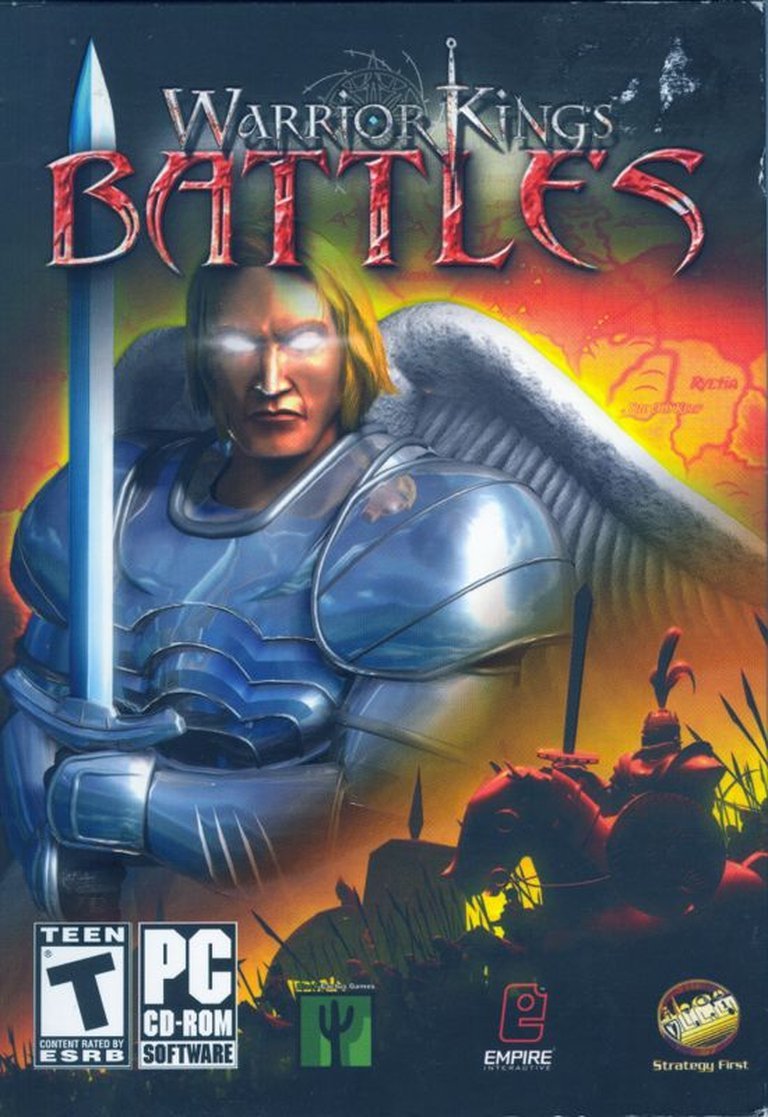
Description
Warrior Kings: Battles is a real-time strategy game set in the fantasy realm of Orbis, where players must conquer provinces to restore peace after Duke Hagen murders the heir to the throne, Artos IV. The game features multiple modes, including a campaign with different alignments (such as Renaissance or Pagan) that shape your empire’s strengths, skirmish battles, a fast-paced Valhalla mode without resource management, and online multiplayer for up to 8 players. With a mix of tactical combat, siege warfare, and mythical creatures, players must strategically expand their dominion while adapting to their chosen faction’s unique advantages.
Gameplay Videos
Where to Buy Warrior Kings: Battles
Warrior Kings: Battles Free Download
Warrior Kings: Battles Cracks & Fixes
Warrior Kings: Battles Guides & Walkthroughs
Warrior Kings: Battles Reviews & Reception
metacritic.com (64/100): Black Cactus has crafted a game that is just different enough for mainstream RTSers to appreciate, while adding things like a unique and involving storyline and intelligent adversaries for those who don’t want to play the same old thing.
impulsegamer.com (92/100): Warrior Kings Battle is not about brute force and huge battles but on the contrary, it’s all about thinking, tactics and realistic warfare.
mobygames.com (69/100): There are several modes to play that include the typical campaign mode in which you will play missions to conquer one province at a time, skirmish mode where you can play a single player mode against 1 to 7 pre-made AI players on a selected map, Valhalla mode like skirmish mode lets you play with no economy for shorter games and a multiplayer mode to play against live opponents online or a mix of AI and human players.
Warrior Kings: Battles Cheats & Codes
PC
Enter one of the following codes during gameplay:
| Code | Effect |
|---|---|
| gimmegimme | Extra resources |
| doyousee | Full map |
| makemenails | Tougher units |
Warrior Kings: Battles: A Deep Dive into a Forgotten RTS Gem
Introduction
In the early 2000s, the real-time strategy (RTS) genre was dominated by titans like Warcraft III, Age of Mythology, and Command & Conquer. Amidst this competitive landscape, Warrior Kings: Battles emerged as a bold, if flawed, attempt to carve out its own niche. Developed by Black Cactus and published by Empire Interactive in 2003, this sequel to Warrior Kings (2002) sought to refine its predecessor’s ambitious mechanics while introducing new layers of strategic depth. Though it never achieved the mainstream acclaim of its contemporaries, Warrior Kings: Battles remains a fascinating artifact of its era—a game that dared to challenge RTS conventions with its alignment system, tactical combat, and emphasis on AI-driven multiplayer.
This review will explore the game’s development history, narrative and thematic underpinnings, gameplay mechanics, artistic and auditory design, critical reception, and lasting legacy. By examining these elements in detail, we can better understand why Warrior Kings: Battles remains a cult favorite among strategy enthusiasts, despite its shortcomings.
Development History & Context
The Studio and Vision
Black Cactus, the British studio behind Warrior Kings: Battles, was founded by veterans of the UK gaming scene, including creative director Jamie Thomson and lead designer Charlie Bewsher. The studio’s origins trace back to Eidos’ ill-fated Plague project, a 3D RTS that never saw release. When Eidos shuttered its internal development division in 1999, the Plague team regrouped as Black Cactus, salvaging the project’s core ideas into Warrior Kings (2002).
Warrior Kings: Battles was conceived as both a sequel and a refinement of the original game’s mechanics. In interviews, the developers emphasized their desire to create an RTS that prioritized strategy over brute force. Unlike many contemporaries, which often devolved into “click-fests” where sheer unit numbers decided battles, Battles aimed to reward tactical positioning, unit synergy, and adaptive playstyles. The game’s alignment system—where players could evolve their faction along Imperial, Pagan, or Renaissance paths—was a direct reflection of this philosophy.
Technological Constraints and Innovations
Released in 2003, Warrior Kings: Battles was built on an updated version of the original game’s engine, which supported full 3D terrain and dynamic camera angles. However, the technology of the era imposed limitations. Pathfinding, a perennial issue in RTS games, was particularly problematic in Battles, with units often getting stuck on terrain or failing to navigate complex environments. The game’s AI, while ambitious, also struggled with the era’s hardware constraints, leading to occasional inconsistencies in enemy behavior.
Despite these challenges, the developers introduced several innovations:
– Valhalla Mode: A multiplayer-focused mode that stripped away base-building, instead tasking players with capturing strategic flags. This was a precursor to modern “battle royale” or “king of the hill” modes in RTS games.
– AI General Editor: A tool that allowed players to customize AI opponents, adjusting their aggression, unit preferences, and tactical tendencies. This was a rare feature at the time and spoke to the game’s emphasis on AI-driven gameplay.
– Hybrid Alignments: The introduction of sub-paths like Pagan-Renaissance and Imperial-Renaissance, which blended unit rosters and strategies, added replayability and strategic variety.
The Gaming Landscape of 2003
Warrior Kings: Battles launched into a crowded RTS market. In 2003 alone, players could choose from Warcraft III: The Frozen Throne, Rise of Nations, Age of Mythology, and Command & Conquer: Generals. Each of these games offered polished mechanics, strong narratives, or innovative features that Battles struggled to match.
The game’s fantasy-medieval setting also placed it in direct competition with Warcraft III and Age of Mythology, both of which boasted more vibrant visuals and streamlined gameplay. Battles’ darker, grittier aesthetic and slower pacing made it a harder sell to casual players, though it found a niche audience among hardcore strategy fans who appreciated its depth.
Narrative & Thematic Deep Dive
Plot and Setting
Warrior Kings: Battles is set 100 years after the events of the first game, in the fractured world of Orbis. The once-unified Empire has collapsed into 22 warring provinces, each ruled by a general with their own agenda. The player assumes the role of a general from Angland, tasked with reuniting Orbis by conquering these provinces and overthrowing the usurper Duke Ignis Hagens.
The narrative is minimalist by design. Unlike its predecessor, which followed the revenge-driven story of Artos, Battles eschews a linear plot in favor of a Civilization-style emergent narrative. The campaign unfolds like a game of Risk, with players choosing which provinces to conquer in any order. Each province is defended by a unique general, complete with their own portrait, alignment preference, and tactical style. As players defeat these generals, they unlock them for use in skirmish and multiplayer modes, adding a meta-progression layer to the campaign.
Themes: Power, Ideology, and Conquest
At its core, Warrior Kings: Battles is a meditation on the cyclical nature of power. The collapse of Orbis mirrors historical empires—Rome, the Holy Roman Empire, or even the British Empire—where centralized authority gives way to feudalism and infighting. The game’s three alignments (Imperial, Pagan, Renaissance) represent competing ideologies vying for dominance:
– Imperial: A theocratic faction modeled after medieval Christianity, emphasizing faith, heavy armor, and divine retribution. Their “Acts of God” abilities (e.g., calling down fire or summoning the Archangel) reflect their belief in divine mandate.
– Pagan: A nature-worshipping faction that embraces chaos, sacrifice, and demonic pacts. Their reliance on swarms of weaker units and dark magic mirrors historical pagan resistance to organized religion.
– Renaissance: A secular, science-driven faction that prioritizes gunpowder, siege engines, and economic efficiency. Their lack of magic or divine intervention underscores their belief in human ingenuity.
The hybrid alignments (e.g., Pagan-Renaissance) further explore the tension between these ideologies, allowing players to blend occultism with technology or faith with firearms. This thematic depth is rare in RTS games, which often reduce factions to superficial aesthetic differences.
Characters and Dialogue
The game’s characters are largely defined by their alignments and tactical preferences. Each general in the campaign has a distinct personality, reflected in their unit composition and battle strategies. For example:
– An Imperial general might favor defensive play, relying on fortified positions and priestly magic.
– A Pagan general might employ hit-and-run tactics, overwhelming the player with waves of demons and sacrificial units.
– A Renaissance general might focus on siege warfare, using cannons and rocket launchers to break enemy lines.
Dialogue is sparse but effective, with voice acting that leans into the game’s medieval tone. The Imperial faction’s priests intone Latin-inspired chants, while Pagan units snarl in guttural tongues. The Renaissance faction’s soldiers bark orders in a more modern, disciplined cadence. These auditory cues reinforce the ideological divides between factions.
Gameplay Mechanics & Systems
Core Gameplay Loop
Warrior Kings: Battles is, at its heart, a game about conquest. The campaign mode tasks players with capturing all 22 provinces of Orbis, each defended by a unique general. Victory in each province unlocks rewards, such as additional starting resources or alignment bonuses, which carry over to subsequent battles.
The game’s economy is resource-driven, with three key commodities:
1. Food: Grown on farms and consumed by units. Fertile land speeds up growth.
2. Materials: Gathered from forests and mines, used for construction.
3. Gold: Mined or traded, essential for advanced units and upgrades.
Unlike many RTS games, resources in Battles are not automatically added to a global pool. Instead, they must be transported via carts from villages to the main base, adding a logistical layer to gameplay. This system forces players to protect supply lines, lest their economy grind to a halt.
Combat and Unit Diversity
Combat in Warrior Kings: Battles is defined by its rock-paper-scissors unit counters and emphasis on terrain. Units are divided into seven classes:
– Light Infantry (ranged, weak to cavalry)
– Heavy Infantry (melee, strong against cavalry)
– Cavalry (fast, weak to spears)
– Siege (long-range, vulnerable to melee)
– Reconnaissance (scouts, weak in direct combat)
– Demonic (magic-based, weak to “special” units)
– Special (unique abilities, e.g., priests, druids)
Each alignment has its own unit roster, with strengths and weaknesses that encourage adaptive play. For example:
– Imperial: Strong heavy infantry (knights, war elephants) and priestly magic, but slow and expensive.
– Pagan: Fast, cheap units (demons, witches) with swarm tactics, but fragile.
– Renaissance: Powerful siege weapons (cannons, rocket launchers) and riflemen, but lacks magic.
Terrain plays a crucial role in battles. Archers on high ground gain range bonuses, while cavalry struggles in forests. Players must position units carefully, using formations (e.g., vanguard, orb, line) to maximize effectiveness. This level of tactical depth is rare in RTS games, where terrain often serves as mere decoration.
Base-Building and Alignment Progression
Base-building in Battles is restrictive but meaningful. Most military and economic structures must be built within the base’s walls, which expand as new buildings are added. This creates a natural choke point, forcing players to defend their base while managing outward expansion.
The alignment system is the game’s most innovative feature. Players begin as a neutral faction and evolve by constructing alignment-specific buildings:
– Imperial: Cathedrals, barracks, and inquisitor towers.
– Pagan: Wicker men, druid circles, and demon pits.
– Renaissance: Laboratories, gunpowder mills, and rocket workshops.
Each alignment unlocks unique units, buildings, and abilities. For example:
– Imperial players can summon the Sword of God, an uncontrollable archangel that attacks nearby enemies.
– Pagan players can sacrifice units to summon Abaddon, a massive demon.
– Renaissance players gain access to rocket launchers and mortars, but no magical units.
Hybrid alignments (e.g., Pagan-Renaissance) offer mixed rosters, such as undead legions or dragoon cavalry, adding replayability.
Multiplayer and Valhalla Mode
Multiplayer in Battles supports up to 8 players via LAN or internet, with standard skirmish and Valhalla modes. Valhalla Mode is the standout feature, removing base-building entirely. Players pre-select an army and compete to capture flags scattered across the map, earning points over time. This mode is fast-paced and tactical, emphasizing unit composition and positioning over economic micromanagement.
The AI in multiplayer is notably aggressive, probing defenses and seeking alliances. This was a selling point at launch, as many RTS games of the era featured predictable, passive AI.
UI and Controls
The game’s UI is functional but dated. Unit selection and command are standard for the era, with hotkeys and drag-select mechanics. However, the 3D camera is notoriously finicky, often obscuring units or making precise selection difficult. Pathfinding issues exacerbate this, as units frequently get stuck on terrain or fail to navigate complex environments.
The lack of a comprehensive tutorial also hurts accessibility. New players are thrust into the campaign with minimal guidance, forcing them to learn through trial and error.
World-Building, Art & Sound
Setting and Atmosphere
Orbis is a dark, medieval-fantasy world steeped in political intrigue and supernatural horror. The game’s art direction leans into this tone, with gothic architecture, mist-shrouded battlefields, and grotesque demonic units. The Imperial faction’s cathedrals loom over the landscape, while Pagan villages are nestled in eerie forests. Renaissance cities, by contrast, are industrial and utilitarian, with smokestacks and siege workshops.
The world feels alive, thanks to small details like birds circling battlefields or fish swimming in rivers. These ambient touches reinforce the game’s immersive atmosphere, though they are often overshadowed by the chaos of large-scale battles.
Visual Design
Warrior Kings: Battles uses a proprietary 3D engine that supports dynamic lighting and terrain deformation. Unit models are detailed, with distinct animations for each faction. Imperial knights clank in heavy armor, Pagan demons writhe unnaturally, and Renaissance riflemen reload with mechanical precision.
However, the game’s visuals are held back by the era’s technical limitations. Textures are muddy, and the draw distance is short, leading to units popping into view. The camera’s fixed diagonal-down perspective also limits tactical visibility, making it difficult to assess battles at a glance.
Sound Design and Music
The game’s audio design is one of its strongest aspects. The soundtrack, composed by Paul Weir, blends orchestral and choral elements to create a sweeping, cinematic score. Battle themes are bombastic, with pounding drums and brass fanfares, while ambient tracks evoke the game’s medieval setting with lute and flute melodies.
Sound effects are equally impressive. The clash of steel, the thunder of cannons, and the guttural roars of demons all contribute to the game’s immersive battles. Voice acting is minimal but effective, with each faction’s units speaking in distinct tones—Imperial soldiers bark orders in disciplined Latin, while Pagan units snarl in bestial tongues.
Reception & Legacy
Critical Reception
Warrior Kings: Battles received mixed but generally favorable reviews upon release, with an average critic score of 69% on MobyGames and a 64 Metacritic score. Critics praised the game’s depth, alignment system, and AI but criticized its technical issues and lack of polish.
Positive Aspects:
– Depth and Strategy: Reviewers like PC Zone UK and ActionTrip lauded the game’s tactical combat and unit diversity. PC Zone UK called it “a game that never fails to surprise you,” while ActionTrip praised its “highly innovative units.”
– AI and Multiplayer: The improved AI was a standout feature, with IGN noting that it “probes your defenses and finds weaknesses unlike any other strategy game.”
– Alignment System: The faction evolution mechanic was widely praised for adding replayability and strategic variety.
Negative Aspects:
– Technical Issues: Pathfinding and camera problems were universal complaints. GameSpot called the camera control “an exercise in futility,” while Worth Playing criticized the “poorly-done camera angles.”
– Pacing and Accessibility: The game’s slow pace and lack of a tutorial frustrated critics. PC Gamer dismissed the campaign as “a series of missions with no cohesion,” and GameSpot noted that the “slow buildup of action” made it hard to recommend.
– Visuals: The game’s dark, muddy visuals were often compared unfavorably to contemporaries like Warcraft III. Computer Gaming World joked that the game “comes with curlers in its hair,” implying it was outdated at launch.
Commercial Performance and Legacy
Warrior Kings: Battles was not a commercial success, failing to match the sales of its competitors. However, it developed a cult following among strategy enthusiasts who appreciated its depth and ambition. The game’s alignment system and Valhalla Mode influenced later RTS titles, such as Rise of Nations and Company of Heroes, which adopted similar faction diversity and multiplayer modes.
The game’s legacy is also tied to its developer, Black Cactus. Despite the studio’s closure in 2005, its work on Warrior Kings and Battles remains a testament to the UK’s contributions to the RTS genre. The game’s emphasis on tactics over brute force foreshadowed modern titles like Total War and Battlefleet Gothic: Armada, which prioritize positioning and unit synergy.
Conclusion: A Flawed but Fascinating Strategy Experience
Warrior Kings: Battles is a game of contradictions. It is ambitious yet flawed, deep yet inaccessible, innovative yet outdated. Its alignment system and tactical combat set it apart from its contemporaries, offering a level of strategic depth rarely seen in RTS games. However, its technical shortcomings—poor pathfinding, a finicky camera, and a lack of polish—hold it back from greatness.
For modern players, Warrior Kings: Battles is a curiosity, a relic of an era when RTS games were unafraid to experiment. It is not a game for everyone; its steep learning curve and micromanagement-heavy gameplay will frustrate casual players. But for those willing to invest the time, it rewards with a uniquely satisfying strategic experience.
Final Verdict: 7.5/10 – A Cult Classic Worth Rediscovering
Warrior Kings: Battles may not have achieved the acclaim of Warcraft III or Age of Mythology, but its bold ideas and tactical depth ensure its place in RTS history. It is a game that dared to be different, and for that, it deserves to be remembered.