
- Release Year: 2004
- Platforms: Windows
- Publisher: Idee Software
- Developer: Idee Software
- Genre: Platform, Puzzle
- Perspective: Side view
- Game Mode: Hotseat, Single-player
- Gameplay: Bomb usage, Elevator mechanics, Puzzle-solving, Skill-based
- Setting: Abstract
- Average Score: 88/100
Description
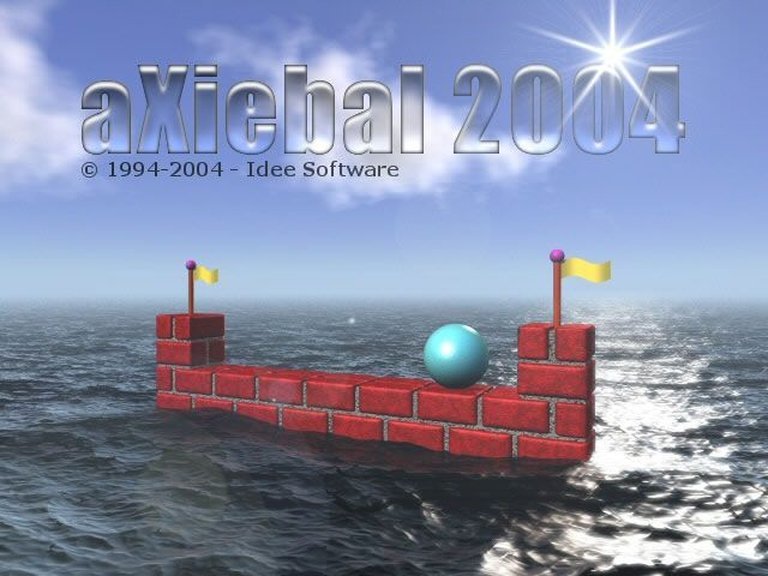
aXiebal 2004 is a free-to-play puzzle-platformer and a remake of Idee Software’s 1994 game, Aktie-Bal, created to celebrate the studio’s 10th anniversary. Players control a green metallic ball, navigating through 75 levels to collect flags and reach the exit, using bombs and elevators to overcome obstacles. The game blends puzzle-solving with skill-based challenges, featuring vibrant graphics, upbeat music, and quirky sound effects. As a faithful recreation of the original, it retains the same level designs while offering a nostalgic yet engaging experience for fans of rolling-ball games.
aXiebal 2004 Free Download
PC
aXiebal 2004 Guides & Walkthroughs
aXiebal 2004 Reviews & Reception
idee-software.itch.io (100/100): A unique game that will keep even the non-gamer captivated.
mobygames.com (66/100): A remake of Idee Software’s first game to celebrate their 10th anniversary.
retro-replay.com : A finely tuned blend of puzzles and action that will challenge both your brain and your reflexes.
vgtimes.com (98/100): A third-person arcade game with a mixture of action, strategy, platformer and puzzle.
aXiebal 2004 Cheats & Codes
PC
Start the game with the ‘+console’ command line parameter. Press ‘Enter’ during gameplay, then type one of the following codes to activate the corresponding cheat function.
| Code | Effect |
|---|---|
| enigma | No fog of war |
| fieldpromotion | 100 Experience points |
| swissbank |
Money |
| isurrender | Surrender |
| veday | Win |
| rosieriveter | No queue for construction |
| medic | All units have full health |
| crushers | Allied trucks get devastating rockets |
| killers | Kills enemies in one shot |
| bravery | No retreat |
| rocketarmy | Infantry shoots rockets |
| god mode | Invincibility |
| fieldpromotion [1-5000] | Get indicated amount of experience points |
| swissbank[1-9999] | Provides 100 money |
aXiebal 2004: A Timeless Puzzle-Platformer Reborn
Introduction: The Legacy of a Rolling Ball
In the vast ocean of video game history, certain titles emerge not as blockbusters but as quiet, enduring classics—games that, despite their modest origins, carve out a niche in the hearts of players. aXiebal 2004 is one such gem. Released as a loving remake of Aktie-Bal (1994), this deceptively simple puzzle-platformer celebrates Idee Software’s 10th anniversary by refining and reimagining its predecessor for a new generation. At its core, aXiebal 2004 is a game of precision, logic, and reflexes, where a metallic ball must navigate treacherous mazes, collect flags, and escape through exits—all while contending with bombs, elevators, and gravity-defying physics.
Yet, beneath its minimalist premise lies a game that transcends its era. It is a testament to the power of tight design, where every level is a meticulously crafted challenge, and every mechanic serves a purpose. This review will dissect aXiebal 2004 in exhaustive detail, exploring its development history, narrative subtleties, gameplay systems, artistic direction, and lasting influence. By the end, it will become clear why this unassuming title remains a cult favorite and a benchmark for indie puzzle games.
Development History & Context: A Decade of Passion
The Birth of Idee Software and Aktie-Bal
Idee Software, a small Belgian studio founded by Hendrik Knaepen, emerged in the early 1990s during a golden age of shareware and indie development. Their debut title, Aktie-Bal (1994), was a labor of love—a rolling ball puzzle game inspired by the likes of Marble Madness and Ballgame 2 (1992). The game’s title, a Dutch play on words meaning “Action Ball,” reflected its blend of cerebral puzzles and twitch-based platforming. Though modest in scope, Aktie-Bal garnered a dedicated following, thanks to its tight controls and inventive level design.
The 2004 Remake: A Celebration of Legacy
By 2004, the gaming landscape had shifted dramatically. The rise of 3D graphics, online multiplayer, and AAA blockbusters dominated the industry, leaving little room for niche puzzle games. Yet, Idee Software saw an opportunity to revisit their roots. aXiebal 2004 was conceived as both a celebration of their 10th anniversary and a modern reinterpretation of their inaugural title. The remake retained the original’s 75 levels but overhauled the visuals, sound, and mechanics to align with contemporary standards.
Technological Constraints and Design Philosophy
Developed for Windows, aXiebal 2004 was built with the limitations of early 2000s hardware in mind. The game’s side-view perspective and 2D physics were optimized for low-end systems, ensuring accessibility for a broad audience. The team, consisting of just five people (including Hendrik Knaepen as lead programmer and designer, Zeger Knaepen handling graphics and sound, and Jan Van Nieuwerburgh contributing to level design), worked within tight constraints to deliver a polished experience.
The decision to preserve the original level layouts was a bold one. Rather than reinventing the wheel, Idee Software focused on refining the gameplay loop—enhancing the ball’s movement, improving collision detection, and introducing subtle quality-of-life improvements. The result was a game that felt familiar to veterans of Aktie-Bal while offering a fresh coat of paint for newcomers.
The Gaming Landscape of 2004
The year 2004 was a transitional period for the industry. Titles like Half-Life 2, World of Warcraft, and Halo 2 dominated headlines, showcasing the potential of immersive 3D worlds and online connectivity. In this climate, aXiebal 2004 stood as an anomaly—a throwback to the simplicity of early puzzle games. Its freeware distribution model (later re-released as free-to-play) ensured it reached a wide audience, even as it competed with the era’s more ambitious projects.
Narrative & Thematic Deep Dive: The Silent Story of a Rolling Ball
Minimalism as a Strength
aXiebal 2004 eschews traditional storytelling in favor of environmental and mechanical narrative. There are no cutscenes, no dialogue, and no lore-heavy exposition. Instead, the game’s “story” is told through its gameplay: a lone metallic ball, navigating a series of abstract, maze-like stages, collecting flags (symbolizing objectives or achievements), and escaping through exits (representing triumph over adversity).
This minimalist approach is not a flaw but a deliberate design choice. By stripping away narrative distractions, the game forces players to engage directly with its core mechanics. The ball becomes a blank slate—a vessel for the player’s own motivations. Are you a treasure hunter? A problem-solver? A speedrunner? The game’s lack of explicit storytelling allows for personal interpretation, making each playthrough feel uniquely tailored to the player.
Themes of Persistence and Problem-Solving
At its heart, aXiebal 2004 is a meditation on perseverance. The game’s levels are designed to test both patience and ingenuity, with later stages demanding near-perfect execution. The act of collecting flags before exiting mirrors real-world problem-solving: breaking down a complex challenge into manageable steps, learning from failure, and refining one’s approach.
The inclusion of bombs and elevators as interactive elements reinforces this theme. Bombs, which can clear obstacles or create new paths, symbolize the destructive yet transformative power of change. Elevators, with their methodical ascent and descent, represent progress—both literal and metaphorical. Together, these mechanics create a gameplay loop that is as much about mental agility as it is about physical dexterity.
Nostalgia and Legacy
For longtime fans of Idee Software, aXiebal 2004 is more than just a game—it’s a time capsule. The remake’s faithful recreation of the original Aktie-Bal levels serves as a love letter to the studio’s early days. Subtle nods to other Idee Software titles (such as Info Harry and Kerker) are scattered throughout, rewarding eagle-eyed players with a sense of continuity.
The game’s title itself is a linguistic artifact. The Dutch word aktiebal (later revised to actiebal in 1995) translates to “Action Ball,” a playful moniker that encapsulates the game’s hybrid identity. This linguistic quirk adds a layer of cultural context, grounding the game in its Belgian roots while appealing to an international audience.
Gameplay Mechanics & Systems: The Art of Precision
Core Gameplay Loop
aXiebal 2004’s gameplay is deceptively simple: guide a metallic ball through a series of levels, collecting all flags before reaching the exit. However, the execution is anything but straightforward. The game’s 75 levels are divided into progressively difficult stages, each introducing new mechanics or twists on existing ones.
- Movement and Physics: The ball’s movement is governed by realistic physics, with momentum playing a crucial role. Players must account for inertia, gravity, and friction, making precise control essential. The ball can be nudged gently or launched at high speeds, depending on the player’s input.
- Flags and Objectives: Each level requires the collection of all flags before the exit becomes accessible. Flags are often placed in hard-to-reach areas, necessitating creative use of bombs and elevators.
- Bombs: These explosive devices can be detonated to clear obstacles, create new pathways, or trigger environmental changes. However, mistimed detonations can send the ball careening off-course or into hazards.
- Elevators: These moving platforms transport the ball between different vertical sections of a level. Timing jumps onto and off elevators is critical, as missteps can result in falls or missed opportunities.
Difficulty Curve and Level Design
The game’s difficulty curve is masterfully balanced. Early levels serve as tutorials, introducing basic mechanics in isolation. As players progress, the challenges become more complex, combining multiple mechanics in ways that demand both quick reflexes and strategic planning.
- Early Levels (1-20): Focus on basic movement and flag collection. Hazards are minimal, allowing players to acclimate to the ball’s physics.
- Mid-Game Levels (21-50): Introduce bombs and elevators as core mechanics. Players must learn to chain actions—e.g., detonating a bomb to clear a path, then using an elevator to reach a flag.
- Late-Game Levels (51-75): Test mastery of all mechanics. Levels feature moving platforms, time-sensitive puzzles, and precision jumps. Some stages require near-flawless execution to complete.
Multiplayer and Replayability
While primarily a single-player experience, aXiebal 2004 includes a same-screen multiplayer mode, allowing two players to compete or cooperate. This mode, though simple, adds a layer of chaotic fun, as players can interfere with each other’s progress or work together to solve puzzles.
The game’s replayability is further enhanced by its speedrunning potential. The lack of a built-in timer encourages players to set personal bests, and the precise physics engine rewards mastery. Additionally, the game’s freeware status and modding-friendly design have led to a small but dedicated community creating custom levels and challenges.
UI and Controls
The game’s user interface is minimalist, with on-screen indicators for flags collected and time elapsed (if playing in a timed mode). Controls are responsive, with keyboard inputs mapped to intuitive commands (arrow keys for movement, spacebar for bombs). The lack of clutter ensures that the focus remains on the gameplay.
World-Building, Art & Sound: A Feast for the Senses
Visual Design: A Modern Retro Aesthetic
aXiebal 2004’s visuals strike a delicate balance between retro charm and modern polish. The game’s environments are rendered in vibrant, high-contrast colors, with the metallic ball gleaming under dynamic lighting. Levels are designed with a clean, geometric aesthetic, reminiscent of early 3D platformers but executed with a 2D side-view perspective.
- Character Design: The protagonist—a greenish metallic ball—is simple yet expressive. Its reflective surface catches light realistically, and subtle animations (such as a slight wobble when idle) give it a sense of personality.
- Environmental Details: Each level is distinct, with unique textures and backgrounds. Some stages feature industrial themes (metal grates, conveyor belts), while others evoke natural landscapes (stone platforms, water hazards).
- Particle Effects: Explosions, sparks, and dust clouds add a layer of polish, making interactions feel impactful. Bomb detonations, in particular, are accompanied by satisfying visual feedback.
Sound Design: The Unsung Hero
The game’s audio design is understated but effective. Sound effects are crisp and functional, with distinct cues for collecting flags, detonating bombs, and activating elevators. The metallic clang of the ball colliding with surfaces reinforces the game’s industrial aesthetic.
- Music: Composed by Ron Clarke, the soundtrack is upbeat and catchy, blending electronic and synthwave influences. Tracks are looped seamlessly, ensuring they never grow repetitive. The music’s tempo often syncs with the gameplay, subtly enhancing the player’s focus.
- Ambient Sounds: Background noises, such as the hum of machinery or distant echoes, immerse players in the game’s abstract world. These details, though subtle, contribute to the overall atmosphere.
Atmosphere and Immersion
Despite its abstract setting, aXiebal 2004 creates a compelling sense of place. The combination of vibrant visuals, dynamic sound, and responsive controls draws players into its world. The lack of a traditional narrative is compensated by the game’s strong environmental storytelling—each level feels like a self-contained challenge, a puzzle waiting to be solved.
Reception & Legacy: A Cult Classic’s Journey
Critical and Commercial Reception
Upon its release in April 2004, aXiebal 2004 received modest attention. As a freeware title, it lacked the marketing push of commercial releases, but word-of-mouth praise from puzzle enthusiasts helped it gain traction. Reviews from outlets like Lockergnome, CFS Program Review, and PC Welt highlighted its addictive gameplay, polished presentation, and accessibility.
- Player Ratings: On platforms like MobyGames, the game holds a respectable 3.3/5 average, though its lack of widespread reviews suggests it remained a niche title.
- Community Feedback: Players praised the game’s difficulty curve, with many noting its ability to appeal to both casual and hardcore audiences. The inclusion of multiplayer and custom level support further endeared it to fans.
Evolution of the Series
aXiebal 2004 was not the end of the road for Idee Software’s rolling ball saga. The game spawned several sequels and spin-offs, including:
– aXiebal: Winter (2004): A winter-themed expansion with slippery physics and new hazards.
– AxieBal 7 (2008): A sequel introducing new mechanics and a revised art style.
– Balaxie (2024): A comprehensive collection featuring remakes of all previous Axiebal titles, along with new content.
Each iteration built upon the foundation laid by aXiebal 2004, refining mechanics and expanding the game’s scope.
Influence on the Puzzle Genre
While aXiebal 2004 may not have revolutionized the puzzle genre, it stands as a prime example of how tight design and polished execution can elevate a simple concept. Its influence can be seen in later indie titles like Portal, The Talos Principle, and Super Meat Boy, which similarly blend precision platforming with cerebral challenges.
The game’s legacy is also evident in its enduring community. Even two decades after its release, aXiebal 2004 remains a favorite among retro gaming enthusiasts, with modern re-releases (such as the 2025 version on itch.io) introducing it to new audiences.
Conclusion: A Masterclass in Minimalist Design
aXiebal 2004 is a game that defies easy categorization. It is at once a puzzle game, a platformer, and a test of reflexes—a hybrid that rewards both patience and quick thinking. Its minimalist narrative, precise controls, and meticulously designed levels make it a standout title in the indie puzzle genre.
What sets aXiebal 2004 apart is its ability to distill complex gameplay into an accessible, addictive experience. It is a game that respects its players’ intelligence, offering challenges that are difficult but never unfair. Its visual and auditory polish, though modest by modern standards, enhance the gameplay without overshadowing it.
In the grand tapestry of video game history, aXiebal 2004 may not be a household name, but it is a title that deserves recognition. It is a testament to the power of indie development, a celebration of gaming’s past, and a blueprint for how to remake a classic with respect and innovation. For puzzle enthusiasts, retro gamers, and anyone who appreciates tight, rewarding gameplay, aXiebal 2004 is nothing short of essential.
Final Verdict: 9/10 – A Timeless Puzzle-Platformer That Still Shines