
- Release Year: 2006
- Platforms: Windows
- Publisher: Intenium GmbH
- Genre: Compilation
- Game Mode: Single-player
- Average Score: 68/100
Description
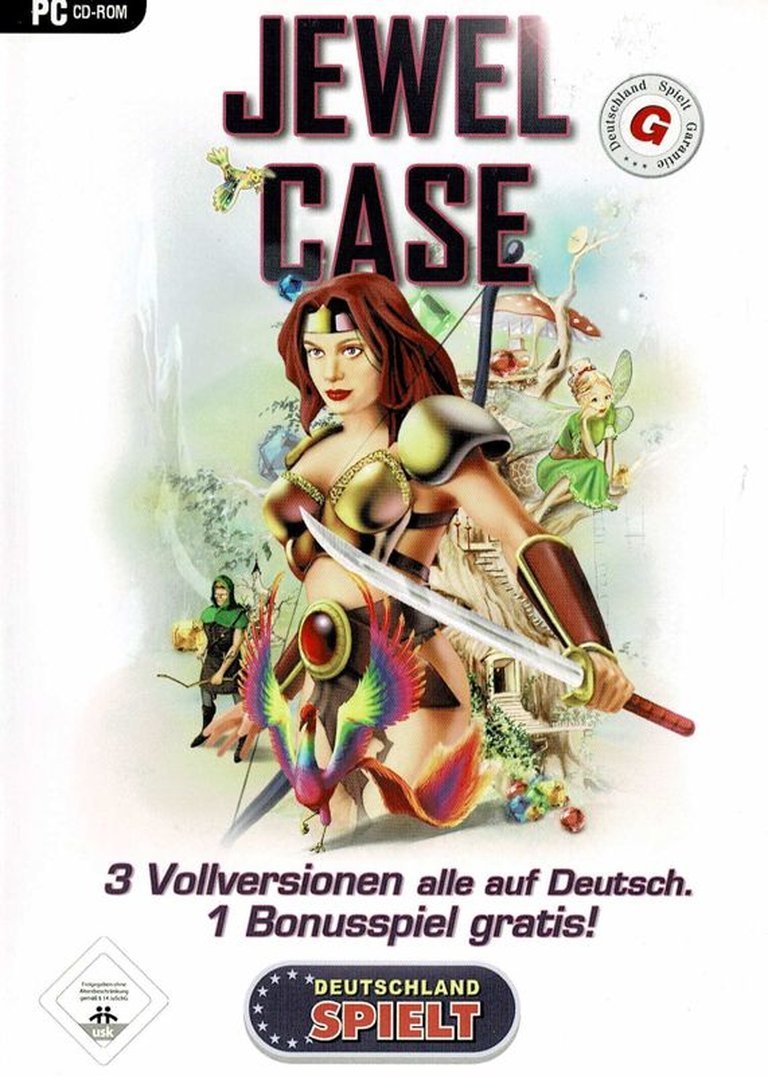
Jewel Case is a 2006 retail compilation for Windows, published by Intenium GmbH, featuring a collection of four casual puzzle games: Charm Tale, InSpheration, Puzzle Prinz, and Beetle Ju. 2. Designed for a broad audience with a PEGI 3 rating, the game offers a variety of jewel-matching and puzzle-solving challenges, catering to fans of lighthearted, family-friendly entertainment.
Jewel Case Reviews & Reception
pages.cs.wisc.edu (68/100): The objective in a level is to do exactly what the ancient script states, ‘Align the relics you can see, across or down in groups of three.’
Jewel Case Cheats & Codes
PC
Press [Ctrl] + [Alt] + [Shift] + Z to enable cheat mode. Then, enter one of the following codes.
| Code | Effect |
|---|---|
| CTRL-ALT-SHIFT-z | Activate Cheats |
| CTRL-1 thru 5 | Levels |
| ALT-1 thru 0 | Rounds |
| SHIFT-1 thru 5 | Cycles |
| CTRL-W | Auto-Win |
| ALT-W | Kill Auto-Win |
| CTRL-l | Add Life (lower case L) |
| ALT-l | Lose Life (lower case L) |
| CTRL-t | Add 1 minute |
| Alt-t | Subtract 1 minute |
Jewel Case: A Forgotten Relic of the Mid-2000s Casual Gaming Boom
Introduction
In the vast, ever-shifting landscape of video game history, some titles emerge as towering monuments of innovation, while others fade into obscurity, becoming little more than footnotes in the annals of interactive entertainment. Jewel Case (2006), a modest compilation released for Windows by Intenium GmbH, belongs firmly to the latter category. Yet, its existence offers a fascinating glimpse into the mid-2000s casual gaming market, a time when budget-friendly compilations and digital distributions were beginning to reshape how games were consumed. While Jewel Case itself is not a singular masterpiece, its components—Charm Tale, InSpheration, Puzzle Prinz, and Beetle Ju. 2—reflect the era’s penchant for accessible, bite-sized experiences. This review seeks to explore Jewel Case not just as a product, but as a cultural artifact, dissecting its development, gameplay, and legacy to understand its place in the broader tapestry of video game history.
Development History & Context
The Studio and the Era
Intenium GmbH, the publisher behind Jewel Case, was a relatively obscure player in the gaming industry, primarily focusing on budget titles and compilations. The mid-2000s were a transitional period for the industry, marked by the rise of digital distribution platforms like Steam (launched in 2003) and the growing popularity of casual games. The market was flooded with low-cost, easy-to-play titles, often bundled together in compilations to appeal to a broader audience. Jewel Case was one such product, designed to capitalize on the demand for affordable, accessible gaming experiences.
The technological constraints of the era were minimal for a compilation like Jewel Case. The games included were not graphically intensive, relying instead on simple mechanics and straightforward designs. This made them ideal for the average PC of the time, which might not have been capable of running the latest AAA titles but could easily handle lightweight puzzle and casual games.
The Gaming Landscape
The mid-2000s saw a surge in the popularity of casual games, driven in part by the success of titles like Bejeweled (2001) and Peggle (2007). These games appealed to a demographic beyond the traditional “hardcore” gamer, including older players and those who preferred shorter, less complex gaming sessions. Jewel Case was positioned to tap into this market, offering a variety of puzzle and casual games in a single package.
However, the compilation faced stiff competition. The market was already saturated with similar products, and digital distribution was beginning to make physical compilations less appealing. Players could now download individual games at a low cost, reducing the need for bundled collections. Despite this, Jewel Case managed to carve out a niche, albeit a small one, in the crowded casual gaming space.
Narrative & Thematic Deep Dive
The Games Within
Jewel Case is not a single game but a collection of four distinct titles, each with its own narrative and thematic elements. However, given the casual nature of these games, the narratives are minimal, often serving as little more than a backdrop for the gameplay.
-
Charm Tale: A puzzle game with a fairy-tale aesthetic, Charm Tale tasks players with solving increasingly complex puzzles to progress through a storybook-like world. The narrative is simple, revolving around a protagonist navigating a magical realm, but the charm lies in its whimsical presentation and straightforward gameplay.
-
InSpheration: This title is a more abstract puzzle game, focusing on geometric shapes and spatial reasoning. The narrative is virtually non-existent, with the game instead emphasizing its mechanical puzzles. The thematic elements are tied to its visual design, which leans heavily into clean, minimalist aesthetics.
-
Puzzle Prinz: A match-three game in the vein of Bejeweled, Puzzle Prinz features a royal theme, with players matching gems and jewels to score points. The narrative is minimal, with the “Prinz” (Prince) serving as a loose framing device for the gameplay.
-
Beetle Ju. 2: A sequel to an earlier casual game, Beetle Ju. 2 is a puzzle game centered around guiding a beetle through various obstacles. The narrative is simple, focusing on the beetle’s journey, but the game’s appeal lies in its colorful visuals and accessible gameplay.
Themes and Presentation
The overarching theme of Jewel Case is accessibility. Each game within the compilation is designed to be easy to pick up and play, with minimal barriers to entry. The narratives, while thin, serve to enhance the games’ appeal, providing a lighthearted, often whimsical context for the gameplay.
The presentation of Jewel Case is consistent with other casual compilations of the era. The games are bright, colorful, and visually appealing, with a focus on simplicity and clarity. The sound design is similarly unobtrusive, with cheerful, upbeat music that complements the gameplay without overwhelming it.
Gameplay Mechanics & Systems
Core Gameplay Loops
The gameplay mechanics of Jewel Case are varied, reflecting the different genres represented within the compilation. However, each game adheres to the principles of casual gaming: simplicity, accessibility, and short play sessions.
-
Charm Tale: The core gameplay loop involves solving puzzles by manipulating objects within a grid. Players must use logic and spatial reasoning to progress, with the difficulty ramping up gradually. The game’s mechanics are intuitive, making it easy for players of all skill levels to enjoy.
-
InSpheration: This game focuses on rotating and manipulating geometric shapes to fit into designated spaces. The mechanics are straightforward, but the challenge lies in the increasing complexity of the puzzles. The game’s minimalist design ensures that the focus remains on the gameplay.
-
Puzzle Prinz: As a match-three game, Puzzle Prinz follows the established formula of swapping adjacent gems to create matches. The mechanics are familiar to anyone who has played similar games, but the royal theme and polished presentation give it a distinct identity.
-
Beetle Ju. 2: The gameplay revolves around guiding a beetle through a series of obstacles, often requiring quick reflexes and strategic planning. The mechanics are simple, but the game’s charm lies in its colorful visuals and engaging level design.
Innovations and Flaws
While Jewel Case does not introduce any groundbreaking innovations, it does offer a well-curated selection of casual games. The compilation’s strength lies in its variety, providing players with multiple gameplay experiences in a single package. However, the lack of innovation is also a flaw. None of the games within Jewel Case stand out as particularly revolutionary, and the compilation as a whole feels somewhat derivative.
The user interface (UI) is functional but unremarkable. The games are easy to navigate, with clear menus and intuitive controls, but the UI lacks the polish of more high-profile titles. This is consistent with the budget nature of the compilation, but it does little to elevate the overall experience.
World-Building, Art & Sound
Visual Design
The visual design of Jewel Case is one of its strongest aspects. Each game within the compilation has a distinct aesthetic, but they all share a commitment to bright, colorful, and engaging visuals. Charm Tale and Beetle Ju. 2 are particularly notable for their whimsical, storybook-like designs, which enhance their accessibility and appeal.
The art style is consistent with other casual games of the era, prioritizing clarity and simplicity. The visuals are not overly complex, but they are effective in conveying the games’ mechanics and themes. The use of color is particularly striking, with each game featuring a vibrant palette that draws players in.
Sound Design
The sound design of Jewel Case is functional but unremarkable. The music is cheerful and upbeat, complementing the games’ casual nature without becoming intrusive. The sound effects are similarly understated, providing feedback for player actions without overwhelming the gameplay.
The audio design does not detract from the experience, but it also does little to enhance it. The music and sound effects are serviceable, but they lack the memorability of more high-profile titles. This is consistent with the budget nature of the compilation, but it does little to elevate the overall experience.
Reception & Legacy
Critical and Commercial Reception
Jewel Case received little critical attention upon its release, reflecting its status as a budget compilation. The games within the compilation were generally well-received by casual gamers, but they did not make a significant impact on the broader gaming community. The compilation’s lack of innovation and derivative nature likely contributed to its muted reception.
Commercially, Jewel Case was a modest success, appealing to the growing market of casual gamers. However, its physical format and lack of digital distribution limited its reach. As digital distribution became more prevalent, physical compilations like Jewel Case became less relevant, further limiting its commercial potential.
Influence and Legacy
Jewel Case does not have a significant legacy in the gaming industry. The games within the compilation did not spawn sequels or inspire major innovations, and the compilation itself is largely forgotten. However, its existence is a testament to the mid-2000s casual gaming boom, offering a snapshot of an era when budget-friendly compilations were a viable product.
The compilation’s influence is minimal, but it serves as a reminder of the importance of accessibility in gaming. The games within Jewel Case were designed to be easy to pick up and play, appealing to a broad audience. This philosophy has since become a cornerstone of the modern gaming industry, with many AAA titles incorporating casual-friendly mechanics to appeal to a wider range of players.
Conclusion
Jewel Case is a forgotten relic of the mid-2000s casual gaming boom, offering a modest but enjoyable collection of puzzle and casual games. While it does not stand out as a groundbreaking or innovative title, it serves as a fascinating snapshot of an era when budget-friendly compilations were a viable product. The games within Jewel Case are accessible, engaging, and visually appealing, making them ideal for casual gamers. However, the compilation’s lack of innovation and derivative nature limit its appeal to a broader audience.
In the grand tapestry of video game history, Jewel Case is a minor footnote, but it is a footnote worth examining. It reflects the changing landscape of the gaming industry in the mid-2000s, a time when digital distribution was beginning to reshape how games were consumed. While Jewel Case itself may not be remembered as a classic, it serves as a reminder of the importance of accessibility and variety in gaming, principles that continue to shape the industry today.
Final Verdict: Jewel Case is a modest but enjoyable compilation that offers a variety of casual gaming experiences. While it lacks innovation and does not stand out as a groundbreaking title, it serves as a fascinating snapshot of the mid-2000s casual gaming boom. For fans of puzzle and casual games, Jewel Case is a worthwhile but unremarkable addition to the genre. 6/10