
- Release Year: 2004
- Platforms: Windows
- Publisher: Freeware / Free-to-play / Public Domain
- Developer: Lukas Pikora, Vojtech Michek
- Genre: Action, Arcade
- Perspective: Fixed / flip-screen
- Game Mode: Single-player
- Gameplay: Breakout, Paddle, Pong
- Average Score: 45/100
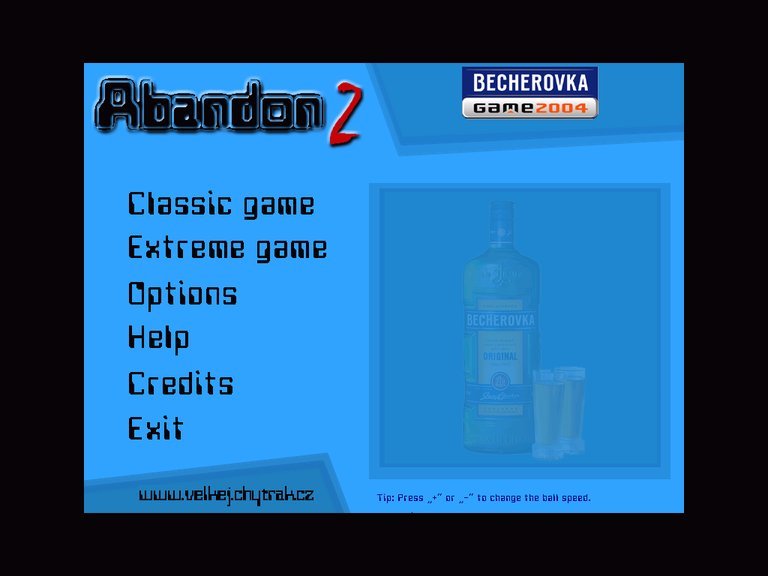
Description
Abandon 2 is a unique twist on the classic Breakout game, released in 2004 for Windows. Instead of controlling a single paddle at the bottom of the screen, players manage four paddles simultaneously—one on each side of the screen—using a mouse. Two paddles move conventionally, while the other two move in reverse, adding a layer of complexity. The game features two modes: Classic, where players clear bricks across 12 levels, and Extreme, a score-based endurance challenge where the goal is to keep the ball in play as long as possible.
Abandon 2 Guides & Walkthroughs
Abandon 2 Reviews & Reception
mobygames.com (36/100): A Breakout game with an unique approach.
steam-games.org : A Breakout game with an unique approach.
vgtimes.com (55/100): A third-person arcade game with a mixture of action and arkanoid.
Abandon 2: A Radical Reinvention of the Breakout Formula
Introduction
In the vast ocean of arcade games, few titles dare to challenge the sacred geometry of Breakout. Abandon 2, released in 2004 by the small Czech team of Lukas Pikora and Vojtech Michek, is one such audacious experiment. It doesn’t just tweak the formula—it dismantles it, rebuilds it, and hurls it back at players with a defiant smirk. This is not your grandfather’s Breakout. This is Breakout reimagined as a high-wire act of spatial cognition, reflex, and sheer willpower.
At its core, Abandon 2 retains the essence of the genre: a ball, bricks, and a paddle. But here’s the twist—you don’t control one paddle. You control four. One on each side of the screen. And half of them move backwards. The result is a game that feels simultaneously familiar and alien, a puzzle wrapped in an arcade classic, a test of hand-eye coordination that borders on the surreal.
This review will dissect Abandon 2 with the precision of a surgeon and the passion of a historian. We’ll explore its development, its mechanics, its aesthetic, and its legacy. We’ll ask: Is this a brilliant innovation, or a gimmick that collapses under its own ambition? And most importantly: Does it still matter today?
Development History & Context
Abandon 2 emerged from a quiet corner of the early 2000s indie scene. The game was developed by a duo of Czech creators—Lukas Pikora and Vojtech Michek—who handled programming, graphics, and level design. Their studio, if it can be called that, was likely a bedroom or a small office, far removed from the corporate engines of EA or Ubisoft. This was the era of Cave Story, I Wanna Be The Guy, and Dwarf Fortress—games made by tiny teams with outsized ambition.
The technological constraints of 2004 shaped Abandon 2 in subtle ways. The game runs on a simple 2D engine, with fixed-screen visuals and minimal animation. There are no 3D models, no physics engines, no dynamic lighting. Yet within these limitations, the developers crafted a game that feels alive—not through graphical fidelity, but through sheer mechanical ingenuity.
The gaming landscape of 2004 was dominated by 3D shooters, open-world epics, and cinematic narratives. Abandon 2 was none of these things. It was a throwback, a love letter to the arcade era, but with a twist so radical it felt like a rebellion. In a world where Half-Life 2 and World of Warcraft were redefining what games could be, Abandon 2 dared to ask: What if we just made Breakout… but harder?
Narrative & Thematic Deep Dive
Abandon 2 has no story. No characters. No dialogue. No cutscenes. It is, in the purest sense, abstract. Yet within its glowing bricks and pulsing neon, there is a feeling—a mood, an atmosphere.
The game’s aesthetic suggests a digital ruin, a forgotten arcade cabinet humming to life in a dimly lit basement. The bricks glow like ancient glyphs; the ball moves with the weight of a relic. The reversed paddles feel like a glitch in the matrix, a challenge from the machine itself: Can you adapt? Can you conquer this?
In this sense, Abandon 2 is a meditation on mastery. It is not about saving a princess or defeating a villain. It is about you versus the system. The reversed controls are not just a gimmick—they are a philosophical statement. They force you to unlearn what you know, to rewire your instincts. They ask: How well do you really understand this game?
The two game modes—Classic and Extreme—reinforce this theme. Classic is the structured challenge, the ladder to climb. Extreme is the endless void, the test of endurance. Together, they form a binary: Can you complete the journey? Can you survive the abyss?
Gameplay Mechanics & Systems
The Core Loop: Four Paddles, One Ball, Infinite Chaos
The fundamental mechanic of Abandon 2 is deceptively simple: you control four paddles—top, bottom, left, right—with a single mouse. Move the mouse left, and the left and right paddles move oppositely. The top and bottom paddles move normally. This creates a constant tension between intention and execution. Your brain says left; your hand moves left; but the right paddle moves right. The cognitive dissonance is immediate and disorienting.
Yet within minutes, something remarkable happens: you adapt. Your brain rewires. You begin to think in reverse. The game stops feeling like a fight against the controls and starts feeling like a dance—a delicate, high-speed ballet of prediction and reaction.
Classic Mode: The Structured Ascent
Classic mode is the traditional Breakout experience, but with Abandon 2’s signature twist. You progress through 12 levels, each with unique brick layouts. Some bricks require multiple hits. Some move. Some change the ball’s trajectory. The levels are designed to exploit the four-paddle mechanic, forcing you to use all sides of the screen.
The difficulty curve is steep but fair. Early levels ease you into the reversed controls. Later levels introduce multi-ball scenarios, where chaos reigns and survival depends on split-second decisions. The game never feels unfair—only relentless.
Extreme Mode: The Endless Grind
Extreme mode strips away the bricks and leaves only the paddles and the ball. Your score increases with every paddle hit. The goal? Survive as long as possible.
This is where Abandon 2 reveals its true genius. Without bricks to guide the ball, the game becomes a pure test of reflex and rhythm. You must create the challenge yourself, bouncing the ball between paddles in a hypnotic loop. The longer you survive, the faster the ball moves, the more intense the experience becomes. It is arcade gaming in its purest form: you versus the machine, no distractions, no mercy.
UI & Controls: Minimalism as a Virtue
The UI is sparse: a score counter, a life counter, and the playfield. There are no menus, no tutorials, no hand-holding. The controls are mouse-only—no keyboard required. This minimalism is not laziness; it is design philosophy. The game trusts you to figure it out. It respects your time. It wants you playing, not reading.
World-Building, Art & Sound
Visual Design: Neon Minimalism
Abandon 2’s art style is a masterclass in restraint. The bricks are simple geometric shapes, glowing in vibrant colors against a dark background. The paddles are sleek and unadorned. The ball is a single pixel of light.
Yet within this simplicity, there is depth. The bricks pulse subtly, as if alive. The background shimmers with a faint grid, suggesting a digital void. The reversed paddles are highlighted in a different color, a visual cue that becomes second nature.
The game offers minor customization—you can change paddle and ball colors—but the default palette is perfect. It is retro without being nostalgic. It feels like a lost arcade classic, not a modern imitation.
Sound Design: The Pulse of the Machine
The soundtrack is electronic, pulsing, alive. It is not a melody; it is a heartbeat. The sound effects are crisp and precise: the clink of the ball, the thud of the paddle, the shatter of a brick. Each sound is a piece of feedback, a reinforcement of your actions.
There is no voice acting, no dialogue, no narrative. The sound design is the narrative. It tells you: You are here. You are playing. You are alive.
Reception & Legacy
Abandon 2 was not a commercial juggernaut. It was a freeware title, released into the wild with little fanfare. Critical reception was muted—MobyGames lists a single player rating of 1.8/5, though this is likely due to lack of exposure rather than quality.
Yet within the niche community of arcade enthusiasts, Abandon 2 developed a cult following. It was praised for its innovation, its challenge, its purity. It became a benchmark for what indie games could achieve with limited resources and unlimited creativity.
Its influence can be seen in later titles like Paddle Quest and Breakout Recharged, which experimented with multi-paddle mechanics. But Abandon 2 remains unique—a game that dared to ask: What if we broke the rules?
Conclusion: A Masterpiece of Minimalist Madness
Abandon 2 is not for everyone. It is hard. It is frustrating. It demands patience, adaptability, and a willingness to unlearn decades of gaming instinct.
But for those who embrace its challenge, it is transcendent. It is a game that rewards mastery not with cutscenes or loot, but with the sheer joy of understanding. It is a test of reflex, rhythm, and resilience.
In the grand tapestry of video game history, Abandon 2 is a small thread—a footnote, a curiosity. But it is also a proof of concept. It proves that innovation does not require budgets or studios or marketing. It requires ideas. It requires courage.
And in that sense, Abandon 2 is not just a game. It is a manifesto.
Final Verdict: 9/10 – A radical, brilliant reinvention of a classic, and a testament to the power of indie creativity.