
- Release Year: 2006
- Platforms: Windows
- Publisher: Disky Communications Europe B.V.
- Genre: Compilation
- Game Mode: Single-player
- Average Score: 80/100
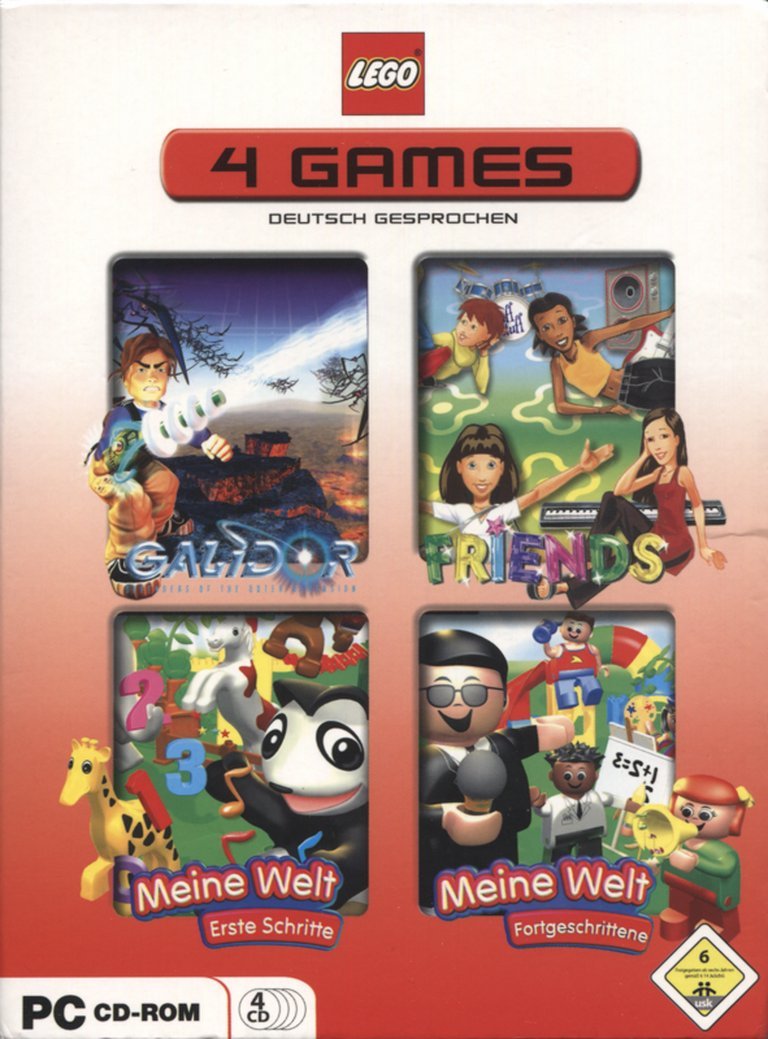
Description
LEGO: 4 Games (Red Edition) is a compilation released in 2006 for Windows, bundling four distinct LEGO-themed games: Galidor: Defenders of the Outer Dimension, LEGO Friends, LEGO My Style: Preschool, and LEGO My Style: Kindergarten. The collection offers a mix of adventure, creativity, and educational gameplay, targeting younger audiences with its colorful, block-based worlds and simple mechanics. Each game provides unique experiences, from action-packed sci-fi adventures to preschool-friendly activities, all tied together by the iconic LEGO brand.
LEGO: 4 Games (Red Edition) Reviews & Reception
ign.com (80/100): If you’re a parent, LEGO Star Wars: The Video Game should be at the top of your child’s birthday list.
LEGO: 4 Games (Red Edition) Cheats & Codes
LEGO Star Wars II: The Original Trilogy
| Code | Effect |
|---|---|
| NBP398 | Clown nose |
| CL4U5H | Santa hat and red clothes |
| TYH319 | White beard |
LEGO Star Wars III: The Clone Wars
| Code | Effect |
|---|---|
| mell07 | Savage Opress |
LEGO Pirates of the Caribbean: The Video Game
| Code | Effect |
|---|---|
| vdjspw | Jack Sparrow (dancing/musical) |
LEGO City Undercover (Wii U)
| Code | Effect |
|---|---|
| 3D74QF9 | High Speed Chase Bonus Mission 1 (Pursuit) |
| N7NN4F9 | High Speed Chase Bonus Mission 2 (Getaway) |
The LEGO Movie Videogame
| Code | Effect |
|---|---|
| 6LK78NN9 | Angry Kitty and Construction Pants |
| HVLH63VL | Angry Kitty and Construction Pants |
| 6LKMNDHR | Blacktron Fan and Musical Pants |
| HVLLRX6R | Blacktron Fan and Musical Pants |
| 6LK3FRL6 | Johnny Thunder and Super Secret Pants |
| HVL4TQT4 | Johnny Thunder and Super Secret Pants |
| 6LK3RRY4 | Robo Pilot and Astro Pants |
| HVL4TB94 | Robo Pilot and Astro Pants |
| BC2XJ5 | Vitruvius (Young) |
LEGO Ninjago Nindroids
| Code | Effect |
|---|---|
| DB3QWS | Bonezai |
| S9AM6U | Jay DX |
| 1F82MD | Lasha |
| YLG27K | Lloyd (Young) |
| 68XPG8 | Nindroid Drone |
| EA2MTD | P.I.X.A.L. (Bad) |
| JNV137 | Sensei Wu DX |
| CSQI3Q | Zane (Pink) |
LEGO Worlds
| Code | Effect |
|---|---|
| XP76VF | Cargo Helicopter (LEGO City) |
| BG7DWK | Getaway Car (LEGO City) |
| ND284C | Jungle Buggy (LEGO City) |
| XP3BN2 | Lance’s Driller (LEGO Nexo Knights) |
| LY9C8M | Lock & Roller (LEGO Nexo Knights) |
| YG43JH | Manta Ray Bomber (LEGO Ninjago the Movie) |
| U98BR2 | Pizza Van (LEGO City) |
| P42FJ6 | Police Car (LEGO City) |
| PPA72V | Tuk Tuk (LEGO Ninjago the Movie) |
The LEGO Ninjago Movie Video Game
| Code | Effect |
|---|---|
| D9TZ39 | Lloyd (Hoodie) |
LEGO Star Wars The Skywalker Saga
| Code | Effect |
|---|---|
| C3PHOHO | C-3PO (Holiday Special) |
| WOOKIEE | Chewbacca (Holiday Special) |
| WROSHYR | Darth Vader (Holiday Special) |
| TIPYIPS | D-O (Holiday Special) |
| LIFEDAY | Gonk Droid (Holiday Special) |
| KORDOKU | Poe Dameron (Holiday Special) |
| SHUTTLE | Resistance I-TS (Intersystem Transport Ship) |
| ARVALA7 | The Razor Crest |
LEGO Harry Potter: Years 1-4
Enter codes at the Leaky Cauldron terminal.
| Code | Effect |
|---|---|
| AUC8EH | Carrot Wands |
| H27KGC | Character Studs |
| HA79V8 | Character Token Detector |
| T7PVVN | Christmas |
| 4DMK2R | Disguise |
| J9U6Z9 | Extra Hearts |
| ZEX7MV | Fall Rescue |
| Z9BFAD | Fast Dig |
| FA3GQA | Fast Magic |
| 84QNQN | Gold Brick Detector |
| TTMC6D | Hogwarts Crest Detector |
| F88VUW | Ice Rink |
| QQWC6B | Invincibility |
| 7AD7HE | Red Brick Detector |
| 89ML2W | Regenerate Hearts |
| 74YKR7 | Score x2 |
| J3WHNK | Score x4 |
| XK9ANE | Score x6 |
| HUFV2H | Score x8 |
| H8X69Y | Score x10 |
| HZBVX7 | Silhouettes |
| BMEU6X | Singing Mandrake |
| 67FKWZ | Stud Magnet |
| VE9VV7 | Accio |
| QFB6NR | Anteoculatia |
| 6DNR6L | Calvorio |
| 9GJ442 | Colovaria |
| CD4JLX | Engorgio Skullus |
| MYN3NB | Entomorphis |
| ND2L7W | Flipendo |
| ERA9DR | Glacius |
| H8FTHL | Herbifors |
| YEB9Q9 | Incarcerous |
| 2M2XJ6 | Locomotor Mortis |
| JK6QRM | Multicorfors |
| UW8LRH | Redactum Skullus |
| 2UCA3M | Rictusempra |
| U6EE8X | Slugulus Eructo |
| UWDJ4Y | Stupefy |
| KWWQ44 | Tarentallegra |
| YZNRF6 | Trip Jinx |
| QE4VC7 | Gold Brick 01 |
| FY8H97 | Gold Brick 02 |
| 3MQT4P | Gold Brick 03 |
| PQPM7Z | Gold Brick 04 |
| ZY2CPA | Gold Brick 05 |
| 3GMTP6 | Gold Brick 06 |
| XY6VYZ | Gold Brick 07 |
| TUNC4W | Gold Brick 08 |
| EJ42Q6 | Gold Brick 09 |
| GFJCV9 | Gold Brick 10 |
| DZCY6G | Gold Brick 11 |
LEGO City Undercover
Enter codes in the Extras menu.
| Code | Effect |
|---|---|
| YCMWKP | Baseball Player |
| DWJVCT | Chan’s Drakonas |
| WRSKVC | Roman Soldier |
| FHSZYG | Ninja |
| CQSZBJ | Classic Alien |
| VZHHDM | Relocator vehicle |
| HVGTPG | Disguised Natalia Kowalski |
| XKGZVJ | Gorilla Suit Guy |
| MRPHVQ | Karate Guy |
| SSVKCT | Minotaur |
| NRRXYM | Pharaoh |
| CNCNRH | Pop Star |
| MHHRHM | Racecar Driver |
| RJYZHC | Samurai Warrior |
| SYFMWJ | Soccer Player |
| GYSTQP | Werewolf |
| DWJVCT | Drakonas vehicle |
| 3D74QF9 | Bonus mission one |
| 3GCC7XR | Bonus mission two |
LEGO: 4 Games (Red Edition): A Forgotten Compilation of Early LEGO Digital Experiments
Introduction
In the vast, colorful universe of LEGO video games, LEGO: 4 Games (Red Edition) (2006) stands as a curious artifact—a budget compilation that bundles four distinct titles from the late 1990s and early 2000s, a period when LEGO was still tentatively exploring the digital frontier. Released exclusively on Windows by Disky Communications Europe B.V., this collection is a time capsule of experimental gameplay, educational ambitions, and the fledgling steps of a franchise that would later dominate family-friendly gaming. While it lacks the polish and cultural resonance of later hits like LEGO Star Wars or LEGO Batman, Red Edition offers a fascinating glimpse into the creative chaos of early LEGO gaming—a world where brick-building mechanics were still being defined, and the line between toy and game was delightfully blurred.
This review will dissect LEGO: 4 Games (Red Edition) in exhaustive detail, analyzing its historical context, gameplay diversity, thematic inconsistencies, and its overlooked role in shaping the LEGO gaming identity. Far from a mere footnote, this compilation is a testament to the franchise’s willingness to experiment, fail, and iterate—a process that would eventually lead to its global dominance.
Development History & Context
The Studio and the Era
The late 1990s and early 2000s were a tumultuous time for licensed video games. The industry was transitioning from 2D to 3D, and developers were grappling with how to adapt beloved toys and franchises into interactive experiences. LEGO, already a household name in physical play, was eager to establish a digital foothold. However, unlike later entries developed by Traveller’s Tales (the studio behind LEGO Star Wars and LEGO Batman), the games in Red Edition were created by a variety of developers, each with their own vision of what a “LEGO game” could be.
- LEGO Friends (1999) and LEGO My Style: Preschool/Kindergarten (2000) were developed by LEGO Media International, a now-defunct subsidiary of the LEGO Group that focused on multimedia projects. These titles were part of a broader push to create educational software for young children, capitalizing on the LEGO brand’s association with creativity and learning.
- Galidor: Defenders of the Outer Dimension (2005), the outlier of the collection, was developed by Saffire Corporation and based on a short-lived LEGO action figure line. Its inclusion in Red Edition is particularly intriguing, as it represents a rare attempt by LEGO to compete in the action-adventure genre, far removed from the brick-building simulators that would later define the franchise.
The compilation itself was published by Disky Communications Europe B.V., a Dutch company known for distributing budget software collections. Red Edition was one of several LEGO-themed compilations released in the mid-2000s, including the Green Edition (which featured different titles) and the later 10 Lego PC Games: Collectors Box (2007). These compilations were marketed as affordable family entertainment, often sold in bargain bins or bundled with hardware.
Technological Constraints
The games in Red Edition were developed during a period of rapid technological change. The late 1990s saw the rise of 3D acceleration, but many educational and budget titles still relied on 2D sprites and simple polygon models to ensure compatibility with lower-end PCs. This technological limitation is evident in the visual design of LEGO Friends and LEGO My Style, which use a mix of pre-rendered 3D backgrounds and 2D character sprites—a common approach for children’s software of the era.
Galidor, by contrast, attempts a fully 3D action-adventure experience, albeit with rudimentary physics and clunky controls. Its inclusion in the compilation highlights the tension between LEGO’s desire to innovate and the technical realities of budget game development.
The Gaming Landscape
In 1999–2000, the gaming landscape was dominated by platformers, first-person shooters, and real-time strategy games. Educational software was a niche but lucrative market, with titles like The Oregon Trail and Reader Rabbit proving that games could be both fun and instructional. LEGO’s foray into this space was a natural extension of its brand, but it faced stiff competition from established players like Broderbund and The Learning Company.
The inclusion of Galidor in Red Edition is particularly noteworthy, as it reflects LEGO’s brief flirtation with action-oriented gaming. At the time, action-adventure games like Tomb Raider and Zelda were wildly popular, and LEGO saw an opportunity to capitalize on this trend. However, Galidor’s lackluster reception demonstrated that LEGO’s strengths lay elsewhere—in creativity, humor, and family-friendly appeal rather than high-octane action.
Narrative & Thematic Deep Dive
A Fragmented Anthology
LEGO: 4 Games (Red Edition) is not a single cohesive experience but rather a fragmented anthology of four distinct games, each with its own narrative (or lack thereof) and thematic focus. This fragmentation is both the compilation’s greatest strength and its most glaring weakness. On one hand, it offers a diverse range of gameplay styles, from educational minigames to action-adventure. On the other, it lacks the unified vision that would later define LEGO’s most successful titles.
1. LEGO Friends (1999)
- Plot and Setting: LEGO Friends is a virtual playset that simulates a suburban neighborhood where children can interact with LEGO minifigures, build simple structures, and engage in open-ended play. There is no traditional narrative; instead, the game encourages players to create their own stories through exploration and experimentation.
- Themes: The game’s themes revolve around friendship, creativity, and community. It reflects LEGO’s core philosophy of “play well,” emphasizing cooperation and imaginative play. However, its lack of structured goals or challenges may leave some players adrift, unsure of what to do beyond the initial novelty.
- Characters and Dialogue: The game features generic LEGO minifigures with no distinct personalities or voices. Dialogue is limited to text bubbles with simple, child-friendly phrases like “Let’s play!” or “Build something fun!” This minimalist approach to characterization is both a strength (it allows children to project their own ideas onto the characters) and a weakness (it lacks the charm and humor of later LEGO games).
2. LEGO My Style: Preschool/Kindergarten (2000)
- Plot and Setting: These two games (often bundled together) are educational titles designed to teach basic skills like counting, shape recognition, and problem-solving. Preschool focuses on simpler activities for younger children, while Kindergarten introduces slightly more complex challenges.
- Themes: The themes here are explicitly educational, with a focus on early childhood development. The games use LEGO’s colorful, tactile aesthetic to make learning feel like play, a strategy that aligns with LEGO’s broader mission to blend education and entertainment.
- Characters and Dialogue: Like LEGO Friends, these games feature generic minifigures with minimal dialogue. The emphasis is on clear, concise instructions rather than storytelling, which makes sense given the target audience but results in a somewhat sterile experience.
3. Galidor: Defenders of the Outer Dimension (2005)
- Plot and Setting: Galidor is the odd one out in the compilation. Based on a short-lived LEGO action figure line, the game follows the adventures of a young hero named Nick Bluetooth (yes, that’s his name) as he battles the evil Gorm in a sci-fi universe. The game is a 3D action-adventure title with platforming and combat elements.
- Themes: Galidor attempts to blend classic hero’s journey tropes with LEGO’s signature humor and creativity. However, its execution is uneven. The game’s tone oscillates between earnest sci-fi adventure and self-aware silliness, never quite finding a consistent voice. Themes of bravery, teamwork, and perseverance are present but underdeveloped.
- Characters and Dialogue: Galidor features a cast of original characters, including Nick Bluetooth, his robot sidekick, and a roster of villains. The dialogue is more expansive than in the other games, with voice acting and cutscenes that attempt to drive the narrative forward. However, the writing is often clunky, and the voice acting lacks the polish of later LEGO titles. The game’s attempt at humor falls flat more often than not, making it feel like a missed opportunity.
Underlying Themes and Missed Opportunities
While the games in Red Edition are thematically disparate, they collectively highlight LEGO’s early struggles to define its digital identity. The educational titles (LEGO Friends, LEGO My Style) emphasize creativity and learning, but their open-ended nature sometimes feels aimless. Galidor, meanwhile, represents an ambitious but flawed attempt to break into the action-adventure genre.
The compilation’s greatest missed opportunity is its failure to unify these disparate experiences under a single cohesive vision. Later LEGO games would excel at blending humor, storytelling, and gameplay into a seamless whole, but Red Edition feels like a grab bag of ideas rather than a carefully curated collection.
Gameplay Mechanics & Systems
A Study in Contrasts
The gameplay mechanics in LEGO: 4 Games (Red Edition) are as varied as the themes, ranging from open-ended sandbox play to linear action-adventure. This diversity is both a strength and a weakness, offering something for different types of players but also resulting in an inconsistent experience.
1. LEGO Friends (1999)
- Core Gameplay Loop: LEGO Friends is a virtual dollhouse where players can explore a neighborhood, interact with objects, and build simple structures. The game is divided into several locations, including a house, a park, and a school, each filled with interactive elements.
- Building Mechanics: The building system is rudimentary by modern standards. Players can snap together pre-fabricated LEGO pieces to create structures, but there’s little freedom to design custom creations. The game’s physics are simplistic, with no real sense of weight or stability.
- Exploration and Interaction: Players can click on objects and characters to trigger animations or minigames. For example, clicking on a soccer ball might start a kicking animation, while clicking on a LEGO set might initiate a simple building challenge.
- UI and Controls: The UI is designed for young children, with large, colorful buttons and clear visual feedback. However, the controls can feel clunky, especially when trying to manipulate objects in 3D space.
2. LEGO My Style: Preschool/Kindergarten (2000)
- Core Gameplay Loop: These games are structured around a series of educational minigames, each designed to teach a specific skill. For example, Preschool might include a game where players match shapes, while Kindergarten features a counting challenge.
- Educational Mechanics: The games use a reward system where players earn virtual LEGO bricks for completing tasks. These bricks can then be used to “build” simple structures, reinforcing the connection between learning and creativity.
- UI and Controls: The UI is even more simplified than in LEGO Friends, with large, easy-to-click buttons and minimal text. The controls are straightforward, but the games can feel repetitive after extended play.
3. Galidor: Defenders of the Outer Dimension (2005)
- Core Gameplay Loop: Galidor is a linear action-adventure game with platforming, combat, and puzzle-solving elements. Players control Nick Bluetooth as he navigates through a series of levels, battling enemies and collecting power-ups.
- Combat and Platforming: The combat system is simple, with basic attacks and a limited range of moves. Platforming sections are similarly straightforward, with jump-and-run mechanics that feel dated even by 2005 standards.
- Puzzle-Solving: The game includes occasional puzzles, such as moving blocks to create paths or activating switches to open doors. These puzzles are rarely challenging, but they add a layer of depth to the gameplay.
- UI and Controls: The UI is functional but uninspired, with a health bar, inventory system, and minimap. The controls are responsive but lack the precision of modern action-adventure games.
Innovative or Flawed Systems?
The games in Red Edition are not particularly innovative by today’s standards, but they do offer a fascinating look at the evolution of LEGO’s digital gameplay.
- Building Mechanics: The building systems in LEGO Friends and LEGO My Style are primitive compared to later titles like LEGO Worlds or LEGO Builder’s Journey. However, they represent early attempts to translate the tactile joy of LEGO building into a digital format. The lack of freedom in these systems is a major flaw, but it’s understandable given the technological constraints of the era.
- Educational Integration: The educational minigames in LEGO My Style are well-intentioned but often feel like shallow edutainment. They lack the depth and engagement of later educational games like Minecraft: Education Edition or Kerbal Space Program.
- Action-Adventure Experimentation: Galidor’s attempt to blend action, platforming, and puzzle-solving is ambitious but ultimately unsuccessful. The game’s clunky controls and repetitive gameplay highlight the challenges of adapting LEGO’s brand to a genre that demands precision and polish.
World-Building, Art & Sound
Visual Design: A Clash of Styles
The visual design of LEGO: 4 Games (Red Edition) is a mixed bag, reflecting the disparate origins of its component games.
- LEGO Friends and LEGO My Style: These games use a bright, colorful aesthetic that closely mimics the look of physical LEGO sets. The environments are pre-rendered 3D models with 2D sprites for characters and objects. While charming, the visuals feel dated, with low-resolution textures and simplistic animations.
- Galidor: Galidor attempts a more ambitious 3D style, with fully rendered environments and character models. However, the game’s visuals are hampered by technical limitations, resulting in muddy textures and stiff animations.
Sound Design: Minimalist and Functional
The sound design in Red Edition is similarly uneven.
- LEGO Friends and LEGO My Style: These games feature cheerful, upbeat music and simple sound effects (e.g., the clinking of LEGO bricks). The audio is functional but unmemorable, serving its purpose without adding much to the overall experience.
- Galidor: Galidor includes voice acting and a more robust soundtrack, but the quality is inconsistent. The voice acting is often stiff, and the music lacks the memorable hooks of later LEGO games.
Atmosphere: A Sense of Potential
Despite their flaws, the games in Red Edition share a sense of potential—a feeling that LEGO was on the cusp of something greater. The bright colors, playful designs, and emphasis on creativity hint at the franchise’s future success, even if the execution is uneven.
Reception & Legacy
Critical and Commercial Reception
LEGO: 4 Games (Red Edition) received little critical attention upon release, likely due to its status as a budget compilation. The games it contains were similarly overlooked, with Galidor being the only title to receive any significant coverage—and even then, the reception was lukewarm.
- LEGO Friends and LEGO My Style: These games were praised for their educational value but criticized for their lack of depth and repetitive gameplay. Parents and educators appreciated their child-friendly design, but reviewers noted that they lacked the polish of competing educational software.
- Galidor: Galidor was met with mixed reviews. Some critics appreciated its attempt to bring LEGO into the action-adventure genre, but most found the gameplay clunky and the story unengaging. The game’s short length and lack of replayability were also common complaints.
Evolution of the Franchise
Despite its modest reception, Red Edition played a small but important role in the evolution of the LEGO gaming franchise. The compilation’s experiments with open-ended play, educational mechanics, and action-adventure gameplay laid the groundwork for future successes.
- From Edutainment to Blockbusters: The educational focus of LEGO Friends and LEGO My Style would later evolve into more sophisticated titles like LEGO Builder’s Journey, which blends puzzle-solving with creative building. Meanwhile, the action-adventure elements of Galidor foreshadowed the success of LEGO Star Wars and LEGO Batman, which proved that LEGO could thrive in the action genre when paired with strong licenses and polished gameplay.
- The Rise of Compilations: Red Edition was part of a broader trend of LEGO game compilations in the mid-2000s. While these collections were often overlooked, they helped establish LEGO as a viable brand in the gaming space, paving the way for the franchise’s later dominance.
Influence on the Industry
LEGO: 4 Games (Red Edition) is not a landmark title in the history of video games, but it is a fascinating case study in how a beloved brand can experiment, iterate, and ultimately find its footing in a new medium. The compilation’s failures are as instructive as its successes, demonstrating the importance of unified vision, polished execution, and strong licensing in creating a lasting gaming franchise.
Conclusion: A Flawed but Fascinating Artifact
LEGO: 4 Games (Red Edition) is not a great game—it is, in many ways, a flawed and forgotten relic of a bygone era. However, it is also a fascinating artifact that offers valuable insights into the evolution of the LEGO gaming franchise. The compilation’s diverse gameplay styles, uneven execution, and experimental spirit highlight the challenges and opportunities that LEGO faced as it transitioned from physical toys to digital experiences.
While Red Edition lacks the polish, humor, and cultural resonance of later LEGO titles, it deserves recognition as an important stepping stone in the franchise’s journey. It is a reminder that even the most successful franchises begin with humble, imperfect experiments—and that failure is often the first step toward greatness.
Final Verdict: LEGO: 4 Games (Red Edition) is a curiosity for LEGO historians and retro gaming enthusiasts, but it is not a must-play experience. Its value lies in its historical context rather than its gameplay, offering a glimpse into the creative chaos that preceded LEGO’s rise to gaming dominance. For those interested in the evolution of the franchise, it is a fascinating time capsule. For everyone else, it is a reminder of how far LEGO has come. 6/10 – A flawed but important piece of LEGO gaming history.