
- Release Year: 2004
- Platforms: Macintosh, Windows
- Publisher: Larivière Jeunesse
- Genre: Educational, History
- Game Mode: Single-player
- Gameplay: Art Studio, Coloring
- Setting: Ancient Egypt
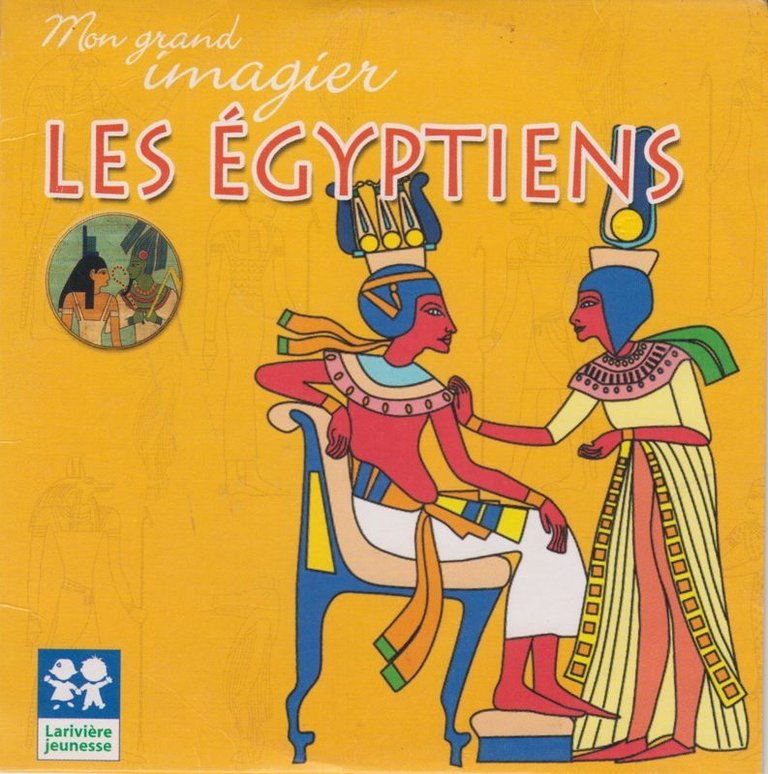
Description
Mon Grand Imagier: Les Egyptiens is an educational game that introduces players to ancient Egyptian architecture, specifically the temple of Karnak and Cheops’ pyramid, while also serving as an art studio program. It allows users to create coloring books, invitations, and writing paper using Egyptian-themed patterns and designs.
Mon Grand Imagier: Les Egyptiens – A Deep Dive into an Overlooked Edutainment Gem
Introduction: Uncovering a Hidden Treasure of Educational Gaming
In the vast landscape of video game history, certain titles slip through the cracks of mainstream recognition, yet their contributions to niche genres remain invaluable. Mon Grand Imagier: Les Egyptiens (2004), developed and published by Larivière Jeunesse, is one such title—a hybrid of educational software and creative tool that sought to immerse young players in the wonders of ancient Egypt. While it may not have the name recognition of Civilization or Assassin’s Creed, this French edutainment title stands as a fascinating artifact of early 2000s educational gaming, blending historical exploration with artistic expression.
This review aims to dissect Mon Grand Imagier: Les Egyptiens in exhaustive detail, examining its development context, educational and creative mechanics, and its place within the broader history of historical video games. Though often overlooked, this game offers a unique lens into how developers approached interactive learning in the pre-smartphone era, and how it attempted to make history tangible for children.
Development History & Context: The Rise of Edutainment in the Early 2000s
The Studio Behind the Game: Larivière Jeunesse
Larivière Jeunesse, a French publisher specializing in children’s educational software, was part of a wave of companies in the late 1990s and early 2000s that sought to merge entertainment with learning. Unlike larger studios focused on blockbuster titles, Larivière Jeunesse catered specifically to younger audiences, creating software that aligned with school curricula while incorporating playful, interactive elements.
The studio’s output was modest but purposeful, with titles like Mon Premier Karaoké (2015) and Mon Bazou (2021) demonstrating a commitment to child-friendly creativity. Mon Grand Imagier: Les Egyptiens fit squarely within this philosophy, targeting children aged 6–12 with a dual focus: teaching them about ancient Egyptian architecture and empowering them to create their own Egypt-themed art.
Technological Constraints and Design Philosophy
Released in 2004 for Windows and Macintosh, Mon Grand Imagier was constrained by the hardware limitations of its time. Unlike modern educational games that leverage 3D rendering and real-time interactivity, this title relied on 2D graphics, pre-rendered images, and a straightforward point-and-click interface. The game’s simplicity was not a flaw but a deliberate choice—it prioritized accessibility and ease of use for its young audience.
The early 2000s were a transitional period for edutainment software. The market was moving away from the CD-ROM-based “digital encyclopedia” model of the 1990s (e.g., Encarta, The Oregon Trail) toward more interactive, game-like experiences. Mon Grand Imagier embodied this shift by combining factual content with creative tools, allowing children to engage with history in a hands-on way rather than passively consuming information.
The Gaming Landscape in 2004
In 2004, the gaming industry was dominated by major franchises like Halo 2, World of Warcraft, and Grand Theft Auto: San Andreas. Educational games, while present, were often relegated to a secondary market. However, titles like The Sims 2 (which included educational elements) and Zoo Tycoon proved that learning could be seamlessly integrated into gameplay.
Mon Grand Imagier did not compete with these blockbusters. Instead, it occupied a quiet but important niche: the home and classroom. Its target audience was not hardcore gamers but parents and educators looking for software that could supplement history lessons. In this regard, it was part of a broader tradition of French edutainment, which included titles like Adi and Les Schtroumpfs educational games.
Narrative & Thematic Deep Dive: History as a Creative Playground
The Game’s Dual Identity: Education and Artistry
Mon Grand Imagier: Les Egyptiens is not a game in the traditional sense. It lacks a linear narrative, characters, or progression systems. Instead, it functions as an interactive digital workbook divided into two core components:
-
The Historical Introduction – A guided tour of two iconic Egyptian structures:
- The Temple of Karnak: Players explore the layout, significance, and architectural features of this vast religious complex.
- The Great Pyramid of Cheops (Khufu): The game provides a virtual walkthrough of the pyramid’s chambers, explaining its construction and purpose.
The historical content is presented through text, images, and simple animations. While not as immersive as modern VR experiences, it was an early attempt to make ancient history accessible to children through digital media.
-
The Art Studio – A creative suite where players can:
- Design coloring books featuring Egyptian motifs (hieroglyphs, gods, pharaohs).
- Craft invitations and writing paper adorned with Egyptian patterns.
- Experiment with digital tools to create their own Egypt-inspired artwork.
This dual structure reflects the game’s thesis: history is not just something to be learned but something to be interacted with and reimagined.
Themes: Empowering Young Historians and Artists
The game’s underlying themes revolve around:
– Cultural Appreciation: By focusing on Egyptian art and architecture, it encourages players to engage with a civilization often mythologized in Western media.
– Creative Learning: The art studio component reinforces the idea that history can inspire creativity, not just rote memorization.
– Accessibility: The game avoids complex mechanics, ensuring that even young children can navigate its features independently.
While the game does not delve into deeper historical contexts (e.g., the socio-political dynamics of ancient Egypt), its simplicity is its strength. It serves as a gateway for children to develop an interest in history before moving on to more complex material.
Gameplay Mechanics & Systems: A Digital Crafting Tool
Core Gameplay Loop: Explore, Learn, Create
Mon Grand Imagier operates on a non-linear, sandbox-like structure. Players can:
1. Explore the Historical Sections – Click through images and text to learn about Karnak and the Great Pyramid.
2. Engage with the Art Studio – Use pre-loaded templates or blank canvases to design Egypt-themed projects.
3. Save and Print Creations – A practical feature that allowed children to share their work physically, bridging the digital and analog worlds.
UI and Usability: Designed for Young Users
The user interface is minimalist, with large buttons, clear icons, and intuitive navigation. This was essential for its target demographic, as children in the early 2000s were not yet as digitally literate as today’s youth. The game’s design adheres to the “no wrong answers” philosophy—players cannot fail, only experiment.
Innovations and Limitations
Innovations:
– Integration of Learning and Play: Unlike traditional educational software that quizzed players, Mon Grand Imagier encouraged open-ended creativity.
– Printable Outputs: The ability to print coloring books and stationery was a novel feature that extended the game’s utility beyond the screen.
Limitations:
– Lack of Interactivity in Historical Sections: The historical content is largely static, with no quizzes, puzzles, or interactive elements to reinforce learning.
– Limited Replayability: Once players exhausted the art templates, there was little incentive to return, as the game lacked procedural generation or updates.
World-Building, Art & Sound: A Stylized Journey to Ancient Egypt
Visual Design: Authentic Yet Child-Friendly
The game’s art style strikes a balance between historical accuracy and accessibility. The illustrations of Karnak and the Great Pyramid are based on real architectural plans, but they are rendered in a bright, cartoonish style that appeals to children. The coloring book templates feature simplified yet recognizable Egyptian motifs, such as:
– Anubis and other deities.
– Hieroglyphic borders.
– Pharaohs in regal poses.
The visuals avoid the “dark and gritty” aesthetic often associated with Egypt in pop culture (e.g., The Mummy films), instead opting for a vibrant, inviting palette.
Sound Design: Minimal but Effective
Given its educational focus, Mon Grand Imagier does not feature a complex soundtrack. Instead, it uses subtle ambient sounds—soft instrumental music reminiscent of traditional Egyptian melodies—to enhance immersion during the historical sections. The art studio mode is largely silent, allowing children to focus on their creations without distraction.
Atmosphere: A Safe Space for Exploration
The game’s atmosphere is one of curiosity and wonder. It does not attempt to simulate the “danger” or “mystery” of Egypt (unlike adventure games like Egypt 1156 B.C.) but instead presents it as a place of beauty and creativity. This aligns with its goal of making history feel approachable rather than intimidating.
Reception & Legacy: The Quiet Impact of a Niche Title
Critical and Commercial Reception
Mon Grand Imagier: Les Egyptiens received little to no coverage in major gaming publications, as it was not marketed toward traditional gamers. However, within French educational circles, it was likely well-received for its simplicity and alignment with school curricula. The lack of reviews on platforms like MobyGames and Metacritic suggests it remained a niche product, primarily distributed through schools and specialty software retailers.
Evolution of Edutainment Post-2004
The game’s legacy lies in its representation of a transitional era in edutainment. By the mid-2000s, educational software began shifting toward:
– Gamification (e.g., Brain Age, Typing of the Dead).
– Online Interactivity (e.g., JumpStart’s web-based games).
– Mobile Learning (e.g., Duolingo, Khan Academy).
Mon Grand Imagier was a precursor to these trends, proving that children’s software could be both educational and creative. However, its lack of digital updates or sequels meant it faded into obscurity as more dynamic platforms emerged.
Influence on Later Games
While Mon Grand Imagier did not directly inspire major titles, its hybrid approach (combining history with creativity) can be seen in later games such as:
– Minecraft: Education Edition – Allows students to build historical structures.
– Assassin’s Creed: Discovery Tour – A non-combat mode focused on exploring ancient civilizations.
– Civilization VI’s “Interactive Historical Scenarios” – Blends strategy with educational content.
These modern titles owe a debt to early edutainment software like Mon Grand Imagier, which demonstrated that history could be engaging when paired with interactive tools.
Conclusion: A Small but Significant Footnote in Gaming History
Mon Grand Imagier: Les Egyptiens is not a game that will appear on “best of” lists or retrospective documentaries. It lacks the depth of Civilization, the narrative ambition of Assassin’s Creed, or the mechanical complexity of Age of Empires. Yet, within its modest scope, it achieves something remarkable: it makes history feel like play.
For children in 2004, this game was more than software—it was a portal to creativity, a way to engage with the past without the pressure of tests or quizzes. Its greatest strength was its simplicity, and its greatest weakness was its inability to evolve beyond its initial design.
Final Verdict: 7/10 – A Charming, If Limited, Educational Experiment
- For Historians & Educators: A fascinating artifact of early 2000s edutainment, worth preserving for its innovative blend of learning and art.
- For Gamers: Too simplistic for modern audiences, but a nostalgic curiosity for those who grew up with early children’s software.
- For Developers: A case study in how to make educational content accessible and fun without sacrificing historical integrity.
Mon Grand Imagier: Les Egyptiens may be forgotten, but its spirit lives on in every game that dares to teach by letting players create, explore, and imagine. In the grand tapestry of video game history, it is a small but meaningful thread—one that reminds us that the best educational tools are those that inspire as much as they inform.
Further Reading & Exploration:
– For those interested in historical games, explore Assassin’s Creed: Origins or Total War: Pharaoh for deeper dives into ancient Egypt.
– Educators seeking modern edutainment tools should investigate Minecraft: Education Edition or Kerbal Space Program.
– To experience Mon Grand Imagier today, check archives like Internet Archive or retro gaming repositories.
Mon Grand Imagier: Les Egyptiens proves that even the most overlooked games have stories worth telling—and lessons worth learning.*