
- Release Year: 2009
- Platforms: Windows
- Publisher: GameTop
- Developer: GameTop
- Genre: Driving, Racing
- Perspective: 3rd-person
- Game Mode: Single-player
- Gameplay: Nitro Boost, Obstacle Courses, Off-roading, Time-based challenges, Tricks, Vehicular
- Setting: Obstacle Courses
- Average Score: 67/100
Description
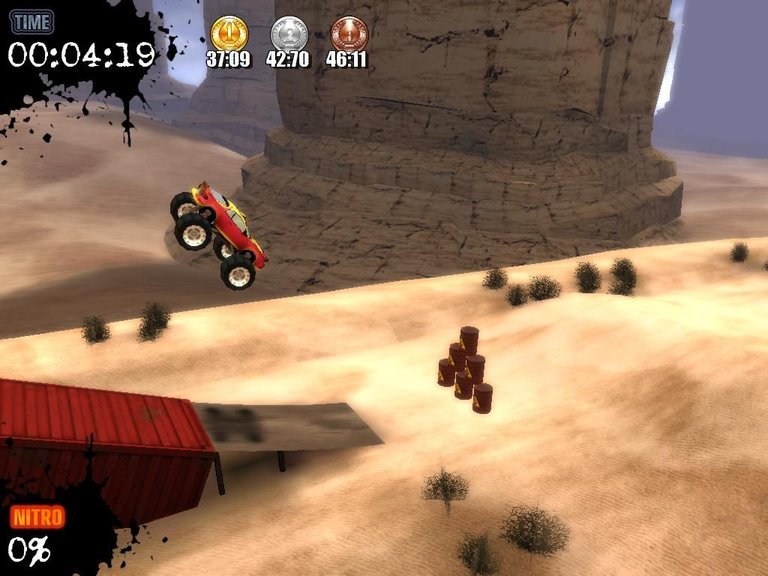
Monster Truck Challenge is a high-energy racing game released in 2009, where players navigate monster trucks through obstacle-filled courses against the clock. Featuring exaggerated physics akin to Elasto Mania and gameplay reminiscent of the Trials series, the game offers a 2.5D perspective with a fixed camera, allowing for dynamic stunts and nitro-boosted speed. Players can collect medals to unlock new trucks while performing tricks and mastering off-road challenges in a single-route, time-limited environment.
Monster Truck Challenge Cracks & Fixes
Monster Truck Challenge Reviews & Reception
metacritic.com (67/100): A surprisingly enjoyable off-road licence which never impresses visually, but manages to combine good handling and a wealth of tracks and arenas to create the right chemistry for a shallow but very playable dip into an ironically droll and niche motorsport.
lanoc.org : It isn’t the only monster truck offering, but smashing cars, doing tricks, drag races, and normal races all piqued my interest.
gametyrant.com : The game definitely isn’t without its flaws, so let’s get into the breakdown of why I recommend this title a bit more than I would the former monster truck game.
Monster Truck Challenge Cheats & Codes
Nintendo 64
Enter codes at the password screen.
| Code | Effect |
|---|---|
| YRDR | Low-rider trucks |
| JMPNG | Alternate Textures |
| Y-WNT-T | Unlimited missiles |
| CFFNYN | Turbo Mode |
| BRPS | Gut Bomb |
| JMPR | Change Track Color |
| L + R + All 4 c’s | Always Have Jet-pack |
| C-Down, C-Up, A, Z, R, B | Packer Smasher Truck |
| HVR PNK | Unlimited Hover |
Nintendo 64 (GameShark)
Enter codes using a GameShark device.
| Code | Effect |
|---|---|
| D0014B34 00?? | Activator 1 P1 |
| D0014B35 00?? | Activator 2 P1 |
| D1014B34 ???? | Dual Activator P1 |
| 801256BF 0001 | Have Aztec Valley Track |
| 801256DF 0001 | Have Alpine Challenge Track |
| 801256FF 0001 | Have Death Trap Track |
| 811A671C 3C00 | Stop Timer |
| 811A5EF4 CECE | Lots Of Points-Summit Rumble |
| 81123556 0080 | Low Rider Trucks |
| 81123556 0040 | Always Have Hover Mode |
| 81123556 1000 | Weird Mode |
| 80123555 0008 | Gut Bomb |
| 81123556 0020 | Full Time Missiles |
| 81123556 0800 | Alternate Textures |
| D0164BBF 0001 | FAKE Always Place 1st |
| 811A5F30 0000 | FAKE Always Place 1st |
| D0014B35 0020 | Press L For Low Timer (Everyone) |
| 811A671C 3E00 | Press L For Low Timer (Everyone) |
| D0164BBF 0001 | Infinite Missiles (Upon Pickup) |
| 801A6054 0009 | Infinite Missiles (Upon Pickup) |
| D11A5F2E 00FF | No Laps To Race (GS 3.0 Or Higher Needed!) |
| 801A5F2F 0002 | No Laps To Race (GS 3.0 Or Higher Needed!) |
| 8015B4DB 00?? | Soccer Ball & Hockey Puck Height Modifiers |
| 8015E6F3 00?? | Soccer Ball & Hockey Puck Height Modifiers |
| D0014B35 0020 | Moon Jump-Graveyard |
| 811A6058 0000 | Moon Jump-Graveyard |
| D0014B35 0020 | Moon Jump-Graveyard |
| 811A605A 0001 | Moon Jump-Graveyard |
| D0014B35 0010 | Moon Jump-Graveyard |
| 802B213B 0001 | Moon Jump-Graveyard |
| 803115BA 0002 | Drive Through Walls Codes |
| 8033A7DA 0002 | Drive Through Walls Codes |
| 80312ADA 0002 | Drive Through Walls Codes |
| 802B572A 0002 | Drive Through Walls Codes |
| 80335812 0002 | Drive Through Walls Codes |
| 80305562 0002 | Drive Through Walls Codes |
| 8034BE8A 0002 | Drive Through Walls Codes |
| 8032142A 0002 | Drive Through Walls Codes |
| 802A7BF2 0002 | Drive Through Walls Codes |
| 802B308A 0002 | Drive Through Walls Codes |
| 803115B9 0000 | Invisibility Codes |
| 8033A7D9 0000 | Invisibility Codes |
| 80312AD9 0000 | Invisibility Codes |
| 802B5729 0000 | Invisibility Codes |
| 80335811 0000 | Invisibility Codes |
| 80305561 0000 | Invisibility Codes |
| 8034BE89 0000 | Invisibility Codes |
| 80321429 0000 | Invisibility Codes |
| 802A7BF1 0000 | Invisibility Codes |
| 802B3089 0000 | Invisibility Codes |
| 891A6054 00FF | GS Button For 255 Homing Missiles |
| 891A6058 0000 | GS Button For Item |
| 891A605A 000X | GS Button For Item |
| 801A605B 00XX | Item Modifier 1 |
| 801A605B 0006 | Infinite Missiles |
| 801A6054 0003 | Infinite Missiles |
| 803115BA 0002 | Drive Through Walls Codes |
| 8033A7DA 0002 | Drive Through Walls Codes |
| 80312ADA 0002 | Drive Through Walls Codes |
| 802B572A 0002 | Drive Through Walls Codes |
| 80335812 0002 | Drive Through Walls Codes |
| 80305562 0002 | Drive Through Walls Codes |
| 8034BE8A 0002 | Drive Through Walls Codes |
| 8032142A 0002 | Drive Through Walls Codes |
| 802A7BF2 0002 | Drive Through Walls Codes |
| 802B308A 0002 | Drive Through Walls Codes |
| 803115B9 0000 | Invisibility Codes |
| 8033A7D9 0000 | Invisibility Codes |
| 80312AD9 0000 | Invisibility Codes |
| 802B5729 0000 | Invisibility Codes |
| 80335811 0000 | Invisibility Codes |
| 80305561 0000 | Invisibility Codes |
| 8034BE89 0000 | Invisibility Codes |
| 80321429 0000 | Invisibility Codes |
| 802A7BF1 0000 | Invisibility Codes |
| 802B3089 0000 | Invisibility Codes |
Monster Truck Challenge: A Forgotten Gem in the Shadow of Giants
Introduction
In the vast, mud-splattered arena of monster truck video games, Monster Truck Challenge (2009) stands as a curious footnote—a title that slipped through the cracks of gaming history, overshadowed by its more illustrious predecessors and successors. Developed and published by GameTop, this Windows-exclusive racing game arrived at a time when the genre was already crowded with heavyweights like Monster Truck Madness (1996) and Monster Jam: Maximum Destruction (2002). Yet, Monster Truck Challenge carved out its own niche with a unique blend of exaggerated physics, time-sensitive obstacle courses, and a progression system tied to medal collection.
This review aims to resurrect Monster Truck Challenge from obscurity, examining its development context, gameplay mechanics, and the reasons behind its muted reception. By dissecting its strengths and flaws, we can better understand its place in the evolution of monster truck games and why it remains a fascinating, if flawed, experiment in the genre.
Development History & Context
The Studio Behind the Wheels
GameTop, the studio responsible for Monster Truck Challenge, is a relatively obscure developer with a portfolio primarily consisting of casual and browser-based games. Unlike Terminal Reality, the powerhouse behind Monster Truck Madness, GameTop lacked the resources and experience to craft a deeply immersive or technically groundbreaking title. Monster Truck Challenge was one of their few forays into the racing genre, and it shows in both the game’s ambitions and its limitations.
The game’s development coincided with a period of transition in the monster truck gaming landscape. The late 2000s saw a shift away from the simulation-heavy approach of Monster Truck Madness toward more arcade-style, destruction-focused titles like Monster Jam: Urban Assault (2008). Monster Truck Challenge attempted to straddle this divide, offering a hybrid experience that leaned heavily on exaggerated physics and platforming-like obstacle courses.
Technological Constraints and Design Choices
Released in 2009, Monster Truck Challenge was constrained by the technological standards of its time. The game employed a 2.5D perspective, blending 3D graphics with a fixed camera angle and linear track design. This approach was reminiscent of earlier titles like Elasto Mania (2000) and Trials (2008), which also emphasized precision driving and physics-based challenges. However, unlike those games, Monster Truck Challenge lacked the polish and depth to fully capitalize on its inspirations.
The game’s fixed camera and single-route tracks were likely a concession to the hardware limitations of the era, particularly for a studio without the budget for more complex 3D environments. While this design choice simplified development, it also limited the game’s replayability and sense of exploration. Players were funneled through predetermined paths, with little room for creative driving or alternative strategies.
The Gaming Landscape in 2009
By 2009, the monster truck genre had already seen its golden age. Monster Truck Madness (1996) and its sequel (1998) had set the standard for realistic physics and modding communities, while later titles like Monster Jam: Maximum Destruction (2002) and Monster 4×4: Masters of Metal (2003) had embraced a more arcade-like, combat-oriented approach. The market was saturated with monster truck games, many of which were tied to the Monster Jam license, giving them built-in brand recognition and appeal.
Monster Truck Challenge entered this crowded field as an independent title, lacking the marketing muscle or licensing deals of its competitors. Its release on Windows alone further limited its reach, as console gaming was rapidly becoming the dominant platform for racing games. Without the backing of a major publisher or a recognizable franchise, Monster Truck Challenge struggled to stand out.
Narrative & Thematic Deep Dive
The Absence of Story
Monster Truck Challenge is a game devoid of narrative ambition. There are no characters, no dialogue, and no overarching plot to speak of. The game’s focus is purely on gameplay, with players assuming the role of an unnamed driver navigating a series of obstacle courses. This minimalist approach is not inherently flawed—many racing games thrive without narrative—but in Monster Truck Challenge, the lack of context or personality makes the experience feel hollow.
The game’s themes, such as they are, revolve around the thrill of off-road driving and the challenge of mastering its physics. The obstacle courses are designed to test the player’s precision and timing, with jumps, ramps, and tight turns demanding careful control. However, without any narrative or thematic depth to anchor these challenges, they often feel repetitive and disconnected.
Themed Tracks and Visual Storytelling
While Monster Truck Challenge lacks a traditional narrative, it does attempt to convey a sense of atmosphere through its track design. The game’s obstacle courses are set in a variety of environments, from volcanic landscapes to industrial zones, each with its own visual identity. These settings are rendered in a cartoonish, exaggerated style that emphasizes the game’s arcade sensibilities.
The volcanic track, for example, features a spiral ascent up the side of a volcano, culminating in a dramatic jump over a cliff. This track, as described in a Reddit post by user KirukIvi, is one of the game’s most memorable, offering a sense of scale and spectacle that is otherwise lacking. Similarly, other tracks incorporate elements like collapsing bridges, moving obstacles, and hazardous terrain to create a sense of danger and excitement.
However, these environmental themes are undercut by the game’s repetitive structure. Each track follows the same basic formula: drive from point A to point B, collect medals, and unlock new trucks. There is little variation in gameplay mechanics or objectives, which makes the themed tracks feel more like window dressing than integral parts of the experience.
Gameplay Mechanics & Systems
Core Gameplay Loop
At its heart, Monster Truck Challenge is a time-trial racing game with platforming elements. Players must navigate a series of obstacle courses within a strict time limit, collecting medals to unlock new trucks. The game’s physics are intentionally exaggerated, with trucks capable of performing unrealistic jumps and flips. This design choice aligns with the game’s arcade roots, prioritizing fun and spectacle over realism.
The core gameplay loop is simple but effective:
1. Select a Track: Players choose from a variety of obstacle courses, each with its own unique challenges.
2. Drive and Collect: Navigate the track while collecting medals scattered throughout the environment.
3. Unlock New Trucks: Medals are used to unlock new trucks, each with its own handling characteristics and visual design.
4. Repeat: Progress through increasingly difficult tracks, refining skills and unlocking more content.
This loop is straightforward and easy to grasp, making the game accessible to casual players. However, its simplicity also limits its depth. There are no upgrades, no customization options, and no meaningful progression beyond unlocking new trucks. The lack of variety in objectives or mechanics means that the gameplay can quickly become repetitive.
Physics and Handling
The physics in Monster Truck Challenge are the game’s most defining feature. The trucks handle in an exaggerated, almost cartoonish manner, with an emphasis on high-flying jumps and dramatic crashes. This approach is reminiscent of games like Trials, where precision and timing are key to success. However, unlike Trials, Monster Truck Challenge lacks the tight controls and polished mechanics to make its physics feel satisfying.
The trucks in Monster Truck Challenge are sluggish and imprecise, making it difficult to execute the precise maneuvers required by the game’s obstacle courses. The fixed camera angle further exacerbates this issue, as it limits the player’s visibility and makes it harder to judge distances and angles. As a result, the game’s physics, while visually impressive, often feel frustrating rather than fun.
Nitro and Tricks
To add a layer of strategy to the gameplay, Monster Truck Challenge includes a chargeable nitro boost that allows players to temporarily increase their speed. This mechanic is a staple of arcade racing games, and it works well here, providing a risk-reward dynamic that encourages players to use nitro strategically.
In addition to nitro, the game allows players to perform tricks, such as flips and spins, which can earn bonus points. These tricks are largely cosmetic, however, and do not significantly impact gameplay. They serve primarily as a way to add visual flair to the experience, rather than as a meaningful gameplay mechanic.
Progression and Unlocks
The primary incentive for playing Monster Truck Challenge is the unlocking of new trucks. Each track contains a special medal, and collecting these medals allows players to unlock new vehicles. The trucks vary in appearance and handling, but the differences are largely superficial. There are no upgrades or customization options, so the unlocks feel more like cosmetic rewards than meaningful progression.
This lack of depth in the progression system is one of the game’s biggest weaknesses. Without meaningful upgrades or customization, there is little reason to continue playing once all the trucks have been unlocked. The game’s replayability is further limited by its linear track design and lack of multiplayer or competitive modes.
World-Building, Art & Sound
Visual Design and Aesthetics
Monster Truck Challenge employs a bright, cartoonish art style that emphasizes its arcade sensibilities. The trucks are colorful and exaggerated, with oversized wheels and bold, eye-catching designs. The tracks are similarly vibrant, featuring a variety of themed environments that range from volcanic landscapes to industrial zones.
The game’s visual design is functional but unremarkable. The 2.5D perspective and fixed camera angle limit the game’s ability to create immersive or detailed environments. The tracks are linear and repetitive, with little variation in scenery or obstacles. As a result, the game’s visuals quickly become monotonous, failing to hold the player’s interest over extended play sessions.
Sound Design and Music
The sound design in Monster Truck Challenge is similarly underwhelming. The game features generic engine noises and crash sounds, but these lack the depth and realism found in more polished racing games. The music is equally forgettable, consisting of generic rock tracks that do little to enhance the game’s atmosphere.
The absence of commentary or voice acting further contributes to the game’s lack of personality. Unlike Monster Truck Madness, which featured the iconic commentary of Armey Armstrong, Monster Truck Challenge is devoid of any narrative or auditory flair. This makes the game feel sterile and impersonal, lacking the charm and character that define the best racing games.
Reception & Legacy
Critical and Commercial Reception
Monster Truck Challenge received little critical attention upon its release, and what reviews exist are overwhelmingly negative. On MobyGames, the game holds an average player score of 2.4 out of 5, with no critic reviews available. This lack of coverage is indicative of the game’s obscurity and its failure to make a significant impact on the genre.
The game’s poor reception can be attributed to several factors:
1. Lack of Innovation: Monster Truck Challenge offered little that hadn’t been done before, and what it did offer was executed poorly.
2. Technical Limitations: The game’s physics and controls were imprecise, making it frustrating to play.
3. Repetitive Gameplay: The linear track design and lack of variety in objectives made the game feel monotonous.
4. Weak Presentation: The game’s visuals and sound design were unremarkable, failing to create a compelling atmosphere.
Evolution of the Genre
Monster Truck Challenge arrived at a time when the monster truck genre was already in decline. The late 2000s saw a shift away from simulation-heavy titles like Monster Truck Madness toward more arcade-like, destruction-focused games like Monster Jam: Urban Assault. Monster Truck Challenge attempted to bridge this gap but ultimately failed to deliver on either front.
The game’s legacy is one of obscurity. It is rarely mentioned in discussions of the genre, and its influence on subsequent titles is negligible. While it may have inspired some indie developers to experiment with exaggerated physics and obstacle courses, its impact on the broader gaming landscape is minimal.
Conclusion
Monster Truck Challenge is a flawed but fascinating experiment in the monster truck genre. Its exaggerated physics and platforming-like obstacle courses set it apart from its contemporaries, but its lack of polish, repetitive gameplay, and weak presentation ultimately hold it back. The game’s obscurity is well-deserved, as it fails to deliver the depth, innovation, or excitement that define the best racing games.
However, Monster Truck Challenge is not without its charms. The game’s bright, cartoonish visuals and over-the-top physics create a sense of fun and spectacle that is occasionally engaging. For players who enjoy arcade-style racing games with a focus on precision driving, Monster Truck Challenge offers a unique, if imperfect, experience.
In the grand tapestry of monster truck games, Monster Truck Challenge is a minor footnote—a title that tried to carve out its own niche but ultimately fell short. It is a game best remembered as a curiosity, a reminder of the genre’s experimental phase before it settled into the more polished, if less ambitious, titles of today.
Final Verdict: 5/10 – A flawed but occasionally fun experiment that fails to leave a lasting impression.