
- Release Year: 2004
- Platforms: Windows
- Publisher: 10tacle studios AG
- Developer: reakktor.com
- Genre: Action, Role-playing (RPG)
- Perspective: 1st-person
- Game Mode: MMO
- Gameplay: Hacking, Massively Multiplayer, Open World, PvP Combat, Shooter, Vehicle driving
- Setting: Cyberpunk, dark sci-fi, Futuristic, Post-apocalyptic, Sci-fi
- Average Score: 58/100
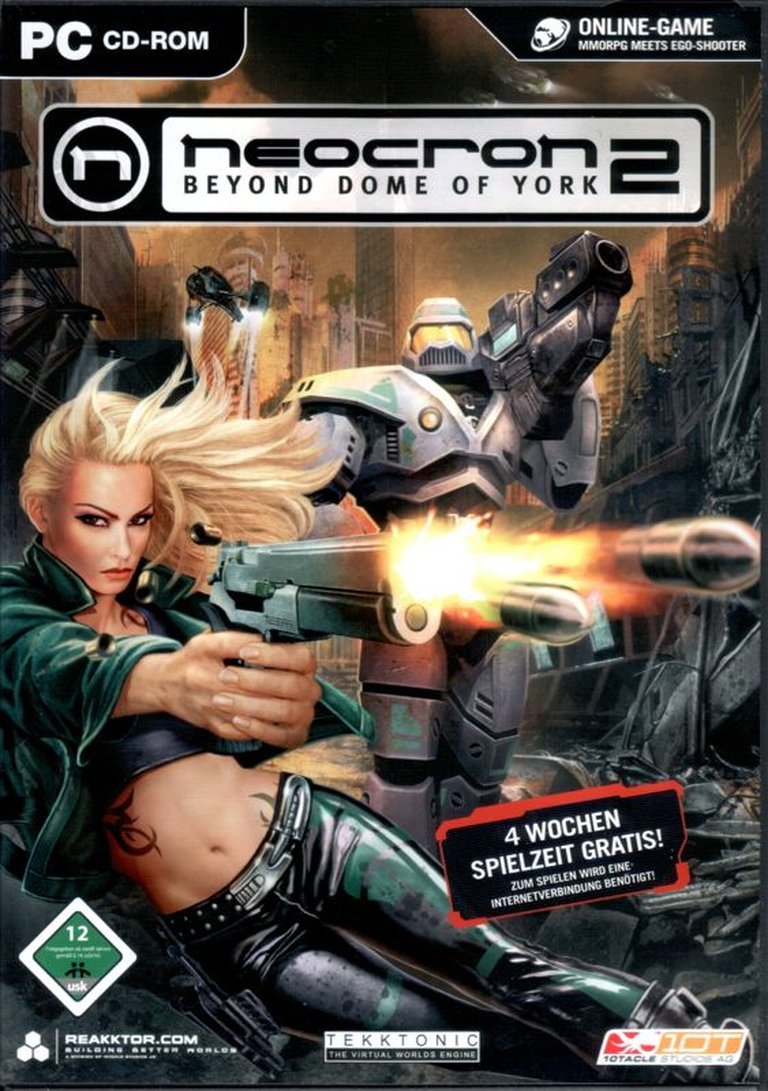
Description
Neocron 2: Beyond Dome of York is a cyberpunk MMORPG set in the 28th century, where humanity survives in fortified cities after global devastation. Players choose between the authoritarian Neocron or the anarchistic Dome of York, engaging in faction warfare, PvP combat, and missions across toxic wastelands. The game features diverse classes like hackers, PSI monks, and fighters, with a unique ‘Hacknet’ system for digital exploration and vehicle-based travel. Combining shooter mechanics with persistent-world RPG elements, it offers a gritty, post-apocalyptic sci-fi experience.
Gameplay Videos
Neocron 2: Beyond Dome of York Mods
Neocron 2: Beyond Dome of York Reviews & Reception
mobygames.com (58/100): Average score: 58% (based on 7 ratings)
retro-replay.com : Neocron 2 thrusts you into a massive, persistent multiplayer universe where two rival factions vie for supremacy across a desolate landscape.
Neocron 2: Beyond Dome of York Cheats & Codes
PC
Use the trainer functions during gameplay.
| Code | Effect |
|---|---|
| F1 | Fast Time Of Day |
| F2 | Research Points |
| F3 | Edit Yellow Diamond Orbs |
| F4 | Instant Drop Altitude |
| F5 | Unlimited Racing Boost |
| F6 | Instant Buildings |
| F7 | Easy XP Level Up |
| F8 | Set Awakening Meter |
| F9 | Pick Up All Loot |
| F10 | Unlimited Health Kits |
| F11 | Can Build Without Resources |
| HOME | Disable All |
Neocron 2: Beyond Dome of York – A Cyberpunk Odyssey in a Dying World
Introduction: A Legacy of Ambition and Flaw
Neocron 2: Beyond Dome of York (2004) is a game that defies easy categorization—a bold, flawed, and fascinating hybrid of first-person shooter (FPS) mechanics and massively multiplayer online role-playing game (MMORPG) systems. Set in a dystopian 28th-century Earth ravaged by war and ecological collapse, it dared to blend the immediacy of Deus Ex with the persistence of EverQuest, carving out a niche in the cyberpunk genre that remains unmatched. Yet, for all its innovation, Neocron 2 is a game of contradictions: a world rich in lore but marred by repetitive quests, a combat system that thrills in bursts but frustrates in grind, and a vision so ambitious it outpaced its own execution.
This review dissects Neocron 2 through the lens of history, design, and legacy, drawing from critical reception, developer insights, and the game’s enduring (if niche) community. It is a study of a title that was both ahead of its time and a victim of it—a game that, despite its shortcomings, remains a cult classic for those who crave depth, atmosphere, and a cyberpunk world that feels lived-in.
Development History & Context: The Birth of a Cyberpunk MMO
From Expansion to Standalone: A Troubled Genesis
Neocron 2 began life as an expansion to Neocron (2002), a game that had already established itself as a unique, if polarizing, entry in the MMO space. Developed by Reakktor Media GmbH and published by 10tacle Studios, the sequel was reimagined as a full-fledged standalone title, expanding the original’s scope with a new city (the Dome of York), refined mechanics, and a deeper narrative. The shift was driven by both creative ambition and commercial necessity—Neocron’s player base, while dedicated, was small, and the team saw an opportunity to attract a broader audience.
Key figures in its development included:
– Holger Nathrath (CEO/Art Director), whose vision shaped the game’s gritty aesthetic.
– Jörg Martin Schwiezer (Executive Producer), who oversaw the project’s funding and direction.
– Daniel Ludwig (Technical Director/Lead Programmer), tasked with merging FPS and MMO systems—a technical challenge that would define the game’s identity.
Technological Constraints and the MMO Landscape of 2004
Neocron 2 launched in a crowded MMO market dominated by World of Warcraft (2004) and EverQuest II (2004). Unlike these fantasy juggernauts, Neocron 2 staked its claim in the cyberpunk genre, a setting that, while beloved in tabletop RPGs (Shadowrun, Cyberpunk 2020), had struggled to find a foothold in MMOs. The game’s engine, an evolution of the original Neocron’s technology, was pushed to its limits to support:
– Persistent world streaming (a rarity for FPS-MMOs at the time).
– Vehicle physics (ground and air units).
– The Hacknet, a Shadowrun-inspired cyber-combat minigame.
– Real-time combat (a departure from the tab-targeting norm).
Yet, these innovations came at a cost. The engine’s limitations led to long load times, clunky collision detection, and AI that ranged from predictable to nonsensical—issues that would haunt the game’s reception.
The Cyberpunk MMO That Could Have Been
Neocron 2’s development was a race against time. Reviews from PC Games (Germany) and Gameswelt hint at a game rushed to market, with beta testing cut short. The result was a title that felt unfinished yet undeniably ambitious—a cyberpunk Deus Ex meets EverQuest, but with the rough edges of a prototype. As PC Format (UK) noted, it was “packed with promise, yet hard to love.”
Narrative & Thematic Deep Dive: A World on the Brink
Setting: Earth in the 28th Century
The game’s premise is a masterclass in dystopian world-building:
– Ecological Collapse: Earth is a toxic wasteland, its atmosphere perforated, its ecosystems replaced by mutations.
– The Last Cities: Humanity clings to survival in fortified megacities—Neocron, a corporate dystopia ruled by the authoritarian CityAdmin and its Copbots, and the Dome of York, a militarized rival with its own brutal order.
– The Wastelands: Between them lies a no-man’s-land of irradiated deserts, rogue AI, and monstrous creatures.
This setting is more than backdrop—it’s a character. The game’s lore is delivered through:
– Environmental storytelling (graffiti, abandoned terminals, propaganda posters).
– Faction newspapers (pro-Neocron and anti-establishment broadsheets).
– Mission logs and audio recordings that flesh out the world’s history.
Factions and Political Intrigue
Players align with one of 12 factions, each with distinct ideologies:
– Neocron’s Factions:
– CityAdmin: The ruling elite, enforcing order at any cost.
– Twilight Guardian: Revolutionaries fighting for freedom.
– Fallen Angels: Techno-mystics blending science and spirituality.
– Dome of York’s Factions:
– Black Dragon: A syndicate of criminals and mercenaries.
– Templars: Zealots wielding PSI powers.
The faction system is Neocron 2’s greatest narrative strength. Unlike many MMOs, where factions are mere window dressing, here they drive the plot. Missions pit factions against each other in espionage, sabotage, and open warfare, with player choices influencing territorial control.
Themes: Survival, Control, and Humanity’s Last Stand
Neocron 2 explores:
– Authoritarianism vs. Anarchy: Neocron’s oppressive order vs. the Dome of York’s militarized chaos.
– Technology as Both Savior and Destroyer: The Hacknet and cybernetic augmentations offer power but at the cost of humanity.
– The Cost of Survival: In a dying world, morality is a luxury few can afford.
Yet, the narrative stumbles in execution. While the main questline delivers cyberpunk noir at its best, side missions often devolve into repetitive fetch-and-kill tasks, a common MMO pitfall. As GameStar (Germany) lamented, “a red thread is missing.”
Gameplay Mechanics & Systems: Innovation and Frustration
Combat: A Hybrid of FPS and MMO
Neocron 2’s most defining feature is its real-time, skill-based combat, a radical departure from the tab-targeting norm of 2004 MMOs. Key elements:
– First-Person Shooter Mechanics: Aiming, recoil, and cover matter. Headshots deal extra damage.
– Skill Progression: Accuracy, reload speed, and weapon handling improve with use.
– Weapon Variety: From pistols and rifles to plasma cannons and PSI powers.
The Good:
– Combat feels visceral. Gunfights are tense, especially in PvP.
– The Hacknet (a Shadowrun-like cyberspace) adds a layer of strategic depth, allowing players to disable defenses or steal data.
The Bad:
– Repetitive Grind: Early-game combat is a slog against endless waves of identical mutants.
– Clunky Controls: Movement and aiming lack the polish of contemporary FPS games.
– AI Issues: Enemies often stand still or pathfind poorly.
Character Progression: Classes and Careers
Players choose from four archetypes, each with sub-specializations:
1. Fighters (Tanks, Snipers, Brawlers).
2. PSI Monks (Telekinetics, Healers).
3. Hackers (Netrunners, Engineers).
4. Hybrids (e.g., combat-medics).
Progression is skill-based: using a skill improves it, allowing for organic character growth. However, the early-game grind is brutal. As PC Games (Germany) noted, players spend hours fighting weak enemies before accessing meaningful content.
The Hacknet: A Cyberpunk Masterstroke
The Hacknet is Neocron 2’s standout feature—a 3D cyberspace where hackers:
– Battle security programs in real-time.
– Steal data from corporate mainframes.
– Sabotage enemy infrastructure.
It’s a game within a game, offering a parallel progression system for non-combat players. Unfortunately, it’s also underutilized—many players never engage with it due to the steep learning curve.
Vehicles and Exploration
The wastelands are traversed via:
– Ground Vehicles (hoverbikes, jeeps, tanks).
– Air Vehicles (scouts, bombers).
Vehicle combat is clunky but fun, adding a Mad Max flavor to the cyberpunk aesthetic. However, the empty wastelands lack meaningful content, making travel feel like a chore.
UI and Quality-of-Life Issues
The interface is a relic of early 2000s MMO design:
– Inventory management is cumbersome.
– No item comparison tool (a glaring oversight).
– Menus are overly complex, burying critical information.
As PC Powerplay put it: “grobe Design-Schnitzer” (glaring design flaws).
World-Building, Art & Sound: A Cyberpunk Nightmare Realized
Visual Design: Gritty and Atmospheric
Neocron 2’s art direction is its greatest triumph. The game’s aesthetic blends:
– Industrial Decay: Rust, neon, and concrete dominate Neocron’s streets.
– Militarized Brutalism: The Dome of York’s architecture is cold, angular, and oppressive.
– Biomechanical Horrors: Mutants and cyborgs are grotesque yet fascinating.
Strengths:
– Lighting and Weather: Dynamic shadows and radioactive fog create immersion.
– Character Design: Cybernetic augmentations and faction-specific armor add personality.
Weaknesses:
– Aging Textures: Even in 2004, some models looked dated.
– Performance Issues: Frame drops in crowded areas.
Sound Design: The Sounds of a Dying World
The audio landscape is hauntingly effective:
– Ambient Noise: Distant gunfire, industrial hums, and mutant screeches.
– Music: A synth-heavy score that evokes Blade Runner and Deus Ex.
– Voice Acting: Serviceable, though some NPCs sound stiff.
The lack of a dynamic soundtrack (music loops repetitively) is a missed opportunity.
Reception & Legacy: A Cult Classic’s Mixed Fortune
Critical Reception: Praise for Ambition, Criticism for Execution
Neocron 2’s reviews were polarized:
– Positive:
– PC Games (Germany): 71% – “Fascinating but frustrating.”
– Gameswelt: 70% – “A unique cyberpunk world.”
– PC Format (UK): 68% – “Nearly unique… more immediate than most MMOs.”
– Negative:
– Jeuxvideo.com: 40% – “A remix of the first game, poorly executed.”
– CVG: 24% – “I wish I could find something redeeming.”
Common criticisms:
– Repetitive gameplay.
– Technical issues.
– Lack of polish.
Yet, even detractors acknowledged its bold vision. As CVG ruefully admitted, there was “a staggeringly good William Gibson-esque cyberpunk MMOG waiting to happen.”
Commercial Performance and Community
Neocron 2 underperformed commercially, overshadowed by World of Warcraft’s juggernaut. However, its dedicated community kept it alive long after launch. Today, the game is free-to-play, maintained by fans who continue to update it with high-res textures and bug fixes.
Legacy: The Cyberpunk MMO That Never Was
Neocron 2’s influence is subtle but enduring:
– It proved that FPS-MMOs could work, paving the way for games like PlanetSide 2 and Destiny.
– Its faction-driven PvP and cyberpunk setting remain benchmarks.
– The Hacknet inspired later games (Watch Dogs, Cyberpunk 2077) to explore cyber-combat.
Yet, its failure to achieve mainstream success meant no true successor emerged. The cyberpunk MMO genre remains largely untapped, a testament to Neocron 2’s unfulfilled potential.
Conclusion: A Flawed Masterpiece
Neocron 2: Beyond Dome of York is a game of soaring ambition and crushing flaws. It is:
✅ A triumph of world-building, with a cyberpunk setting that feels alive and oppressive.
✅ A pioneer in hybrid gameplay, blending FPS and MMO in ways few games have attempted.
✅ A cult classic, beloved by a small but passionate community.
❌ A victim of its era, plagued by technical limitations and repetitive design.
❌ A game that overpromised, leaving players with a grind-heavy experience that couldn’t sustain its vision.
Final Verdict: 7/10 – A Bold Experiment Worth Experiencing
For cyberpunk fans and MMO historians, Neocron 2 is essential. It is a time capsule of early 2000s ambition, a game that dared to be different and paid the price for it. While it may not be a masterpiece, it is a flawed gem—one that, despite its rough edges, offers a glimpse of what could have been.
If you’re willing to overlook its jank, Neocron 2 rewards with a world unlike any other—a dying Earth where every bullet, every hack, and every alliance matters. In a genre dominated by fantasy, it remains the cyberpunk MMO that got away.
Post-Script: The Game That Refuses to Die
Nearly two decades after its release, Neocron 2 is still playable for free, its servers kept alive by fans. In an industry that often discards its past, that alone is a testament to its enduring legacy. For those who seek depth over polish, it awaits—beyond the dome.
Sources Cited:
– MobyGames (reviews, credits, specs)
– Wikipedia (development history)
– Retro Replay (gameplay analysis)
– IGN, Metacritic, and GOG (community reception)
– Schwiezer System GmbH (developer insights)