
- Release Year: 2003
- Platforms: Windows
- Publisher: ValuSoft, Inc.
- Developer: Antidote Entertainment
- Genre: Action, Compilation, Driving, Racing, Sports, Strategy, Tactics
- Game Mode: Single-player
- Gameplay: Board game, Cards, Golf, Shooter, Tiles
- Setting: Futuristic, Sci-fi
Description
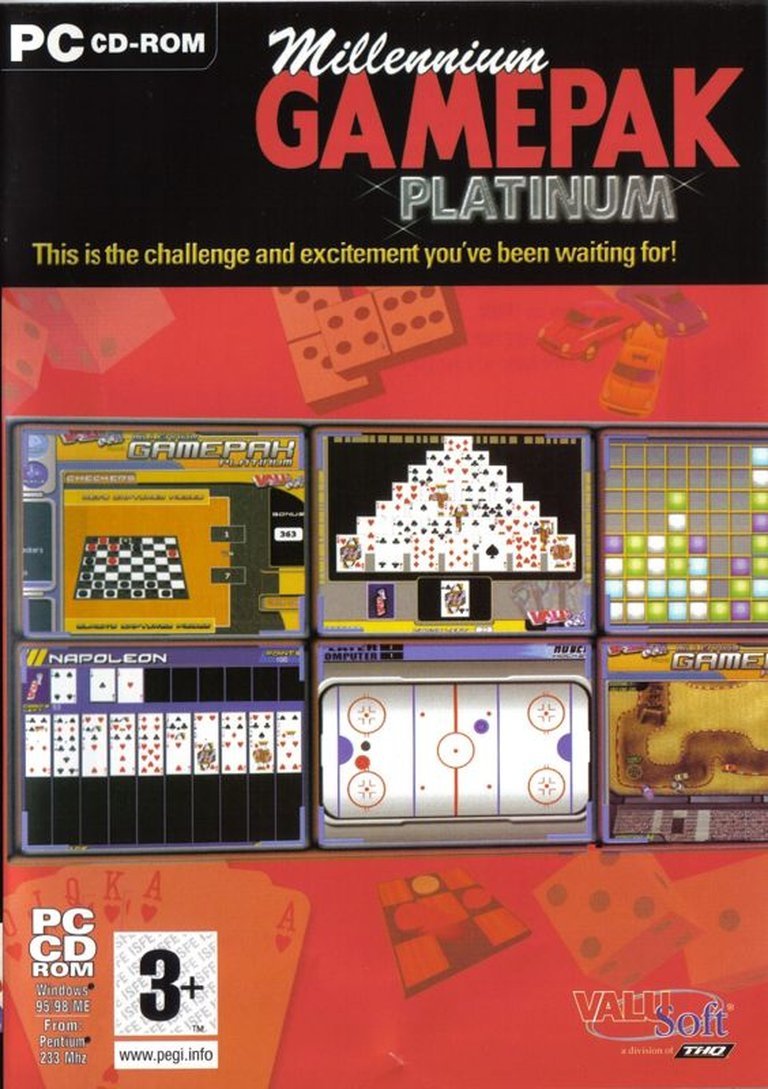
Millennium Gamepak Platinum is a 2003 compilation of casual games for Windows, featuring a diverse collection of over 100 titles across four categories: Action, Board, Puzzle, and Cards. The games range from arcade-style shooters and sports simulations to classic board games and brain-teasing puzzles, all accessible via a CD-based menu system that displays brief descriptions and screenshots. Designed for quick, accessible gameplay, the collection includes sci-fi-themed adventures, golf and pool variants, card games like Poker and Klondike, and strategy-based challenges, making it a versatile package for casual gamers.
Gameplay Videos
Millennium Gamepak Platinum Free Download
Millennium Gamepak Platinum: A Comprehensive Retrospective on the Ultimate Casual Gaming Compilation
Introduction: The Unsung Hero of Early 2000s Shovelware
In the early 2000s, the PC gaming landscape was a battleground of innovation and excess. While blockbuster titles like Half-Life 2 and The Sims dominated headlines, a quieter revolution was unfolding in the realm of budget-friendly compilations. Millennium Gamepak Platinum (2003), developed by Antidote Entertainment and published by ValuSoft, Inc., stands as a fascinating artifact of this era—a digital time capsule of casual gaming’s golden age.
At first glance, Millennium Gamepak Platinum appears to be little more than a shovelware collection, a term often used pejoratively to describe cheap, mass-produced game bundles. Yet, beneath its unassuming CD-ROM exterior lies a meticulously curated library of 100+ mini-games, spanning action, puzzle, board, and card genres. This was not just another throwaway compilation; it was a strategic response to the growing demand for accessible, bite-sized entertainment in an era before mobile gaming dominated.
This review will deconstruct Millennium Gamepak Platinum in exhaustive detail—examining its development context, gameplay mechanics, narrative (or lack thereof), artistic direction, and lasting legacy. By the end, we will determine whether this title deserves its obscurity or if it is, in fact, an underrated gem of early 2000s gaming culture.
Development History & Context: The Rise of the Gamepak Phenomenon
The Studio Behind the Scenes: Antidote Entertainment
Antidote Entertainment was a relatively obscure developer specializing in budget-friendly compilations and casual games. Little is known about the studio’s internal workings, but their output—including titles like Millennium GamePak Gold (2000) and Ultimate Game Pak—suggests a focus on quantity over polish. Their games were designed to be easily digestible, low-risk entertainment for a broad audience.
ValuSoft’s Business Model: The Art of the Budget Bundle
ValuSoft, the publisher, was a master of the budget gaming market. Their strategy revolved around repackaging existing games into new compilations, often with minimal additional development. Millennium Gamepak Platinum was part of a long-running series that included:
– Millennium Gamepak (1998)
– Millennium GamePak Gold (2000)
– Millennium MegaHits (1999)
These titles were not designed for critical acclaim but rather for mass-market appeal, often sold in bargain bins or bundled with new PCs.
Technological Constraints & the Early 2000s Gaming Landscape
Released in 2003, Millennium Gamepak Platinum was a product of its time:
– Windows XP dominance meant games had to run on modest hardware.
– CD-ROM distribution was still king, with digital downloads in their infancy.
– The casual gaming boom was just beginning, with titles like Bejeweled (2001) and Diner Dash (2003) proving that simple, addictive gameplay could thrive.
The game’s menu-driven interface, where players launched titles from a persistent CD-based launcher, was a practical solution to the limitations of the era. Unlike modern compilations (e.g., The Orange Box), which integrate games seamlessly, Millennium Gamepak Platinum required constant disc access, a relic of pre-broadband gaming.
The Shovelware Stigma: Why Compilations Like This Matter
While “shovelware” is often dismissed as low-effort cash grabs, titles like Millennium Gamepak Platinum served a crucial role:
– Gateway for non-gamers – Many players’ first exposure to gaming came through these bundles.
– Preservation of obscure titles – Some games in the collection (Bunker 1452, Dimensia) are lost to time outside of compilations.
– Historical snapshot – The inclusion of sci-fi-themed mini-games (Galactic War, Space Escape) reflects the era’s fascination with futurism.
Narrative & Thematic Deep Dive: The Absence of Story (And Why It Works)
A Collection Without a Plot: The Beauty of Pure Gameplay
Millennium Gamepak Platinum is not a narrative-driven experience. There are no characters, no lore, no overarching story—just pure, unfiltered gameplay. This was a deliberate design choice, catering to players who wanted instant gratification without cutscenes or exposition.
Themes Across the Compilation
While individual games lack deep storytelling, broader themes emerge when examining the collection as a whole:
-
Nostalgia & Retro Futurism
- Games like Space Hunt and DefCon-X evoke 1980s arcade sci-fi, complete with pixelated spaceships and neon aesthetics.
- Mini Golf and Puttz 2001 hark back to classic mini-golf simulators, a staple of early PC gaming.
-
Accessibility & Universal Appeal
- The inclusion of board games (Checkers, Dominoes) and card games (Klondike, War) ensured that even non-gamers could find something familiar.
- Puzzle games like Tower of Hanoi and Word Jumble were educational yet entertaining, appealing to parents and children alike.
-
The Illusion of Variety
- While the 100+ games sound impressive, many are variations on the same mechanics (e.g., Aces High and Crazy Eights are both card games with minor rule tweaks).
- This was a marketing tactic—quantity over quality—to justify the “Platinum” branding.
Dialogue & Presentation: Minimalism as a Virtue
- No voice acting – All instructions are text-based.
- Simple UI descriptions – Each game has a one-sentence summary and a screenshot, reinforcing the “pick-up-and-play” ethos.
- No cutscenes or cinematics – The focus is 100% on gameplay.
This stripped-down approach was both a limitation and a strength—it ensured that anyone, regardless of gaming experience, could jump in without confusion.
Gameplay Mechanics & Systems: Deconstructing the Mini-Game Matrix
The Core Gameplay Loop: Menu → Select → Play → Repeat
The structure of Millennium Gamepak Platinum is deceptively simple:
1. Launch the CD-based menu.
2. Browse through four categories (Action, Board, Puzzle, Cards).
3. Select a game and read its brief description.
4. Play in a small window alongside the menu (no fullscreen option).
5. Exit and repeat.
This modular design was both a blessing and a curse:
✅ Pros:
– Instant access to any game without lengthy load times.
– No installation required (games ran directly from the CD).
– Low system requirements (compatible with Windows 98/XP).
❌ Cons:
– No save functionality – Progress was lost upon exiting.
– Small windowed mode made some games hard to see.
– Repetitive mechanics – Many games felt like reskinned clones.
Category Breakdown: What Each Section Offers
1. Action Games (34 Titles) – Arcade Thrills & Misses
The largest and most varied category, featuring:
– Shooters: Sharp Shooter, Skeet Shooting, Space Hunt
– Sports: Mini Golf, Hover Hockey, Foosball
– Arcade-Style: Meteoroids (an Asteroids clone), Robo Snake
– Oddities: Clam Jump (a bizarre platformer), Snail Patrol (a slow-paced shooter)
Standout Titles:
– Bunker 1452 – A top-down shooter with a Robotron vibe.
– Galactic War – A space strategy game with surprisingly deep mechanics.
– Truck Rally – A rudimentary racing game with physics that feel intentionally janky.
Flaws:
– Many games lack depth – Balloon Bust is literally just popping balloons.
– Controls are often clunky – Paddle Attack suffers from imprecise mouse input.
2. Board Games (15 Titles) – Digital Tabletop Classics
A safe, familiar selection including:
– Backgammon
– Checkers
– Chinese Checkers
– Snakes & Ladders
– Dominoes (2 & 4 Player)
Strengths:
– Faithful adaptations of real-world games.
– Multiplayer potential (though local-only).
Weaknesses:
– No AI personality – Opponents play predictably.
– Visuals are barebones – Just 2D boards with basic sprites.
3. Puzzle Games (30 Titles) – Brain Teasers & Time Wasters
A mixed bag of:
– Word Games: Word Jumble, Bingo Dictionary
– Logic Puzzles: Tower of Hanoi, Safe Code
– Arcade Puzzles: Color Cubes, Metal Madness
– Physics-Based: Marble Toss, Spring Drop
Best in Class:
– Enigma – A mystery-solving game with surprisingly atmospheric pixel art.
– Fling It – A physics-based puzzle reminiscent of The Incredible Machine.
– Trap It – A strategy puzzle where players corner AI opponents.
Worst Offenders:
– Alphabetize – Literally just sorting letters—hardly a “game.”
– Apple Orchard – A tedious matching game with no challenge.
4. Card Games (10 Titles) – Solitaire and Its Cousins
A standard deck of digital card games:
– Klondike (Solitaire)
– Pyramid
– Tri Peaks
– War
– Crazy Eights
Verdict:
– Perfectly functional but nothing revolutionary.
– Aces High is the only unique entry, a gambling-style card game.
Innovation vs. Repetition: Did It Push Boundaries?
Millennium Gamepak Platinum was not innovative—it was iterative. However, it perfected the art of the casual compilation by:
– Categorizing games effectively (unlike earlier, disorganized bundles).
– Including screenshots and descriptions (a small but important UX improvement).
– Offering a mix of genres to appeal to different player types.
Missed Opportunities:
– No customization – Players couldn’t adjust difficulty or rules.
– No progression system – No unlocks, achievements, or rewards.
– No online multiplayer – A huge oversight given the rise of internet gaming.
World-Building, Art & Sound: The Aesthetic of Budget Gaming
Visual Design: Functional, Not Flashy
The art style of Millennium Gamepak Platinum is utilitarian:
– 2D sprites dominate, with minimal animation.
– Sci-fi themes (Deep Space, Orbitron) use neon colors and pixel art.
– Board games feature static, grid-based layouts.
Strengths:
– Clear, readable UI – Important for casual players.
– Nostalgic charm – The low-res aesthetics feel authentically retro.
Weaknesses:
– No visual cohesion – Each game has a different art style, making the collection feel disjointed.
– Some games look unfinished – Bubble Craft has placeholder graphics.
Sound Design: The Silence of the CDs
Audio in Millennium Gamepak Platinum is almost nonexistent:
– No background music in most games.
– Basic sound effects (e.g., clicks in card games, explosions in shooters).
– No voice acting or ambient noise.
Why It Works (And Doesn’t):
✅ Minimalist approach keeps the focus on gameplay.
❌ Lack of atmosphere makes some games feel sterile.
Atmosphere & Immersion: The Illusion of a “Game World”
Unlike narrative-driven games, Millennium Gamepak Platinum doesn’t try to immerse players in a world. Instead, it embodies the “arcade cabinet” mentality—each game is a self-contained experience, like walking up to a different machine in a virtual arcade.
The Menu as a Hub:
– The persistent menu acts as a central lobby, reinforcing the compilation’s identity.
– The screenshot previews serve as arcade marquees, enticing players to try new games.
Reception & Legacy: The Forgotten Footnote of Gaming History
Critical Reception: The Sound of Silence
Millennium Gamepak Platinum received virtually no professional reviews. This was not unusual for budget compilations, which were rarely covered by major gaming outlets like IGN or GameSpot.
Why the Lack of Coverage?
– Not marketed as a “premium” product – ValuSoft targeted bargain hunters, not critics.
– No standout features – It was just another compilation in a sea of similar products.
– No post-launch support – No patches, DLC, or community engagement.
Commercial Performance: A Bargain Bin Staple
While exact sales figures are unavailable, the game’s longevity in budget bins suggests modest success. It was likely bundled with PCs or sold in discount retail chains (e.g., Walmart, Best Buy).
Legacy: The Unintentional Time Capsule
Millennium Gamepak Platinum’s true value lies in historical preservation:
– A snapshot of early 2000s casual gaming before mobile took over.
– A repository of obscure mini-games that would otherwise be lost to time.
– Influence on later compilations – Titles like The Bejeweled Collection and PopCap Hits! owe a debt to its menu-driven design.
Where Are They Now?
– Antidote Entertainment faded into obscurity, with no major releases post-2005.
– ValuSoft was acquired by THQ in 2006 and later dissolved.
– Many games in the collection remain undocumented outside of archives like MobyGames and Internet Archive.
Modern Relevance: Does It Hold Up?
Playing Millennium Gamepak Platinum today is a mixed experience:
✅ Charming nostalgia – A time machine to early 2000s PC gaming.
✅ Some genuinely fun mini-games (Galactic War, Enigma).
❌ Clunky controls – Modern players will struggle with imprecise mouse inputs.
❌ No modern conveniences – No saves, no fullscreen, no controller support.
Verdict for Retro Gamers:
– Worth a try for historians – A fascinating artifact.
– Not a must-play – Most games are forgotten for a reason.
Conclusion: The Platinum Paradox – A Flawed Gem
Millennium Gamepak Platinum is not a masterpiece, nor was it ever intended to be. It is, however, a perfect example of its genre—a budget-friendly, no-frills compilation that delivered quantity over quality in an era that demanded it.
Final Verdict: 6/10 – “A Flawed but Fascinating Relic”
| Category | Score (1-10) | Notes |
|---|---|---|
| Gameplay Variety | 8/10 | 100+ games ensure something for everyone, but many are shallow. |
| Visuals | 5/10 | Functional but dated—some games look unfinished. |
| Sound Design | 3/10 | Almost nonexistent—missed opportunity for atmosphere. |
| Replayability | 7/10 | High for casual players, but no progression hurts long-term engagement. |
| Historical Value | 9/10 | A time capsule of early 2000s gaming culture. |
| Overall Experience | 6/10 | Flawed but charming—worth experiencing for retro enthusiasts. |
Where It Excels:
✔ Unmatched variety – Few compilations offer this many games in one package.
✔ Accessible to all – No prior gaming knowledge required.
✔ Nostalgic charm – A snapshot of pre-mobile casual gaming.
Where It Fails:
✖ Repetitive mechanics – Many games feel like reskinned clones.
✖ Technical limitations – No saves, no fullscreen, CD-dependent.
✖ Lack of depth – Most games are shallow time-wasters.
Final Thoughts: The Unsung Hero of Shovelware
Millennium Gamepak Platinum will never be remembered alongside Half-Life or World of Warcraft, but it doesn’t need to be. It served its purpose perfectly—providing hours of simple, accessible fun for a generation of gamers who just wanted to kill a few minutes between school, work, or chores.
In the grand tapestry of gaming history, it is a small but important thread—a reminder that not every game needs to be a blockbuster to leave a mark. For those willing to dig through the rough edges, there are hidden gems waiting to be discovered.
Should you play it today? Only if you’re a retro gaming historian or curious about the roots of casual gaming. For everyone else, it remains what it always was—a budget bin curiosity, but one with more heart than it lets on.
Final Rating: ★★★★★★☆☆☆☆ (6/10) – “A Flawed but Fascinating Relic of Early 2000s Gaming”
Millennium Gamepak Platinum is not a lost classic, but it is a piece of history worth preserving. And in the end, isn’t that what gaming is all about?